For more than a year, a campaign has mobilised residents, staged rallies, generated media coverage, organised letter-writing campaigns, encouraged political pressure and built an active Facebook community around a simple and emotionally powerful proposition: Kincumber’s wetlands are threatened by a proposed Woolworths development on land owned by Darkinjung Local Aboriginal Land Council.
That story is becoming increasingly difficult to sustain.
There is no signed development agreement with Woolworths. There is no approved development. The proposal would first require rezoning, environmental studies, public scrutiny and planning assessment. Most importantly, Darkinjung has now stated explicitly that the potential development area does not include the mapped wetlands.


Woolworths had already independently told BetaShares essentially the same thing, confirming that there was no formal development proposal and that the area initially under consideration was outside identified wetlands conservation zones (BetaShares, 2026). (Betashares)

Even Save Kincumber Wetlands spokesperson Sue Chidgey conceded the essential point in October 2025:
“It is not on the wetland but it will seriously affect the health of the wetland.”
(Central Coast News, 2025a). (Coast Community News)
That admission matters.
The campaign is called Save Kincumber Wetlands, not “Investigate Possible Indirect Effects of Potential Development Adjacent to Kincumber Wetlands”.

Its public power comes from collapsing those two very different propositions into one.
The wetlands are real.
The environmental constraints are real.
The supposed proposal to build a Woolworths on the mapped wetlands is not.
Darkinjung has put the facts on the table
On 4 August 2026, Darkinjung Local Aboriginal Land Council issued a direct public response titled Potential Development at 7 Carrak Road, Kincumber.
Its opening clarification should fundamentally change how this controversy is reported:
“The potential development site does not include any of the mapped wetland areas on the site.”
Darkinjung says this was deliberate. The potential development area was selected specifically so that mapped wetland areas were excluded.

Darkinjung also confirmed that discussions have occurred, but there is no signed development agreement with Woolworths or anybody else.
If an agreement is eventually reached, Darkinjung says the land would first require rezoning. That process would involve technical studies, scrutiny and public engagement. Only after that process could a development application be considered, and that application would itself require further assessment and public participation.

Darkinjung members would also need to support proceeding.
So, after more than a year of campaigning, protesting and inflammatory claims about what is supposedly going to happen at Kincumber, the actual position in August 2026 is remarkably simple.
There is no signed development agreement.
There is no approved supermarket.
There is no development application authorising construction.
The mapped wetlands are outside the potential development area.
Those are not minor technicalities.
They go directly to the truthfulness of the campaign’s central public framing.

The campaign decided what was happening before anybody had assessed what was happening
The fundamental problem with Save Kincumber Wetlands has been present from the beginning.
It started with a conclusion.
Then it began looking for evidence to support it.

In February 2025, Lisa Bellamy was already urging residents to “get on the front foot” against potential development before a formal development application existed (Central Coast News, 2025b). The Save Kincumber Wetlands group then emerged rapidly, with founding member Cassie Roese warning that a Woolworths development would “decimate” bushland and interfere with the wetland ecosystem (Central Coast News, 2025c). (Betashares)

But what development?
Where was its footprint?
Where was its hydrological assessment?
Where was the stormwater modelling?
Where was its Biodiversity Development Assessment Report?
Where was the detailed clearing plan?
Where was the traffic assessment?
Where was the engineering design?
Where was the development application?
It did not exist.
By the first quarter of 2026, Woolworths was still telling BetaShares that discussions remained preliminary and that there was no formal development proposal (BetaShares, 2026). (Betashares)

That means Save Kincumber Wetlands had already generated a substantial political campaign against the environmental consequences of a project whose final environmental consequences could not yet have been determined because the project itself had not yet been finalised.
That is not environmental assessment.
It is campaigning certainty preceding evidence.
Previous GuriNgai.org analysis described this as a “manufactured crisis”. Darkinjung’s August 2026 statement substantially strengthens that criticism rather than weakening it (Cooke, 2025a, 2025b). (A Long Con, Gone on Too Long.)

The wetlands are real. The campaign’s framing is the problem
This distinction needs to be made carefully because criticism of Save Kincumber Wetlands should not depend upon denying obvious environmental facts.
The Carrak Road property is environmentally constrained.
The NSW Government’s Darkinjung Development Delivery Plan identifies the approximately 7.7 hectare site at 7, 25 and 39 Carrak Road as affected by biodiversity values, flooding, bushfire considerations and coastal management controls. Potential future uses identified at a strategic level include commercial and residential development together with environmental conservation or management (NSW Department of Planning and Environment, 2022). (Planning NSW)
There are therefore legitimate questions about what, if anything, should eventually be developed there.
Those questions deserve evidence.
What they do not deserve is exaggeration.
The fact that wetlands exist somewhere on or adjacent to a larger parcel does not mean every development somewhere on that property is “development of the wetlands”.
The fact that endangered or vulnerable species occur in the wider area does not automatically demonstrate that a particular future development will destroy them.
The fact that a property is flood affected does not itself determine whether all development is impossible.
Those issues are exactly why planning assessments exist.
Environmental concern should trigger investigation.
Save Kincumber Wetlands has repeatedly treated concern as though it were already a conclusion.

Sue Chidgey’s admission should have changed the campaign
Sue Chidgey occupies a particularly important position because she is not an incidental Facebook commenter.
She has been publicly identified as the founder of the Save Kincumber Wetlands Facebook page, campaign coordinator and spokesperson. She also has a legitimate history of earlier community environmental campaigning independent of Coast Environmental Alliance.
That history deserves acknowledgment.
It also makes her responsible for the accuracy of the campaign she now leads.
In October 2025, Chidgey openly acknowledged that the contemplated development was not on the wetland (Central Coast News, 2025a). (Coast Community News)
Her argument was instead that development nearby could affect the wetland through runoff, pollution and impacts on a creek.
That is a completely legitimate hypothesis to investigate.
It is also a materially different claim.
Once the spokesperson for Save Kincumber Wetlands publicly acknowledges that the development is not actually on the wetland, continuing to allow the public controversy to be framed as though Woolworths intends to bulldoze Kincumber Wetlands becomes increasingly difficult to defend.
If the campaign’s real claim is indirect ecological impact, then its obligation is obvious.
Produce the evidence.
Publish the ecological work.
Identify the proposed development footprint.
Map the wetland boundaries.
Demonstrate the hydrological pathway.
Model the runoff.
Identify the likely pollutants.
Show how mitigation would fail.
Explain which vegetation is actually proposed for clearing.
Until that information exists, predictions about serious environmental effects remain predictions.
A Facebook group cannot substitute for an environmental impact assessment.
Darkinjung’s response exposes an even bigger problem
The most damaging part of Darkinjung’s August statement may not be the confirmation that the mapped wetlands are outside the potential development area.
It is what Darkinjung says would happen to those wetlands if the rezoning process proceeds.
According to the Land Council, the balance of the property would be rezoned from recreation to conservation, including the wetland areas.
Darkinjung says this would provide the wetlands with greater protection than they have under their current zoning.
Think about that for a moment.
A campaign called “Save Kincumber Wetlands” may be opposing a planning process that, according to the Aboriginal landowner, could place the actual wetlands under stronger conservation zoning.
That does not prove that an eventual development should proceed.
It does expose the poverty of the campaign’s simplistic story.
The real choice may not be:
Woolworths or wetlands.
It may involve limited development on one part of a larger property, formal conservation protection over another part, environmental controls, public assessment and long-term investment in conservation elsewhere.
That is a considerably more complicated argument.
It is also the argument the public deserves to hear.
The conservation outcome does not end at Carrak Road
Darkinjung’s statement goes further.
The Land Council says income generated through development could increase its capacity to establish a Central Coast Aboriginal ranger program, including the people, equipment and capability necessary to care for thousands of hectares of land and waterways.
It says development revenue could help establish biodiversity stewardship sites permanently conserving hundreds of hectares of Darkinjung-owned land.
It also identifies affordable housing, seniors accommodation, independent living and improved services for Elders and older Aboriginal people as potential beneficiaries.
Save Kincumber Wetlands is therefore not simply contesting whether one environmentally sensitive site should be protected.
It is contesting a land-use decision being considered by an Aboriginal organisation attempting to balance conservation, economic independence, housing, community services and management of a much larger Aboriginal land estate.
Campaigners may still believe the trade-off is environmentally unacceptable.
But they should stop pretending no trade-off exists.
Aboriginal land rights were never limited to preserving bushland for settlers
This is where the Kincumber campaign moves beyond ordinary environmental disagreement.
The Aboriginal Land Rights Act 1983 does not say Aboriginal people received land so that surrounding non-Aboriginal communities could determine how it should permanently remain unused.
The Act expressly recognises that land and waters have spiritual, social, cultural and economic importance to Aboriginal people. Its purposes include vesting land in representative Aboriginal Land Councils and enabling those councils to manage land, assets, investments and community benefit schemes (Aboriginal Land Rights Act 1983 [NSW]). (NSW Legislation)
The NSW Government similarly explains that the Darkinjung Development Delivery Plan exists to help provide an economic base for Aboriginal communities in response to historic dispossession. It explicitly connects Aboriginal land use with homes, employment, community benefit, cultural heritage protection and self-determination (NSW Department of Planning, Housing and Infrastructure, 2026). (Planning NSW)
That context makes some Save Kincumber Wetlands rhetoric extraordinarily revealing.
Lisa Bellamy has publicly argued that there are other ways for Darkinjung to make money without developing sensitive bushland.
It is difficult to imagine a clearer expression of settler paternalism.
A non-Aboriginal political activist is effectively telling an Aboriginal Land Council how Aboriginal people should obtain economic benefit.
Darkinjung owns the land.
Darkinjung members have rights within the governance structure controlling that land.
NSW environmental and planning law regulates what can occur there.
Government planning authorities determine whether particular proposals satisfy legal requirements.
Yet CEA-linked activists insert themselves into this structure as an additional moral authority, deciding not merely whether a particular environmental impact is acceptable, but whether an Aboriginal organisation ought to be seeking economic return from its property at all.
This is precisely the possessive logic identified by Moreton-Robinson (2015): settler authority continually reasserting itself over Aboriginal land, even when formal ownership has supposedly been returned.
The “custodian” language is not respectful when it is used as a leash
The campaign’s invocation of Aboriginal custodianship deserves the same scrutiny.
Aboriginal people are warmly celebrated as custodians when custodianship means preserving landscapes according to settler expectations.
The admiration becomes much less comfortable when Aboriginal people exercise the economic dimension of land rights.
Then the instructions begin.
You should preserve this.
You should not build there.
You should make your money elsewhere.
You should behave as custodians.
You should accept our interpretation of what caring for Country requires.
There is an old colonial relationship hiding underneath that language.
The settler still decides what proper Aboriginal behaviour looks like.
The language has simply changed.
Aboriginal people are not environmental mascots.
Land Councils are not required to keep Aboriginal-owned land permanently economically sterile to validate somebody else’s romantic idea of Indigenous custodianship.
Environmental laws apply to Darkinjung.
That is appropriate.
A special moral rule under which Aboriginal landowners must obtain approval from self-appointed settler custodians is not.
Different banner, same network
Save Kincumber Wetlands is also becoming increasingly difficult to portray as an isolated community campaign entirely separate from Coast Environmental Alliance.
That does not mean every person in its Facebook group belongs to CEA.
It does not mean every resident who attends a rally shares the views of Jake Cassar, Lisa Bellamy or anybody else.
There are plainly people involved because they sincerely care about wildlife, flooding, development and the future of Kincumber.
The organisational overlap nevertheless exists.
Emma French provides the clearest evidence.
In June 2025, Central Coast News identified French as a spokesperson for both Save Kincumber Wetlands and Coast Environmental Alliance.
That is not inference.
That is a publicly reported dual role.
Lisa Bellamy was campaigning against the prospective Kincumber development before Save Kincumber Wetlands formally emerged. She subsequently became one of its prominent speakers. Bellamy was already deeply involved in CEA-linked opposition to Darkinjung’s Kariong development.
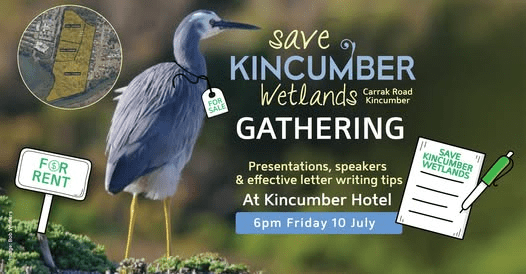
Jake Cassar, founder of Coast Environmental Alliance, was advertised alongside Sue Chidgey and Bellamy as a speaker at the Save Kincumber Wetlands community gathering at Kincumber Hotel in July 2026. That event was designed not simply to discuss wetlands, but to teach attendees practical techniques for writing to politicians and decision-makers and to “keep building momentum” (Cooke, 2026). (A Long Con, Gone on Too Long.)
Seamus Turton has been publicly identified as CEA’s biodiversity spokesperson and has participated in the broader online Kincumber campaign.
By September 2025, Sue Chidgey, Lisa Bellamy, Emma French and founding campaign participant Cassie Roese were appearing together in Save Kincumber Wetlands advocacy (Central Coast News, 2025d). (Coast Community News)
Different campaign, familiar target
This becomes more significant when Kincumber is placed beside Kariong.
At Kariong, CEA figures and associated activists spent years opposing Darkinjung’s proposed use of Aboriginal-owned land.
At Kincumber, many of the same people appear again opposing Darkinjung’s proposed use of Aboriginal-owned land.
At Kariong, the campaign positioned non-Aboriginal activists as defenders of land against the Aboriginal landowner.
At Kincumber, the same moral inversion has emerged.
Different Facebook page.
Different campaign branding.
Different ecological claim.
Same Aboriginal Land Council.
Same broad activist network.
Same underlying argument that outsiders know better than Darkinjung what Darkinjung should do with its land.
Previous GuriNgai.org work has described this recurring model as settler custodianship, a political performance in which non-Aboriginal actors assume the moral authority of defenders of Country while recognised Aboriginal governance is reframed as a threat to Country (Cooke, 2025a, 2025b, 2026). (A Long Con, Gone on Too Long.)
Kincumber fits that pattern disturbingly well.
Coast Community News helped create the confusion
Local media reporting also deserves criticism.
In June 2025, Central Coast News simply described the prospective development site as being “on the Kincumber Wetlands” (Central Coast News, 2025e). (Coast Community News)
Four months later, the same publication quoted Sue Chidgey saying:
“It is not on the wetland.”
(Central Coast News, 2025a). (Coast Community News)
Those propositions cannot both be repeated casually as though there is no distinction between them.
The earlier language helped establish the very public misconception around which the campaign was organised.
The publication has since carried material providing greater nuance, but once the distinction became clear, it should have been made explicit.
A development adjacent to or elsewhere on a parcel containing wetlands is not automatically a development “on the wetlands”.
Language matters.
Particularly when language is being used to mobilise political opposition.
Facebook is not an ecological authority
The rapid growth of the Save Kincumber Wetlands Facebook group has repeatedly been presented as evidence of community concern.
It is evidence of community concern.
That is all.
Facebook membership does not establish wetland boundaries.
Likes do not model hydrology.
Shares do not constitute biodiversity assessment.
Comments do not determine whether a planning proposal satisfies the Environmental Planning and Assessment Act.
A protest sign is not a species impact statement.
A photograph of vegetation is not evidence that every tree visible would be cleared.
A video showing wildlife is not evidence that an eventual development footprint would destroy the habitat shown.
And repeating “Save Kincumber Wetlands” several thousand times does not establish that somebody is proposing to develop the mapped wetlands.
That distinction between mobilisation and evidence has been almost entirely lost.
Genuine conservation should have no need for misinformation
This is perhaps the greatest indictment of the campaign.
Kincumber’s environmental values are strong enough to justify scrutiny without exaggeration.
There is no need to manufacture certainty.
There is no need to portray preliminary discussions as an approved development.
There is no need to imply a supermarket will be constructed on mapped wetlands if the proposed development area excludes them.
There is no need to ignore the potential conservation rezoning of the remainder of the property.
There is no need to erase the Aboriginal ranger programs, biodiversity stewardship, housing and Elder services Darkinjung says development revenue could support.
And there is certainly no need for non-Aboriginal campaigners to lecture an Aboriginal Land Council about where it should make money.
If the environmental evidence ultimately establishes that development at Carrak Road would cause unacceptable harm, then oppose it on that evidence.
That would be conservation.
But a campaign that begins with the conclusion, builds the emotional narrative, mobilises supporters and pressures decision-makers before the relevant proposal and environmental assessment exist is doing something different.
It is manufacturing political certainty out of environmental uncertainty.
Save Kincumber Wetlands now owes the community some answers
Darkinjung’s August 2026 statement changes the evidentiary position.
The campaign cannot responsibly continue as though it has not been published.
Save Kincumber Wetlands should explain whether it accepts that the potential development footprint excludes the mapped wetlands.
It should explain whether it accepts that no signed development agreement presently exists.
It should explain whether it accepts that rezoning and a separate development application would be required.
It should address Darkinjung’s claim that the wetlands themselves could receive stronger conservation zoning.
It should address the proposed Aboriginal ranger program and biodiversity stewardship investment.
It should publish the technical evidence underlying claims that the potential development would nevertheless seriously damage the wetlands.
And its CEA-linked figures should explain why another campaign involving many of the same activists has once again formed around preventing Darkinjung from developing Aboriginal-owned land.
These are not hostile questions.
They are accountability questions.
An organisation demanding accountability from Aboriginal landholders should expect the same standard to apply to itself.
The campaign’s central narrative has collapsed
Save Kincumber Wetlands began with an extraordinarily effective story.
There is a wetland.
A supermarket is going to be built on it.
Aboriginal landowners and Woolworths want development.
Local environmentalists are trying to save nature.
It is simple.
It is emotional.
It is politically powerful.
It is also no longer an adequate description of the evidence.
The mapped wetlands are not within the potential development area, according to Darkinjung.
Woolworths independently said the initially considered area was outside identified wetlands conservation zones.
There remains no signed development agreement.
The proposal requires rezoning, environmental study, consultation and further assessment.
The wetlands could receive stronger conservation zoning.
And the economic return could support Aboriginal conservation programs, housing and services.
The real dispute is therefore not whether somebody is about to bulldoze Kincumber Wetlands.
The real dispute is whether some development should potentially occur on one environmentally constrained part of a larger Aboriginal-owned property, subject to detailed assessment, while other parts receive conservation protection.
That is a legitimate planning debate.
It is not the crisis that Save Kincumber Wetlands has sold.
The uncomfortable truth
There is a deeper reason this matters.
For generations, Aboriginal people were prevented from owning, controlling and economically benefiting from land.
The NSW land-rights system was created, imperfectly, to return some economic capacity and autonomy.
Now, when an Aboriginal Land Council considers exercising those rights, a familiar pattern emerges.
Non-Aboriginal people organise.
They claim superior environmental knowledge.
They invoke Country.
They invoke custodianship.
They decide what Aboriginal land ought to be used for.
They demand that Aboriginal people find another way to generate revenue.
They present themselves as protecting the land from the Aboriginal organisation that actually owns it.
That is not a progressive reversal of colonialism.
It is colonial paternalism wearing environmental language.
Moreton-Robinson (2015) describes the deeper structure as the white possessive, the continuing expectation that settler society retains the authority to determine the meaning, value and legitimate use of Indigenous land.
Save Kincumber Wetlands is increasingly difficult to understand outside that context.
The concern for ecology may be genuine.
The environmental questions may be legitimate.
But genuine concern does not excuse misleading framing, predetermined conclusions or settler entitlement over Aboriginal land use.
Save the wetlands. Stop pretending they are being bulldozed.
There is a straightforward position available to anyone genuinely concerned about Kincumber.
Protect the mapped wetlands.
Demand rigorous ecological assessment.
Demand hydrological modelling.
Protect threatened species and ecological communities.
Require proper stormwater controls.
Insist on transparent public consultation.
Reject any eventual development that cannot demonstrate acceptable environmental outcomes.
And at the same time, respect Darkinjung’s right to investigate lawful economic use of Aboriginal-owned land.
Those positions are entirely compatible.
What is not defensible is continuing to sell a story in which a Woolworths supermarket is effectively marching into the wetlands when the Aboriginal landowner, the prospective commercial participant and even the campaign’s own spokesperson have all supplied information contradicting that simplification.
Save Kincumber Wetlands has spent more than a year demanding that other people listen.
It is now their turn.
Darkinjung has answered.
The wetlands are not in the potential development footprint.
There is no signed agreement.
There is no approved development.
There is a planning process still to occur.
There is a proposed conservation outcome the campaign has largely failed to acknowledge.
There are Aboriginal social, economic and environmental benefits that deserve to be part of the discussion.
If Save Kincumber Wetlands continues to present the controversy as though none of those facts exist, then the issue is no longer merely premature environmental alarm.
It becomes misinformation.
And when that misinformation is repeatedly mobilised against the lawful economic aspirations of an Aboriginal Land Council, through a network already associated with similar campaigns against Darkinjung elsewhere, it deserves to be called what it is:
settler interference in Aboriginal self-determination, repackaged as conservation.
References
Aboriginal Land Rights Act 1983 (NSW). NSW Legislation. (NSW Legislation)
BetaShares. (2026). Proxy voting and company engagement: Q1 2026. (Betashares)
Central Coast News. (2025a, October 21). Save Kincumber Wetlands rally. (Coast Community News)
Central Coast News. (2025b). Up in arms over proposed Kincumber development.
Central Coast News. (2025c). New group opposes Kincumber development plan.
Central Coast News. (2025d, September 12). Pressure mounts to save Kincumber Wetlands. (Coast Community News)
Central Coast News. (2025e, June 12). Community gathers to protest wetlands development. (Coast Community News)
Cooke, J. D. (2025a, June 26). Save Kincumber Wetlands: The weaponisation of misinformation. GuriNgai.org. (A Long Con, Gone on Too Long.)
Cooke, J. D. (2025b, June 14). Save Kincumber Wetlands, Coast Environmental Alliance, and the denial of Aboriginal sovereignty. GuriNgai.org. (A Long Con, Gone on Too Long.)
Cooke, J. D. (2026, July 3). The Save Kincumber Wetlands gathering: How a pub meeting becomes a high-demand mobilisation against Aboriginal land rights. GuriNgai.org. (A Long Con, Gone on Too Long.)
Darkinjung Local Aboriginal Land Council. (2026, August 4). Potential development at 7 Carrak Road, Kincumber [Press release].
Moreton-Robinson, A. (2015). The white possessive: Property, power, and Indigenous sovereignty. University of Minnesota Press.
NSW Department of Planning and Environment. (2022). Development Delivery Plan: Darkinjung Local Aboriginal Land Council. (Planning NSW)
NSW Department of Planning, Housing and Infrastructure. (2026). Darkinjung Development Delivery Plan. (Planning NSW)


Leave a Reply