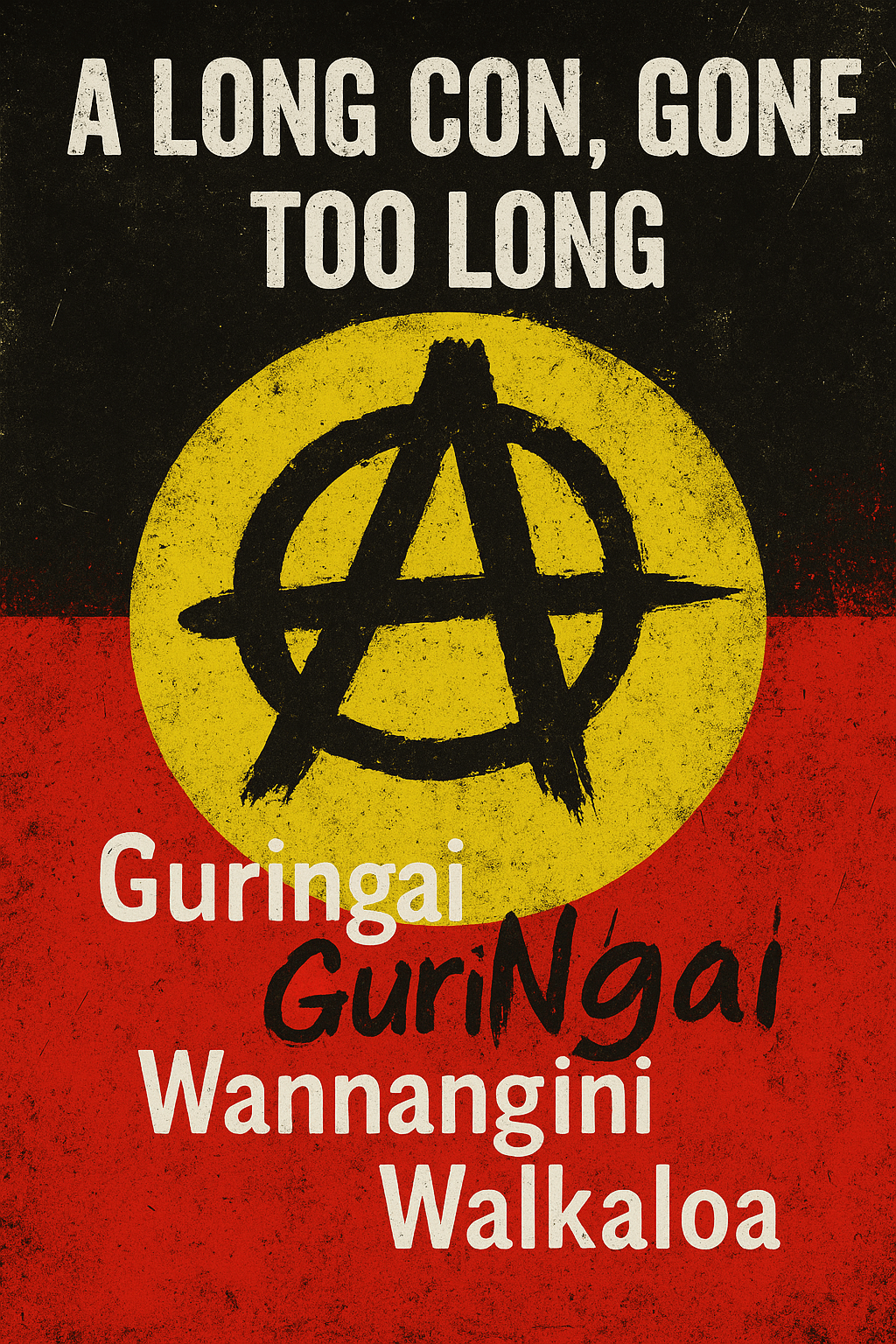
The “GuriNgai” controversy is one of Australia’s most significant cases of Indigenous identity fraud, showing how colonial misclassification, genealogical fabrication, and institutional failure distort truth and undermine Aboriginal sovereignty. What began as a Northern Sydney and Central Coast issue has grown into a national example of how epistemic insecurity enables cultural appropriation, policy capture, and settler simulation.
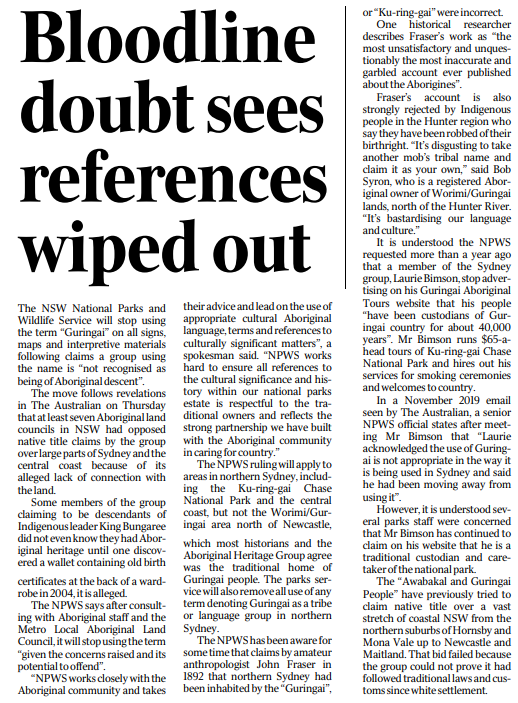
The term originated with missionary John Fraser, who in 1892 falsely extended the name of the Gringai people north of the Hunter River to invent a vast “Kuring-gai tribe.” Later research, including Wafer and Lissarrague (2010), proved Fraser’s claims unfounded; “Kuringgai” appears nowhere in verified colonial records. Linguistic evidence confirms that the true Guringai/Guringay people live north of the Hunter River in the Barrington–Dungog region, speaking a Gathang dialect distinct from Sydney’s languages (Lissarrague & Syron, 2024). The Aboriginal Heritage Office’s Filling a Void (2015) found no colonial record of “Kuringgai,” identifying it as an anachronistic academic error adopted uncritically by local councils lacking consultation with genuine custodians.

This vacuum allowed non-Aboriginal actors to exploit the term. Warren Whitfield created the Guringai Tribal Link Aboriginal Corporation (GTLAC) in 2003, inventing genealogies linking himself and others to Bungaree and Matora through the fictitious “Sophy–Charlotte Ashby” lineage, a claim disproved by archival and genealogical evidence. Figures such as Tracey Howie, Laurie Bimson, and Neil Evers institutionalised the fraud between 2007 and 2008 by performing “Welcome to Country” ceremonies and advising councils as “Elders.” Local governments, schools, and heritage bodies reproduced these claims, normalising the fiction through signage, acknowledgements, and public programming.
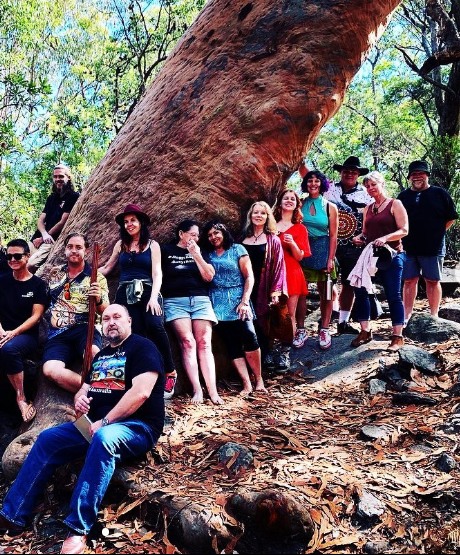
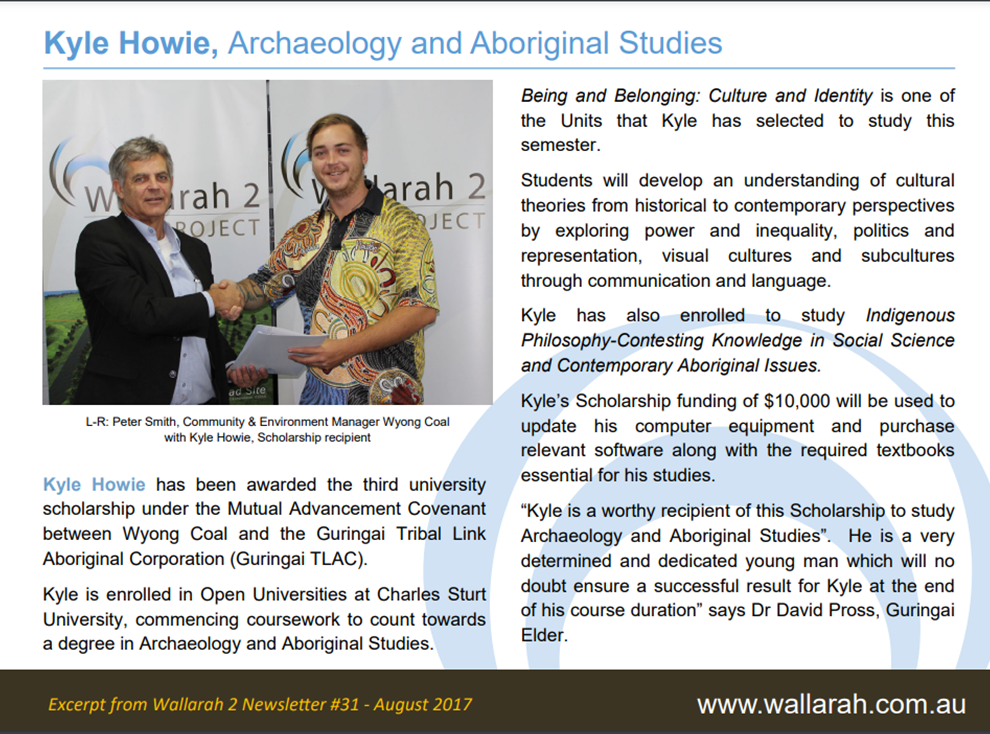
By 2009–2016, the “GuriNgai” network had embedded itself in governance, using reconciliation frameworks to legitimise unverified identities. Partnerships with corporations such as Wyong Coal and environmental groups like the Coast Environmental Alliance (CEA) exemplified policy capture, where fraudulent entities influenced heritage and planning decisions. Scholarly and community opposition grew after the AHO report (2015), yet institutional inertia and fear of appearing exclusionary perpetuated the falsehood.
From 2017 to 2023, Hornsby Shire Council and allied institutions amplified the fraud despite repeated warnings from Aboriginal Land Councils. Letters from Metropolitan, Darkinjung, and other LALCs (2020–2022) confirmed that “GuriNgai” is unrecognised under the Aboriginal Land Rights Act 1983 (NSW) and that the legitimate Guringay belong north of the Hunter River. Still, Hornsby Council continued to list the region as “GuriNgai Country,” entrenching epistemic injustice. The Registrar (2020) and NTSCORP (2020) further verified that no such group held native title or genealogical legitimacy.
The fraud reached the arts and media through the film Nyaa Wa by Charlie Woods (“Charlie Needs Braces”), which recycled the debunked Bungaree–Ashby genealogy. Public exposure by the Aboriginal community prompted institutional re-evaluation, including the removal of “Guringai” from National Parks and Wildlife signage in 2021. These Indigenous-led archives, supported by linguistic and legal research, have provided the definitive evidentiary base for cultural correction.
True reconciliation requires withdrawal of false acknowledgements, consultation with recognised LALCs, and public correction of errors.
Aboriginal Identity cannot be claimed through performance or convenience but Culturally, ethically and legally must rest on genealogical truth and community recognition. As affirmed by the Marramarra Carigal community, multiple Aboriginal run statutory bodies, the genuine Guringai/Guringay, Bungaree.org, and Guringai.org (2025), Northern Sydney, Hornsby Shire, and the Central Coast are not “GuriNgai Country.” Genuine justice demands that institutions restore Indigenous authority through truth-telling, accountability, and respect for authentic custodianship.
JD Cooke
Proud Marramarra Carigal/Garigal man.
Chapter 13. 2023 – Post publication of A Long Con Gone On Too Long.
Addendum. ANTHROPOLOGICAL CONNECTION REPORT: Family history and contemporary connection evidence.
Addendum. A new perspective on Laurence Paul Allen’s thesis.
Addendum. Goolabeen – Saving Kariong ‘Sacred Lands’
Contact the author using the contact form below. If you would like, it’s entirely up to you.

 A Long Con, Gone on Too Long.