
A network of individuals, and community groups on the NSW Central Coast including the Coast Environmental Alliance (CEA), offshoot “save” campaigns (e.g. Save Kariong Sacred Lands and Save Kincumber Wetlands), the political team Coasties Who Care, activist forums like Coast4One, and aligned entities such as Community Voice Australia (Central Coast), Walkabout Wildlife Sanctuary, and My Place Central Coast have spent considerable time and effort constructing a transparently false narrative.
Key figures like self-styled environmental activist Jake Cassar (founder of CEA), Lisa Bellamy (a CEA, and My Place Central Coast member, and unsuccessful local, state, and Federal political candidate since joining CEA) and My Place Central Coast coordinator, CEA member, and self-declared ‘star child’ Vicki Burke, link these initiatives. They have collaborated with a self-identified “GuriNgai” custodian group (comprised of non-Aboriginal people claiming descent from the historical figure Bungaree) and other allies.
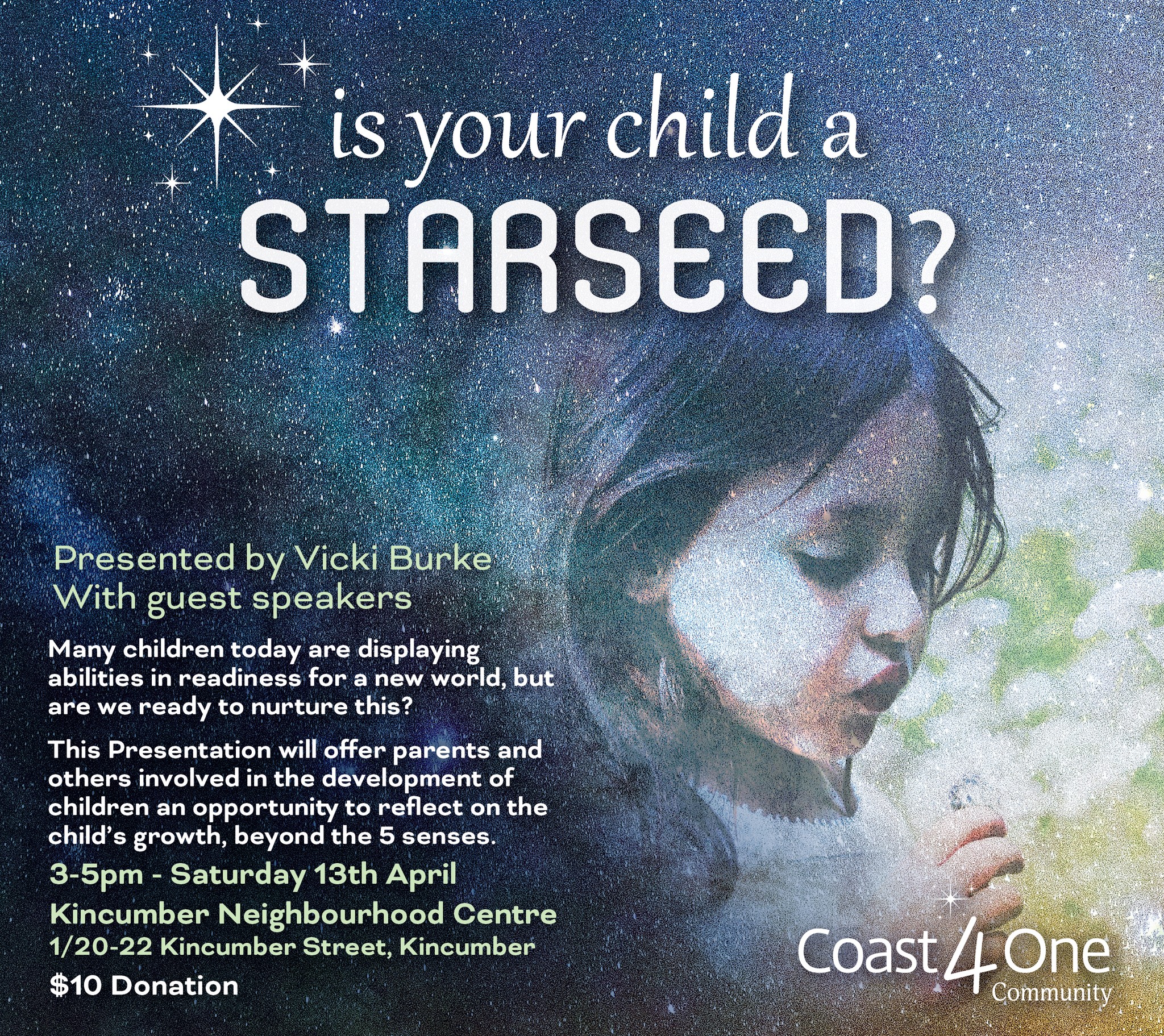
The unifying theme is opposition to the Darkinjung Local Aboriginal Land Council (DLALC), the region’s officially recognized Aboriginal land council, especially whenever DLALC pursues development of land acquired under land rights. This report examines the overlaps in membership and agenda among these groups, the coordinated campaigns they have waged (often framed as environmental or heritage protection), and criticisms raised by Aboriginal organizations and community members about their legitimacy and impact.

Chapter One:
Orchestrated Resistance – Settler Environmentalism against Aboriginal Land Rights
The campaigns against Aboriginal-led development on the New South Wales Central Coast, most notably those targeting the Darkinjung Local Aboriginal Land Council (DLALC) present themselves as grassroots movements to protect sacred lands and fragile ecosystems. Yet, as this exposé demonstrates, these protests reflect a deeper and more insidious form of settler resistance. Through strategic alliances, media amplification, and cultural misappropriation, a coalition of settler activists, self-declared custodians, and political aspirants have weaponised debunked claims to Aboriginal heritage to obstruct land rights and displace cultural authority.
Coast Environmental Alliance (CEA), led by bushcraft instructor Jake Cassar, is central to this network. Emerging from prior campaigns at Bambara and Walkabout Park, CEA rebranded under various banners, including Save Kariong Sacred Lands and Save Kincumber Wetlands, while simultaneously cultivating political offshoots like Coasties Who Care. Despite their diverse public identities, these groups are deeply intertwined, sharing personnel, strategy, ideological messaging, and graphic design.
The media narrative presented in local newspaper and blog Coast Community News (CCN) from 2023–2025 constructs an illusion of independent and spontaneous community uprisings against development at Kariong and Kincumber. However, closer scrutiny of both the participants and the language used across these stories reveals a calculated and coordinated strategy by a small network of repeat actors. These actors, drawn predominantly from the Coast Environmental Alliance (CEA) and its affiliated fronts such as Save Kariong Sacred Lands, Save Kincumber Wetlands, and Coasties Who Care, have consistently framed Aboriginal-led development as culturally and environmentally destructive. This framing, while superficially couched in progressive conservationist discourse, in fact masks a regressive and racialised logic of white territorial entitlement.
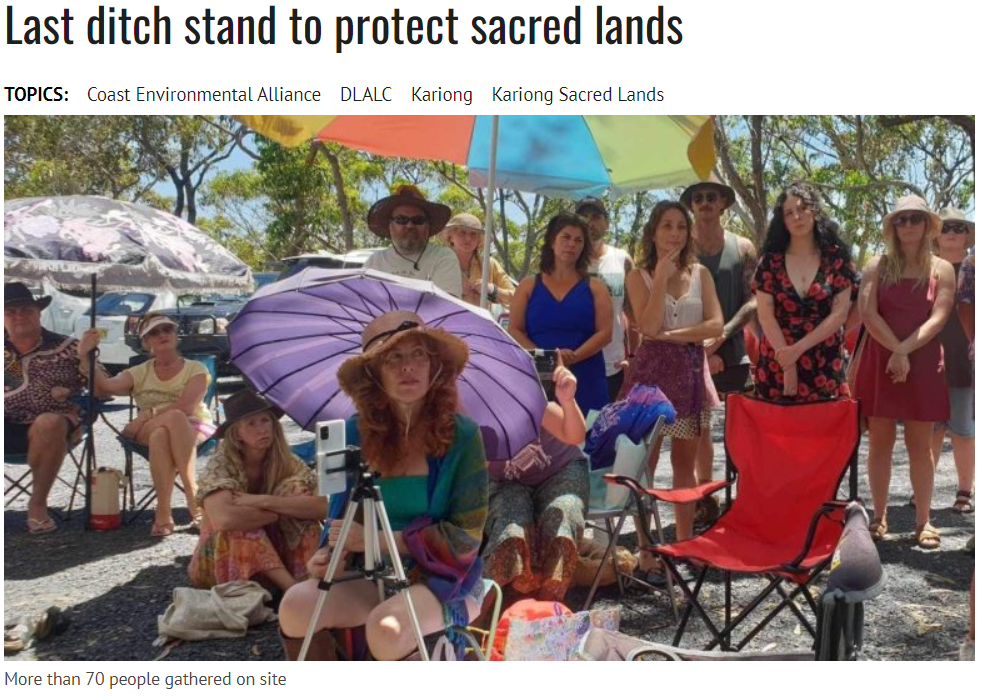
CCN’s articles document a persistent opposition campaign to Darkinjung Local Aboriginal Land Council (DLALC)’s Kariong housing proposal, beginning with “Kariong development back in the spotlight” (CCN, 2023, November) and culminating in “Ombudsman weighs in on Kariong development controversy” (CCN, 2025, February 26). Across this sequence of reporting, the same non-Aboriginal individuals recur as spokespersons; most notably Jake Cassar, Emma French, Lisa Bellamy, Colleen Fuller, and Sue Chidgey. These figures present themselves not only as environmental protectors but also as cultural interpreters, claiming the authority to identify and defend Aboriginal sacred sites, even in direct contradiction to the findings of Aboriginal heritage officers and DLALC’s own custodial representatives.

In one telling example, CCN (2023, September) reports that over 60 protesters, including “community leaders and environmental groups,” gathered at Kariong to decry DLALC’s development plans. Yet these “leaders” are the same cohort organising the Save Kariong Sacred Lands campaign under the CEA banner, as confirmed in other reports (CCN, 2024, January; CCN, 2024, February). The rallying cry for these protests is a supposed threat to “sacred land”. Yet the registered Aboriginal owners, DLALC, are absent from these events or are cast as villains. This inversion of Aboriginal authority in which settler environmentalists claim to better understand Aboriginal cultural heritage than the Aboriginal community itself, is a stark example of what Aileen Moreton-Robinson (2015) terms the white possessive: a relational system where white subjects assert dominance over Indigenous lands and narratives through discourses of care, protection, or stewardship.
Similarly, the “Save Kincumber Wetlands” campaign, described in CCN (2025, February) as a local response to a potential Woolworths proposal, follows the same script. The article identifies CEA-affiliated actors such as Cassie Roese and John Byrnes, figures who have appeared repeatedly in CEA protests. Like the Kariong campaign, the Kincumber initiative deploys the language of ecological fragility and cultural significance, despite the lack of any formal Aboriginal opposition to DLALC’s management of the land. This performance of guardianship over Aboriginal Country, in the absence of Aboriginal community sanction, not only usurps Indigenous authority but reinforces settler notions of custodianship where Aboriginal sovereignty is erased or re-inscribed as failure.
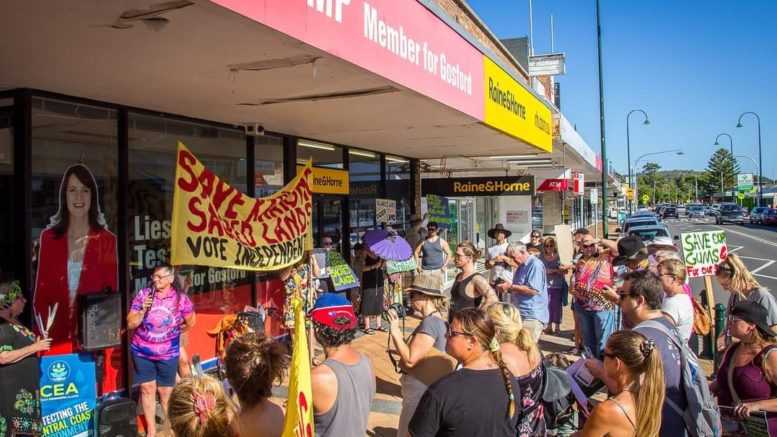
What emerges from these media portrayals is not a constellation of independent movements, but a tightly choreographed campaign of obstruction aimed squarely at Aboriginal land governance. The rebranding of CEA’s environmental goals through different fronts, Kariong, Kincumber, Lake Munmorah, and more, reflects a model of activism that is less about grassroots democracy and more about strategic repetition: the deployment of consistent talking points, symbolic protests, and petition drives across multiple sites of Aboriginal land recovery.

Moreover, the emphasis on symbolic sacredness by CEA and its allies often eclipses the reality of genuine Aboriginal history and Culture, as well as Aboriginal survival and economic development. As documented by ABC News (2020) and Darkinjung LALC’s public statements, the Kariong development is intended to provide affordable housing and economic opportunity for Aboriginal families. By casting this as an act of desecration, groups like CEA reposition themselves as saviours of Country, while simultaneously denying Aboriginal people the right to determine what “caring for Country” looks like. This is settler environmentalism at its most pernicious where Aboriginal land is only worthy of protection when it conforms to settler expectations of authenticity, wilderness, and sacredness (AIATSIS, 2023).
While private developments proceeded with little sustained protest, the Forgotten Origin blog (Strong & Strong, 2022) linked to pseudoarchaeological conspiracy theorists, mobilised to oppose DLALC’s planned development, claiming it would “destroy sacred land.” This rhetoric mirrors the CEA campaigns and raises the spectre of coordinated ideological alignment between fringe groups, environmentalists, and unverified “Traditional Custodians” such as the non-Aboriginal GuriNgai. In each case, the target is the same: Aboriginal-led development, Indigenous land councils, and projects arising from land rights legislation.
This pattern also demonstrates how settler activists strategically mobilise the rhetoric of heritage to undermine Indigenous legal and economic rights. As noted by Walker (2021), such tactics reflect a deeper discomfort with Aboriginal land ownership that transcends environmental concern. By positioning themselves as the moral arbiters of cultural authenticity, CEA-affiliated groups enact a racialised gatekeeping function, redefining whose claims to land and identity are valid, often to the exclusion of Indigenous communities.

The rhetoric of these campaigns consistently frames DLALC as a developer rather than a statutory Aboriginal organisation tasked with managing land for cultural and economic benefit. This framing is not merely misleading, it directly undermines the Aboriginal Land Rights Act 1983 (NSW) and the cultural legitimacy of DLALC, whose land tenure is the outcome of decades of struggle and legal reform. Crucially, the protestors claim to protect Aboriginal heritage even when Aboriginal People support the development in question. This inversion of cultural authority transforms settler activists into de facto gatekeepers of Aboriginal identity and heritage.
Chapter Two:
Pseudoarchaeology and the Rewriting of Custodianship
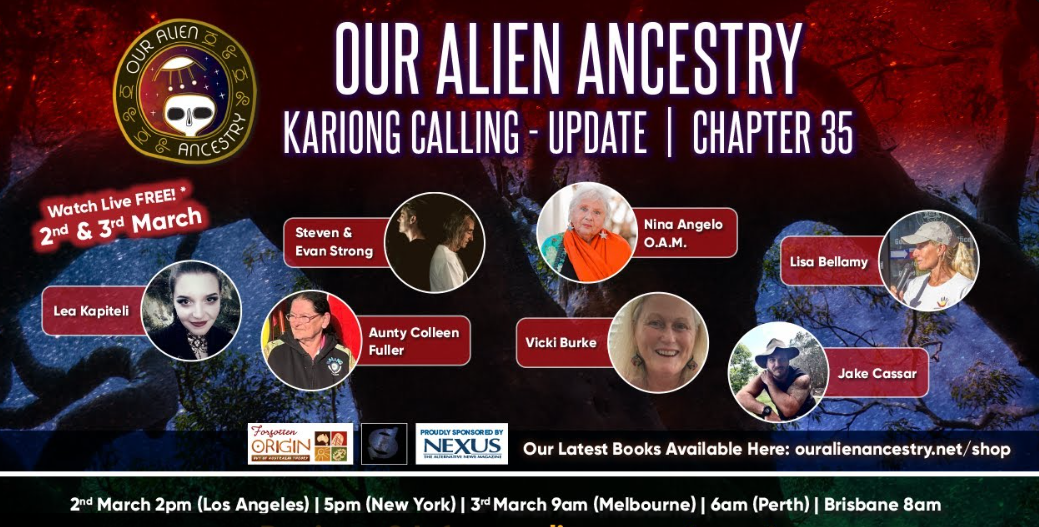
The interventions of the Forgotten Origin blog, operated by Steven and Evan Strong, offer a pseudoarchaeological dimension to this settler-colonial narrative. Through speculative claims about Egyptian hieroglyphs, Atlantean contact, and universal spiritual sites, the Strong family has constructed a mystic overlay atop Aboriginal Country. The Strong family’s publications and public statements reflect a concerted attempt to displace Aboriginal knowledge systems with an esoteric narrative of “Original” ancestry and to reframe sacred Aboriginal land as evidence of a non-Aboriginal “global civilisation” predating Indigenous occupation. These interventions share both personnel and ideology with CEA-led campaigns, exposing a deeply racialised and conspiratorial logic that fuels resistance to Aboriginal land recovery.
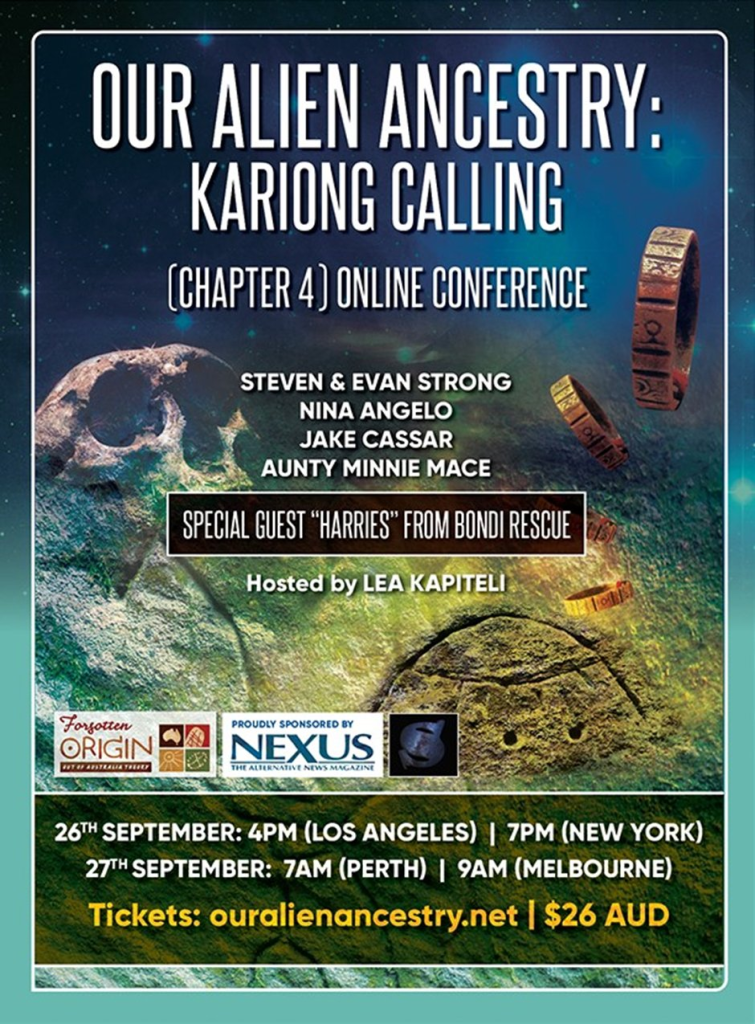
These claims are not benign; they displace Aboriginal law and cultural knowledge in favour of a fabricated cosmology that positions settler spiritualists as the true inheritors of ancient wisdom.
In a press release published on 2 April 2022, entitled “Kariong Bushland Under Siege”, Forgotten Origin frames the proposed DLALC development at Kariong as a cultural apocalypse. The authors write:
“There is no doubt that the land is sacred, and it is not for sale. Not now, not ever. It is the location of ancient wisdom encoded in the land. If this land is destroyed, humanity itself suffers” (Strong & Strong, 2022a).
The rhetorical device here is clear: the Aboriginal landowner, DLALC, is excluded from the frame. “The land” is sacred—but not because of its Aboriginal history or its cultural function in contemporary Aboriginal life. Rather, it is sacred due to alleged evidence of Egyptian glyphs, extra-terrestrials, and universal “Original” spirituality. The local Aboriginal custodians are erased from the narrative in favour of a constructed and fictional lineage that places so-called “Original people” at the centre of a universal human awakening. In this account, Aboriginality becomes irrelevant unless it is reframed within a mythic white saviour cosmology. DLALC, as a modern statutory body invested in economic development and housing provision, cannot be reconciled with this fantasy and is therefore vilified as a “developer,” or worse, a desecrator of ancient prophecy.
This ideological strategy is even clearer in the press release of 4 April 2022, “Opposition to Darkinjung Development Continues”, where the authors accuse DLALC of “threatening an ancient and global sacred site” and imply that Aboriginal people do not possess the authority to make decisions about their land unless they conform to the mysticism of the Forgotten Origin narrative. The post asserts:
“The Darkinjung Local Aboriginal Land Council has no moral right to desecrate land that predates all claims of ownership. It is not theirs to sell.” (Strong & Strong, 2022b).
This is an extraordinary statement: a non-Indigenous father and son publicly declare that Aboriginal people have “no moral right” to determine what happens to their own land, land acquired under legislated land rights. In any other context, such a claim would be seen as unequivocally racist. But within the overlapping worldviews of CEA-style environmentalism and Forgotten Origin’s spiritual revisionism, this narrative gains traction by exploiting public anxieties about “development” and cultural loss—while actively undermining Indigenous governance and sovereignty.
The language here mirrors that used by Jake Cassar and Emma French in their campaigns. French, for example, claimed in a 2024 interview that she and other CEA members “felt” the land at Kariong was sacred and didn’t need confirmation from DLALC (Guringai.org, 2024). Similarly, Jake Cassar has repeatedly positioned himself as a protector of “ancient sites,” even though he is neither Aboriginal nor a trained heritage professional. This populist appropriation of Aboriginal cultural authority reflects what Alana Lentin (2014) describes as “epistemic appropriation”: the theft not of tangible resources, but of the right to define what constitutes legitimate knowledge, history, and custodianship.
The danger of these narratives is compounded by their amplification through sympathetic local media and their deployment in opposition to Aboriginal development. Forgotten Origin’s claims, echoed in public forums and social media campaigns, have emboldened protestors to ignore Aboriginal heritage assessments and to cast doubt on the legitimacy of recognised custodianship. The result is not conservation, but cultural colonisation.
Moreover, Forgotten Origin’s narratives are not somehow not always recognised as isolated crank theories. This serves a specific function in the settler-colonial ecology of the Central Coast: they lend metaphysical legitimacy to land protection arguments advanced by activist groups such as Save Kariong Sacred Lands. By asserting that sacredness exists outside or above Aboriginal land tenure, accessible only to those with “open hearts” or “Original consciousness”, they cast Aboriginal organisations like DLALC as insufficiently spiritual, or worse, corrupted by the materialism of the Western legal system. This is not simply a spiritual claim; it is a political act of replacement. As Moreton-Robinson (2015) argues, whiteness sustains itself through the fantasy of rightful ownership and care, even while dispossessing the other. The Strong family’s writings enact that fantasy in its most literal form: Aboriginal people may live on the land, but its true stewards are those who see beyond nation, law, and race.
Furthermore, Forgotten Origin’s promotion of the so-called “Kariong Hieroglyphs” which have been conclusively debunked numerous times by archaeologists, DLALC, and even the National Parks and Wildlife Service, has played a key role in legitimising settler opposition to Aboriginal-led development. By arguing that the glyphs are evidence of ancient Egyptian or Atlantean contact, they de-centre Aboriginal narratives of place and inject the landscape with a speculative spiritual significance that conveniently excludes the authority of local Aboriginal people. The same arguments were used by groups opposing the Chain Valley Bay development at Lake Munmorah, where DLALC once again became the subject of public suspicion and cultural gaslighting. Forgotten Origin’s involvement provided a convenient metaphysical rationale for opposition: the site was not Aboriginal, but rather “universal.”
This is deeply dangerous. It replaces evidence-based heritage protocols, developed with and for Aboriginal communities, with settler spiritual intuition and pseudoscience. It also feeds into an increasingly visible alliance between settler environmentalism, conspiracy movements (such as My Place), and fraudulent Aboriginal identity claims such as those advanced by the GuriNgai. Forgotten Origin frequently platforms individuals associated with these movements, and its work has been cited by members of Save Kariong Sacred Lands in community forums, social media posts, and Council submissions. Its narratives have also found sympathetic amplification in local media, particularly Coast Community News, which has uncritically reported protests and press releases echoing Forgotten Origin’s terminology of “ancient wisdom,” “global sacred sites,” and “spiritual desecration.”
In this way, Forgotten Origin is not a fringe actor but an embedded part of a broader settler movement seeking to destabilise Aboriginal land tenure through a mixture of environmental rhetoric, spiritual mysticism, and faux-Aboriginal authenticity. Together with CEA and their political allies, they form what could be called a coalition of epistemic sabotage: a group of non-Indigenous actors working to displace Aboriginal authority through alternative narratives of culture and care. The result is not preservation but erasure, a settler-led occupation of both land and story.
Chapter Three:
Manufacturing Consent – Media Platforms and Settler Cultural Authority
In settler-colonial contexts such as Australia, media narratives play a central role in shaping public consciousness around land, identity, and legitimacy. On the New South Wales Central Coast, the coordinated activities of the Coast Environmental Alliance (CEA), Save Kariong Sacred Lands, Save Kincumber Wetlands, and their satellite organisations have not only relied on symbolic protests and community organising but have also cultivated a symbiotic relationship with local media outlets to manufacture public support and delegitimise the authority of recognised Aboriginal organisations. Chief among these media organs are Coast Community News (CCN), a widely distributed local newspaper, and The Point, an online “solutions journalism” platform established by journalist Jackie Pearson.

While both outlets present themselves as champions of grassroots democracy and transparency, their editorial bias in favour of non-Aboriginal campaigns opposing Darkinjung LALC’s developments has contributed significantly to the erosion of Aboriginal legitimacy in the public sphere. This is particularly visible in the uncritical promotion of so-called “Traditional Custodians” from the non-Aboriginal GuriNgai group, and the replication of settler narratives that cast DLALC as a “developer,” thus decontextualising and delegitimising its statutory and cultural mandate.
Coast Community News: Amplifying Settler Environmentalism
Coast Community News has consistently covered campaigns led or supported by Jake Cassar, Emma French, Lisa Bellamy, and other CEA-affiliated figures. In its coverage of the Kariong rezoning from 2023 to 2025, CCN published multiple stories quoting opposition voices while minimising or omitting perspectives from DLALC. In “Opposition to Kariong development ramps up” (CCN, 2023, December) and “Ombudsman weighs in on Kariong development controversy” (CCN, 2025, February 26), the paper foregrounds settler protestors’ claims of sacred site destruction and “community betrayal,” while reducing DLALC’s responses to tokenised rebuttals. Statements by Aboriginal Chairperson Tina West, who clearly articulated DLALC’s intention to preserve significant cultural features and to pursue community benefit through housing, are included only briefly, often undercut by emotive imagery and quotes from white protestors referring to “mother trees” and “ancestral spirits.”
In stories covering Save Kincumber Wetlands, such as “Up in arms over proposed Kincumber development” (CCN, 2025, February), a similar pattern emerges: non-Aboriginal residents are cast as local heroes, while the DLALC is portrayed as distant, bureaucratic, or unaccountable. This creates a subtle binary between “real locals” and “developers,” effectively stripping the Aboriginal land council of its identity as a community-controlled organisation rooted in cultural continuity. These editorial decisions, deliberate or not, serve to amplify settler resentment and mystify the legal realities of land rights.
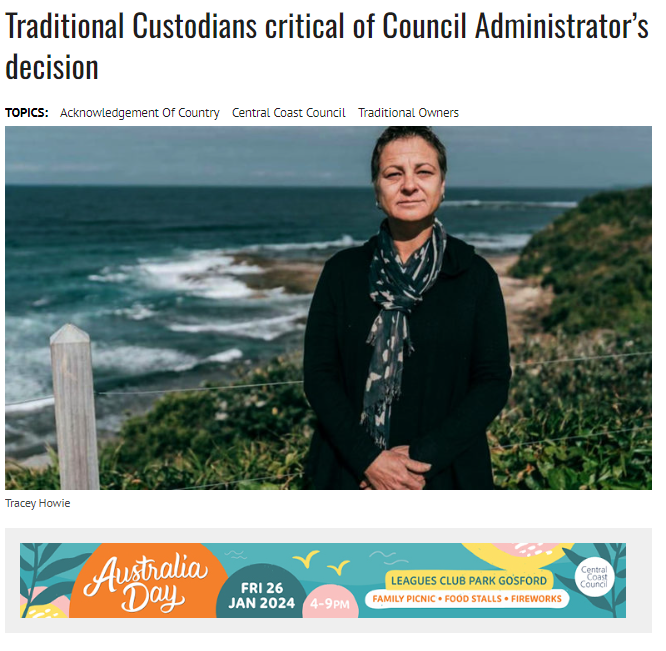
Perhaps most concerning is CCN’s repeated use of the phrase “Traditional Custodians” to describe members of the self-identified GuriNgai group. In its coverage of council debates over acknowledgement wording (see “Traditional Custodians critical of Council Administrator’s decision,” CCN, 2023), the paper presented figures such as Tracey Howie and Lisa Bellamy as credible authorities on local Aboriginal heritage, without interrogating the fact that all registered Aboriginal Land Councils in the region have repudiated these individuals’ claims (MLALC et al., 2020). A comment left by an Aboriginal reader in response to the article reads:
“The term Guringai is a fabricated term… Shame on CCN for publishing propaganda from this cohort.”
This uncritical reporting not only provides legitimacy to fraudulent Aboriginal identity claims but actively undermines the legitimacy of Darkinjung LALC, whose members face erasure in their own Country by settler voices reframed as protectors of Aboriginal culture.
The Point and Jackie Pearson: “Solutions Journalism” as Settler Advocacy
In a more sophisticated iteration of this media strategy, journalist Jackie Pearson, formerly of Coast Community News and now editor of The Point, has positioned herself as a champion of “independent journalism” on the Central Coast. Pearson’s journalism is funded in part by the Public Interest Journalism Initiative (PIJI), and in 2022 she received a grant to advance solutions-based reporting (CCN, 2022). Yet her editorial record in relation to Aboriginal land rights reveals a consistent bias: aligning with protest movements led by non-Indigenous groups and repeating GuriNgai talking points without critical engagement.
Pearson’s platform frequently hosts articles that frame DLALC’s developments as “neo-colonial traumas,” echoing language typically used by Indigenous activists but applying it, paradoxically, to protestors opposing Aboriginal-led projects. In her 2023 article “Neo-colonial traumas run deep on contested land,” Pearson describes a protest at Kariong as a righteous act of decolonisation, drawing on the rhetoric of healing and connection to Country. However, the voices quoted are almost exclusively non-Indigenous: white environmentalists, self-appointed GuriNgai custodians, and CEA affiliates. Pearson fails to mention that DLALC is the legally recognised landholder or that it had conducted Aboriginal heritage assessments in compliance with statutory obligations.
Other articles published on The Point, such as “Photographer supports campaign against planning proposal” and “Peaceful protest and author visit,” function as soft propaganda pieces for CEA-led initiatives. These stories employ a sentimental tone, emphasising the beauty of the landscape, the passion of protestors, and the “deep cultural significance” of the land, yet offer non-Aboriginal people and concepts not recognised by Aboriginal heritage bodies or community. The result is a form of romanticised settler environmentalism: stories of white guardians saving the land from faceless institutions, in which actual Aboriginal voices are absent or replaced by dubious claimants like the GuriNgai.
Pearson’s 2023 article “Traditional Custodian film to premiere at Green Point” takes this replacement even further. The film is described as a celebration of Country and community, yet its deeper function is to reframe settler narratives through faux-Indigenous aesthetics. Such events serve to normalise fraudulent identity claims and reinforce the perception that Aboriginality is something that can be inherited spiritually or aesthetically, rather than through community recognition and lived cultural practice.
In all of these articles, The Point employs a tone of reconciliation and restorative justice, while paradoxically participating in the displacement of Aboriginal authority. The platform’s consistent alignment with Jake Cassar’s events, Emma French’s campaign strategies, and Lisa Bellamy’s political aspirations underscores its role as a public relations tool for the settler coalition opposing Darkinjung LALC and its initiatives. Pearson’s own appearances at protest rallies and media launches further blur the line between journalism and activism, suggesting a form of advocacy journalism that, while well-intentioned, has functioned to legitimise false claims and undermine Aboriginal land governance.
Settler Symbiosis: CEA, Local Media, and the GuriNgai
Together, Coast Community News and The Point form the discursive infrastructure through which the settler-environmentalist alliance amplifies its message, legitimises its personnel, and discredits Aboriginal authority. These outlets create a feedback loop: activist groups like CEA stage events, which are then reported uncritically by local journalists, whose stories are subsequently cited by the activists as evidence of community support and cultural legitimacy. In many cases, these stories are then circulated in council meetings, petitions, and state-level submissions, creating a veneer of credibility for what is, in fact, a settler-led campaign to override Aboriginal land rights.
As the Darkinjung LALC and neighbouring Aboriginal organisations have repeatedly stated, this media ecosystem has contributed to “cultural harm, confusion, and erasure” (MLALC et al., 2020). It does so not through overt racism, but through strategic ambiguity: treating all claims of custodianship as equally valid, failing to distinguish between legally recognised Aboriginal organisations and self-appointed groups, and privileging emotive protest over structural analysis. In this way, the media becomes not a neutral observer, but a co-author of settler resistance, a settler ally cloaked in the language of community journalism.
Chapter Four:
Undermining Land Rights: Legal and Policy Implications of Settler Environmentalist Interference in Aboriginal Governance
The Aboriginal Land Rights Act 1983 (NSW) (ALRA) establishes a statutory framework through which Aboriginal Land Councils (LALCs) hold, manage, and develop land for the benefit of Aboriginal communities. Under Section 52 of the Act, Local Aboriginal Land Councils such as Darkinjung are empowered to acquire, develop, and manage land for housing, business, and cultural purposes (NSWALC, 2023). These powers are not merely administrative, they are the product of long-fought legal and political struggles to reclaim land dispossessed during colonisation and to enable self-determined economic development for Aboriginal communities.
The campaigns against DLALC at Kariong and Kincumber, however, position Aboriginal-controlled development as inherently illegitimate, conflating DLALC with private corporate developers and obscuring its statutory and cultural roles. This rhetorical sleight-of-hand, deployed by groups like Save Kariong Sacred Lands and echoed by media outlets such as CCN and The Point, renders invisible the legal distinction between private development and Aboriginal land recovery. The result is a public narrative that delegitimises Aboriginal governance while reinforcing the false perception that DLALC is an unrepresentative entity rather than a legally constituted and democratically accountable Aboriginal organisation.
This delegitimisation not only frustrates the practical implementation of ALRA but also violates its spirit. As noted by the NSW Aboriginal Land Council (NSWALC), land rights are not simply about returning territory, they are about restoring decision-making authority to Aboriginal communities (NSWALC, 2020). When settler groups mobilise public opposition against LALC-led developments, often invoking fabricated claims of cultural custodianship, they are actively obstructing the very autonomy that ALRA seeks to protect.
The systematic opposition to Aboriginal land development observed in Central Coast campaigns coordinated by settler-led groups such as the Coast Environmental Alliance (CEA), Save Kariong Sacred Lands, Save Kincumber Wetlands, and promoted through platforms like Coast Community News and The Point, has significant implications for the implementation of Aboriginal cultural heritage protection and land rights in New South Wales. These campaigns represent more than localised disputes over environmental values; they pose a structural challenge to Aboriginal sovereignty, statutory governance, and cultural authority, directly undermining the effectiveness of Aboriginal Land Councils and the legal frameworks designed to protect and empower Aboriginal people.
The Aboriginal Cultural Heritage Act 2023 (NSW) seeks to reform how cultural heritage is recognised, assessed, and protected. Central to this reform is the recognition that Aboriginal people must have the final say over their cultural heritage, including how it is managed in the context of development, conservation, and cultural practice. This reflects both international legal norms, such as those enshrined in the United Nations Declaration on the Rights of Indigenous Peoples (UNDRIP), and domestic obligations under human rights frameworks (AHRC, 2016).
Yet in practice, campaigns such as those at Kariong weaponise “cultural heritage” against Aboriginal decision-makers. By insisting that DLALC is failing to “protect sacred land,” and instead elevating unverified “Traditional Custodians” from the GuriNgai network as the proper authorities, groups like CEA invert the principle of Indigenous control. Cultural heritage is reframed not as something governed by Aboriginal law and practice, but as a universal asset to be protected by “the community”, a euphemism for settler activists. This tactic undermines emerging heritage law reforms by promoting the notion that Aboriginal authority is conditional: valid only when it aligns with settler expectations or conservationist ideals.
Creating a Shadow Consultative Regime: Parallel Authority through Settler-Endorsed “Custodians”
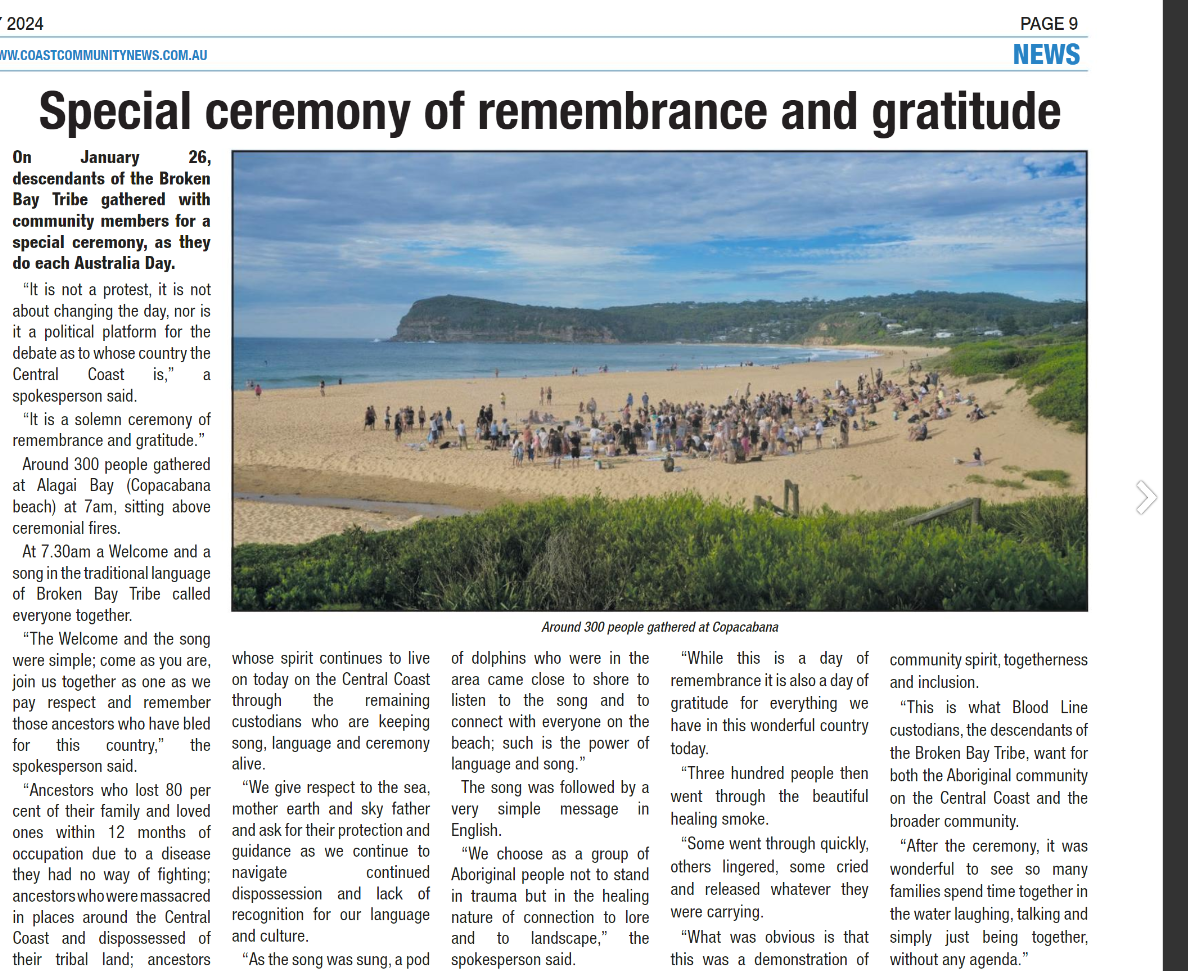
One of the most dangerous policy implications of the settler-led campaigns is the establishment of de facto alternative cultural authorities. Through sustained media representation, strategic partnerships with sympathetic politicians, and the repetition of ceremonial performance (e.g. Welcome to Country by non-recognised GuriNgai figures), groups like the Coast Environmental Alliance have elevated false Aboriginal representatives into positions of perceived cultural authority. In doing so, they have constructed a shadow consultative regime in which non-Indigenous political actors and institutions are pressured to consult with GuriNgai representatives instead of legitimate LALCs.
This not only undermines the ALRA but places local councils and government agencies at risk of violating their obligations under Aboriginal heritage protocols. For instance, the Central Coast Council’s attempt to revise its Acknowledgement of Country to reflect DLALC’s recognition was met with backlash by CEA affiliates, who accused the Council of erasing “true custodians” (CCN, 2023). As a result, some Council meetings now include performative acknowledgements involving non-Aboriginal individuals claiming to be GuriNgai, effectively usurping the cultural and legal authority of DLALC and setting a dangerous precedent for public policy.
Moreover, this strategy has national implications. If unverified custodianship claims can be inserted into public discourse and given equal or greater weight than those of registered Aboriginal bodies, the entire architecture of land rights, heritage management, and Indigenous consultation is at risk. Without strict enforcement of recognition standards, such as those outlined by NSWALC and heritage officers, Aboriginal sovereignty will continue to be displaced by settler-led romanticism and cultural fabrication
In the Kariong case, CEA and its allies have sought to elevate the GuriNgal, whose identity claims have been formally rejected by every Aboriginal Land Council from Sydney to the Hunter (MLALC et al., 2020) as the authoritative voice of cultural concern. This not only pollutes the public understanding of Aboriginal custodianship but threatens to erode the integrity of the Aboriginal Cultural Heritage register and associated legal protections. If unverified claimants are permitted to speak over recognised cultural custodians, the entire system of cultural heritage governance collapses under the weight of misrecognition and confusion.
Chapter Five: Jake Cassar and the Recolonisation of “Sacred Land”
Jake Cassar presents himself as a conservationist, survivalist educator, musician, and protector of Aboriginal sacred sites. Operating under the banner of Jake Cassar Bushcraft, his public identity combines wilderness knowledge with political activism, establishing a persona rooted in rugged environmentalism and community protection. However, beneath this carefully curated image lies a much more troubling legacy, one that reflects a coordinated and persistent pattern of settler resistance to Aboriginal self-determination, dressed in the language of heritage protection and environmental care.
Jake Cassar’s dual identity as a bushcraft educator and conservation activist positions him at the centre of the settler-environmentalist nexus on the Central Coast. Through CEA, Cassar has led coordinated campaigns to block Aboriginal development at Kariong, Kincumber, and beyond, framing these actions as defences of sacred land and cultural heritage. Yet these sites are owned or claimed by DLALC, the statutory Aboriginal body tasked with managing land in accordance with cultural and economic priorities.
From the campaigns to “Save Kariong Sacred Lands” and “Save Kincumber Wetlands” to his mentorship of Coasties Who Care candidates and his support for the non-Aboriginal GuriNgai identity movement, Jake Cassar has consistently positioned himself as a leading voice in local disputes over land use. Yet the land in question is not “public land” in a general sense; it is Aboriginal land, held or claimed by the Darkinjung Local Aboriginal Land Council (DLALC) under the Aboriginal Land Rights Act 1983 (NSW). Cassar’s activities must therefore be understood not simply as environmental protest, but as part of a broader settler-colonial project that seeks to delegitimise Aboriginal governance, discredit Aboriginal voices, and reassert white authority over Country under the guise of conservation.
Cassar’s campaigns consistently ignore or delegitimise DLALC’s authority. He has claimed that DLALC members are “not from the area,” has elevated unrecognised figures as “elders,” and has strategically deployed protests, petitions, and media stunts to pressure councils and the public into opposing Aboriginal-led development. His grooming of political candidates under the Coasties Who Care banner further illustrates his ambition to shape institutional outcomes in favour of a settler-conservationist worldview.
Cassar’s allyship, if it can be called that, is contingent on Aboriginal people acting as passive custodians rather than autonomous landowners. His repeated collaboration with fraudulent identity claimants from the GuriNgai group reveals a pattern of instrumentalising Aboriginality to advance settler control. His bushcraft enterprise, political strategising, and spiritual posturing coalesce into a performative ecology of white sovereignty over Aboriginal Country.
The “Bushman” as Cultural Broker
Cassar’s professional identity as a bushcraft educator trades heavily on the symbolic value of Aboriginal culture. Through Jake Cassar Bushcraft, he teaches plant medicine, tracking, and survivalist skills he claims are rooted in traditional Aboriginal knowledge. He often performs a proxy-Indigenous role in the public imagination, referring to himself in interviews as someone who “works closely with elders,” “cares for sacred sites,” or “protects cultural heritage.” This positioning has enabled him to frame himself as a cultural broker, granting himself and his followers license to speak on matters of Aboriginal cultural significance—even in the absence of any formal authority, descent, or community recognition.
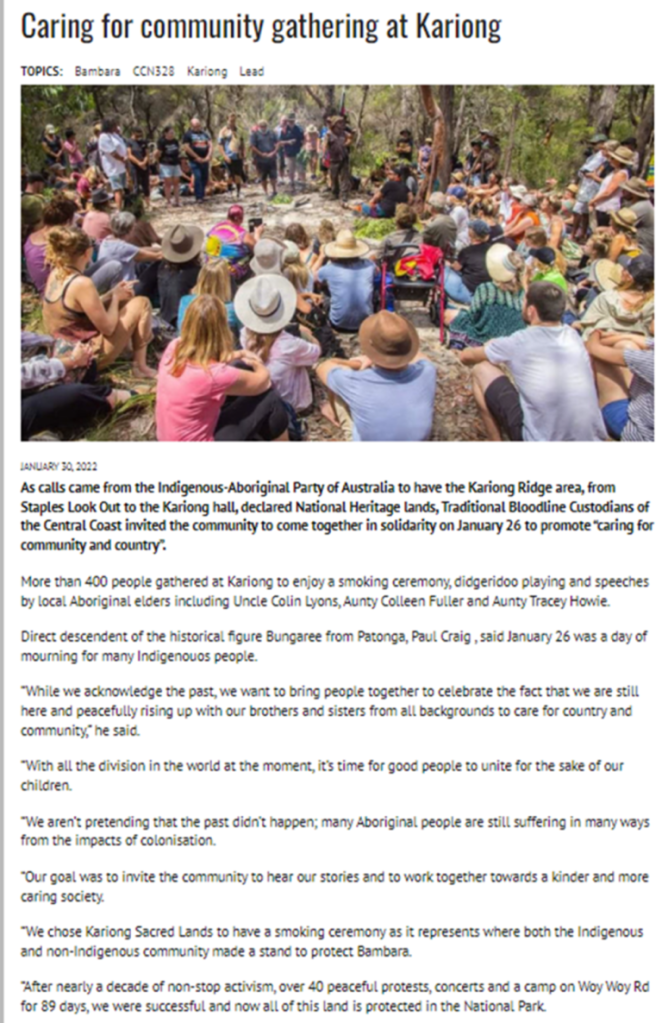
Cassar’s involvement in the Kariong protests, in particular, exemplifies this self-assumed cultural authority. In rally speeches, petitions, and media interviews, including coverage in Coast Community News, Cassar repeatedly invoked “sacred women’s sites,” “ancient engravings,” and the “grandmother tree” as reasons to halt DLALC’s proposed housing development (CCN, 2023, 2024, 2025). What is rarely mentioned, however, is that DLALC’s cultural heritage consultants and Aboriginal staff had already surveyed the land and incorporated protection of these features into the development plan. The heritage arguments advanced by Cassar and his allies were not based on evidence gathered under Aboriginal protocols, but rather on settler sentiment and mystical feeling—a direct contradiction of the very cultural authority they claimed to defend.
A Pattern of Anti-Aboriginal Mobilisation
Jake Cassar’s environmental activism has followed a consistent pattern since at least 2015: identifying land under Aboriginal ownership or claim, casting doubt on the legitimacy of that ownership, and organising localised campaigns to “save” the land by blocking Aboriginal-led development. This strategy is particularly evident in his leadership role in Save Kariong Sacred Lands, which is widely acknowledged to be a rebranded initiative of the Coast Environmental Alliance (CEA), the group Cassar founded. In public statements, Cassar framed DLALC as a “developer,” accused its members of not being “local,” and challenged its cultural legitimacy, despite the fact that DLALC is the only statutorily recognised Aboriginal organisation with custodial authority over the land in question.
The same narrative reappeared at Kincumber in 2025, when a CEA-linked campaign emerged to oppose a proposed Woolworths on DLALC-owned wetland. Although this campaign appeared spontaneous, it quickly became clear that key organisers, such as Cassie Roese and John Byrnes, were also CEA affiliates. Cassar promoted the campaign through his social media and associated platforms, calling again on local residents to protect “the land” from development. Once again, no effort was made to support the autonomy of DLALC as the landowner, nor to acknowledge the Aboriginal community’s internal governance structures.

Cassar’s leadership in these campaigns reveals a recurring and dangerous logic: Aboriginal people are allowed to have land only if they do not exercise their rights to use it. When they do, and when that use deviates from settler expectations of what Aboriginality should look like (i.e. passive custodianship rather than development or self-determination), their authority is swiftly undermined through public protest, media campaigns, and cultural gaslighting.
Political Engineering and the “Coasties Who Care”
Jake Cassar’s role in opposition to Aboriginal land rights is not limited to environmental protest. He has also attempted to engineer political power through his recruitment and mentoring of council candidates aligned with his cause. In 2023–24, he launched and managed the “Coasties Who Care” ticket—a group of three women (Lisa Bellamy, Sarah Blakeway, and Teegan Mulqueeny) who ran for Central Coast Council on a platform centred on protecting Kariong and other contested sites. Cassar himself stated publicly that he encouraged Bellamy to run and helped design her campaign messaging (Guringai.org, 2024). His influence extended to fundraising, social media coordination, and public events, many of which were co-hosted with individuals from the My Place and Community Voice networks.

Notably, all three candidates promoted anti-DLALC messaging, positioning themselves as the “true community voice” while dismissing the role of the Aboriginal Land Council in land use decisions. Bellamy even claimed that Darkinjung’s recognition as the Traditional Owner of the Central Coast was “not inclusive” and “offensive” to other groups, a statement that directly contradicted the formal position of the NSW Aboriginal Land Council and the Aboriginal Cultural Heritage Advisory Committee (CCN, 2023; DLALC, 2024). These comments were not rogue opinions; they were part of a carefully orchestrated campaign by Cassar and his allies to destabilise DLALC’s authority at the level of both public opinion and institutional governance.
Allyship or White Possession?
Although Jake Cassar may perceive his actions as allyship—standing up for “Country,” protecting sacred sites, and amplifying Aboriginal voices—the reality is far more complex, and far more dangerous. His consistent reliance on non-Aboriginal “custodians” such as Tracey Howie, Paul Craig, and Colleen Fuller, has helped to elevate fraudulent identity claims and displace legitimate Aboriginal voices from public discourse. These individuals have no recognised status under the Aboriginal Land Rights Act or native title law and have been explicitly repudiated by all Aboriginal Land Councils from Sydney to the Hunter.
Cassar has nonetheless platformed these individuals at rallies, forums, and media events as “Traditional Custodians,” giving them cultural authority they do not hold. In doing so, he has enacted what Aileen Moreton-Robinson (2015) calls “the white possessive logic”: the fantasy that non-Indigenous people can best care for Country and that Aboriginal governance is flawed, corrupt, or insufficient unless validated by settler norms.
This logic is not only epistemologically violent, it has material consequences. By obstructing DLALC’s development plans at Kariong and Kincumber, Cassar’s campaigns have directly undermined Aboriginal economic self-determination, blocked the delivery of housing and community infrastructure, and fed a public discourse that pits “the environment” against “Aboriginal development”, a false dichotomy rooted in fear.
Jake Cassar as a Settler-Colonial Actor
To understand Jake Cassar’s role on the Central Coast is to recognise the persistence of settler colonialism in new forms: not only through the overt dispossession of land, but through the reassertion of settler control over identity, heritage, and governance. Cassar may not wear a suit or work for a mining company, but his actions reproduce the same colonial outcomes: Aboriginal people denied autonomy, land tied up in endless contestation, and white Australians cast as cultural saviours.
As the campaigns at Kariong, Kincumber, and Lake Munmorah continue to evolve, Cassar remains at their centre, not as a passive supporter, but as a strategist, influencer, and public leader. His legacy is thus not simply one of environmental activism, but of strategic settler resistance to Aboriginal sovereignty, clothed in the language of community care and sacred stewardship. If true reconciliation is to occur on the Central Coast, it must begin with a critical confrontation of these dynamics, and a clear rejection of those who claim to defend Aboriginal land while working tirelessly to ensure Aboriginal people cannot control it.
Chapter Six: Legal and Policy Implications
The coordinated activities of settler-led activist networks on the NSW Central Coast, including the Coast Environmental Alliance, Save Kariong Sacred Lands, Save Kincumber Wetlands, and their promotional media allies—represent an urgent threat to Aboriginal sovereignty, land rights, and cultural authority. The movement’s symbolic language of care, protection, and “community” hides a persistent settler-colonial logic: that Aboriginal people cannot be trusted to manage their own Country, and that white Australians are the rightful stewards of sacred land.
These efforts, as this report has demonstrated, are not isolated protests. They form part of a broader cultural campaign to delegitimise Aboriginal Land Councils (especially Darkinjung LALC), elevate fraudulent identity claims (particularly by the GuriNgai group), and insert settler voices as the ultimate arbiters of heritage. What results is not only the obstruction of Aboriginal-led land development, but the erosion of foundational legal protections under the Aboriginal Land Rights Act 1983 (NSW) and the intended reforms under the Aboriginal Cultural Heritage Act 2023 (NSW).
The campaigns against DLALC reveal critical vulnerabilities in NSW’s legal frameworks for land rights and cultural heritage. The Aboriginal Land Rights Act 1983 (NSW) empowers Local Aboriginal Land Councils to acquire and manage land, yet provides limited protection against third-party ideological attacks. Likewise, while the Aboriginal Cultural Heritage Act 2023 (NSW) seeks to elevate Aboriginal voices in heritage decision-making, it remains open to exploitation by non-recognised claimants.
Media complicity exacerbates these legal failures. By elevating the voices of unverified custodians and settler activists, journalists have contributed to a public discourse that equates protest with authenticity and positions Aboriginal landowners as cultural outsiders. The erosion of DLALC’s legitimacy in public and political spaces undermines both the spirit and the letter of land rights legislation.
Violating Principles of Free, Prior and Informed Consent (FPIC)
The principle of Free, Prior and Informed Consent, enshrined in Article 19 of UNDRIP and echoed in multiple Australian policy documents (AHRC, 2016), mandates that Aboriginal people must be involved in all decisions affecting their lands, territories, and resources. FPIC is not merely about consultation, it is about giving Aboriginal people a genuine seat at the table, and in many cases, veto power over development that affects their Country.
Settler campaigns against Aboriginal-led development, however, violate FPIC not just by obstructing Aboriginal decisions, but by actively substituting Aboriginal voices with settler-approved alternatives. By promoting GuriNgai representatives as legitimate “custodians,” these groups are engineering a false consensus, presenting to the public and to state authorities the appearance of Aboriginal dissent when in fact the dissent comes from non-recognised and in many cases non-Indigenous individuals. This manipulation undermines Aboriginal agency and co-opts the language of decolonisation to perpetuate settler control.
In practical terms, it means Aboriginal communities like those represented by DLALC are denied their right to make economic and cultural decisions on the land they lawfully hold, because settler actors have successfully mobilised public opinion, media, and political pressure to override Aboriginal choices. This is not consultation; it is coercion by proxy. The creation of a shadow consultative regime, in which councils and institutions recognise figures like Tracey Howie or Colleen Fuller as “custodians,” threatens the entire architecture of Indigenous governance.
Conclusion
Investigations into the NSW Central Coast groups – CEA, Save Kariong Sacred Lands, Save Kincumber Wetlands, Coasties Who Care, Community Voice Australia (CC), Coast4One, My Place CC, and the self-styled GuriNgai custodians – reveal a tightly interwoven network of activists. They share overlapping leadership (with Jake Cassar, Lisa Bellamy and colleagues recurring across organizations), coordinate public events and campaigns, and echo a consistent agenda. That agenda, beneath the banner of environmentalism or community rights, consistently positions them against the region’s officially recognized Aboriginal representatives, especially, but not exclusively, Darkinjung LALC. Through joint rallies, petition drives, political tickets and media messaging, they have aligned to challenge or thwart projects led by Aboriginal authorities – from housing at Kariong to a potential supermarket at Kincumber – often employing rhetoric that questions the legitimacy and motives of those Aboriginal bodies.
Their collaboration is evident in shared affiliations (e.g. CEA spawning both “save” campaigns and election candidates), in public statements (repeating talking points about DLALC being “just a developer” or not representing “the community”), and in joint forums where disparate groups stand literally side by side. This coordination has been effective in galvanizing sections of the community and delaying developments. However, it has also provoked a backlash from Aboriginal leaders and organisations, who characterize these groups as opportunistic and even “neo-colonial”. All relevant Aboriginal authorities have repudiated the GuriNgai identity claims at the core of the alliance’s “Traditional Custodian” narrative, and they accuse the alliance of sidelining legitimate Indigenous voices while appropriating Indigenous causes. For instance, every local Aboriginal Land Council in the region affirms Darkinjung’s legitimacy and rejects the GuriNgai activists as “not of Aboriginal descent”. Respected community members have publicly shamed the activist network for spreading “fabricated” claims and propaganda.
In essence, what we see on the Central Coast is a convergence of environmental and community activists, New Age spiritualists, and anti-establishment actors forming a united front that challenges official Aboriginal governance in the name of “saving” the land. There are genuine environmental concerns in play – the sites in question do host threatened species and heritage sites – but the selective focus on lands owned by an Aboriginal Land Council (to the exclusion of other developments) and the reliance on unrecognized “custodians” for cultural authority have made the alliance deeply suspect in the eyes of Aboriginal observers. The collaborations between groups like CEA, Coasties Who Care, CVA, and My Place CC illustrate how fluidly this network shifts tactics: from direct protest to electoral politics to media campaigns, all reinforcing one another.
Ultimately, there is strong evidence that these entities operate in a coordinated and overlapping manner, effectively functioning as one movement. Their leadership cadre is small and interconnected, their membership base overlaps, and their agenda is unified around blocking DLALC initiatives and promoting an alternative narrative of who speaks for Country on the Central Coast. This has put them on a collision course with established Aboriginal organisations. As the Darkinjung Chairperson wrote, Aboriginal elders have “for almost a decade” supported Darkinjung’s development plans as a path to community benefit – yet they now face a well-organized coalition marshaling public opinion against those plans. The situation highlights a complex intersection of environmental activism and Indigenous rights: a case where allies and adversaries are hotly disputed.
Going forward, the key question is whether these groups will continue to gain influence – perhaps by securing elected positions or broader public support – or whether the weight of Aboriginal community opposition will discredit their efforts. Already, scrutiny is increasing: some local journalists and community members have begun calling out the inconsistencies and motives of the alliance. What is clear from this investigation is that the relationships among Coast Community News, CEA, Save Kariong, Save Kincumber, Coasties Who Care, Lisa Bellamy, Community Voice Australia (CC), Coast4All, My Place CC, the GuriNgai claimants, and Jake Cassar form a web of collaboration that has significantly shaped discourse on the Central Coast. This web blurs the line between environmental concern and cultural conflict. And according to the region’s recognized Aboriginal people, it represents a concerted challenge to their authority – one they are increasingly organizing to rebut in an equally coordinated fashion.
To counter these threats, legal and policy interventions must affirm the exclusive authority of recognised Aboriginal organisations. The Aboriginal Cultural Heritage Act must include penalties for identity fraud, and the ALRA must be amended to prohibit parallel consultation with unrecognised entities. Only legally constituted Aboriginal bodies should be involved in cultural consultation, heritage assessments, and ceremonial representation.
Public media must be held to account. Journalists reporting on Aboriginal issues should be required to verify identity claims through community recognition and statutory frameworks. Government grants, such as those awarded to The Point, must be subject to cultural competency conditions.
Aboriginal communities must also be supported to reclaim narrative authority. This includes funding public education campaigns on Aboriginal governance, establishing regional cultural authority protocols, and creating Cultural Integrity Units to monitor misrepresentation.
Above all, institutions must adopt a clear policy of no platforming fraudulent claimants. Welcomes to Country, funding, and heritage roles must be reserved for recognised custodians. Councils, schools, and media outlets must cease engaging with groups like the GuriNgai, whose identity claims have been roundly rejected by Aboriginal communities.
Reconciliation cannot coexist with settler campaigns to destabilise Aboriginal sovereignty. The path forward requires clear legal boundaries, institutional courage, and an unwavering commitment to Aboriginal self-determination.
What has occurred on the Central Coast is not a series of unfortunate misunderstandings, it is a deliberate, coordinated colonial occupation of Aboriginal cultural authority, enacted through protest, media, politics, and pseudospirituality. Jake Cassar and his network have inserted themselves into Aboriginal affairs, leveraged false custodianship claims, and used settler platforms to broadcast anti-Aboriginal narratives under the banner of environmentalism. This is not allyship; it is white possessiveness in action.
The path forward requires more than rebuttal. It demands the full reassertion of Aboriginal governance, legally, culturally, politically, and narratively. The statutory protections that underpin the Aboriginal Land Rights Act and Aboriginal Cultural Heritage Act must be honoured not only by governments, but by the wider public, including the media, education institutions, and NGOs. Aboriginal people must not be forced to “prove” their legitimacy every time they act as owners and custodians of land returned through struggle and law. Nor must fraudulent voices be permitted to stand as cultural equals in spaces they have no right to occupy.
This exposé offers a warning, but also a roadmap. Through rigorous policy reform, institutional accountability, community leadership, and sustained truth-telling, the assault on Aboriginal authority in places like Kariong and Kincumber can be confronted. More than that, it can be ended.
Appendix 1:
Summary of Overlaps and Affiliations
To illustrate the interconnected nature of these entities, the table below summarizes key overlaps in leadership/membership and notable collaborations:
| Entity/Person | Connections & Overlaps | Aligned Agenda |
| Jake Cassar (CEA founder) | Leads CEA; behind Save Kariong & Save Kincumber campaigns. Mentor to Lisa Bellamy and Coasties Who Care candidates. Works closely with GuriNgai figures (Tracey Howie, Colleen Fuller). | Stop DLALC developments; promote “true custodians”; position CEA as defender of sacred land. |
| Lisa Bellamy (activist, candidate) | CEA member; co-led Save Kariong campaign; figurehead of Coasties Who Care (rebranded Kariong group). Affiliated with My Place CC. Publicly opposes Darkinjung’s legitimacy (calls DLALC a “developer”). | “Protect” Kariong, wetlands, etc. from development; demand broader “custodian” recognition beyond DLALC. Mixed with personal choice/anti-“establishment” rhetoric. |
| CEA (Coast Environmental Alliance) | Core group founded by Cassar; members include Bellamy, Emma French, Vicki Burke, Cassie Roese, John Byrnes, etc. Runs multiple Facebook groups and petitions. Allied with GuriNgai claimants who attend CEA events as elders. | Environmental activism focused on sites owned by DLALC or slated for development. Challenges authority of DLALC in name of heritage/environment. |
| Save Kariong Sacred Lands | Campaign initiative of CEA (essentially same membership). Spokespeople: Jake Cassar, Kirt Mallie, Lisa Bellamy. Collaborates with Coast4One events and Coasties Who Care (the political offshoot). | Prevent Kariong rezoning/development; preserve “Aboriginal Place” status. Often directly confronts DLALC and questions its representation. |
| Save Kincumber Wetlands | New 2025 campaign, started by local reserve activists and boosted by CEA members (Cassie Roese, John Byrnes). Supported by Coast4One network (speakers like Sue Chidgey, Colette Baron). Linked by theme (DLALC land slated for Woolworths) to Kariong fight. | Stop any lease/sale of wetland by DLALC to developers (Woolworths); protect endangered species habitat. Messaging appeals to DLALC to act as “custodian” not developer. |
| Coasties Who Care (Council election team) | Candidates: Lisa Bellamy, Sarah Blakeway, Teegan Mulqueeny – all emerged via CEA campaigns. Founded/managed by Jake Cassar. Blakeway and others are active in My Place-style “freedom” circles. Received support from CEA base (fundraisers emceed by Cassar). | Ran on pro-environment, anti-development platform specifically citing Kariong, etc. Also echoed anti-council, anti-mandate sentiments (e.g. “globalist agenda” fears). Goal was to gain institutional power to further the activism. |
| Community Voice Australia – CC | Key member: Kate Mason (friend of Cassar/Bellamy). Co-hosted forums with CEA/Coast4One. Invited GuriNgai reps to speak. Collaborated on petitions and media (e.g. joint interviews on ABC) with Save the Bees and others. | Broad “community” advocacy with emphasis on grassroots voices. On the Coast, CVA often reinforces the CEA narrative (environmental protection, skepticism of authorities). Has campaigned for inclusive recognition of custodians (not just DLALC) and against certain government policies (health, energy). |
| Coast4One (aka Coast for All) | Organizer: Vicki Burke (CEA member). Brought together CEA, Save Kariong (Bellamy), CVA (Mason), Greens, One Nation, GuriNgai elders, etc. in joint meetings. Uses a Facebook page for events and info-sharing. | Serves as a coalition-builder on environmental issues. Facilitates information exchange and unity among disparate groups that share opposition to current Council/Administrator or DLALC projects. Essentially a forum to synchronize campaigns. |
| My Place Central Coast | Overlap with CEA/Coasties: Bellamy, Burke, Blakeway involved. Networked with other freedom groups (anti-vaccine/mandate, etc.). Provides volunteers and social media amplification. For example, My Place members helped with Coasties Who Care election materials and events (per social media posts). | Anti-establishment local activism. On the Coast, My Place energy feeds into challenging Council decisions and questioning DLALC authority (viewed as part of “the system”). Emphasizes “community self-determination,” aligning with the pushback on official Aboriginal bodies in favor of self-identified custodians. |
| “GuriNgai” group (Tracey Howie, Colleen Fuller, et al.) | Appear as “Traditional Custodians” in CEA/Coast4One events. Work closely with Cassar and Bellamy (e.g. giving welcomes, co-signing letters). Not recognized by any Aboriginal Land Council – in fact actively refuted by all local LALCs. Tracey Howie was involved in Indigenous-Aboriginal Party and council advisory efforts alongside Bellamy. Colleen Fuller publicly supports the narrative that Guringai are the true traditional owners of the Central Coast (contrary to Darkinjung). | Agenda is to gain official acknowledgment as the custodians of Central Coast lands, displacing or at least sharing authority with Darkinjung. They lend cultural legitimacy to the anti-DLALC campaigns by asserting those developments threaten “sacred Guringai sites.” Often align with environmental arguments, but with an undercurrent of seeking validation of their Aboriginality and custodianship. |
| Coast Community News (media) | Local news outlet frequently covering all the above. Publishes statements from Bellamy, Howie, Cassar, etc. giving them visibility. Has been accused of bias by Darkinjung supporters – a commenter condemned CCN for “supporting propaganda” of the Guringai cohort. CCN also runs op-eds and letters that debate these issues, effectively acting as a battleground for narratives. | (Not an activist agenda per se, but CCN’s reporting often mirrors the talking points of the alliance – highlighting environmental and cultural objections to developments, often without equally extensive input from Darkinjung or government. This has aided the group’s messaging reach in the community.) |
Table: Overlapping membership, affiliations, and agenda among Central Coast groups.
References
ABC News. (2020, July 9). Battlelines drawn over Kariong housing project proposed by Darkinjung Aboriginal Land Council. https://www.abc.net.au/news/2020-07-09/darkinjung-kariong-housing-development-tensions-mount/12426348
Central Coast News. (2020, July 3). Controversy continues over Darkinjung development proposal. https://coastcommunitynews.com.au/central-coast/news/2020/07/controversy-continues-over-darkinjung-development-proposal/
Central Coast News. (2025, February 26). Ombudsman weighs in on Kariong development controversy. https://coastcommunitynews.com.au/central-coast/news/2025/02/ombudsman-weighs-in-on-kariong-development-controversy/
DoSomething Near You. (n.d.). Coast Environmental Alliance. https://dosomethingnearyou.com.au/cause/coast-environmental-alliance/
Forgotten Origin. (2022a). Press release: Kariong bushland under siege. https://forgottenorigin.com/press-release-kariong-bushland-under-siege
Forgotten Origin. (2022b). Press release: Opposition to Darkinjung development continues. https://forgottenorigin.com/press-release-opposition-to-darkinjung-development-continues
Guringai.org. (2024, June 2). Coast Environmental Alliance vs the local Aboriginal Land Council: An interview with Walk for Kariong organiser Emma French. https://guringai.org/2024/06/02/coast-environmental-alliance-vs-the-local-aboriginal-land-council-an-interview-with-walk-for-kariong-organiser-emma-french/
Moreton-Robinson, A. (2015). The white possessive: Property, power, and Indigenous sovereignty. University of Minnesota Press.
Australian Human Rights Commission. (2013, July). We have a right to participate in decisions that affect us – effective participation, free, prior and informed consent, and good faith (Declaration Dialogue Series Paper No. 3). https://humanrights.gov.au/sites/default/files/2014_AHRC_DD_3_Consent.pdf
Central Coast News. (2020, July 3). Controversy continues over Darkinjung development proposal. https://coastcommunitynews.com.au/central-coast/news/2020/07/controversy-continues-over-darkinjung-development-proposal/
Central Coast News. (2025, February 26). Ombudsman weighs in on Kariong development controversy. https://coastcommunitynews.com.au/central-coast/news/2025/02/ombudsman-weighs-in-on-kariong-development-controversy/
Guringai.org. (2024, June 2). Coast Environmental Alliance vs the local Aboriginal Land Council: An interview with Walk for Kariong organiser Emma French. https://guringai.org/2024/06/02/coast-environmental-alliance-vs-the-local-aboriginal-land-council-an-interview-with-walk-for-kariong-organiser-emma-french/
Moreton-Robinson, A. (2015). The white possessive: Property, power, and Indigenous sovereignty. University of Minnesota Press.
Steven Strong & Evan Strong. (2022a, April 2). Kariong Bushland Under Siege. Forgotten Origin. https://forgottenorigin.com/press-release-kariong-bushland-under-siege
Steven Strong & Evan Strong. (2022b, April 4). Opposition to Darkinjung Development Continues. Forgotten Origin. https://forgottenorigin.com/press-release-opposition-to-darkinjung-development-continues
UN General Assembly. (2007). United Nations Declaration on the Rights of Indigenous Peoples. https://undocs.org/A/RES/61/295
JD Cooke
Marramarra–Carigal Researcher, Descendant of Bungaree and Matora
© 2025


Leave a Reply