
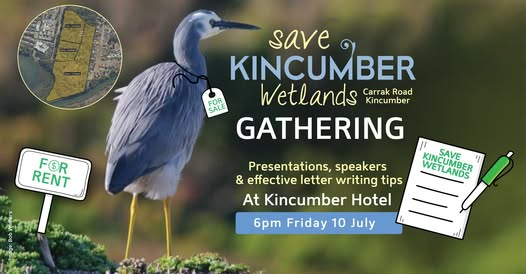
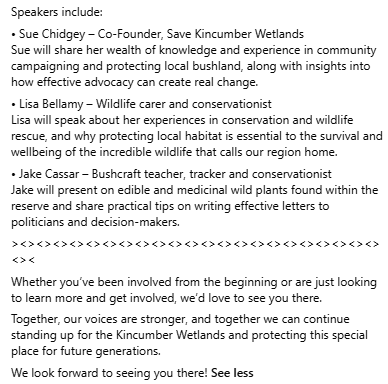
On Friday 10 July 2026, from 6 pm to 8 pm, the Save Kincumber Wetlands campaign is scheduled to hold a community gathering at the Kincumber Hotel. The public event notice invites Save Kincumber Wetlands members to “keep building momentum,” share ideas, strengthen connections, hear presentations, and learn practical letter-writing strategies for contacting politicians and decision-makers. The advertised speakers are Sue Chidgey, co-founder of Save Kincumber Wetlands; Lisa Bellamy, described as a wildlife carer and conservationist; and Jake Cassar, described as a bushcraft teacher, tracker, and conservationist.

On the surface, this appears to be a local conservation meeting. It is framed through familiar, soft civic language: wetlands, wildlife, bushland, community, advocacy, and care for future generations. Yet the structure of the event reveals something more politically significant.
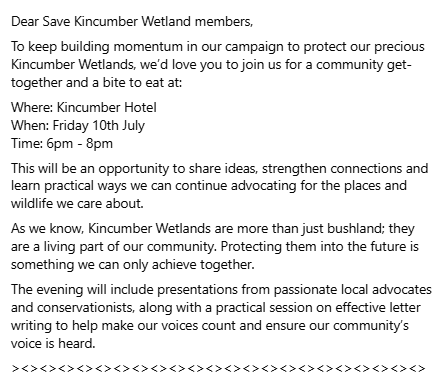
This is not merely an information session. It is a mobilisation meeting. Its purpose is to consolidate group identity, reinforce a campaign narrative, and train participants in practical political pressure.

That matters because Save Kincumber Wetlands does not exist in isolation. It sits inside a wider Central Coast activist ecology already documented across GuriNgai.org: Coast Environmental Alliance, Campfire Collective, Jake Cassar Bushcraft, Coasties Who Care, pseudo-Indigenous networks, and a recurring pattern of campaigns that use ecological language to obstruct Aboriginal land rights, especially the lawful authority of Darkinjung Local Aboriginal Land Council.
Previous GuriNgai.org analysis has argued that Save Kincumber Wetlands and Save Kariong Sacred Lands are not isolated campaigns, but recurring nodes in a broader strategy of settler simulation, where non-Aboriginal actors perform custodianship while displacing recognised Aboriginal governance (Cooke, 2025a, 2025b, 2025c).

The event notice is useful because it makes the campaign’s method visible. Attendees are not simply invited to listen. They are invited to become more effective campaign participants. The advertised “practical session on effective letter writing” shows that the gathering is designed to convert feeling into political output. People are being encouraged to write to politicians and decision-makers before the public has been presented with a complete planning record, a lodged development application, a settled ecological assessment, or a transparent explanation of what Darkinjung has actually proposed.
That is the recurring problem. A campaign formed around uncertainty has been organised as if the danger is already proven.
The public narrative around Kincumber has repeatedly suggested that Kincumber Wetlands are under imminent threat from a Woolworths-related development on land associated with Darkinjung Local Aboriginal Land Council. Yet previous GuriNgai.org analysis noted that the campaign intensified before a formal development application or completed public environmental assessment was available for scrutiny (Cooke, 2025a). NSW Planning’s Darkinjung Development Delivery Plan material also makes clear that the plan is a pathway for considering future use of Darkinjung-owned land, not an approval of development, not a rezoning instrument, and not a substitute for future assessment, community consultation, and ordinary planning process (NSW Department of Planning, Housing and Infrastructure, 2026). In other words, the campaign’s public urgency appears to have moved faster than the evidence.
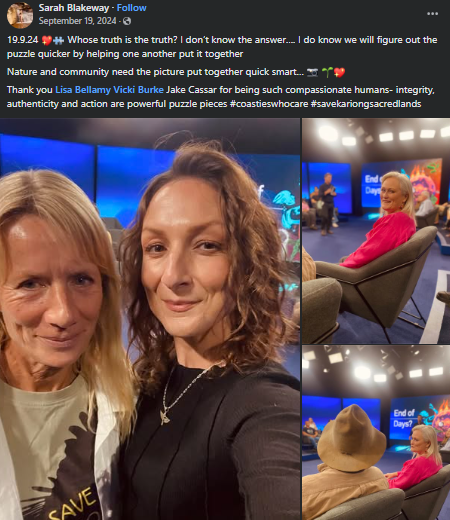
This is not a minor procedural concern. It is the mechanism by which rumours become political pressure. A possible future proposal becomes an imminent threat. A planning pathway becomes a secret approval. An Aboriginal landholder becomes a villain. A Facebook group becomes a community authority. A pub meeting becomes a campaign school.
The Save Kincumber Wetlands event should therefore be read as part of a broader high-demand group dynamic. Previous GuriNgai.org articles have analysed how CEA-adjacent networks generate belonging through urgency, grievance, moral purity, shared suspicion, and repeated claims that members are protecting sacred or threatened land from corrupt institutions (Cooke, 2025d, 2025e, 2026a). The campaign does not need every participant to believe the whole ideology. It only needs people to accept the emotional frame: “we” are the protectors; “they” are the threat; the system cannot be trusted; urgent action is required; dissenting information is part of the problem.
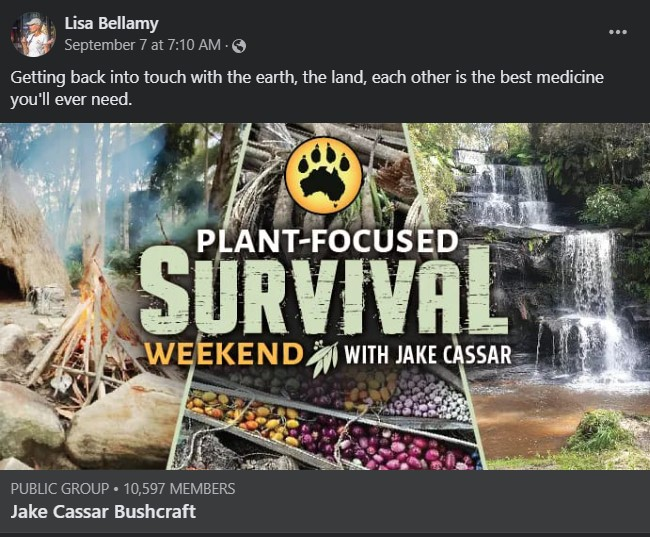
This is how high-demand movements often function in localised activist settings. They do not always announce themselves as extreme. They may appear as community groups, wildlife networks, wellness circles, bushcraft communities, or conservation alliances. Entry points can be soft: a picnic, a pub dinner, a bushwalk, a letter-writing session, a wildlife talk, a petition, or a social media post about trees. Once inside, members may be gradually exposed to a stronger worldview: government is corrupt, Aboriginal land councils are compromised, mainstream science cannot be trusted, local activists possess special insight, and charismatic figures have access to hidden truth.
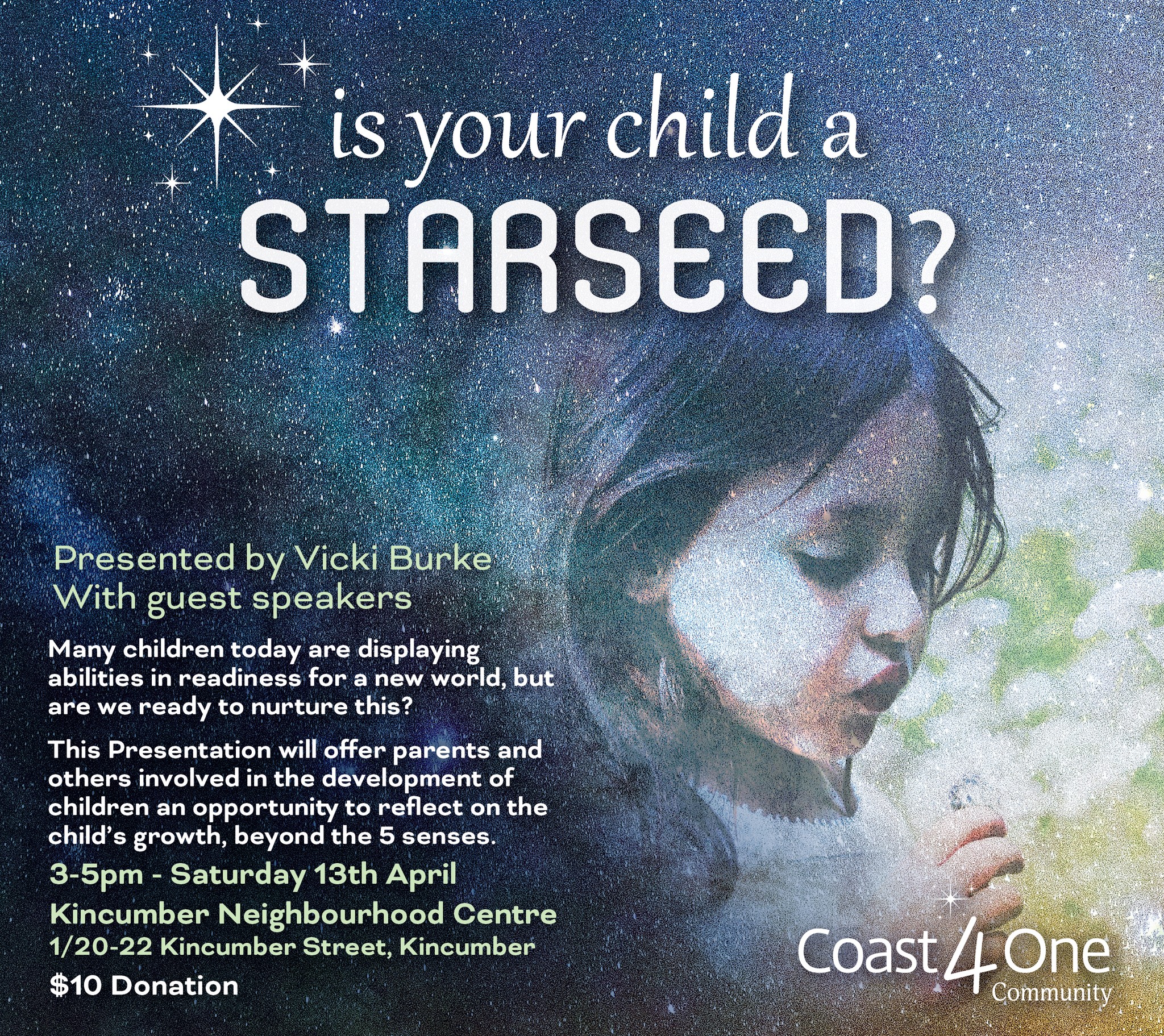
The advertised presence of Jake Cassar is significant in this context. Cassar is not merely presented as a conservationist. He is advertised as a bushcraft teacher and tracker who will speak about edible and medicinal wild plants found within the reserve, then teach practical letter-writing strategies. This fuses three kinds of authority: ecological authority, survivalist authority, and political authority. Previous GuriNgai.org analysis has argued that Cassar’s public persona operates through precisely this fusion, blending bushcraft, survivalism, anti-institutional suspicion, spiritualised land politics, and environmental activism into a charismatic role that can influence followers beyond ordinary conservation campaigning (Cooke, 2025f, 2025g, 2026b).
The problem is not that people should not learn about plants. The problem is the political use of bushcraft performance in a campaign targeting Aboriginal land rights. When a non-Aboriginal figure teaches people about wild plants on or near contested Aboriginal land, then trains them to write to decision-makers about that land, the performance can create an impression of cultural and ecological authority without the accountability of Aboriginal governance, scientific assessment, or statutory process. It allows a non-Aboriginal activist to appear as the person who knows the land best, speaks for the land most authentically, and can teach others how to defend it from Aboriginal decision-making.
That is settler custodianship.
Lisa Bellamy’s role also sits inside a documented CEA pattern. The event notice describes her as a wildlife carer and conservationist who will speak about habitat and the survival of local wildlife. Wildlife care is important, and ecological concern can be genuine. But previous GuriNgai.org work has identified Bellamy as a recurring figure in campaigns that position Aboriginal-led land use as environmental harm, while presenting CEA-aligned activists as the true defenders of Country (Cooke, 2025b, 2025h). In that context, wildlife language becomes more than environmental concern. It becomes a moral shield. It allows political obstruction of Aboriginal governance to be framed as compassion.
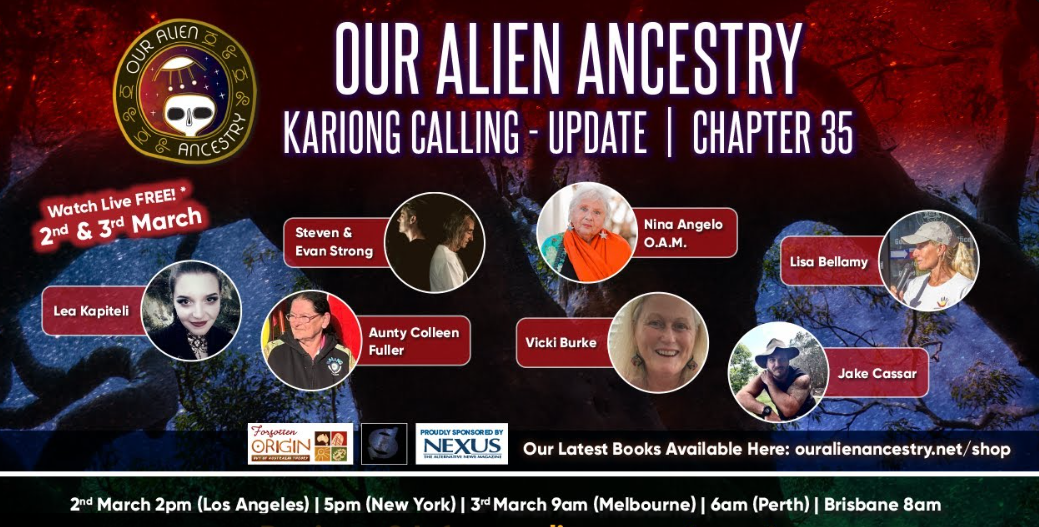
This is a form of cultural laundering. The public-facing message is wildlife protection. The underlying political effect is the delegitimisation of Aboriginal land use. The event does not need to say “oppose Aboriginal land rights.” It only needs to create a campaign structure in which Aboriginal landholders are continually associated with destruction, secrecy, greed, development, and ecological loss, while non-Aboriginal campaigners are associated with care, protection, knowledge, and community voice.

Previous GuriNgai.org analysis has described this as image laundering and cultural laundering: benign activities such as community aid, youth support, wildlife care, bushcraft, and conservation are used to soften the public image of a network whose campaigns repeatedly undermine recognised Aboriginal authority (Cooke, 2025c, 2025d, 2026a). This is why the Kincumber Hotel gathering should not be assessed only by its language. Its language is deliberately ordinary. Its structure, speakers, affiliations, and political function are what matter.

The deeper pattern is visible across the CEA network. GuriNgai.org’s analysis of CEA campaigns from 2023 to 2025 identified a repeated focus on Aboriginal land council projects, especially Darkinjung-linked sites, with campaign narratives built around alleged sacredness, ecological threat, distrust of statutory process, and the platforming of contested or false custodial authority (Cooke, 2025i). A later analysis argued that this network obstructs Aboriginal governance by displacing Darkinjung’s statutory role with settler-led claims to moral and cultural authority (Cooke, 2025c). The Kincumber event fits this pattern: the campaign is not only opposing a possible development; it is organising people to pressure decision-makers against an Aboriginal landholder.

This distinction is crucial. Opposing a development is lawful. Asking environmental questions is lawful. Demanding rigorous assessment is lawful. But using rumour, pseudo-custodial authority, fear, and coordinated pressure to pre-emptively delegitimise an Aboriginal land council is something else. It is not normal environmental advocacy. It is a political strategy that makes Aboriginal self-determination conditional on settler approval.
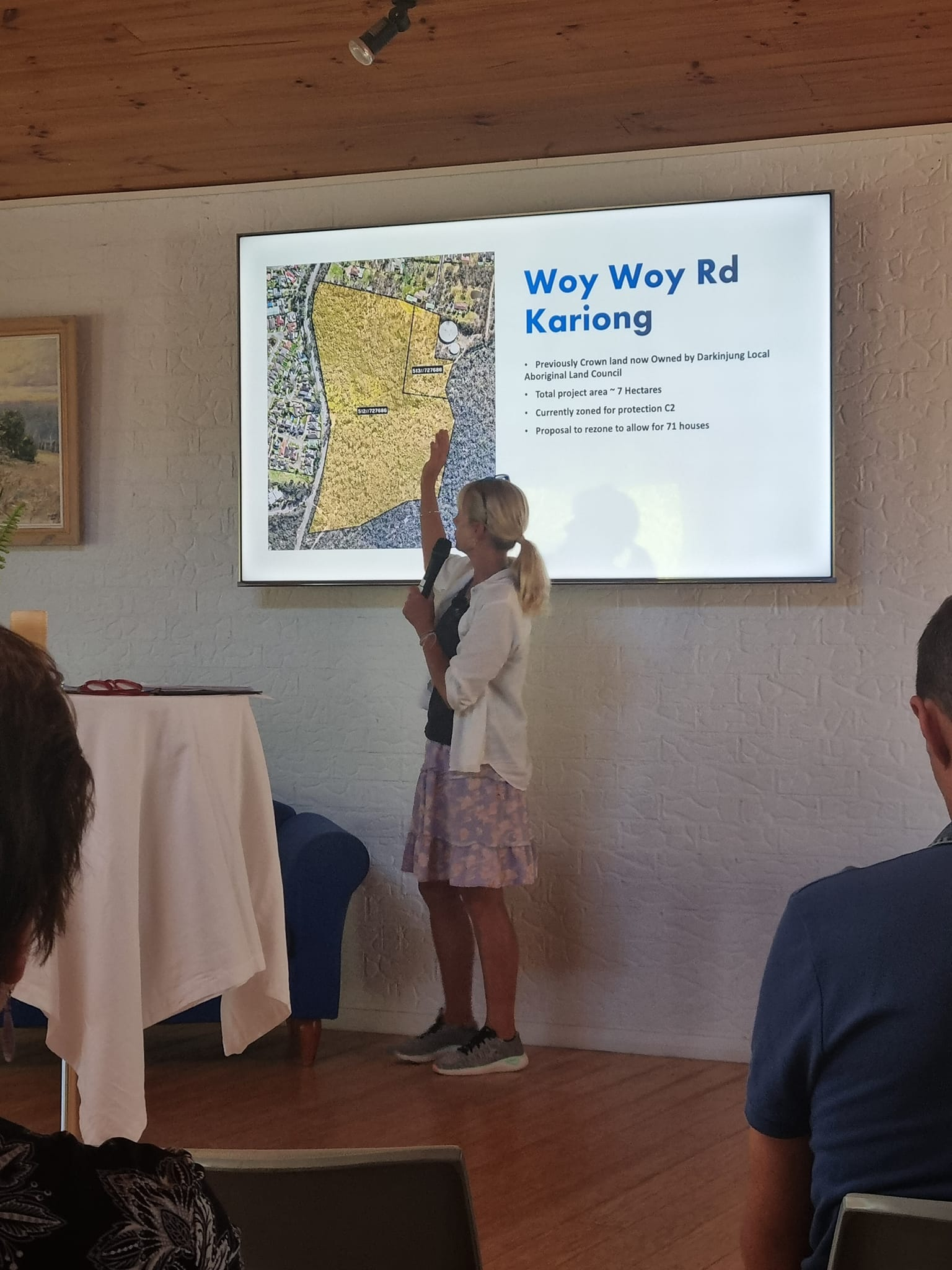
Darkinjung Local Aboriginal Land Council is not an ordinary private developer. It is a statutory Aboriginal body created under the Aboriginal Land Rights Act 1983. NSW Planning describes Darkinjung land as land granted to compensate Aboriginal people for historic dispossession and in recognition of ongoing disadvantage (NSW Department of Planning, Housing and Infrastructure, 2024). Darkinjung’s own public material describes its role across the Central Coast, from Catherine Hill Bay to the Hawkesbury River and from the Pacific Ocean to the Watagan Mountains (Darkinjung Local Aboriginal Land Council, n.d.). When land returned through land rights law becomes the subject of settler mobilisation, the issue is not only ecological. It is also about sovereignty, law, compensation, governance, and the right of Aboriginal people to make decisions about Aboriginal land.
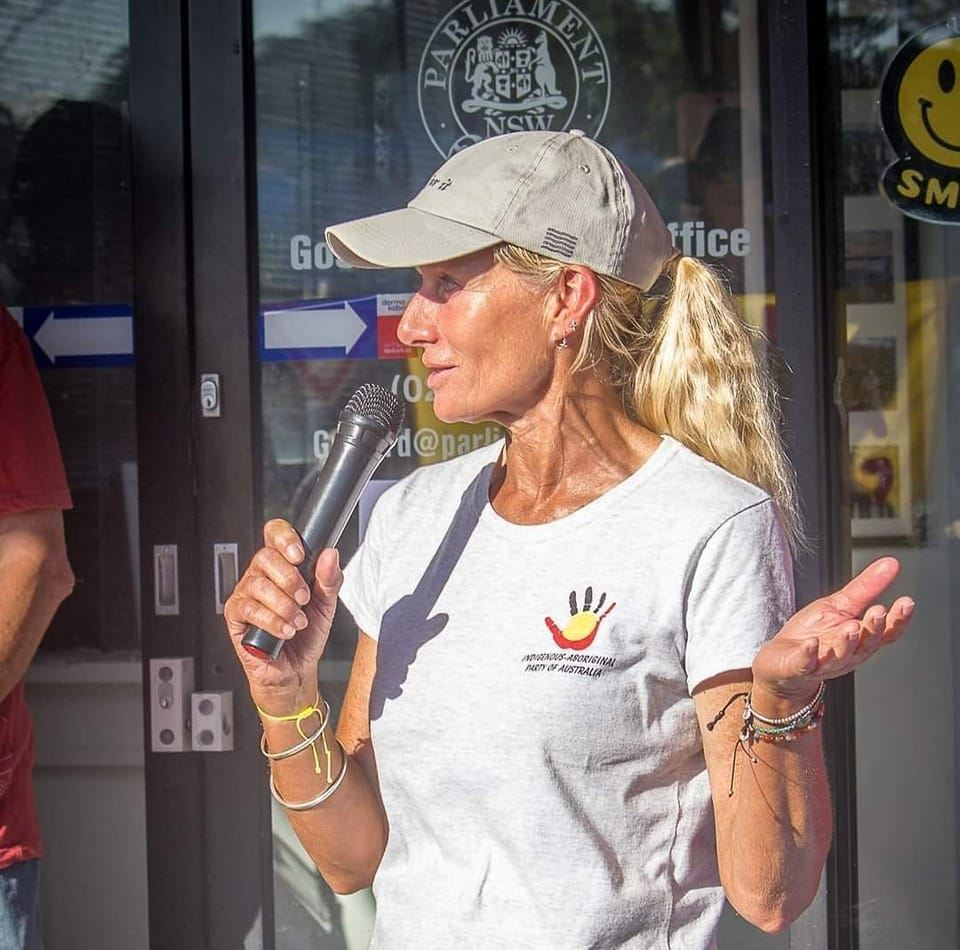
This is what the Save Kincumber Wetlands campaign continually obscures. The campaign presents “the community” as if it were a single body, unified against harm. But on Aboriginal land, “community” cannot be defined only by the loudest non-Aboriginal residents, Facebook administrators, pub attendees, or activist networks. The relevant community includes Aboriginal landholders, Aboriginal members, recognised Aboriginal governance bodies, and the people for whom land rights were created. When those voices are displaced or reduced to obstacles, environmentalism becomes a vehicle for recolonisation.

The event’s emphasis on letter writing is therefore particularly concerning. Letter-writing campaigns can create the appearance of widespread public consensus, especially when participants are given shared talking points and encouraged to contact politicians in large numbers. Decision-makers may then receive dozens or hundreds of letters that repeat a campaign frame without disclosing the networked origin of that frame, the absence of settled planning facts, or the broader history of CEA opposition to Aboriginal-led land use. This can produce a manufactured consensus, where a coordinated group appears to represent “the community,” while Aboriginal governance is framed as isolated, unpopular, or illegitimate.
High-demand group dynamics intensify this effect. Participants are not simply asked to assess evidence. They are asked to belong. The campaign language appeals to shared love of place, shared fear of loss, shared moral urgency, and shared identity as protectors. Once that emotional identity is formed, contradictory evidence can be experienced as betrayal. Questions about Darkinjung’s rights can be reframed as support for destruction. Requests for evidence can be treated as attacks. Aboriginal objections to false custodianship can be dismissed as politics. This is how epistemic closure forms: the group becomes the source of truth, and outside correction becomes proof of conspiracy.
Previous GuriNgai.org articles on cult exiting and recovery are useful here. They emphasise that people drawn into high-demand groups are not necessarily malicious or unintelligent. Many enter through genuine care, vulnerability, grief, social isolation, environmental concern, or a desire for belonging (Cooke, 2025d, 2025e). That point matters. Many people attending the Kincumber Hotel gathering may sincerely care about wetlands, wildlife, and local planning. They may not understand the broader CEA pattern. They may not know the history of the non-Aboriginal GuriNgai network, the obstruction of Darkinjung projects, or the ways in which settler activists can misuse conservation language to attack Aboriginal authority.
But sincerity does not make a campaign safe. A person can care about wildlife and still be recruited into a movement that undermines Aboriginal land rights. A person can oppose Woolworths and still participate in a campaign built on misinformation. A person can attend a pub meeting for the wetlands and leave with a script that contributes to political pressure against an Aboriginal land council.
This is why public-interest warnings are necessary. GuriNgai.org’s earlier public-interest warning about Jake Cassar, Campfire Collective, Coast Environmental Alliance, and Jake Cassar Bushcraft argued that Central Coast residents should be alert to the way seemingly benign community, bushcraft, and environmental activities can operate as entry points into a broader ideological network (Cooke, 2026b). That warning applies directly to the Kincumber gathering. A pub meal, wildlife talk, plant presentation, and letter-writing workshop may appear harmless. But when these activities are connected to a network with a documented history of attacking Aboriginal governance, platforming false authority, and reframing Aboriginal land rights as ecological threat, the public should not treat the event as politically neutral.
The July 2025 attack on Elder Uncle Gavi Duncan, previously documented by GuriNgai.org, further illustrates the risks of this activist ecology. That incident was analysed as part of a pattern in which CEA and Cassar-aligned networks have not merely criticised institutions, but targeted Aboriginal people and Elders who challenge false custodianship or defend recognised Aboriginal authority (Cooke, 2025j). This matters for Kincumber because campaigns do not remain abstract. When movements build identity around saving land from supposed enemies, those enemies become people: Aboriginal leaders, land council members, cultural authorities, researchers, journalists, and community members who refuse the campaign narrative.
The danger is not only misinformation. It is social permission. A movement that repeatedly frames Aboriginal governance as corrupt, fake, destructive, or illegitimate creates a permission structure for harassment, intimidation, reputational attacks, and institutional pressure. That is why the Kincumber event cannot be treated as a harmless local catch-up. It is part of a networked pattern with real consequences.
Those consequences are material. Previous GuriNgai.org analysis has linked CEA-aligned obstruction to delays, reputational damage, community confusion, and the undermining of Aboriginal-led responses to housing and land justice on the Central Coast (Cooke, 2025c, 2025h). The Central Coast is facing severe housing stress. Aboriginal land councils are among the few institutions with land, statutory purpose, and community mandate to pursue long-term Aboriginal social, cultural, environmental, and economic outcomes. When campaigns repeatedly block, delay, or delegitimise those initiatives through fear-based public pressure, the result is not only an environmental debate. It is structural harm.
The Save Kincumber Wetlands campaign therefore needs to answer direct questions.
Has a development application been lodged for the specific development the campaign is opposing? What exact land is being discussed? What ecological assessments exist? What has Darkinjung actually said? Has the campaign sought direct, respectful engagement with Darkinjung Local Aboriginal Land Council? What safeguards would satisfy the campaign, and are those safeguards based on ecological evidence or opposition to Aboriginal land use itself? Why are CEA-aligned figures repeatedly involved in campaigns against Aboriginal land council projects? Why is Jake Cassar being positioned as a land-based authority in a campaign concerning Aboriginal land? Why are supporters being trained to write to politicians before the public has been given a full planning and assessment record?
A legitimate environmental campaign should welcome those questions. A high-demand campaign will treat them as hostile.
The moral inversion at the centre of the campaign remains stark. Darkinjung LALC, a statutory Aboriginal land council operating within land rights law, is implicitly positioned as the danger. Non-Aboriginal campaigners, including CEA-linked figures, are positioned as the protectors. This inversion is the essence of settler environmentalism at its most dangerous: Aboriginal people are framed as threats to Country, while settlers claim the right to save Country from Aboriginal decision-making.
Kincumber Wetlands deserve rigorous protection. Wildlife deserves care. Planning decisions should be transparent. Environmental assessment should be serious. But none of those truths justify the laundering of anti-Aboriginal land rights politics through conservation language. None justify the displacement of Aboriginal governance by charismatic non-Aboriginal activists. None justify building a campaign around fear before evidence. None justify turning a pub gathering into a pressure campaign against an Aboriginal landholder.
The July 10 Save Kincumber Wetlands Gathering should therefore be understood as more than a local event. It is a live example of the broader CEA pattern: soft-entry community language, charismatic environmental authority, coordinated political pressure, settler custodianship, and the cultural laundering of opposition to Aboriginal self-determination.
People who genuinely care about Kincumber Wetlands should insist on truth. They should ask for planning facts, not rumours. They should respect Aboriginal land rights, not treat them as obstacles. They should engage Darkinjung, not campaign around Darkinjung. They should reject false custodianship, not platform it. They should protect wetlands without helping reproduce the old colonial fantasy that non-Aboriginal people are the rightful guardians of Aboriginal land.
Until that happens, the Save Kincumber Wetlands Gathering should be seen for what it appears to be: a carefully framed community event that converts ecological anxiety into organised pressure against Aboriginal land rights, while drawing participants deeper into a CEA-adjacent network whose history of misinformation, cultural laundering, and obstruction is already on the public record.
References
Cooke, J. D. (2025a, June 14). Save Kincumber Wetlands, Coast Environmental Alliance, and the denial of Aboriginal sovereignty. A Long Con, Gone on Too Long.
Cooke, J. D. (2025b, June 26). Save Kincumber Wetlands: The weaponisation of misinformation. A Long Con, Gone on Too Long.
Cooke, J. D. (2025c, November 15). The obstruction of Aboriginal governance by the Coast Environmental Alliance network. A Long Con, Gone on Too Long.
Cooke, J. D. (2025d, July 6). Investigating disengagement and recovery from high-demand groups: A psychological and sociological analysis for members of Guringai and Coast Environmental Alliance. A Long Con, Gone on Too Long.
Cooke, J. D. (2025e, July 9). Cult exiting and recovery: Applying psychological and sociological insights to the Guringai and Coast Environmental Alliance. A Long Con, Gone on Too Long.
Cooke, J. D. (2025f, December 7). The conspirituality of Jake Cassar, the Campfire Collective, and Coast Environmental Alliance. A Long Con, Gone on Too Long.
Cooke, J. D. (2025g, December 14). Jake Cassar, the non-Aboriginal Guringai network, and the circulation of falsified authority. A Long Con, Gone on Too Long.
Cooke, J. D. (2025h, August 10). False custodians, real homelessness: Bellamy, Cassar and CEA’s role in the Central Coast housing crisis. A Long Con, Gone on Too Long.
Cooke, J. D. (2025i, June 30). A comprehensive analysis of the Coast Environmental Alliance Facebook campaigns, 2023 to 2025. A Long Con, Gone on Too Long.
Cooke, J. D. (2025j, July 24). Coast Environmental Alliance and Jake Cassar Bushcraft attack Elder Uncle Gavi Duncan. A Long Con, Gone on Too Long.
Cooke, J. D. (2025k, June 25). Settler cultism and charismatic fraud in the Guringai and Coast Environmental Alliance networks. A Long Con, Gone on Too Long.
Cooke, J. D. (2026a, January 11). High-demand group dynamics and the cultural laundering of extremism in contemporary Australia: The Jake Cassar, Coast Environmental Alliance, Campfire Collective, and Guringai nexus. A Long Con, Gone on Too Long.
Cooke, J. D. (2026b, January 4). A public interest warning to Central Coast residents: Jake Cassar, the Campfire Collective, Coast Environmental Alliance, and Jake Cassar Bushcraft. A Long Con, Gone on Too Long.
Darkinjung Local Aboriginal Land Council. (n.d.). Darkinjung Local Aboriginal Land Council.
NSW Department of Planning, Housing and Infrastructure. (2024). Darkinjung Local Aboriginal Land Council.
NSW Department of Planning, Housing and Infrastructure. (2026). Darkinjung Development Delivery Plan.


Leave a Reply