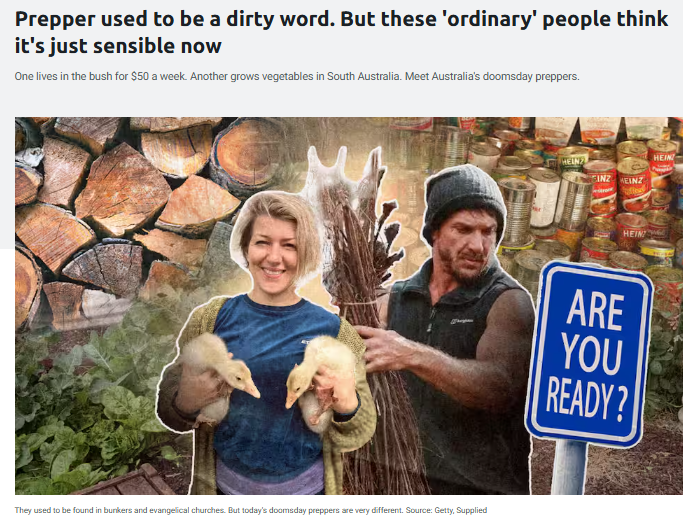
The SBS article “Prepper used to be a dirty word. But these ‘ordinary’ people think it’s just sensible now” opens deep in the bush of Mangrove Mountain, where Seamus Turton is described as preparing for the end of the world. His off-grid camp includes solar panels, large lithium batteries, stored food, a double-door fridge, a comfortable sleeping area, an outdoor bathroom with hot water, salvaged meat, rabbits intended for food, and chickens.
SBS frames this as part eccentricity, part practicality, and part response to global instability, especially anxiety about fuel supply and conflict in the Middle East (Koster, 2026). Turton’s camp is then placed in direct relationship to Jake Cassar, identified as his nearby mentor and as a survivalist and bushcraft instructor whose courses have reportedly attracted growing interest in the current geopolitical climate (Koster, 2026).
On the surface, the article is a human-interest story about resilience. Underneath, it is a revealing media snapshot of a broader ideological ecology in which ordinary preparedness, apocalyptic anxiety, spiritualised collapse narratives, bushcraft branding, follower devotion, pseudo-Indigenous authority, settler environmental politics, and contested Aboriginal governance become mutually reinforcing. The visible surface is solar panels, stored food, chickens, motorhomes, bushcraft, charity language, and community resilience. The deeper structure is a crisis worldview in which society is imagined as approaching collapse, certain people are framed as more awake than others, charismatic figures become guides through uncertainty, and land-based authority is performed in ways that risk displacing Aboriginal governance.
Preparedness itself is not the problem. There is nothing inherently extreme about storing food, learning first aid, maintaining water, growing vegetables, keeping chickens, preparing for bushfire, or building community-based resilience. In Australia, practical preparedness is often sensible. Floods, fires, pandemics, rental stress, fuel shocks, power outages, medication interruptions, and service-system failure have made many people feel vulnerable. Aboriginal families, rural communities, low-income households, remote communities, and disaster-affected towns have long practised forms of survival, repair, reciprocity, and mutual aid without needing the language of doomsday culture.
The problem begins when proportionate preparedness becomes folded into a totalising worldview, where ordinary life is reinterpreted as a fragile prelude to civilisational breakdown, public places become zones of danger, institutions are assumed to be incapable or untrustworthy, and survivalist teachers acquire authority not only over skills, but over meaning, morality, land, community, and sovereignty. At that point, “prepping” is no longer just about food, water, shelter, and safety. It becomes a worldview. It tells people that society is near collapse, that ordinary institutions cannot be trusted, that only the awakened few can see what is coming, and that alternative leaders, networks, and belief systems are needed to survive.
From preparedness to collapse identity
The distinction between emergency preparedness and collapse identity is essential. A household with batteries, water, medicine, food, and evacuation plans is not the same as a person preparing for imminent social breakdown. A family growing vegetables is not the same as a survivalist imagining the collapse of public order. A flood plan is not a bunker fantasy. A community pantry is not a self-defence course. Aboriginal ecological knowledge is not settler bushcraft branding. Disaster readiness is not conspiratorial withdrawal. Mutual aid is not charismatic control.
The SBS article blurs these distinctions. It presents a broad spectrum of behaviour under the category of “ordinary prepping,” including food storage, gardening, off-grid living, stockpiling, go bags, self-sufficiency, and survival courses. This flattening matters because it allows more ideologically loaded forms of survivalism to benefit from the legitimacy of practical household preparedness. Once the reader accepts preparedness as ordinary, the article can slide into self-defence, collapse fear, spiritual war, and survivalist authority without fully confronting their implications.
Turton’s comments show the shift clearly. He does not simply say that households should keep emergency supplies. He imagines a fuel crisis producing social collapse, empty shelves, hunger, and people eating pets (Koster, 2026). That is not neutral risk planning. It is catastrophic storytelling. It turns uncertainty into imminent breakdown. It creates urgency, fear, and distinction between those who are prepared and those who are supposedly asleep. In this structure, the prepper becomes not only someone with supplies, but someone who knows. Anxiety becomes evidence of insight. Fear becomes proof of realism. Suspicion becomes discernment. Withdrawal becomes wisdom.
This is why prepper culture can overlap so easily with conspiratorial thinking. Both rely on the idea that ordinary people are being misled, that visible systems are fragile or deceptive, and that survival depends on accepting a hidden truth before everyone else does. Every new crisis can then be interpreted through a confirmation loop: fuel concerns, war, inflation, supply-chain disruption, natural disaster, government failure, and social division become proof that the prepper’s worldview is correct. The result is preparedness as identity, not preparedness as proportionate emergency planning.
Seamus Turton and the materialisation of collapse belief
Turton is introduced through an almost comic contrast between doomsday anxiety and domestic comfort. His Mangrove Mountain setup is described as “the Hilton” of off-grid camps, with marble tiles, hot water, a large fridge, a double bed, a lounge, an engineered oak deck, sixteen solar panels, two large lithium batteries, coconut cream powder, salvaged roadkill, rabbits, and chickens (Koster, 2026). The effect is disarming. Turton appears eccentric, practical, inventive, and self-aware. He admits he has “gone a bit overboard,” but frames the excess as a decision to be comfortable if the worst occurs (Koster, 2026).
That framing converts apocalyptic preparation into lifestyle aspiration. The camp is not shown as grim, paranoid, or militarised. It is shown as comfortable, resourceful, and almost charming. The reader is encouraged to see collapse preparation through solar panels, chickens, bushland, domestic ingenuity, and off-grid self-sufficiency. Yet Turton’s own language reveals a darker imaginary. SBS reports that he has spent around $25,000 preparing for a feared breakdown connected to the Middle East conflict, threats to the Strait of Hormuz, fuel insecurity, and possible social collapse (Koster, 2026). He is quoted as saying that the crisis could happen within months and that if fuel runs out, people may end up eating pets (Koster, 2026).
This is not ordinary risk planning. It is catastrophic social imagination. A proportionate preparedness plan says: keep water, food, medication, a radio, batteries, evacuation plans, and neighbours’ contact details. Turton’s frame moves rapidly from global conflict to fuel anxiety, from fuel anxiety to food collapse, and from food collapse to social desperation. That escalation is the central ideological movement of prepping. It takes real vulnerabilities and narrates them into civilisational failure.
Turton embodies a stage of movement from ordinary concern into lived collapse infrastructure. He is not merely keeping extra goods. He has built a habitat around the expectation that ordinary systems may soon fail. He has converted geopolitical news into daily life, animals, food systems, energy systems, and social identity. His camp is not only an off-grid setup. It is a materialised belief system.
His role becomes even more significant when placed in relation to Cassar. SBS describes Cassar as Turton’s mentor and notes that he lives nearby (Koster, 2026). Mentorship is not merely technical. It shapes perception. A mentor teaches what counts as danger, what counts as knowledge, who can be trusted, what institutions should be doubted, and what kind of future should be expected. A student may learn food storage, but also learn that supermarkets are fragile. A student may learn bushcraft, but also learn that institutions are unreliable. A student may learn self-defence, but also learn that ordinary public spaces are dangerous. Turton is therefore evidence of survivalism as pedagogy, not merely survivalism as private lifestyle.
Jake Cassar and the charisma of practical authority
Cassar’s public role in the SBS article is carefully rehabilitative. He is not framed as a fringe survivalist. He is presented as a long-term bushcraft teacher who attracts everyday Australians seeking nature connection, self-reliance, and practical skills. He distances his audience from stereotypes of tactical gear obsessives and doomsday fantasists, while describing preparation as sensible in the current political and climatic moment (Koster, 2026). SBS also presents his philosophy as cooperative rather than lone-wolf, quoting his phrase “survival of the most cooperative” and linking it to charity work with homeless youth, people in juvenile justice, and women over fifty-five experiencing homelessness (Koster, 2026).
This is powerful public branding. It turns survivalism into care. It turns bushcraft into social work-adjacent community benefit. It turns prepping into cooperation. It turns a survivalist figure into a mentor for vulnerable people. These are not neutral rhetorical moves. They create a moral shield around Cassar’s authority. The reader is invited to see him through the language of service, care, nature, cooperation, and community before the article reveals more troubling elements of his worldview.
The same SBS material contains precisely those troubling elements. Cassar says he runs survival and self-defence courses, describes survival and self-defence as going together, and claims that people may be in more danger walking in a supermarket around closing time than going for a bushwalk (Koster, 2026). He also frames the contemporary crisis as a “spiritual war between people,” describing social division as more apocalyptic than bombs or invasion (Koster, 2026). Those statements must be read together. Cassar’s public discourse blends cooperation, self-defence, spiritual warfare, crisis readiness, nature connection, vulnerable-group work, and survivalist training. That combination is precisely what makes the phenomenon difficult to assess. It does not present as simple extremism. It presents as care, ecology, fitness, community, and moral awakening. Yet it also trains people to understand the world through danger, collapse, division, and spiritual conflict.
The supermarket comment is particularly revealing. A supermarket is an ordinary civic space, not a battlefield. To describe it as potentially more dangerous than the bush shifts the listener’s sense of everyday life. It invites hypervigilance. It turns normal public space into a possible threat environment. When paired with self-defence training, this is no longer merely preparedness. It is emotional rehearsal for social breakdown.
The “spiritual war” claim intensifies the issue. It frames social division not as a political, economic, media, or institutional problem, but as a metaphysical condition. Once social conflict becomes spiritual war, disagreement is no longer ordinary disagreement. It becomes a contest between awakened and asleep, authentic and corrupted, natural and artificial, pure and degraded. That is the grammar of conspirituality: the fusion of alternative spirituality, conspiracy thinking, apocalyptic expectation, anti-institutional distrust, and claims to hidden knowledge (Ward & Voas, 2011).
Vicki Burke and the spiritualisation of collapse
Vicki Burke provides a second public example of the same follower ecology. SBS Insight describes Burke as a former teacher and school principal who did not expect to spend retirement learning survival skills, but who began to see signs of global shift after COVID-19. She is quoted as saying that the world people are living in now is not the world that will continue, and that it cannot continue. SBS reports that she bought a motorhome, sought survival knowledge, and met Jake Cassar, a Central Coast survivalist (SBS Insight, 2024).
Burke’s importance lies in the spiritual and transitional framing of collapse. She is not presented as simply preparing for a local power outage. She is preparing for “another transition,” including possible world war, global food shortage, or cyber attack (SBS Insight, 2024). Cassar, in the same Insight article, is quoted as hoping that when humanity receives an “epic kick” through world war, climate issues, or natural disasters, people may realise the importance of caring for loved ones and community (SBS Insight, 2024).
The old world cannot continue. A disruptive event may be necessary. The collapse may be frightening, but it may also be corrective. People should not live in fear, but they should prepare. Disaster is not only feared. It is imagined as a portal.
Burke therefore complements Turton. Turton materialises collapse through infrastructure. Burke spiritualises collapse as transition. Turton builds the camp. Burke articulates the worldview. Cassar sits between them as the teacher who gives practical skills, communal language, and interpretive authority. Burke should not be treated as an unrelated prepper case. Her story shows how Cassar’s survivalist teaching can be received by people already searching for meaning in crisis. The danger is not that such people learn useful skills. The danger is that those skills may be embedded in a larger worldview of awakening, transition, mistrust, spiritual conflict, and charismatic dependency.
The Cave as mythic infrastructure
The Cave is central because it appears to provide narrative infrastructure for Cassar’s public persona. A survivalist teacher can claim practical authority through skills. A campaigner can claim moral authority through causes. A charity figure can claim social authority through vulnerable groups. But a mythic text can deepen all of those by giving the figure an origin story, symbolic destiny, and cosmology.
The publisher’s page for The Cave does not present the text simply as conventional fantasy. It describes Cassar as one of Australia’s recognised survival and tracking teachers and states that the book “blurs the lines between reality and myth,” combining fiction, non-fiction, and autobiography (Books Online Australia, 2026). It says the story challenges assumptions about the world, the self, and survival, and invites readers into a narrative that may leave them questioning everything (Books Online Australia, 2026).
That marketing language is analytically important. It does not draw a firm boundary between fiction and autobiography. It explicitly makes ambiguity part of the product. This matters because the broader Cassar ecology already operates through ambiguity: bushcraft and spiritual teaching, environmental activism and sacred-land rhetoric, charity and public branding, survival skills and collapse expectation, Aboriginal symbolism and settler authority. The Cave becomes the literary expression of the same structure. It allows the text to be defended as fiction when challenged, while still being received by followers as hidden autobiography, spiritual testimony, or coded revelation.
The subtitle, In Order to Survive the Future, We Must Return to the Beginnings, condenses the survivalist worldview. The future is dangerous, survival requires return, modernity has failed, and salvation lies in an imagined earlier order. That is restorationist survivalism. It frames the future as something to be survived and the past as the source of redemption. In an Aboriginal sovereignty context, “returning to the beginnings” can sound like respect for ancient knowledge, but in a settler survivalist text it risks becoming a fantasy of access to origins without accountability to Aboriginal people.
The reviews on the publisher page are especially revealing because they show how the book is being received by Cassar’s audience. One review describes the book against the background of climate change, environmental degradation, plagues, war, and questions about human history timelines, then describes the protagonist being drawn into a magical and enlightening world of nature and cryptic beings (Books Online Australia, 2026). Another describes it as offering “interesting insights” and a fantasy-grounded look at humanity’s current state (Books Online Australia, 2026).
Most significantly, Turton’s public review reportedly treats the book not as ordinary fiction, but as something that may be substantially true. In that account, the unresolved question of what is true and what is fictional does not weaken belief. It strengthens fascination. The author becomes the keeper of hidden truth. The follower becomes someone near enough to ask, but not authorised to know. That is a classic charismatic structure: secrecy produces mystique, mystique produces loyalty, and loyalty produces deeper interpretive investment.
The critical point is not whether The Cave is literally believed in every detail by every reader. The point is that its reception appears to blur fiction, autobiography, mythology, ecological warning, survivalist transformation, and hidden knowledge. In that form, the text can operate as a mythic extension of Cassar’s public persona. It can make the survival instructor appear not merely skilled, but chosen, initiated, transformed, or uniquely connected to land and hidden forces. When a survivalist leader’s public identity is reinforced through mythic storytelling, followers may stop evaluating him as an ordinary service provider, activist, or author. They may begin relating to him as a guide through collapse.
High-demand group dynamics and the illusion of freedom
The language of cultism must be used carefully. It should not be used as a casual insult. It is most useful when applied analytically to patterns of influence, dependence, authority, identity control, bounded belief, and exit difficulty. The relevant question is not whether a group has robes, ceremonies, or formal membership. The question is whether people’s sense of reality, belonging, threat, and moral identity becomes organised around a charismatic centre.
The cult-exiting and recovery framework is useful because it shifts attention from sensational stereotypes to social and psychological mechanisms. Lifton’s work on ideological totalism identifies processes such as charismatic authority, mystical manipulation, sacred science, loaded language, doctrine over person, and the dispensing of existence (Lifton, 1961). Lalich’s concept of bounded choice explains how people may experience themselves as free while their choices are increasingly structured by the group’s worldview, commitments, and charismatic centre (Lalich, 2004). Hassan’s work on undue influence similarly emphasises behavioural, informational, thought, and emotional control in high-control settings (Hassan, 2015).
These frameworks are useful for analysing the Cassar ecology because the public materials show several relevant patterns: charismatic authority, crisis urgency, spiritualised conflict, insider knowledge, follower admiration, mythic ambiguity, charitable cover, and campaigns that position outsiders or institutions as corrupt, blind, or hostile. The “illusion of freedom” is especially important. Survivalist movements often present themselves as the ultimate expression of freedom: freedom from supermarkets, power grids, government failure, urban dependency, modern weakness, and institutional lies. Yet that freedom can become bounded by a new dependency. The person leaves trust in public systems, but becomes dependent on the teacher, the group, the alternative media feed, the charismatic worldview, and the crisis narrative. The person feels liberated, but their choices become organised by fear.
This is visible in the transition from practical preparedness to total worldview. It is one thing to store water. It is another to interpret every global event as confirmation of collapse. It is one thing to learn edible plants. It is another to believe that a survivalist mentor has privileged insight into a spiritual war. It is one thing to build community. It is another to divide the world into the awake and the unaware.
The cultic lens also clarifies why charity work and vulnerable-group programming require scrutiny. Working with homeless youth, justice-involved people, and older women experiencing homelessness creates an ethical obligation to maintain clear boundaries, evidence-based practice, cultural safety, and non-ideological support. Vulnerable people may benefit from nature-based programs, skills development, connection, routine, and confidence-building. However, they may also be more vulnerable to charismatic influence, dependency, fear-based messaging, and closed belief systems. The question is not whether bushcraft can be helpful. The question is whether the program environment exposes participants to collapse narratives, spiritual warfare language, pseudo-Indigenous authority, self-defence hypervigilance, or anti-institutional distrust.
Vulnerable groups and safeguarding risk
The most ethically serious issue is Cassar’s reported work with homeless youth, people in juvenile justice, and older women experiencing homelessness (Koster, 2026). These groups deserve high-quality, culturally safe, trauma-informed, accountable support. Nature-based and skills-based programs may be valuable when properly governed. However, the presence of vulnerable participants raises the threshold for scrutiny.
A program working with such groups should be assessed for safeguarding, professional boundaries, cultural authority, evidence-based practice, ideological neutrality, referral pathways, complaint mechanisms, child safety, and cultural safety. It should be clear whether participants are being taught only practical skills or whether they are being exposed to collapse narratives, spiritual-war framing, self-defence fear, anti-institutional suspicion, pseudo-Indigenous authority, or charismatic dependency.
This matters because vulnerable people may already carry trauma, mistrust, instability, and histories of institutional harm. A program that intensifies fear or distrust may worsen risk. A program that positions a charismatic figure as the person who truly understands the crisis may create dependency. A program that uses land-based language without Aboriginal authority may produce cultural harm. A program that blends self-defence with survival may increase hypervigilance. A program that frames crisis as spiritual war may distort decision-making. The question is not whether harm is intended. The question is whether the structure of influence is safe.
The same scrutiny applies to charity-facing legitimacy. Campfire imagery, fundraising, community meals, youth work, disability-facing programs, and support for vulnerable people all create a benevolent public surface. That surface may reflect real acts of help, and those acts should not be dismissed. However, charity can also function as reputational insulation. A figure associated with care, food, youth, and disadvantage becomes harder to criticise. The public may hesitate to scrutinise survivalist rhetoric, conspiracist motifs, contested cultural authority, or anti-Aboriginal land politics because the same figure appears to be helping vulnerable people.
Conspirituality and counterfeit sovereignty
The wider significance of Cassar, Turton, Burke, and the surrounding ecology emerges most clearly through the concept of conspirituality. Conspirituality describes the fusion of conspiracy thinking and alternative spirituality (Ward & Voas, 2011). Settler conspirituality adds a colonial layer: non-Aboriginal people adopt the language, aesthetics, symbols, and political force of Indigenous sovereignty or land-based spirituality while avoiding accountability to Aboriginal law, kinship, community, and governance. Day and Carlson (2023) describe how Australian anti-vaccination and conspiracist communities have pieced together settler narratives of spiritual sovereignty, nativism, and anti-state resistance, often borrowing from Indigenous political concepts without accepting Indigenous authority.
This framework is essential for understanding why Cassar’s bushcraft persona cannot be assessed as merely outdoorsy or practical. In Australia, land-based authority is never culturally neutral. When a non-Aboriginal survivalist teaches plant knowledge, speaks of ancestral roots, positions himself as a protector of sacred places, aligns with contested custodial claims, or campaigns against Aboriginal land councils, he is entering a field governed by Aboriginal law, history, community, and land rights.
The issue is not that non-Aboriginal people may never learn about plants, bush safety, ecology, or survival. The issue is that such knowledge must not be used to simulate custodianship, undermine Aboriginal governance, or create a public impression that a settler bushcraft instructor has cultural authority over Country. When the figure also speaks in spiritual crisis language and attracts followers preparing for collapse, the risk multiplies. Cassar’s role is best understood as one of amplification, distribution, and mutual reinforcement. Through Coast Environmental Alliance, Save Kariong Sacred Lands, Save Kincumber Wetlands, Coasties Who Care, and related campaign identities, contested claims of Aboriginal custodial authority circulate in ways that can strengthen the moral force of environmental campaigns, while those campaigns in turn expand Cassar’s audience, influence, reputation, and commercial viability.
That argument shifts the critique from personal eccentricity to structural function. The question is not simply whether Cassar privately believes particular claims. The more important question is how his platforms operate. If a campaign repeatedly presents contested custodial claims as authoritative, and if those claims are then used to oppose Aboriginal landholders, influence public opinion, attract media attention, mobilise followers, and enhance the organiser’s public standing, then the harm is not private belief. The harm is circulation. Falsified or contested authority becomes politically useful because it can be repeated, photographed, quoted, shared, and institutionalised.
This is where Cassar’s survivalist persona, environmental activism, and cultural politics converge. Bushcraft gives him practical authority. Environmental campaigns give him moral authority. Charity work gives him social authority. The Cave gives him mythic authority. Associations with people presented as cultural custodians give him borrowed Aboriginal authority. Media coverage then converts all of this into public legitimacy. The result is not one isolated brand, but an authority system.
Media laundering and the SBS problem
The SBS stories matter because media coverage is not passive. It creates legitimacy. In the 2024 Insight article, Burke and Cassar are presented as everyday preppers responding to global uncertainty, with Cassar framed as a long-term bushcraft teacher whose courses have grown since COVID and who promotes “survival of the cooperative” (SBS Insight, 2024). In the later SBS article, Turton is presented as Cassar’s nearby mentee, while Cassar is again positioned as a credible survival authority, teacher, charity figure, and interpreter of crisis (Koster, 2026).
This repetition is significant. SBS repeatedly uses Cassar as an accessible face of Australian prepping. That platforming gives him national legitimacy without adequately interrogating the wider controversies and networked harms associated with his public influence. The result is a laundering effect. The audience sees bush skills, community, cooperation, children in circles, survival courses, and vulnerable-group charity. It does not necessarily see contested Aboriginal authority, anti-DLALC campaigns, sacred-land crisis framing, the non-Aboriginal “GuriNgai” network, mythic self-authorisation, high-demand group dynamics, and follower ecology.
Human-interest journalism is especially vulnerable to this problem. It favours character, anecdote, colour, and relatability. It makes readers feel that they have met a person. It often avoids slow, difficult network analysis. That genre can be useful, but it becomes dangerous when it profiles charismatic actors embedded in contested political and cultural fields. The softer the frame, the more effective the laundering. Solar panels, chickens, bush shelters, children, gardens, and community language create affective warmth. By the time self-defence, spiritual war, collapse, and apocalyptic transition appear, the reader has already been invited to identify with the subjects as ordinary and sensible. The result is not critical inquiry. It is normalisation.
A responsible public-interest analysis must insist on connection. Turton’s prepper setup must be connected to his CEA-linked positioning and Cassar mentorship. Burke’s prepping and spiritual transition language must be connected to CEA, Save Kincumber, Cassar, and anti-DLALC campaigning. Blakeway’s aesthetic role must be connected to the movement’s need for visual softening. Campfire Collective must be connected to Cassar’s broader authority system. The mythic material around caves, ancient beings, ecological judgment, Yowies, and hidden knowledge must be connected to Cassar’s self-authorisation. The non-Aboriginal “GuriNgai” network must be connected to the political use of contested custodial claims. Online campaigns must be connected to obstruction of Aboriginal governance and housing.
Counterfeit sovereignty and the inversion of Aboriginal authority
Turton shows how collapse belief becomes material life. Burke shows how collapse belief becomes spiritual transition. The Cave shows how Cassar’s authority can be mythologised. SBS shows how the public image is laundered through ordinary-prepper framing. Kariong and Kincumber show how environmental emergency can be used to challenge Aboriginal land governance. Coasties Who Care shows how the same networks can migrate into local political branding. The non-Aboriginal “GuriNgai” issue shows how contested cultural authority can circulate through these campaigns. The pseudolaw and hijacked sovereignty framework shows how settler actors can appropriate Aboriginal resistance while refusing Aboriginal governance.
This is not just prepping. It is a survivalist ecology of counterfeit sovereignty. Genuine Aboriginal sovereignty is collective, relational, genealogical, place-based, and accountable to Country, kinship, law, and community. Counterfeit sovereignty is individualised, performative, aesthetic, and self-authorising. It uses the language of freedom, nature, sacredness, and resistance, but it does not accept the obligations of Aboriginal governance. It wants the aura of Indigeneity without the discipline of Aboriginal authority.
Survivalist culture can feed this counterfeit sovereignty because it teaches people to imagine themselves outside ordinary systems. Settler environmentalism can feed it because it allows non-Aboriginal actors to claim moral authority over land. Conspirituality can feed it because it presents hidden truth and spiritual awakening as superior to institutions. Pseudolaw can feed it because it reframes lawful authority as illegitimate. Media can feed it because it turns charismatic actors into relatable public figures without tracing the networks behind them.
This is a modern form of white possession. It does not always operate through direct ownership claims. It can operate through emotional attachment, spiritual entitlement, ecological performance, and claims to special knowledge. The settler becomes the one who truly sees the land, truly hears the land, truly protects the land, and truly understands the crisis. Aboriginal governance is then treated as bureaucratic, compromised, absent, or insufficiently spiritual.
The most serious risk is that the network turns Aboriginal sovereignty upside down. Aboriginal institutions are framed as threats to Country. Settler activists become protectors. Contested custodial claims become cultural cover. Environmental concern becomes a veto over Aboriginal land rights. Charity becomes moral insulation. Myth becomes authority. Social media becomes governance. This is not decolonisation. It is recolonisation through the language of care.
Conclusion
Australia does need preparedness. It needs disaster-ready communities, food security, climate adaptation, emergency planning, practical skills, and strong local networks. But preparedness must be grounded in evidence, community accountability, cultural safety, trauma-informed practice, and respect for Aboriginal authority. It must not become a vehicle for fear, charismatic control, spiritual warfare, anti-institutional paranoia, or the recolonisation of Country through settler performance.
The danger on the Central Coast is not simply that some people are preparing for the end of the world. The deeper danger is that survivalist culture can make settler fantasies of sovereignty appear practical, charitable, ecological, creative, and wise. When media outlets fail to examine that process, they do not merely report on it. They help normalise it.
The expanded conclusion is therefore concrete: the Cassar, CEA, Campfire Collective, GuriNgai, Turton, Burke, Save Kariong, and Save Kincumber ecology should be understood as a high-demand, settler-conspiritual network whose public-facing softness masks material governance harms. It is not simply a fringe belief community. It intervenes in land, housing, cultural authority, public trust, and Aboriginal self-determination. Its campaigns do not merely express concern; they can obstruct projects, delay housing, confuse the public record, and delegitimise Aboriginal governance.
The final lesson is that crisis culture must not be allowed to become a pathway for counterfeit custodianship. Emergency preparedness is legitimate when it is proportionate, evidence-based, accountable, culturally safe, and community governed. It becomes dangerous when it turns fear into identity, collapse into pedagogy, myth into authority, charity into reputational cover, and settler actors into self-authorised guides to land, crisis, and community while Aboriginal authority is displaced.


Leave a Reply