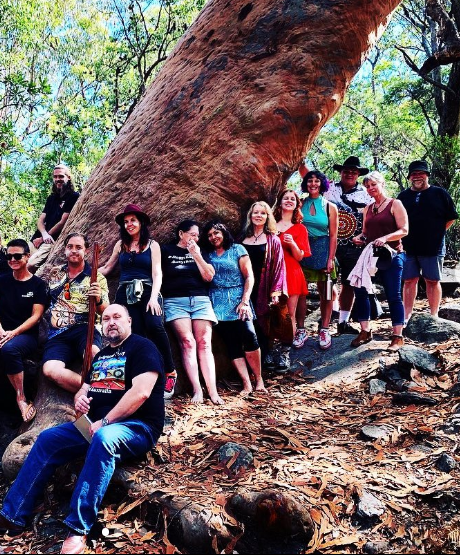
Abstract
Indigenous identity appropriation and fraud, perpetrated by settler-led groups such as the non-Aboriginal GuriNgai cult and the Coast Environmental Alliance (CEA), is not a mere matter of misrepresentation. It is a structural form of violence that undermines cultural continuity, distorts public policy, and contributes to psychological and spiritual harm within Aboriginal communities. This article synthesises evidence from more than forty investigative reports (bungaree.org, 2025a, 2025b; guringai.org, 2025a-c) and draws on suicide prevention frameworks by the Australian Institute of Health and Welfare (AIHW, 2023a) to demonstrate how identity fraud operates as an overlooked determinant of suicide risk.
These settler simulations displace legitimate Aboriginal authority, contaminate statistical data, and weaponize false genealogies and pseudo-rituals to reassert colonial power under the guise of cultural advocacy and environmentalism (Cooke, 2025h).
By integrating insights from Canada and the United States, where Pretendian scandals involving Rachel Doležal, Gina Adams, and others have revealed similar patterns of fraud (Leroux, 2019; Teillet, 2022), we situate Indigenous identity appropriation & fraud as a transnational phenomenon of structural and epistemic violence. The paper concludes with strategic recommendations for statutory verification, policy reform, institutional accountability, and the recognition of identity fraud as a suicide risk factor.
1. Introduction
Suicide remains the leading cause of death for Aboriginal and Torres Strait Islander peoples aged 15-44, with rates three times higher than those of non-Indigenous Australians (AIHW, 2023a). Key protective factors: cultural continuity, self-determination, and culturally safe mental health services, are eroded when settler groups claim fraudulent Aboriginal identities. These impostor groups, often operating under the banner of environmentalism or spirituality, exploit public trust and institutional naivety to position themselves as cultural authorities while sidelining legitimate Aboriginal voices (Cooke, 2025d).
We examine the activities of the non-Aboriginal GuriNgai cult and the Coast Environmental Alliance (CEA), both of which have been extensively documented as engaging in fraudulent genealogical claims, cultic manipulation, and the fabrication of tribal structures such as the so-called “Wannangine Nation” (bungaree.org, 2025a; guringai.org, 2025a-c). These groups weaponize settler fantasies of Indigeneity, performing blackcladding rituals, pseudo-welcome ceremonies, and invented language fragments, all of which have no basis in community recognition or descent-based legitimacy (Cooke, 2025a, 2025e).
The consequences are not merely cultural theft or academic malpractice. Identity fraud contaminates the policy environment, misdirects funding intended for Aboriginal communities, and creates profound spiritual and psychological harm. As Leroux (2019) observes in the North American context, this “white desire for Indigeneity” often arises from settler guilt and a longing to occupy moral authority. In Australia, these dynamics are compounded by a weak verification framework that allows self-identification to substitute for community recognition, leading to widespread statistical distortion and misrepresentation (Watt & Kowal, 2019; Watt et al., 2020).
By analyzing the mechanisms of settler simulation, this article argues that Indigenous identity fraud is a form of structural violence with direct implications for suicide risk and public health. It is a phenomenon that not only re-enacts colonial dispossession but also interferes with cultural grieving, ancestral belonging, and the healing practices critical to Aboriginal wellbeing (Watego, 2021).
2. Settler Simulation and Cultural Harm
Settler simulation refers to the process by which non-Indigenous individuals or groups mimic the symbols, authority, and cultural expressions of Aboriginal identity in order to access legitimacy, power, or material benefit (Cooke, 2025a; Moreton-Robinson, 2015). Unlike conventional cultural appropriation, which typically involves the superficial borrowing of Indigenous aesthetics or practices, settler simulation constructs entire false genealogies, invents tribal nations, and performs mimicries of spiritual authority designed to displace or obscure legitimate Aboriginal governance. These simulations are not accidental misidentifications but deliberate acts of epistemic theft and cultural manipulation that extend the logics of settler colonialism through symbolic fraud.
The GuriNgai group and Coast Environmental Alliance (CEA) exemplify this mode of cultural harm. Both groups have been extensively documented as using blackcladding, that is, the theatrical performance of Aboriginal identity by non-Aboriginal actors, to present themselves as “traditional custodians,” “Elders,” or “traditional bloodline custodians” despite lacking any verified Aboriginal ancestry or community recognition (bungaree.org, 2025a; guringai.org, 2025a-c). These performances rely on invented rituals, faux language fragments, and the strategic misuse of respected names such as Bungaree and Matora to anchor fabricated descent claims in plausible historical figures (Cooke, 2025a; AIATSIS, 2020).
One of the most egregious examples of this harm is the fabrication of a daughter named “Sophy” to Bungaree and Matora, an entirely invented figure used to legitimize a false genealogical descent line through the Charlotte Ashby family (bungaree.org, 2025a; guringai.org, 2025b). This fictional lineage has been used by the GuriNgai Tribal Link Aboriginal Corporation, and affiliated settler cult actors to justify claims of cultural authority, facilitate media appearances, receive awards, and run events such as NYAA WA, a musical ‘film ‘documentary’ that falsely presents its creators as Aboriginal descendants of Bungaree (Cooke, 2025f). These acts are not merely deceptive; they are epistemic violations that misappropriate the sacred cultural memory and responsibilities of legitimate descendants while exploiting widespread institutional hesitancy to challenge Indigenous identity claims due to the chilling effect of Eatock v Bolt (Gelber & McNamara, 2013; Cooke, 2025c).
Settler simulation results in a form of symbolic displacement that interferes with cultural grieving and spiritual continuity. As Watego (2021) argues, Aboriginal wellness is not simply a matter of health service provision but a question of cultural and ontological integrity: of being able to live as Aboriginal people in ways that are socially recognized, spiritually grounded, and politically sovereign. When impostor groups assume the role of “traditional owners” or “knowledge holders,” they usurp the space needed for genuine intergenerational healing, mentorship, and truth-telling. They fracture kinship networks, redirect cultural labor to defend against fraud, and place legitimate community members in a position of perpetual defense against erasure. This is not merely cultural confusion; it is cultural violence.
Moreover, settler simulations distort the historical record. Fabricated nations such as “GuriNgai” and “Wannangine” and invented totemic claims are strategically inserted into ceremonial contexts and media events to simulate continuity and rootedness (guringai.org, 2025c). These appropriations function as simulations in the Baudrillardian sense: they are not just poor copies of Aboriginal culture but symbolic systems that displace the original while masquerading as authentic (Baudrillard, 1994). They hollow out meaning by replacing relationships of descent, recognition, and responsibility with settler fantasies of spiritual legitimacy, ecological purity, and mythic connection.
The cultural harm inflicted by these practices is measurable and enduring. It includes the emotional toll on Aboriginal communities who must continually relive and explain their dispossession. It includes the confusion sown in educational materials, media representations, and public ceremonies where settler-simulated Indigeneity is mistaken for truth. And it includes the systemic erosion of cultural governance, as institutions such as local councils, schools, and arts festivals make decisions based on impostor claims, thereby undermining the authority of legitimate custodians (bungaree.org, 2025b; Cooke, 2025d).
3. Psychological Exploitation and Cultic Harm
Indigenous identity fraud does not only distort policy, data, and cultural authority; it creates coercive psychological environments that exert real harm on individuals and communities. The GuriNgai group and Coast Environmental Alliance (CEA), while presenting themselves as environmental or cultural advocacy organizations, exhibit features consistent with coercive, high-control groups. These features include charismatic leadership, epistemic closure, secrecy, symbolic violence, black-and-white thinking, and emotional manipulation (Lalich, 2004; Hassan, 2016). In this context, psychological exploitation and cultic harm are not incidental but foundational to the simulation’s longevity and power.
Charismatic authority figures such as Tracey Howie, and Jake Cassar have positioned themselves as spiritual intermediaries or protectors of sacred lands, despite lacking verified Aboriginal descent (guringai.org, 2025b; bungaree.org, 2025a). These individuals often cultivate dependency and loyalty through emotional appeals, fabricated mythology, and quasi-religious narratives. For instance, members of the GuriNgai simulation regularly invoke invented ceremonies, prophecies, and spiritual destinies tied to “ancient bloodlines” and “sacred custodianship” (Cooke, 2025f). These narratives are deployed not just to recruit but to isolate followers from critical reflection or external verification, hallmarks of cultic behavior.
Such tactics mirror what Lalich and Tobias (2006) define as “bounded choice”: a condition in which individuals are presented with apparent freedom but are psychologically constrained by dogma, loyalty expectations, and fear of exclusion. Followers are indoctrinated into a worldview in which to question the leader or the group’s claims is to betray the “truth,” the “ancestors,” or the “movement.” Emotional dependency is often reinforced through trauma bonding, a process in which periodic rewards and recognitions are alternated with guilt, shame, or exclusion, thereby deepening psychological control (Freyd, 1996; Hassan, 2016).
This coercive environment disproportionately affects vulnerable individuals, including young people seeking cultural belonging, settlers experiencing “white guilt,” and marginalized people searching for meaning or identity (Leroux, 2019; Cooke, 2025g). The cultic structure exploits these longings by offering fabricated lineage and ritual inclusion as forms of emotional salvation. But this is a counterfeit form of belonging: one that reinforces colonial logics of possession, fantasy, and racial masquerade under the guise of spiritual healing.
In this context, the concept of betrayal trauma becomes particularly salient. Freyd (1996) describes betrayal trauma as the unique psychological harm that arises when trusted figures or institutions inflict abuse while maintaining a façade of care or legitimacy. For Aboriginal communities, settler-led simulations of Indigeneity compound intergenerational trauma by mimicking the very systems of cultural connection, healing, and kinship that colonization sought to destroy. When these are mimicked and manipulated by impostors, the result is not merely hurt; it is retraumatization cloaked in ceremony.
Further, the cultic dynamics of the GuriNgai and CEA groups often lead to the suppression of dissent, the rewriting of genealogical records, and retaliation against whistleblowers. Reports from bungaree.org (2025a, 2025c) document cases where individuals who questioned the group’s legitimacy were ostracized, defamed, or publicly accused of “spreading division.” These forms of epistemic retaliation deepen psychological harm, isolate truth-tellers, and suppress the restoration of cultural integrity.
This pattern is consistent with what cult researchers term “thought-stopping” and “loaded language”: tactics used to prevent independent analysis by replacing dialogue with slogans or moral binaries (Hassan, 2016). Common examples within the GuriNgai simulation include statements such as “the blood knows,” “truth is in your heart,” or “we are the ancient ones returned.” These emotionally charged affirmations displace the need for genealogical evidence, community verification, or critical scrutiny. The result is an environment of myth-based coercion: psychologically immersive, spiritually manipulative, and structurally colonial.
The long-term impacts of these environments are considerable. Individuals enmeshed in cultic identity simulations report symptoms consistent with complex trauma, including identity confusion, derealization, anxiety, and loss of social trust (Lalich & Tobias, 2006; Cooke, 2025h). In Aboriginal communities, these effects are magnified by the necessity of defending kinship, cultural knowledge, and sovereign identity against systemic impersonation. The psychological burden of constantly confronting fraud while preserving cultural healing spaces is itself a form of structural oppression.
Thus, settler-led Indigenous identity fraud is not only an ethical and cultural violation; it is a mental health issue and a public health crisis. It requires recognition not simply as misrepresentation, but as a form of coercive abuse that produces measurable psychological distress, especially in contexts already saturated with intergenerational trauma and dispossession.
4.1 Policy Distortion
The widespread phenomenon of Indigenous identity fraud in Australia, particularly when performed by settler groups such as the GuriNgai and Coast Environmental Alliance, undermines not only cultural and psychological wellbeing, but also the integrity of public policy and resource distribution. At its core, policy distortion occurs when impostor identities are treated as legitimate participants in Aboriginal-specific programs, consultations, and funding mechanisms, thereby diverting institutional attention, material support, and cultural authority away from authentic Aboriginal communities (bungaree.org, 2025a; Cooke, 2025e).
The structural foundation of this distortion is Australia’s current reliance on a three-part definition of Aboriginality: descent, self-identification, and community recognition. However, as numerous commentators and statutory bodies have noted, this framework is vulnerable to exploitation when institutions emphasize self-identification while failing to verify descent or community recognition (AIATSIS, 2020; Watt & Kowal, 2019). This imbalance has allowed non-Aboriginal individuals and settler cults to falsely claim Aboriginal identity and gain access to policy forums, employment opportunities, and decision-making spaces reserved for Indigenous peoples (bungaree.org, 2025a; Teillet, 2022).
Impostor groups often present themselves as “the rightful custodians,” especially in contentious domains such as land use, heritage assessment, and environmental development. In the Central Coast region of NSW, for example, the non-Aboriginal GuriNgai group has been repeatedly included in council-led consultations on Aboriginal heritage and land management, despite being excluded from statutory Aboriginal Land Council networks (guringai.org, 2025a-c). This creates a false equivalence between legitimate Aboriginal organizations, such as Darkinjung LALC or Metropolitan LALC, and settler simulations, undermining the authority of bodies grounded in legal recognition and cultural legitimacy (Cooke, 2025b).
The consequence is what might be called epistemic parity by deception: settler simulations are granted equal consultative standing in policy forums through performance, repetition, and institutional hesitation. This is particularly damaging in contexts such as cultural heritage protection, where impostor groups block or delay development proposals under the guise of Aboriginal sovereignty, only to later collaborate with commercial or environmental actors whose agendas directly conflict with genuine community priorities (bungaree.org, 2025b; Cooke, 2025d).
Another key area of distortion is the funding of cultural programs. Impostor individuals and groups have accessed grant money, artist residencies, and public commissions earmarked for Aboriginal people, including through national arts and music institutions. In the case of NYAA WA, the musical film produced by the non-Aboriginal duo “Charlie Needs Braces,” multiple awards, promotional placements, and screening invitations were granted under the false premise of Aboriginal identity and cultural authorship (bungaree.org, 2025c; Cooke, 2025f). The result is not just an injustice in funding allocation, but a reputational risk for institutions that unwittingly legitimize identity fraud.
In education, policy distortion manifests through impostor individuals being hired to teach Indigenous studies, provide “cultural safety” workshops, or advise on curriculum development. As has occurred in Canada with the hiring of false Métis or “Indigenous” academics (Leroux, 2019; Teillet, 2022), Australian institutions risk embedding misinformation into policy, pedagogy, and professional development. This epistemic contamination compounds the problem: future generations are taught fraudulent lineages, simulated nations, and settler-fabricated cosmologies as if they were legitimate Indigenous knowledge systems.
Policy distortion also contributes to public confusion and erodes institutional trust. When media outlets or government departments promote false narratives of Aboriginal identity, they not only compromise their own credibility; they feed into a cycle of performative reconciliation that privileges settler comfort over Aboriginal truth (Moreton-Robinson, 2015). This dynamic helps explain the persistence of groups like the GuriNgai even after widespread exposure: policy structures and public discourse are not yet equipped to differentiate between legitimate Aboriginal sovereignty and settler simulation.
Ultimately, identity fraud is not an isolated cultural offense; it is a policy issue. It creates misdirection, inefficiency, and injustice in the allocation of resources, the consultation of communities, and the implementation of programs. Any serious reform of Indigenous affairs in Australia must reckon with the structural vulnerability of current frameworks to simulation and fraud, and must invest in statutory mechanisms of verification that prioritize descent, community recognition, and cultural continuity.
4.2 Statistical Sabotage
Indigenous identity fraud does not merely distort policy processes and funding allocation; it sabotages the statistical foundations of Aboriginal affairs in Australia. Government programs such as Closing the Gap, Aboriginal health strategies, and community service delivery rely on accurate population data to track disadvantage, assess need, and measure progress. When non-Aboriginal individuals falsely self-identify as Indigenous, especially in the census, administrative datasets, and institutional reporting mechanisms, they corrupt these datasets at the source, creating what can be described as statistical sabotage (bungaree.org, 2025a; Cooke, 2025b).
The integrity of Indigenous statistics in Australia is already fraught with challenges, including undercounting, inconsistent definitions across agencies, and the complexities of mobility and remote registration (AIHW, 2023b). However, the more recent issue of overcounting due to fraudulent or opportunistic self-identification has received comparatively little policy attention. As Watt and Kowal (2019) explain, the dramatic increase in self-identified Aboriginal and Torres Strait Islander populations, often concentrated in urban areas, cannot be fully explained by birth rates, changing attitudes, or improved enumeration. Rather, this surge is increasingly driven by what scholars term race-shifting: the strategic (and sometimes opportunistic) adoption of an Indigenous identity without verified descent or community recognition (Teillet, 2022; Leroux, 2019).
This trend is particularly visible in metropolitan and peri-urban regions such as the Central Coast, Northern Beaches, and Sydney’s north shore, areas where GuriNgai cult actors have actively encouraged settler followers to “reclaim” or “awaken” a spiritual Aboriginal identity (guringai.org, 2025a-b). These pseudo-Indigenous affiliations are then reported in census forms, school enrollments, grant applications, and workplace diversity statistics. Once entered into administrative data systems, these fraudulent claims become statistically indistinguishable from verified Aboriginal identities unless cross-checked against genealogical records or community verification processes.
The implications are profound. Misclassified data distorts indicators used to track Indigenous disadvantage and policy success. For example, if settler individuals with higher education levels, stable employment, or suburban housing identify as Aboriginal, this lifts average socioeconomic indicators for the Aboriginal population and can create a false narrative of progress (bungaree.org, 2025b; AIATSIS, 2020). This undermines the policy rationale for targeted support and may lead to reductions in funding or service provision to communities in genuine need.
Furthermore, statistical sabotage creates policy “noise” that masks the specific needs of distinct cultural and geographic groups. Urban settlers claiming a fabricated GuriNgai identity have no connection to the area or Aboriginal peoples. Yet their self-identification feeds into data that is then used to inform decisions affecting these communities. This erodes the cultural specificity of Aboriginal policy frameworks and replaces it with a pan-Indigenous abstraction more reflective of settler fantasy than community reality (Cooke, 2025e; Watego, 2021).
There is also a data justice dimension to this sabotage. As Indigenous data sovereignty scholars have argued, Aboriginal people must have control over the data collected about them, including how identity is defined, verified, and operationalized (Kukutai & Taylor, 2016; Rainie et al., 2017). Fraudulent self-identification not only corrupts statistical integrity; it violates the principle of Indigenous data governance by allowing non-Indigenous individuals to define themselves into a dataset meant to empower Indigenous self-determination.
Compounding the issue is institutional hesitancy to verify identity claims, driven in part by fears of repeating the perceived injustices of Eatock v Bolt or of being accused of racism. As a result, census administrators, arts bodies, and educational institutions often accept declarations of Indigeneity at face value without verification (Gray, 2012; bungaree.org, 2025c). The GuriNgai and their affiliated settler networks have exploited this gap, enabling wide-scale statistical infiltration and epistemic manipulation.
The sabotage is not hypothetical; it is measurable. Cooke (2025d) documents instances where GuriNgai cult members inflated their numbers to claim they were the largest “tribe” on the Central Coast. These fabrications were then repeated in council documents, media reports, and grant justifications, creating a feedback loop in which statistical lies became institutional truth. Such loops cannot be undone without rigorous audit, statutory verification, and the restoration of cultural governance.
In short, statistical sabotage erodes the empirical foundation upon which Aboriginal policy is built. It inflates success, masks need, and displaces community authority. Addressing this requires not just better data methods but institutional courage to name and challenge identity fraud where it occurs.
5. Suicide Risk, Grief Interference, and Cultural Disruption
Indigenous identity fraud is not only a matter of cultural harm, policy failure, or data corruption. It contributes directly and indirectly to suicide risk and the disruption of cultural grieving processes, particularly among Aboriginal individuals and communities subjected to identity theft, erasure, and betrayal. This section outlines the psychological and spiritual pathways through which settler simulations, such as those conducted by the non-Aboriginal GuriNgai group, generate trauma, interfere with healing, and exacerbate vulnerabilities related to self-worth, cultural continuity, and mental wellbeing.
Suicide among Aboriginal and Torres Strait Islander people in Australia remains a public health crisis. According to the Australian Institute of Health and Welfare (AIHW, 2023a), suicide rates for Aboriginal peoples are more than double those of non-Indigenous Australians, with young people disproportionately affected. While structural drivers such as poverty, racism, and intergenerational trauma are well-established risk factors, cultural continuity has been consistently shown to function as a protective factor (Chandler & Lalonde, 1998; Watego, 2021). The disruption of cultural authority, kinship systems, and identity by settler impostor groups must therefore be understood not as peripheral, but as contributing to suicide vulnerability through a form of epistemic sabotage.
Settler simulations such as the GuriNgai perform a kind of spiritual occupation. They insert false actors into ceremonial spaces, misappropriate ancestral names, and host cultural events that mimic sacred practice while displacing those with legitimate cultural rights and responsibilities (bungaree.org, 2025a; Cooke, 2025f). This disruption generates what Cooke (2025e) refers to as grief interference: the intrusion of fraudulent presences into spaces of mourning, remembrance, and cultural restoration. When Aboriginal people must defend their identity or prove their descent in response to settler simulation, their grieving processes are interrupted by demands for resistance, clarification, or bureaucratic self-exposure. The trauma of loss is compounded by the trauma of misrecognition.
These effects are not abstract. Community testimonies submitted to bungaree.org (2025a) detail how the false descent claims of the Woods-Hird family and the broader GuriNgai cult have disrupted community funerals, cultural events, and healing ceremonies. In one case, a genuine descendant of Bungaree recounted the retraumatization caused by seeing her ancestor’s name misused by a musical act that claimed to speak for her lineage, despite having been notified of the genealogical fraud. In another, Elders expressed the emotional weight of having to repeatedly refute lies in public, while watching those lies gain institutional traction. These are forms of cumulative grief that cannot be addressed through standard mental health interventions, because they are epistemic and spiritual in nature.
The cultic dimension of impostor Indigeneity compounds these harms by creating high-control environments where disinformation, secrecy, and emotional manipulation undermine critical thinking and isolate individuals from authentic support networks (Lalich & Tobias, 2006; Hassan, 2016). Those drawn into these environments, whether Aboriginal or non-Aboriginal, may find themselves alienated from kin, mistrustful of community institutions, or uncertain about their own cultural standing. These dynamics intersect with mental health risk factors such as shame, identity confusion, and cultural dislocation.
Moreover, legitimate Aboriginal people who challenge impostor claims often face public hostility, institutional gaslighting, or accusations of lateral violence. This deepens what Watego (2021) terms colonial harm fatigue: the exhaustion that comes from having to survive and respond to an unending series of settler intrusions into Aboriginal life. When Aboriginal people are forced to prove their identity while frauds are welcomed without scrutiny, a profound moral injury occurs. This injustice can erode self-worth, fuel despair, and contribute to the psychosocial burdens that heighten suicide risk.
The impact extends beyond individuals to cultural systems. Knowledge transmission is disrupted when impostors are placed in roles as “teachers,” “Elders,” or “custodians.” Youth are exposed to fabricated narratives, performative rituals, and romanticized versions of culture designed for settler consumption rather than cultural survival (Cooke, 2025g). This weakens epistemic confidence and severs young Aboriginal people from their rightful inheritance.
To understand identity fraud as a contributor to suicide risk is to recognize that culture is not decorative; it is vital. When culture is distorted, erased, or impersonated, its protective function is compromised. Healing is not possible where truth is displaced by simulation. Suicide prevention in Aboriginal contexts must therefore include the defense of cultural sovereignty, the removal of impostor identities from sacred and policy spaces, and the institutional validation of grief as a legitimate response to cultural betrayal.
6. Institutional Complicity and Epistemic Failure
The persistence and proliferation of Indigenous identity fraud in Australia, particularly by settler cult groups such as the GuriNgai and Coast Environmental Alliance, is not solely a consequence of individual deceit or community vulnerability. It is made possible by systemic institutional complicity and epistemic failure. Schools, universities, councils, arts bodies, museums, and media outlets have all, at various times, failed to exercise due diligence in verifying claims of Indigeneity, enabling settler simulations to masquerade as cultural authority. This section addresses how institutions, through omission, error, and fear, have facilitated the rise of fraudulent identities and the accompanying harms.
The failure begins with verification. In many cases, institutions have accepted declarations of Aboriginality without checking for descent-based evidence or community recognition. This occurs across multiple domains: education departments employing false “Elders” or cultural consultants, arts organizations awarding grants to fraudulent applicants, and councils consulting non-Aboriginal groups on matters of Aboriginal heritage. The reliance on self-identification, in the absence of verification protocols, reflects a misunderstanding of Indigenous identity as an individual psychological attribute rather than a collective, relational, and genealogically grounded status (AIATSIS, 2020; Watego, 2021).
This failure is often driven by fear: fear of legal repercussions, fear of being labeled racist, or fear of entering the complex and sensitive terrain of Aboriginal identity politics. The 2011 Eatock v Bolt decision, while rightly identifying vilification, has had a chilling effect on public discourse about identity fraud. Institutions have internalized the idea that questioning identity is inherently discriminatory, even when the question arises from a duty to protect Aboriginal cultural integrity and statutory representation (Gray, 2012; Tate, 2016). As a result, impostor groups flourish in the space created by institutional silence.
In some cases, institutions have gone beyond omission and entered the realm of collaboration. Media platforms such as Coast Community News (CCN) have repeatedly amplified the voices of fraudulent actors, including the GuriNgai and affiliated campaigners, without verifying their identity or reporting the widespread opposition to their claims from legitimate Aboriginal bodies (guringai.org, 2025c; bungaree.org, 2025b). Such coverage not only normalizes impostor narratives but legitimizes them through repetition and public visibility. Once published, these articles are cited by other entities, councils, funding bodies, festival organizers, as evidence of legitimacy, creating a recursive feedback loop of fraud validation.
Universities and researchers have also played a troubling role. In particular, some non-Aboriginal scholars have constructed or supported genealogical myths through uncritical historiography, the elevation of fabricated oral histories, or reliance on discredited sources. In the case of the GuriNgai, the genealogical fraud involving “Sophy” and “Charlotte Ashby” has been reproduced in theses, museum exhibitions, and curricula, despite conclusive refutation by primary documents and community testimony (bungaree.org, 2025d; Cooke, 2025c). When scholarship is co-opted into simulation, it ceases to be research and becomes epistemic laundering: the washing of falsehood through the apparatus of academic authority.
Complicity also manifests in arts and culture institutions. The film NYAA WA, produced by Charlie Needs Braces, was accepted into multiple festivals and supported by grants on the basis of its purported Aboriginal authenticity. Despite warnings from Aboriginal community members, the film continued to be promoted as an Indigenous cultural product until public exposure led to its removal from at least one festival (bungaree.org, 2025c). The failure to act sooner represents a refusal to listen to Aboriginal voices and to uphold the principle of informed consent in cultural representation.
What links these failures is an epistemic double standard: Aboriginal people must continually prove and defend their identity, while settlers are believed without scrutiny if they speak in the right tone, wear the right symbols, or perform the right rituals. This double standard is a colonial residue. It reflects the ongoing authority of whiteness to define Indigeneity, even in error, while denying Aboriginal people the right to safeguard their own epistemologies.
Institutional reform is both necessary and possible. It begins with the development of rigorous identity verification protocols grounded in community authority and cultural governance. It includes the application of due diligence procedures for grants, consultancies, and public appointments. It requires media ethics policies that reject platforming fraudulent claims, and academic standards that reject genealogical fabrication. Above all, it demands a shift in institutional culture: from fearful avoidance to accountable engagement.
Impostor Indigeneity is not a fringe issue. It is a systemic one, reproduced and validated by institutional inertia. Without reform, institutions risk becoming co-conspirators in cultural theft, policy distortion, and the erasure of Aboriginal sovereignty.
7. Recommendations for Reform
Addressing the cultural, psychological, institutional, and policy harms of Indigenous identity fraud requires a multi-level reform agenda grounded in Indigenous self-determination, statutory verification, and epistemic justice. The following recommendations draw from the preceding analysis and from community-based proposals articulated in platforms such as bungaree.org and guringai.org, along with contributions from scholars, statutory authorities, and frontline Aboriginal organizations. These recommendations target key institutional domains and are oriented toward practical, systemic change.
7.1 Statutory Identity Verification
Government bodies at all levels must implement statutory identity verification processes based on descent, community recognition, and cultural continuity. While the current three-part definition of Aboriginality remains a useful foundation, its application must be rigorous, and not reduced to self-identification alone. Verification should be managed through independent Aboriginal-controlled entities, such as Local Aboriginal Land Councils (LALCs) or recognized community governance structures, to ensure cultural legitimacy and to prevent state overreach into Indigenous affairs (AIATSIS, 2020; bungaree.org, 2025a). Such protocols are especially urgent in contexts involving funding, public appointments, and cultural representation.
7.2 Institutional Duty of Diligence
All institutions, especially councils, universities, museums, schools, and media organizations, must adopt a formal duty of diligence when engaging with individuals or groups claiming Aboriginal identity. This includes verification of descent-based claims, checking for current community affiliation, and consulting with relevant statutory Aboriginal bodies before offering platforms, grants, or consultative roles. Institutional negligence should no longer be shielded by plausible deniability or fear of controversy. As part of this reform, institutions should develop internal guidelines and staff training informed by Aboriginal governance bodies.
7.3 Cultural Governance and Sovereignty Recognition
Aboriginal cultural authority must be embedded as a foundational principle across all levels of engagement. This requires recognizing the authority of established Aboriginal organizations, including LALCs, Native Title groups, and culturally mandated Elders, rather than deferring to self-appointed individuals or settler-constructed “nations” with no basis in cultural governance. Where contested identity claims arise, institutions must defer to the legitimate and recognized cultural governance of the area, not to fabricated genealogies or pseudohistorical constructs (bungaree.org, 2025b; Cooke, 2025b).
7.4 Media Accountability and Ethical Standards
Media platforms must adopt and enforce policies that prohibit the uncritical promotion of identity fraud. Editorial teams should be trained in the ethics of Indigenous representation and instructed to verify Aboriginality through trusted sources before publishing claims of cultural authority. This includes refusing to amplify false “custodians,” correcting previously published misinformation, and giving voice to Aboriginal organizations that challenge impostor narratives (bungaree.org, 2025c; guringai.org, 2025a). Investigative reporting should be resourced and protected when it seeks to expose fraud grounded in evidence.
7.5 Educational and Academic Reform
Universities, schools, and research institutions must cease the inclusion of fabricated genealogies or fraudulent identity narratives in curricula, research projects, and public education programs. Peer review processes must include cultural verification checks when claims of Aboriginality form the basis of scholarly authority. An independent Aboriginal ethics body should be consulted when research involves genealogical claims, ancestral lineages, or assertions of custodianship (AIATSIS, 2020; Cooke, 2025c). This reform also entails auditing and removing discredited theses or exhibitions from public circulation.
7.6 Suicide Prevention and Cultural Healing
Suicide prevention strategies for Aboriginal people must include recognition of grief interference, cultural betrayal, and impostor trauma as risk factors. This includes funding programs led by legitimate Aboriginal communities to address the harms caused by identity fraud, repair trust, and restore cultural continuity. Mental health services must be culturally safe, trauma-informed, and prepared to acknowledge that identity theft and simulation can cause spiritual and emotional injury (AIHW, 2023a; Watego, 2021).
7.7 Restoration and Restitution
Institutions that have platformed, funded, or legitimized impostor groups must make public acknowledgements of error and engage in cultural restitution. This includes revoking falsely obtained grants, issuing apologies, returning awards, and removing fraudulent individuals from advisory roles. Cultural healing must include repair, not only for those deceived by impostors but for the Aboriginal communities harmed by their displacement.
7.8 National Inquiry into Identity Fraud and Simulation
Finally, a national inquiry should be established to investigate the scale and systemic impact of Indigenous identity fraud in Australia. Such an inquiry should be led by an independent panel of Aboriginal experts, with powers to compel evidence, review genealogical records, document harm, and recommend statutory reforms. The inquiry should examine case studies including the GuriNgai, the Eatock v Bolt chilling effect, and institutional complicity across education, media, and government. Its aim should be the protection and restoration of Indigenous sovereignty, data integrity, and epistemic justice.
8. Conclusion
Indigenous identity fraud is not a marginal aberration or a benign mistake. It is a structural act of simulation that distorts cultural truth, harms communities, corrupts data, sabotages policy, and undermines Aboriginal sovereignty. As this report has demonstrated, the rise of settler impostor groups such as the non-Aboriginal GuriNgai is made possible not merely by individual deceit, but by institutional complicity, policy blind spots, and a profound failure to understand Aboriginal identity as genealogically and communally grounded. The harms are multidimensional: cultural, psychological, institutional, epistemic, and they are ongoing.
Cultural harm occurs when sacred names, lineages, and practices are appropriated by those with no right to them. Psychological harm arises when Aboriginal people are forced to witness or refute impostor claims in spaces meant for healing and ceremony. Institutional harm occurs when governments, schools, universities, and media outlets platform and fund fraudulent identities without due diligence. Epistemic harm arises when lies are laundered into truth through repetition, citation, and academic or artistic legitimacy.
Most gravely, these combined harms contribute to suicide risk, cultural grief interference, and the breakdown of trust within and across Aboriginal communities. When Aboriginal people must constantly prove who they are, while frauds are celebrated for who they are not, a deep psychic wound is opened. This is not simply an identity dispute; it is a crisis of justice, recognition, and survival.
The Australian nation-state has an obligation to protect the integrity of Aboriginal identity and to support the cultural, legal, and spiritual frameworks through which identity is known and transmitted. This requires institutional reform, media accountability, genealogical truth-telling, and the political courage to name fraud when it occurs. It requires the restoration of Aboriginal authority, the repair of stolen knowledge, and the removal of impostor voices from policy, pedagogy, and ceremony.
This report has advanced a framework for understanding Indigenous identity fraud not as isolated deception but as settler simulation: a patterned displacement of truth by mimicry, facilitated by epistemic double standards and institutional cowardice. Redressing these harms begins with recognizing that cultural authenticity is not found in performance, affect, or aesthetics, but in ancestry, community, and relational accountability.
We cannot close the gap if the gap itself is simulated. We cannot heal if our grief is hijacked. We cannot protect culture if we refuse to protect identity. And we cannot tell the truth about this country unless we are willing to expose the lie.
JD Cooke.
 A Long Con, Gone on Too Long.
Leave a reply to Charlie Needs Braces: Cultural Misrepresentation of the GuriNgai Simulation – Bungaree.org Cancel reply