
Introduction
This exegesis provides a comprehensive, chapter by chapter critical analysis of The Cave by Jake Cassar, situating the text within the intersecting domains of eco spiritual mythmaking, conspirituality, settler simulation, high demand group dynamics, and the ongoing appropriation of Indigenous cultural forms in Australia. While framed as fiction, The Cave operates as a mythopoetic extension of Cassar’s public persona and ideological commitments. The narrative constructs a subterranean cosmology that positions its protagonist as a chosen intermediary between hidden ancestral forces and a corrupted human world, thereby reflecting the core narrative patterns of charismatic leader formation and spiritual exceptionalism documented in contemporary cultic studies and radicalisation research.
We approach the text through a forensic interpretive lens, examining not only the narrative content but also the symbolic, psychological, and sociopolitical functions embedded within the story. Each chapter is treated as a structural component in a larger ideological architecture designed to cultivate awe, trauma bonding, spiritual dependency, and belief in a metaphysical destiny centred on the protagonist. Across the narrative, recurring motifs such as abduction, initiation, prophecy, cosmic struggle, and moral dualism reveal a coherent system of meaning that parallels the operational methods of high demand groups and new age conspirituality movements.
A critical focus of the exegesis is the text’s extensive use of Indigenous coded metaphysics, ceremony, vocabulary, and narrative functions. Terms such as Yar Way and Baah Boraahk, along with structural parallels to Aboriginal initiation grounds and ancestral cosmologies, are repurposed into a synthetic subterranean mythology that removes these concepts from their cultural, legal, and relational contexts. This displacement aligns with the broader mechanisms of settler simulation identified in analyses of Cassar’s activism, wherein fabricated or hybridised spiritual systems function to overwrite or replace genuine Aboriginal sovereignty. The Cave therefore operates as both a literary product and as a cultural mechanism that legitimises non Aboriginal authority over spiritual, ecological, and custodial narratives.
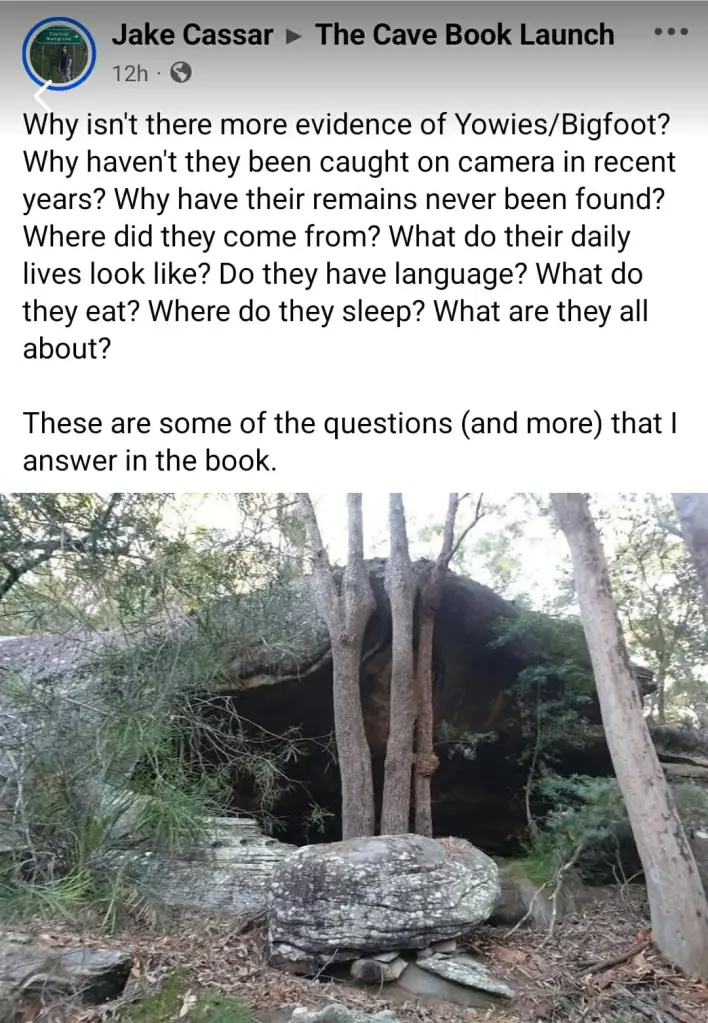
The exegesis is additionally informed by the extensive corpus of forensic reports examining Cassar’s involvement in the Coast Environmental Alliance, the Campfire Collective, and GuriNgai aligned identity manufacturing networks. These analyses highlight how The Cave reinforces conspiratorial narratives of institutional corruption, ecological collapse, and spiritual warfare that underpin Cassar’s public messaging. They further reveal the text’s role as a mythic blueprint for ecofascist rhetoric and anti Aboriginal political mobilisation, where environmental protection is reframed as a battle requiring spiritual warriors rather than democratic, Aboriginal led governance.
By contextualising the narrative within these frameworks, we demonstrate that The Cave cannot be understood solely as fictional entertainment. It is a strategic artefact produced within an ecosystem of cultural appropriation, political disinformation, charismatic identity construction, and settler mysticism. Its subterranean mythology operates as a symbolic justification for Cassar’s real world activities, enabling the consolidation of spiritual authority, the amplification of conspiracist belief systems, and the continued displacement of Aboriginal sovereignty in the Central Coast and Northern Sydney regions.
The following chapters therefore examine The Cave not only as a narrative text but as an ideological instrument. Through systematic exegesis, the analysis reveals the mechanisms by which Cassar constructs mythic legitimacy, cultivates affective resonance, merges spirituality with activism, and embeds appropriated cultural motifs into a high stakes narrative of cosmic conflict. The result is an integrated critical understanding of The Cave as a work that participates actively in the broader landscape of Australian identity fraud, settler nativism, and conspiritual political mobilisation.
FOREWORD
The foreword to The Cave operates as a framing device that seeks simultaneously to authorise the narrative and to establish a particular relationship between the reader and the narrator. Cassar presents an affective origin story rooted in suffering, emotional collapse, and an existential crisis. His tone echoes conversion narratives found across new age spiritual literature, where a moment of despair opens the protagonist to revelatory experience. In this sense, the foreword uses the rhetoric of autobiographical authenticity to prepare the reader for accepting subsequent fantastical events as symbolically, emotionally, or spiritually true.
Cassar positions himself as a person who has experienced pain and loss yet emerged with insight by entering a cave. This spatial metaphor is ancient, seen in Plato’s cave allegory, Aboriginal initiation caves, Christian monastic desert caves, and contemporary self help pilgrimage narratives. Cassar aligns himself with this lineage, implying that his own cave encounter is another iteration of the universal archetype of descent and transformation. The absence of cultural context is notable, since cave based initiations within Aboriginal traditions are specific, relational, and governed by community authority. Cassar’s foreword abstracts these traditions into a generic spiritual template. This is significant because it anticipates the book’s later patterns of adopting Aboriginal motifs and linguistic forms without genealogical or cultural grounding. The critical reading recognises that the foreword lays the ideological foundation for such appropriation by presenting the cave as an open, borderless spiritual realm rather than a culturally bounded site of ceremony.
The emotional appeal in the foreword is designed to produce sympathy and identification. Cassar recounts feeling broken, defeated, and directionless. He describes the cave experience as not only transformative but salvific. This establishes an asymmetrical power dynamic with the reader. Those who accept the emotional sincerity of the narrator may be more inclined to accept the mythic revelations that follow. In literary terms, this is a contractual foreword: the author promises transformation, and the reader is invited to receive it. In cultic studies, such openings are often termed vulnerability preambles, where the leader shares their own suffering as a gateway to introducing exceptional insight. This technique is commonly documented in the literature on new religious movements and hybridised spiritualities that merge ecological concern with mysticism.
Cassar’s language also subtly elevates his experience above ordinary human encounters. He suggests that the revelations he received in the cave gave him a deeper understanding of himself and the world. The implication is that he now sees with clarity unavailable to others who have not undergone similar trials. This is the beginning of a hierarchy that becomes explicit in later chapters through characters like Yar Way, Gymea, and Pee Dar, who introduce the idea of chosen individuals and privileged access to spiritual truth. Although the foreword maintains a tone of gratitude and humility, the underlying narrative structure positions Cassar as someone uniquely initiated. Such positioning foreshadows the book’s broader agenda of constructing a mythic identity for the author, one that grants authority within environmental activism, survivalist subcultures, and the para spiritual communities that follow his public work.
A critical examination of the foreword must also consider the rhetorical absence of Aboriginal custodianship, despite the book’s extensive borrowing of Indigenous sounding names, cosmologies, and relational metaphors. Cassar claims personal revelation but does not acknowledge the cultural traditions whose aesthetics, motifs, and spiritual frameworks he draws upon. This absence sets a precedent for the later text, where the invented lexicon (Aarkiin, Epu Gogu, Waraahn Jeena, Daan Darah, Baah Boraahk) mimics Aboriginal language structures without attribution or permission. From a critical Indigenous studies perspective, such a foreword enacts a displacement. It removes real Indigenous cosmologies from their cultural location and replaces them with settler authored mythopoesis. Cassar’s emotional sincerity therefore operates within a larger dynamic of symbolic appropriation.
The foreword also performs anticipatory self defence. By emphasising the emotional truth of his encounter rather than its empirical verifiability, Cassar pre emptively reframes any challenge as a failure of the critic to understand the spiritual nature of his experience. This creates an interpretive shield. If the story is questioned, it can be defended as metaphor. If taken as metaphor, it can be defended as spiritually true. This rhetorical flexibility is characteristic of contemporary conspirituality literature, where narratives oscillate between literal and symbolic registers as needed to maintain credibility. The foreword therefore not only introduces the story but constructs the epistemic conditions under which the story must be read.
The final key function of the foreword is to humanise the narrator before he begins to depict himself as a heroic figure who encounters supernatural beings, survives extreme trials, and is selected for a unique destiny. By anchoring the narrative in vulnerability, Cassar provides the emotional scaffolding that allows for his later transformation into a quasi mythic figure. This arc from despair to revelation mirrors the pathways often seen in survivalist fantasy literature, yet the foreword situates it as autobiography. This blending of genres is deliberate. It encourages readers to interpret the ensuing narrative simultaneously as fiction, allegory, and spiritual truth.
At a structural level, the foreword introduces the book’s central tension. It asks the reader to hold empathy for a man experiencing grief while accepting that his inner transformation grants him special insight into hidden realms. This tension is sustained throughout the text, where the ordinary self coexists with a figure increasingly framed as chosen by supernatural beings. The foreword is therefore essential for understanding how the narrative constructs authority. It presents vulnerability not only as a condition for revelation but as evidence of its legitimacy. For the critical reader, this signals how the text will continually negotiate between emotional authenticity and the construction of mythic authority that underpins the book’s broader ideological work.
CHAPTER TWO EXEGESIS: THE RAVEN
Chapter Two, titled The Raven, establishes the foundational symbolic grammar of the entire narrative. Cassar situates the protagonist at a psychological and spiritual nadir, seated in darkness and despair, when the raven appears as an agent of interruption. This chapter functions as the archetypal threshold moment in myth, marking the crossing from the ordinary world into the liminal domain where transformation becomes possible. The raven’s arrival is presented as both improbable and inevitable. Cassar uses descriptive cues to frame the encounter as uncanny, purposeful, and synchronous, thereby preparing the reader to accept subsequent supernatural events as extensions of a logic initiated here.
Ravens occupy a complex symbolic position across global traditions. In Norse mythology, they serve as the extensions of Odin’s consciousness. In many Western esoteric systems, they herald shadow work and confrontation with the unconscious. Within some Aboriginal stories, corvids play roles as tricksters, messengers, or transformers, although their specific meanings differ by language group and cultural lineage. Cassar does not reference any Indigenous law or relational context yet relies on the raven’s mythic familiarity to create an atmosphere of spiritual significance. This extraction of a cross cultural symbol from its cultural moorings allows Cassar to deploy the raven as a universalised archetype that transcends particular traditions. The result is a symbolic hollowing in which the raven becomes a spiritually flavoured narrative device rather than a culturally located being. This is important for a critical reading because it foreshadows the book’s later pattern of creating invented supernatural beings with phonetic qualities reminiscent of Aboriginal languages while divorcing them from Indigenous law.
The raven’s behaviour in this chapter is intentionally ambiguous. Cassar describes the bird as unusually attentive to the protagonist, turning its head with humanlike curiosity and meeting his gaze with what he describes as unsettling intelligence. The protagonist experiences physiological responses that signal more than coincidence. He feels warmth, resonance, recognition, and a subtle emotional shift that alleviates the heaviness of despair. These reactions mirror the phenomenology described in new age literature concerning animal messengers or spirit allies. Cassar leans into this framework without naming it, allowing the reader to interpret the raven as either literal or symbolic. This dual function is essential to conspiritual narratives, where symbolic readings preserve credibility when literal ones strain plausibility.
A significant thematic feature of the chapter is the construction of destiny. The raven is not merely present but appears to beckon. Cassar describes how the protagonist follows it almost instinctively, as if drawn by an external intelligence that knows a path he does not. The author uses this dynamic to shift the protagonist from passivity to responsiveness. He transitions from despairing immobility to movement, both physical and symbolic. The raven therefore becomes the catalyst for agency, guiding him toward the cave and, metaphorically, toward his latent identity. This reactivation of agency through supernatural intervention is consistent with what anthropologist Tanya Luhrmann identifies as self authorising encounters in contemporary mysticism, where individuals interpret internal impulses as messages from external beings. Cassar frames the raven’s presence similarly, as a guide whose intentions are benevolent and whose appearance is timed with emotional necessity.
The environmental context in this chapter is described with emphasis on darkness, cold air, and the quiet pressure of the natural world. Cassar uses these sensory descriptions to create an atmosphere that is simultaneously oppressive and pregnant with possibility. The forest becomes a space of revelation rather than fear. This aestheticisation of wilderness aligns with his broader public persona as a bushcraft instructor who portrays nature as a site of spiritual instruction. Within the narrative, this emphasis frames the protagonist as someone uniquely attuned to the more than human world. The raven, in this reading, selects him not by chance but because he possesses an intuitive relationship with nature. The selectivity implicit in the raven’s behaviour supports the mythic logic of the chosen one, a recurring trope in hero narratives globally, from Indigenous initiation cycles to European folklore. Cassar, however, positions this selection outside any relational accountability structures, substituting a solitary revelation for a communal process.
Symbolically, the raven serves as the psychopomp. In Jungian terms, the psychopomp mediates between consciousness and the unconscious. In many mythic cycles, it guides the initiate across the boundary between the living world and the world of spirits or ancestors. The cave in this book functions as a symbolic underworld, and the raven becomes the guide who leads the protagonist into it. Cassar describes the bird stopping, looking back, and seeming to encourage him to continue deeper into the forest. This moment marks the irreversible step across the threshold. Once the protagonist follows the raven, he commits himself to the path of transformation. Narrative theorist Joseph Campbell describes this moment as the crossing of the first portal, where the hero leaves the familiar and enters the unknown. Cassar appropriates this monomythic structure but recalibrates it for a hybrid of survivalist fantasy and self help allegory.
From a critical Indigenous studies perspective, the raven’s function is also a settler spiritualisation of Country. Instead of being accountable to real cultural custodians, the protagonist is authorised by a universalised animal spirit. This bypassing of Indigenous authority structures is a hallmark of settler esotericism, where non human beings are framed as the legitimate teachers of spiritual law, thereby allowing the author to claim connection to land based knowledge without relational accountability. Cassar’s narrative positions the raven as an alternative to Elders, implying that nature itself selects and teaches him. This symbolic displacement undergirds the later appearance of beings with faux Indigenous linguistic markers who further validate his transformation.
The chapter concludes with the protagonist entering the cave, a moment described with tension, awe, and a sense of inevitability. The raven does not accompany him inside but remains at the boundary. This is consistent with symbolic traditions where the psychopomp does not cross into the full initiation space but delivers the initiate to the doorway. The protagonist crosses the threshold alone, which mirrors the isolation Cassar associates with his own suffering. The cave is presented as the womb of transformation, the place where the protagonist will be unmade and remade. This positioning frames the protagonist’s encounter with the supernatural beings inside as a continuation of a process initiated externally by the raven.
In summary, The Raven is structurally and symbolically essential to the narrative. It marks the protagonist’s transition from despair to destiny. It introduces the themes of chosenness, spiritual intervention, and non human guidance. It appropriates archetypal and cross cultural symbolism while erasing culturally specific meaning. It establishes the narrative logic that the protagonist’s transformation is not self generated but cosmically ordained. For the critical reader, this chapter exemplifies how Cassar blends myth, personal suffering, and appropriated spiritual motifs to construct a narrative that legitimises the emergence of his mythic self.
CHAPTER THREE EXEGESIS: ABDUCTED
Chapter Three, titled Abducted, represents the narrative’s first decisive rupture between the protagonist’s known world and the mythic domain into which he is forcibly transported. Whereas The Raven frames the transition as spiritually orchestrated and symbolically charged, Abducted reframes the passage as violent, chaotic, and disorienting. This duality is significant because it establishes the core dialectic that shapes the entire text: the protagonist is both chosen and seized, both spiritually selected and physically overpowered. The coexistence of destiny and coercion forms a paradox that Cassar never explicitly resolves. Instead, the narrative tension becomes part of the story’s psychological allure, enabling the protagonist’s transformation to be read as both a gift and an ordeal.
The chapter opens with immediate sensory overwhelm. The protagonist is surrounded by figures he cannot see clearly, carried or dragged through darkness, and confronted with an intense sense of bodily vulnerability. His lack of agency is total. Cassar uses this disorientation to sever the protagonist from familiar frames of interpretation. In trauma studies, such ruptures mimic the phenomenology of abduction narratives, which often involve a collapse of temporal continuity, a loss of bodily control, and a feeling of being transported into an alien environment. Cassar adopts these motifs deliberately. His language mirrors the cadence of both alien abduction stories and folkloric encounters with spirits or subterranean beings. This blending of genres allows him to situate the protagonist’s experience in a liminal zone where empirical interpretation falls away and only symbolic meaning remains.
A critical reading recognises that the chapter depends on the mechanics of disempowerment. The protagonist’s inability to resist or comprehend becomes a precondition for accepting the teachings of the beings he will later encounter. This is a common initiation structure. In many esoteric traditions, the initiate is stripped of personal power before receiving new knowledge. Cassar reproduces this pattern but detaches it from cultural authority and relational accountability. Instead of Elders, community, or law, the agents of transformation are anonymous creatures whose intentions are unclear. The absence of context gives Cassar broad creative license to impose meaning retrospectively. The reader is invited to interpret the abduction as necessary rather than violent, purposeful rather than predatory.
The symbolic structure of the chapter also recalls the mythic theme of the descent into the underworld. Across global traditions, heroes are often seized or compelled into a lower realm where they undergo transformation. The forced descent underscores the notion that humans resist their own evolution and must sometimes be thrust into it by external forces. Cassar appears to draw from these archetypes but reframes them in contemporary survivalist language. His descriptions emphasize physical sensations, environmental hostility, and the primal immediacy of being at the mercy of unknown beings. This situates the narrative in the modern genre of bushcraft mysticism, where nature and its inhabitants serve as both adversaries and teachers.
From a critical Indigenous studies perspective, this chapter also exemplifies the narrative appropriation seen throughout the text. Cassar uses the structural outline of an initiation journey that resembles Aboriginal cultural narratives without acknowledging the specific traditions that give such stories legitimacy. Aboriginal initiation does not occur through forcible abduction by creatures but through relational, lawful, and community governed processes that involve kinship, Country, and story. Cassar departs from this entirely while retaining an aesthetic of underground passage, being taken by powerful non human entities, and being remade through exposure to hidden knowledge. This convergence of form and divergence of meaning highlights the settler esoteric tendency to mimic Indigenous cosmologies while bypassing their ethical and cultural requirements.
The chapter’s key psychological movement is the shift from terror to interpretation. Initially the protagonist believes he is being harmed or taken against his will. His mind races with fear, confusion, and disbelief. Over time, however, the sensations evolve into recognition that the beings are not killing him. The narrative frames this as a subtle communication, a felt sense rather than an explicit message. Cassar uses this to introduce the theme of intuitive knowing, which becomes a central epistemic device throughout the book. The protagonist’s ability to sense intention, emotion, or meaning from non human beings is treated as evidence of his latent spiritual sensitivity. This positions him as someone attuned to the deeper fabric of reality, a motif that strengthens as the narrative progresses.
The setting into which he is delivered resembles a cavern with an atmosphere described through minimal but suggestive detail. Moisture, echoing sound, flickering light, and rough surfaces contribute to an environment that feels primordial. The primordiality is important. Cassar frames the cave as older than human civilisation, a place untouched by time, inhabited by beings who may represent ancestral lineages or forgotten species. This portrayal allows the cave to serve as a mythic origin space and a testing ground. In mythography, such spaces are often symbolic wombs or crucibles where individuals confront death, rebirth, and the truths that lie beneath the surface of the world. Cassar uses these archetypal resonances to invest the cave with spiritual gravitas, further distancing the protagonist from the ordinary world.
A recurring structural element in the chapter is the protagonist’s oscillation between sensory detail and interpretive leap. He hears growling or murmuring but cannot parse language. He feels hands or paws or something in between. He glimpses shapes but cannot make sense of them. Cassar uses this ambiguity to maintain narrative tension while establishing the beings as liminal creatures who blur boundaries between human, animal, and mythic forms. This blurring reinforces the book’s overarching symbolic strategy: the beings exist outside clear classification, which allows Cassar to assign them any cultural or spiritual significance that suits the narrative later. Their indeterminacy becomes a narrative asset because it keeps the reader within the affective domain of mystery and awe.
Another key critical point is the protagonist’s lack of resistance. Though initially terrified, he does not fight, scream, or attempt escape. Cassar frames this resignation as instinctive rather than rational. This detail is not incidental. It suggests that the protagonist is spiritually receptive, that some part of him recognises the necessity of the abduction. This reinforces the destiny motif established in The Raven. The protagonist is not simply a victim of circumstance. He is being called, taken, or claimed by forces that perceive him as significant. This dynamic constructs him as a chosen figure whose transformation is pre ordained. Such positioning is a hallmark of new age personal mythology, where individual suffering is reframed as preparation for spiritual awakening.
The chapter ends with the protagonist suspended in uncertainty. He does not understand where he is, who has taken him, or what will happen next. This narrative pause creates a liminal state, a transitional holding space between terror and revelation. Anthropologist Victor Turner describes such states as betwixt and between, neither in the old identity nor the new. Cassar embraces this liminality to prepare the protagonist for the relational and pedagogical encounters that begin in the next chapter. The abduction becomes not an endpoint but a gateway, violently opening him to the subterranean world where he will meet the beings who will instruct, reshape, and ultimately validate his mythic transformation.
In conclusion, Abducted serves several essential functions within Cassar’s narrative architecture. It severs the protagonist from his old life. It strips him of agency to make room for spiritual reconstruction. It introduces mythic and symbolic structures that circumvent cultural accountability. It positions the supernatural beings as both frightening and purposeful. Above all, it reinforces the narrative’s central claim that the protagonist is not simply a man in crisis but an individual selected by powerful forces for an extraordinary destiny. This claim, grounded in fear and mystery, becomes the psychological basis for the authority he eventually embodies.
CHAPTER FOUR EXEGESIS: IMPRISONED
Chapter Four, Imprisoned, marks the protagonist’s transition from violent abduction to enforced containment within the subterranean world. This shift in spatial and psychological orientation is crucial for understanding the narrative’s broader structures of power, transformation, and symbolic rebirth. Cassar constructs imprisonment not merely as physical captivity but as an existential suspension, a liminal interval in which the protagonist becomes malleable to the teachings, identities, and cosmologies that the beings will later impose. The chapter is therefore a narrative chrysalis, a holding environment in which the protagonist’s old self is stripped away so that something new can emerge.
The protagonist awakens in darkness and immediately confronts the sensory disorientation characteristic of confinement. Cassar emphasises sound, temperature, and tactile sensation to evoke claustrophobia and vulnerability. The walls are close, the air is cold, and the protagonist’s movements are constrained. This sensory economy functions like ritual deprivation in initiation ceremonies, where the removal of environmental cues destabilises the initiate’s perception of time and space. Anthropologist Arnold van Gennep describes such conditions as integral to rites of passage, where separation from the ordinary world must be accompanied by disorientation to facilitate identity dissolution. Cassar employs these mechanisms with precision, though without acknowledging their cultural origins in Indigenous or other relationally grounded initiation systems.
A critical analysis must note that the protagonist’s imprisonment is presented as both traumatic and purposeful. Cassar describes his fear, confusion, and sense of helplessness, yet subtly reframes these emotions as part of a necessary internal process. The protagonist begins by resisting the enclosed space, pounding or pushing at the walls, but quickly realises that escape is impossible. His acceptance is framed not as defeat but as the beginning of comprehension. This narrative conversion from resistance to receptivity mirrors the psychological techniques used in some high demand groups, where isolation and deprivation precede periods of intensive instruction. By representing this transition as spiritually ordained, Cassar normalises the collapse of agency as an essential stage in the protagonist’s transformation.
The spatial setting of the imprisonment chamber also carries symbolic weight. As with many descent narratives, the cave functions as a womb like environment. Darkness is not merely absence but a precondition for gestation, and confinement becomes a metaphor for spiritual incubation. Cassar’s descriptions reinforce this symbolism. The protagonist is alone, vulnerable, stripped of tools, language, and social identity. His body becomes the only instrument of knowing, and his intuitive reactions become his primary source of meaning. In mythic structures, such conditions often precede encounters with supernatural teachers, which Cassar delivers in subsequent chapters. The imprisonment therefore serves as the narrative hinge between the protagonist’s mortal experience and his imminent initiation into the mythology Cassar constructs.
A critical Indigenous reading reveals deeper issues. Caves hold specific ceremonial significance in many Aboriginal cultures, including roles in men’s initiation, story transmission, and contact with ancestral beings. Such spaces are governed by law, kinship, and Elder authority. Cassar’s depiction of imprisonment within a cave ignores these frameworks and instead repurposes the setting into a universalised spiritual container. The beings who observe or guard the protagonist bear no resemblance to ancestors within Aboriginal cosmology and do not follow cultural protocols. The protagonist’s captivity therefore becomes a settler fantasy of being chosen by non human beings without accountability to actual custodians of Country. This symbolic dislocation contributes to the ongoing critique that the text simulates Indigenous motifs while erasing their relational grounding.
Within the psychological arc of the chapter, one of the most significant elements is the protagonist’s growing awareness that he is being watched. Cassar’s descriptions suggest movement or presence just beyond his perceptual reach. The protagonist senses that he is not alone, though the watchers remain unseen and silent. This dynamic of surveillance is central to the power structure of the subterranean world. The protagonist is held, observed, and evaluated in ways he cannot understand. Cassar uses this to shift the protagonist’s emotional landscape from fear to curiosity. The realisation that he is of interest to these beings affirms the earlier theme of chosenness. The watchers are not hostile captors but potential judges or protectors who are determining his readiness for what comes next.
This surveillance dynamic also carries a cultic resonance. In high control environments, the sense of being constantly watched facilitates internalisation of group norms and beliefs. Cassar depicts the protagonist beginning to regulate his fear and posture himself toward acceptance as he realises escape is not possible and resistance is futile. In narrative terms, this is framed as adaptive, even wise. In critical terms, the protagonist’s psychological boundary becomes permeable, reshaped by the invisible authority figures who control his environment. The chapter implicitly constructs obedience as the rational response to captivity.
Another major feature is the gradual dissipation of fear. Cassar attributes this emotional shift to intuition. The protagonist begins to sense that the beings do not intend to kill him. This intuitive certainty lacks external confirmation but is treated as a reliable epistemic tool. This reflects the broader new age epistemology that elevates feeling as evidence, especially in relation to supernatural or spiritual beings. The narrative depends on this epistemic shift. The protagonist must trust his feelings over empirical evidence to make sense of the subterranean world. This trust prepares him for the later teachings of Pee Dar, Yar Way, and Gymea, whose communications rely on emotional resonance and intuitive knowing rather than structured dialogue.
The protagonist’s emotional transformation in this chapter reveals another consistent theme: the erasure of anger. He does not rage against his captors, nor does he dwell on the injustice of being abducted. Instead, his fear transitions rapidly into acceptance. Cassar presents this as spiritual maturity or sensitivity. From a psychological standpoint, this may reflect trauma bonding mechanisms, where the captive begins to reinterpret coercion as care in order to preserve emotional coherence. Cassar reframes these dynamics positively, suggesting that the protagonist’s innate sensitivity allows him to discern the benevolent intentions of the beings. This reinforces the chosen one motif while also smoothing over the violence of the abduction.
The final portion of Imprisoned sets the stage for the protagonist’s first meaningful encounters with the subterranean beings. He senses their proximity, hears their movements, and begins to imagine their forms. Cassar uses these perceptions to heighten anticipation and create a threshold moment. The protagonist is psychologically prepared to meet them. Through deprivation, disorientation, and the gradual introduction of intuitive trust, Cassar ensures that the protagonist is sufficiently destabilised to receive the beings’ teachings without resistance.
Overall, Imprisoned transforms captivity into initiation. It reframes forced confinement as spiritual necessity, erasing the violence of the preceding chapter by embedding it within a mythic structure of rebirth. The chapter relies on psychological mechanisms that mirror real world processes of indoctrination and identity dissolution, yet presents them as sacred preparation. For a critical reader, this chapter illustrates how Cassar constructs authority, vulnerability, and transformation in ways that borrow heavily from Indigenous motifs while severing them from their cultural anchors. It is the softening ground on which the subterranean beings will build the protagonist’s new identity, marking it as one of the most structurally important chapters in the text.
CHAPTER FIVE EXEGESIS: REMARKABLY HUMAN
Remarkably Human marks the protagonist’s first sustained visual and interpersonal contact with the subterranean beings who abducted and imprisoned him. This chapter initiates a narrative pivot from terror and disorientation toward recognition, relationality, and meaning making. It is, structurally, the moment where Cassar shifts from depicting these creatures as monstrous or dangerous to presenting them as wise, emotionally complex, and deeply invested in the protagonist’s transformation. The chapter functions as a foundational bridge between the protagonist’s previous identity and the mythic identity he will eventually assume. Critically, it also introduces the central technique Cassar uses throughout the rest of the book: the simultaneous othering and humanising of beings that appear superficially frightening but possess moral and emotional qualities that mirror, or even surpass, those of humans.
The chapter begins with the protagonist seeing the beings directly for the first time. Cassar describes them as physically imposing, unusual in form, and outside the boundaries of familiar species categories. They are large, powerful, and visually intimidating. However, despite their fearsome appearance, they behave in ways that contradict the protagonist’s expectations. They show curiosity, gentleness, and a sense of restraint. This juxtaposition establishes one of the book’s core symbolic motifs: the truth of beings cannot be understood through appearance but must be discerned through intuitive perception. The protagonist’s initial fear is framed as a failure of human perception, and his ability to see beyond the beings’ monstrous exterior becomes a marker of spiritual sensitivity. This is a key epistemic shift that Cassar will rely on heavily in later chapters when presenting teachings from characters like Pee Dar, Yar Way, and Gymea.
From a psychological standpoint, the beings’ humanlike traits produce a form of narrative dissonance. The protagonist has been violently abducted, imprisoned, and observed, yet he now perceives his captors as gentle or benevolent. This shift resembles the early stages of trauma bonding, where captives begin to reframe coercive experiences through the lens of relational gratitude or admiration. Cassar does not acknowledge the violence inherent in the abduction but instead reframes it as a necessary precursor to revelation. This reinterpretation encourages the reader to normalise the beings’ actions by focusing on their emotional qualities rather than their violations of consent. The chapter thus transforms coercion into pedagogy, a theme that will recur throughout the book.
The title Remarkably Human is itself a critical rhetorical device. It signals that the central task of the protagonist is to look beyond what is visible and recognise shared emotional or moral qualities that link these beings to humanity. Cassar uses descriptors such as expressive eyes, empathetic gestures, and coordinated social behaviour to emphasize their humanity. These features create a subtle hierarchy. The beings are not merely humanlike but are portrayed as possessing the noble aspects of humanity without its flaws. They are calm, wise, purposeful, and unified. In narrative terms, this semantic elevation positions them as teachers, guardians, and moral authorities. The protagonist, by contrast, is depicted as emotionally fragile, overwhelmed, and in need of guidance. This power asymmetry defines their relationship throughout the text.
The beings’ initial interactions with the protagonist emphasize observation and assessment. Cassar describes them watching him, communicating among themselves through a combination of body language and vocalisations. Their observational posture frames the protagonist as a subject of evaluation. This dynamic reinforces the chosen one motif. The beings appear to be considering his suitability for a deeper form of initiation. Their assessments are never fully explained, which adds to the mystery but also reinforces their authority. They hold knowledge the protagonist does not, and they control the interpretive framework within which all subsequent events will be understood. This mirrors initiation processes in esoteric groups where teachers maintain epistemic dominance by controlling the flow of information.
A critical reading must also consider the cultural implications of Cassar’s portrayal. The beings’ visual and linguistic design draws loosely from Indigenous Australian mythic aesthetics. Their names, movements, and roles resemble a synthetic amalgam of language structures and lore categories. However, Cassar never situates them within any specific cultural context, and he presents them as part of a universal subterranean lineage that predates or transcends human culture. This imaginative strategy allows him to borrow the aura of Indigenous sacred beings without acknowledging their origins or relational protocols. The beings become a form of mythic cosplay, designed to evoke Indigenous motifs while being safe for settler reinterpretation. The erasure of actual cultural sovereignty is conspicuous. Instead of respecting the protocols that govern engagements with beings of Country, Cassar invents his own pantheon and assigns it universal spiritual authority.
Another central feature of this chapter is the protagonist’s emotional response. Rather than continuing to resist or fear the beings, he feels unexpectedly calm. This shift is attributed to their presence rather than his own adaptation. Cassar suggests that the beings emit an emotional atmosphere that produces peace. This framing places responsibility for the protagonist’s emotional regulation in the hands of the beings, reinforcing their role as healers or guides. It also shifts the narrative logic from human psychology to supernatural causation. The protagonist trusts them not because of reasoned assessment but because their very being induces trust. This dynamic raises critical concerns about the narrative’s portrayal of authority. If the beings produce calmness, then the protagonist’s trust is not an autonomous choice but a conditioned state. Cassar presents this as spiritual safety, yet it also models a form of emotional dependency that is consistent with high control environments.
The chapter also introduces the first meaningful communication between the protagonist and the beings. Although language barriers remain, there is a clear exchange of intention. The beings want him to understand that they do not intend harm. Cassar uses bodily gestures, slow movements, and facial expressiveness to convey this message. These communication strategies emphasise instinctual and embodied understanding over linguistic clarity. The protagonist begins to rely on non verbal cues and emotional resonance as his primary modes of interpretation. This prepares him for later chapters where teachings are delivered through symbolic or intuitive methods rather than explicit instruction. Cassar is therefore training both the character and the reader to accept emotional intuition as a legitimate pathway to truth.
Structurally, this chapter marks the protagonist’s entry into the interpersonal stage of the initiation. The Raven prepares him symbolically, Abducted destabilises him psychologically, Imprisoned breaks down his resistance, and Remarkably Human introduces the relational bonds that will hold him within the subterranean world. The beings are no longer anonymous captors but emerging mentors. The protagonist no longer sees them as monsters but as figures of potential wisdom. This relational reorientation is essential for the narrative’s progression. Without it, the protagonist’s later acceptance of their teachings would appear incongruous or irrational. By shifting the emotional frame from fear to comfort, Cassar smooths the path for the deepening connection between human and subterranean teacher figures.
One of the most significant thematic developments in this chapter is the erasure of the binary between human and non human beings. Cassar emphasizes that these beings have emotional depth, social structure, and relational ethics. This portrayal destabilises the anthropocentric worldview and suggests a cosmology in which humans are not the pinnacle of creation but one of many sentient species. While this idea resonates with some ecological philosophies, Cassar utilises it selectively to elevate the beings as superior moral agents. The protagonist becomes a student not because of shared equality but because the beings embody a purer, older, and more enlightened form of existence. This reinforces the hierarchy introduced earlier and legitimises the beings’ authority over the protagonist’s transformation.
In conclusion, Remarkably Human is a pivotal chapter that reframes the protagonist’s captors as his future teachers and moral guides. It accomplishes this through emotional repositioning, symbolic humanisation, and the introduction of relational dynamics that will govern the rest of the narrative. The chapter also deepens the critique of cultural appropriation, as Cassar draws heavily on Indigenous inspired imagery without accountability or cultural grounding. By presenting these beings as more human than humans, Cassar constructs a mythic framework that serves both the protagonist’s transformation and his own emerging spiritual authority within the narrative. This chapter therefore functions as a central hinge in the mythic architecture of the text, preparing readers for the pedagogical and metaphysical developments that unfold in the chapters that follow.
CHAPTER SIX EXEGESIS: PEE-DAR
Chapter Six, Pee-Dar, marks the protagonist’s first structured encounter with a single subterranean being who assumes the role of guide, mentor, translator, and interpreter of the cave world. Pee Dar becomes the narrative’s first distinct personality among the non human beings and serves as a bridge between the protagonist’s confusion and the mythic system Cassar is constructing. This chapter formalises the pedagogical dimension of the narrative. The protagonist is no longer simply observed, contained, or reassured. He is now being taught. The transformation that began with vulnerability and disorientation is reorganised into a directed process under the guidance of a being who is portrayed as wise, humorous, and emotionally attuned.
From the outset, Pee Dar’s characterisation serves a dual symbolic function. He is both familiar and alien. Cassar describes him as physically imposing yet expressive, with mannerisms that blend humanlike curiosity and animalistic traits. This hybridity reinforces the theme established earlier in Remarkably Human: beings in the subterranean world are liminal, existing between categories, and therefore capable of imparting knowledge unavailable to ordinary humans. Pee Dar embodies this liminality by being approachable enough to create trust but otherworldly enough to possess deeper truths. Cassar uses this hybridity to legitimize the being as a spiritual intermediary. In mythological terms, Pee Dar fulfils the role of the guide archetype, a figure who leads the initiate through the unknown, provides orientation, and mediates between the initiate and the more powerful or esoteric aspects of the mythic world.
One of the most important functions of this chapter is the establishment of communication. Pee Dar’s ability to convey meaning through gestures, sounds, and eventually simplified language demonstrates that the linguistic barrier between human and subterranean being is not insurmountable. This narrative mechanism allows Cassar to transition the protagonist from bewilderment to comprehension. It also represents a symbolic shift from the ineffable to the interpretable. The subterranean world is no longer entirely mysterious. It has structure and meaning, and Pee Dar becomes the conduit for revealing it. In esoteric narratives, the moment when the guide begins to speak often coincides with the shift from the disorienting initiation phase to the instructional phase. Cassar follows this pattern closely, using Pee Dar to transform the protagonist’s experience from passive suffering to active engagement.
The chapter’s critical significance expands when examining Pee Dar’s pedagogical style. He is portrayed as humorous, gentle, and almost friendly. Cassar’s descriptions suggest that Pee Dar uses lightness and playfulness to disarm the protagonist’s anxiety. This technique is common in transformational narratives where guides use humour to build rapport and soften resistance. In psychological terms, humour creates emotional safety and opens individuals to influence. Cassar uses this dynamic to make Pee Dar appear trustworthy, positioning him as the protagonist’s first ally. The effect is that the protagonist begins to internalise Pee Dar’s interpretations of reality rather than his own. This epistemic shift is foundational for the later chapters, where much of the meaning making in the cave relies on trusting the interpretations provided by the subterranean beings.
A critical reading, however, must recognize that this relationship is asymmetric. Pee Dar possesses knowledge, physical dominance, and control over the environment, while the protagonist remains dependent, disoriented, and without alternatives. The apparent warmth masks the underlying power imbalance. Cassar frames this imbalance as natural and spiritually justified. Pee Dar is not simply a teacher but a necessary authority figure whose guidance the protagonist must accept in order to survive and grow. This dynamic mirrors authority structures in some high demand groups, where the teacher is portrayed as benevolent while also exercising total interpretive control over the initiate’s experience. The protagonist’s growing trust in Pee Dar therefore represents not only emotional connection but also the beginning of ideological alignment.
Pee Dar’s teachings in this chapter are presented as simple yet profound. They revolve around courage, perception, and the idea that the protagonist has been brought to the subterranean world for a meaningful purpose. This concept of purpose is central to the narrative and to Cassar’s broader mythopoetic strategy. It elevates the protagonist from an ordinary person to someone who has a latent destiny recognized by beings beyond human comprehension. The chosen one motif crystallises here. Pee Dar frames the protagonist not as a captive but as an initiate. He implies that the protagonist’s suffering, despair, and emotional sensitivity render him uniquely capable of understanding the teachings offered by the subterranean beings. This repositioning transforms vulnerability into qualification. In new age spiritual narratives, this is a common mechanism for reframing personal trauma as evidence of spiritual calling.
A deeper analysis reveals that Pee Dar’s pedagogical content serves the dual purpose of comforting the protagonist and establishing the cosmological rules of the subterranean world. He explains, either explicitly or implicitly, why the protagonist has been brought there, who the beings are, and what he must learn in order to progress. Cassar uses Pee Dar to introduce themes of interconnectedness, respect for life, and the existence of forces or laws beyond the protagonist’s previous understanding. These teachings closely resemble the superficial language of environmental spirituality found in certain settler eco mysticism subcultures. However, Cassar embeds them in a mythic framework populated by invented beings rather than acknowledging the Indigenous custodial frameworks that underpin real relationships with land, Country, and non human kin.
From the standpoint of cultural analysis, Pee Dar’s name and role participate in the broader pattern of appropriated aesthetics that permeate the text. The phonetic structure of his name echoes patterns found in Aboriginal languages, yet the being is entirely fictional and not grounded in any real cultural lineage. Cassar’s mythmaking relies heavily on this strategy. By borrowing the soundscape and relational themes of Indigenous lore while divorcing them from cultural authority, he constructs a parallel spiritual system that appears grounded in nature but is ultimately a product of settler imagination. Pee Dar becomes not an Aboriginal spirit or ancestor but a settler created hybrid designed to evoke Indigenous authenticity while serving a narrative of personal transformation.
Another narrative function of Pee Dar is to validate the protagonist’s perception. Pee Dar confirms that his intuitions were correct, that he was never in danger, and that his fear stemmed from misunderstanding rather than genuine threat. This retroactive reinterpretation of earlier terror is a powerful technique. It bonds the protagonist to Pee Dar and distances him from his earlier self. Cassar uses this device to rewrite the meaning of the protagonist’s abduction and imprisonment. Experiences that would typically be traumatic become recontextualised as spiritual preparation. In doing so, Cassar creates a narrative logic that denies the legitimacy of fear and replaces it with gratitude for the beings who engineered the protagonist’s suffering. This mechanism is central to the ideological structure of the book because it justifies the beings’ authority and minimises the violence of their actions.
The chapter concludes with the protagonist accepting Pee Dar as his guide. This acceptance marks a significant psychological transformation. He is no longer resisting the cave world but beginning to assimilate into it. Pee Dar’s presence stabilises the protagonist’s identity within the subterranean system. His sense of purpose increases, his fear diminishes, and his curiosity expands. Cassar uses this shift to lay the foundation for increasingly complex teachings that will be delivered by other beings such as Yar Way and Gymea. Pee Dar’s introductory instruction therefore serves as the gateway into a structured mythic pedagogy.
In conclusion, Pee-Dar is a pivotal chapter that formalises the protagonist’s initiation into the subterranean world’s cosmology. It introduces a guide who is simultaneously comforting and authoritative, humorous and powerful, familiar and otherworldly. The chapter reframes earlier coercion as benevolent instruction, reshaping the protagonist’s identity and preparing him for deeper transformation. It also continues Cassar’s pattern of constructing fictional beings with appropriated aesthetics that evoke Indigenous cosmological frameworks while lacking cultural grounding or legitimacy. Through Pee Dar, the narrative constructs a psychological, symbolic, and relational architecture that will govern the protagonist’s progression through the rest of the text.
CHAPTER SEVEN EXEGESIS: YAR-WAY
Chapter Seven, Yar Way, introduces the being who occupies the role of spiritual elder, moral arbiter, and metaphysical interpreter within the subterranean world. If Pee Dar functions as the approachable guide who initiates the protagonist into basic relational trust, Yar Way serves as the authoritative voice who articulates the narrative’s deeper cosmological claims. The chapter therefore marks a shift from affective reassurance to doctrinal instruction. Cassar uses Yar Way to establish a philosophical framework that ties the protagonist’s suffering, abduction, and transformation to an overarching spiritual purpose. This move consolidates the narrative’s internal hierarchy and redefines the protagonist’s identity in terms of destiny rather than accident, trauma, or agency.
Yar Way’s introduction is framed through solemnity and reverence. The protagonist perceives him as older, wiser, and more powerful than the other beings he has encountered. Cassar emphasises his calmness, composure, and gravitas. These traits signal a significant ontological elevation. Yar Way is not merely a creature of the subterranean world. He is a keeper of its meaning. The protagonist immediately experiences a sense of humility in Yar Way’s presence, suggesting an unspoken hierarchy that positions Yar Way as a teacher whose authority surpasses that of Pee Dar. This mirrors the structure of many spiritual or initiatory traditions, where an initial guide introduces the initiate to the liminal realm before a higher teacher assumes responsibility for the deeper lessons.
The name Yar Way itself reflects Cassar’s pattern of using phonetic structures reminiscent of Aboriginal languages to invoke a sense of ancient wisdom and cultural legitimacy. Yet, like the other invented names in the text, it has no grounding in any Indigenous language group, cosmology, or kinship system. This strategy allows Cassar to evoke the aura of Aboriginal sacredness while avoiding responsibility to cultural law or community. In critical analysis terms, Yar Way represents a synthetic elder figure: fabricated in form, appropriative in aesthetics, and positioned as a universalised spiritual authority. This is a hallmark of settler mythopoesis, where cultural motifs are removed from their relational context and reassembled to serve personal or ideological storytelling.
Yar Way’s teachings in this chapter revolve around the themes of fear, purpose, and interconnectedness. Cassar uses the character to articulate the notion that fear is a barrier to understanding and that courage is not the absence of fear but the willingness to move through it. This theme aligns with the survivalist ethos present throughout Cassar’s public persona. However, within the narrative, the message serves a more specific function. It retroactively legitimises the protagonist’s experiences of abduction and imprisonment by framing them as necessary confrontations with internal fear. Yar Way’s role becomes that of a spiritual rationaliser. He provides a metaphysical explanation for events that would otherwise be traumatic violations, suggesting instead that they were orchestrated for the protagonist’s growth.
The protagonist responds to Yar Way with immediate trust and receptivity. This is notable because, at this stage in the narrative, he has no reason to trust the beings other than the emotional impressions cultivated in earlier chapters. Cassar uses Yar Way’s calm demeanour and gentle communicative style to secure this trust. The protagonist feels understood, seen, and even valued in Yar Way’s presence. These affective cues play a significant narrative role. They soften the protagonist’s earlier feelings of violation and prepare him for deeper internalisation of the teachings. The dynamic resembles the psychological relationship between an initiate and a spiritual master, where the master’s presence alone is treated as evidence of wisdom.
A key element of Yar Way’s teachings is the introduction of interconnectedness as a universal law. Cassar uses this theme to position the subterranean beings as guardians of an ecological or cosmic balance. The protagonist is told, explicitly or implicitly, that his own life and suffering are part of a larger web of meaning. This provides him with an interpretive framework that reassigns significance to his previous despair. Instead of being a personal crisis, his suffering is reframed as a sign of sensitivity or readiness. Yar Way becomes the figure who names this readiness. By naming, he authorises the protagonist’s transformation. In mythological terms, this is a consecration. The elder figure recognises the initiate as someone capable of receiving deeper truths.
The chapter also deepens the protagonist’s psychological dependency on the subterranean beings. Yar Way’s teachings do not encourage independent interpretation. Instead, they direct the protagonist to adopt the worldview of the cave beings. The idea that humans have forgotten important truths and that only the subterranean beings retain this ancient knowledge reinforces their narrative superiority. The protagonist’s role becomes that of a student who must abandon the epistemological frameworks of the surface world in order to learn the truth. This dynamic mirrors common structures in new religious movements where initiates are expected to relinquish prior beliefs to access hidden knowledge held by spiritual elites.
From a critical Indigenous perspective, Yar Way’s teachings constitute an appropriation of relational ontologies commonly found in Aboriginal worldviews. Concepts such as interconnectedness, ecological balance, and the need to overcome fear through relational responsibility are foundational principles in many Indigenous cultures. However, Cassar divorces these principles from their cultural contexts and repurposes them within an invented cosmological system. This creates a veneer of Indigenous authenticity while maintaining complete creative control over the narrative. Yar Way therefore becomes a symbolic substitute for real Elders, allowing Cassar to position himself within a lineage of ancient wisdom without acknowledging the actual custodians of these forms of knowledge.
Yar Way’s authority is further legitimised through his manner of communication. Cassar often frames his guidance as intuitive, direct, and emotionally resonant. The protagonist feels the truth of Yar Way’s words rather than thinking through them rationally. This epistemic shift is central to the narrative. Intuition becomes the primary means of knowing, and feeling becomes the measure of truth. This emotional epistemology reinforces the protagonist’s dependence on the beings because they induce the feelings that confirm their own authority. It also prefigures the later lessons that require the protagonist to trust the beings in situations of danger, ambiguity, or supernatural challenge.
The chapter’s closing movement reinforces the hierarchical structure of the subterranean world. Yar Way positions himself as part of a larger collective, suggesting that the protagonist will meet others and learn further lessons. This structure resembles an initiatory curriculum, where teachings are delivered sequentially by different figures who embody different aspects of the cosmological system. Yar Way’s position as an elder and moral authority ensures that the protagonist’s loyalty to the beings is not merely emotional but ideological. He begins to see them not as captors or curiosities but as rightful holders of wisdom he desperately needs.
In conclusion, Yar-Way is one of the most ideologically significant chapters in The Cave. It formalises the spiritual hierarchy of the subterranean world, reinterprets the protagonist’s previous suffering as purposeful, and introduces teachings that blend synthetic Indigenous aesthetics with new age ecological spirituality. Yar Way serves as the central legitimising figure in this mythic architecture. His presence reframes the cave not as a site of danger or violation but as a sacred instructional environment. For the critical reader, the chapter exemplifies the narrative’s strategy of using invented cultural signifiers to generate symbolic authority while erasing the relational protocols, genealogical responsibilities, and cultural sovereignty associated with real Indigenous systems of knowledge.
CHAPTER EIGHT EXEGESIS: GYMEA
Chapter Eight, Gymea, introduces the being who embodies the narrative’s physical, intuitive, and warrior based dimensions of transformation. Whereas Pee Dar serves as the affable guide and Yar Way functions as the elder philosopher and moral authority, Gymea represents the disciplined, embodied, and action oriented aspect of the subterranean world’s pedagogy. Together, these three beings constitute a tripartite initiatory structure that mirrors the cognitive, relational, and physical components of many traditional initiation systems, although Cassar’s version is not anchored in any authentic cultural lineage. Gymea’s role is to teach the protagonist how to inhabit his body differently, how to navigate danger, and how to trust instincts that exceed the rational mind. For this reason, Gymea marks the shift from metaphysical instruction to embodied transformation.
Gymea’s introduction is framed with aura, strength, and an unmistakable intensity. Cassar describes him as commanding and powerful, with physical presence that exceeds what the protagonist has encountered so far. His attributes evoke archetypes of the warrior guardian, reminiscent of figures found in both folklore and superhero narratives. However, Cassar also imbues him with emotional depth and a stern yet compassionate demeanor. This combination positions Gymea as a teacher whose authority is earned through embodied mastery rather than mystical insight. His lessons are not delivered verbally but through movement, example, and controlled physical engagement. Cassar uses Gymea to demonstrate that transformation in the subterranean world requires not only new ways of thinking but also new ways of being in the body.
A central theme of the chapter is instinct. Gymea does not teach through instruction but through activation. He provokes the protagonist to act, to dodge, to respond, often without warning. These moments highlight the rupture between his habitual human reactions, shaped by fear and inexperience, and the innate capacities Gymea believes he possesses. The protagonist’s initial responses are clumsy and uncertain, yet Gymea’s methods push him beyond cognitive processing into immediate embodied response. Cassar uses this dynamic to introduce the concept that the protagonist’s body contains latent knowledge, buried instincts, or ancestral memory waiting to be awakened. This is a common trope in transformation narratives, where the hero’s training reveals innate but dormant abilities. It reinforces the chosen one motif by suggesting that the protagonist is not learning something new but remembering something essential.
The symbolic weight of Gymea’s teachings must be understood within the broader architecture of the narrative. His emphasis on agility, awareness, and embodied courage prepares the protagonist for the physical trials he will face later in the story. These trials include encounters with predatory beings, competitive tests, and dangerous hunts. Gymea’s presence therefore foreshadows the escalation of physical stakes. He is both preparatory figure and narrative signal that the protagonist is entering the stage of active participation in the subterranean world. This contrasts with earlier chapters where he was primarily passive, overwhelmed, or receptive. Gymea marks the beginning of agency.
A critical analysis of this chapter must also address the cultural appropriation embedded in Gymea’s naming and function. The word Gymea names the Gymea Lily, an iconic plant species of the Dharawal language area and a significant cultural symbol for many Aboriginal communities of the Sydney Basin. By assigning the name Gymea to a fictional subterranean being, Cassar employs a strategy of symbolic borrowing that extracts Indigenous cultural signifiers from their relational and custodial contexts. Instead of a plant with ecological and cultural significance for specific communities, Gymea becomes a mythic warrior figure under Cassar’s authorship. This dislocation of meaning is a form of erasure and repurposing that reinforces the book’s larger pattern of using Indigenous aesthetic cues to give depth or legitimacy to a narrative that is not accountable to Indigenous cultural systems.
Moreover, Gymea’s role within the protagonist’s transformation mirrors aspects of Aboriginal initiation and teaching structures without acknowledging their relational complexity. In some Aboriginal traditions, older women or aunties hold significant authority in teaching young men aspects of survival, kinship, or cultural law. These roles operate within strict boundaries of kinship, gender, and community. Cassar replicates the form of a powerful female instructor teaching a young man aspects of resilience and instinct, but he does so within a mythic universe that does not recognise community, kinship, or cultural responsibility. Consequently, Gymea becomes a flattened symbolic figure whose purpose is to authenticate the protagonist’s growing strength while performing Indigenous coded aesthetics without Indigenous meaning.
The relationship between Gymea and the protagonist is also psychologically significant. Cassar constructs a teacher-student dynamic based on intensity, respect, and admiration. Gymea does not comfort him. She challenges him. Her lessons push him toward fearlessness, awareness, and trust in his own capacities. This is a pedagogical model found in martial traditions across cultures, where physical training serves as both discipline and identity formation. Cassar draws on this archetype to situate Gymea as the figure who will reshape the protagonist’s bodily instincts into tools for survival and leadership. Her pedagogy emphasizes that courage is not the absence of fear but the ability to move through it with focus and readiness. This continues the themes introduced by Yar Way but grounds them in the body rather than the mind.
A deeper textual reading reveals that Gymea’s presence also functions as a narrative corrective. Up to this point, the protagonist’s transformation has occurred primarily at the level of trust, intuition, and emotional surrender. Gymea brings physical rigor into the process, preventing the narrative from becoming exclusively introspective. She demonstrates that transformation in the subterranean world is holistic, requiring alignment of mind, body, and instinct. Cassar uses her to ensure that the protagonist becomes not only spiritually attuned but also physically competent. This holistic framing mirrors certain new age survivalist ideologies where spiritual awakening is linked to physical resilience, ecological knowledge, and warrior ethos.
The protagonist’s emotional responses to Gymea are complex. He is intimidated yet drawn to her presence. He respects her strength and feels compelled to meet the standards she sets for him. This internal conflict creates a psychological pressure that propels the protagonist into deeper engagement with the subterranean world’s expectations. Cassar uses Gymea to push him beyond his comfort zones. Her methods instill discipline, focus, and a heightened sense of awareness. These traits become critical for his later encounters and trials. Gymea serves as both catalyst and gatekeeper. Her teachings determine whether the protagonist is ready to continue along the path that the subterranean beings have laid before him.
A final critical point concerns Gymea’s function within Cassar’s broader mythopoetic strategy. Gymea represents authority without accountability, a being who teaches, corrects, and shapes the protagonist without being embedded in a real cultural or relational system. Her authority derives from her physical skill, her age, and her role within the fictional subterranean hierarchy. This reflects Cassar’s approach to constructing legitimacy throughout the text. Instead of grounding the narrative in genuine cultural relationships or community, he creates a closed symbolic system where authority arises from invented lore and fictional hierarchies. Gymea’s strength and wisdom therefore contribute to the aura of an ancient, coherent, and spiritually potent world that Cassar authors into existence.
In conclusion, Gymea is a pivotal chapter that marks the protagonist’s entry into embodied transformation. Through Gymea, Cassar introduces the warrior dimension of his mythic universe, emphasising instinct, physical discipline, and the overcoming of fear through action. The chapter deepens the narrative’s thematic structure while amplifying its cultural appropriation and mythic fabrication. Gymea is both an essential teacher and a symbolic construction that reinforces Cassar’s broader narrative ambitions. She serves as a key architect of the protagonist’s evolving identity and establishes the physical foundation for the increasingly dangerous and demanding challenges that await him in later chapters.
CHAPTER NINE EXEGESIS: HUMANS LIKE YOU
This chapter consolidates the lessons imparted by Pee Dar, Yar Way, and Gymea, and reframes the protagonist’s identity within a broader metaphysical and anthropological narrative. It is a chapter about belonging and exceptionalism, about the relationship between humans and the subterranean beings, and about the protagonist’s emerging role as a bridge between worlds. At a deeper symbolic level, it establishes the ideological foundation for the narrative’s subsequent escalation into mythic trials, revelations, and cosmological confrontations.
The chapter opens by contrasting the protagonist’s humanity with the beings’ perception of humans. The subterranean beings express knowledge of humans that seems ancient, observational, and in some ways mournful. They understand human potential, but also human limitation. Cassar uses their commentary to introduce a critique of humanity’s disconnection from instinct, intuition, and harmonious existence with the natural world. This critique mirrors common themes in new age ecological spirituality, where modern society is portrayed as severed from ancestral wisdom and natural rhythms. The beings’ disappointment in humanity functions as a narrative inversion in which non human entities hold moral and spiritual authority over humans. This inversion amplifies their role as higher order beings and legitimises their instruction.
The phrase “humans like you” is multivalent. On one level, it refers to humans in general. On another, it singles out the protagonist as a specific kind of human, one who retains or can recover instincts and capacities that most humans have lost. This duality reinforces the chosen one motif. The protagonist is not merely human. He is a human with latent potential recognised by beings who possess a more advanced understanding of the world. Cassar uses this recognition to position the protagonist within a lineage of exceptional individuals. Such framing is common in mythic narratives and in certain forms of charismatic leadership discourse, where suffering, sensitivity, or alienation from mainstream society is reframed as evidence of unique calling.
The beings’ explanation of humanity’s failings operates as a thematic fulcrum. They describe humans as disconnected from nature, prone to fear, easily misled, and lacking in the intuitive awareness needed to perceive the deeper realities of the world. These critiques echo environmentalist and anti modern sentiments common in neo primitivist and survivalist subcultures. However, Cassar rearticulates them through the voices of invented beings, which gives the critique an air of timelessness and authority. The beings become the arbiters of humanity’s moral and spiritual condition. Their disappointment is framed not as judgment but as sorrow, implying a once harmonious relationship between humans and subterranean beings that has deteriorated over time.
A critical reading of this framing reveals an ideological pattern that serves Cassar’s broader narrative objectives. By representing humanity as having fallen from an original state of balance, Cassar constructs a mythic past that legitimises the protagonist’s initiation into the subterranean world. This is a narrative of recovery rather than discovery. The protagonist is not learning something new but reclaiming something ancient. This mythic recovery motif is integral to new age constructions of identity, where individuals are encouraged to view themselves as remembering forgotten truths rather than adopting new beliefs. Within the context of Cassar’s story, the protagonist becomes a symbolic redeemer who will reconnect humanity to the wisdom embodied by the subterranean beings.
The beings also tell the protagonist that not all humans are the same. Some, like him, possess heightened perception or spiritual receptivity. This classification creates an implicit hierarchy within humanity. The protagonist is positioned at the top of this hierarchy because of his sensitivity, suffering, and intuitive reactions to the beings. Cassar portrays these attributes as qualifications for deeper initiation. This mirrors the logic of many esoteric belief systems where emotional pain or alienation is reframed as evidence of spiritual depth. In this narrative framework, the protagonist’s despair at the beginning of the book becomes not a flaw but a marker of readiness. The beings recognise this readiness and articulate it in this chapter as the reason they have chosen him.
One of the most significant narrative functions of this chapter is its reframing of the earlier violence. The beings explain that humans often react with fear to what they do not understand, and that the protagonist’s initial terror was due to human conditioning rather than actual danger. This reinterpretation absolves the beings of responsibility for his suffering and places the burden of misunderstanding on the protagonist himself. Cassar uses this dynamic to reframe the abduction and imprisonment as necessary components of a larger process designed for the protagonist’s growth. This narrative technique, which converts coercion into benevolence, is characteristic of story structures that seek to reconfigure traumatic events into spiritual catalysts.
The chapter also deepens the relational bond between the protagonist and the subterranean beings. They articulate affection, admiration, or at least respect for him. This relational intimacy fosters a sense of belonging, which contrasts sharply with the protagonist’s earlier experiences of isolation, despair, and emotional disconnection. The subterranean world becomes a place where he is finally seen and valued, even if the path to this recognition involved profound fear and loss of agency. Cassar constructs this relational dynamic to secure the protagonist’s loyalty to the beings and to frame the subterranean world as the protagonist’s true home or spiritual context.
From a critical Indigenous perspective, the chapter’s discussion of human disconnection from nature replicates aspects of Indigenous relational ontologies but strips them of cultural grounding, turning them into universal principles delivered by fictional beings. The beings speak as though they were custodians of ecological law, yet they are not situated within any cultural or ancestral framework. Instead, they function as proxies for an imagined cosmology that mimics Indigenous knowledge systems without engaging with their relational, ethical, or communal dimensions. This abstraction converts Indigenous ecological principles into settler spiritual allegory. The narrative positions the subterranean beings as the authentic custodians of the land’s hidden knowledge while simultaneously erasing real Indigenous custodianship.
One of the most significant motifs introduced in this chapter is the idea that the protagonist will eventually share what he learns with humans on the surface. The beings imply a future mission, a calling that will unfold after his training. This establishes a narrative arc of return, a common element in hero myths where the initiate must take the wisdom of the otherworld back to their community. However, Cassar’s version lacks a human community rooted in relational obligations. Instead, the protagonist’s community becomes a vague humanity that must be taught, awakened, or corrected. This framing elevates the protagonist into a messianic figure, someone who bridges the worlds and carries truth between them.
In the closing movement of the chapter, the beings prepare the protagonist for deeper training. They reassure him, affirm his progress, and articulate their belief in his potential. This consolidates the emotional transformation that has occurred since his arrival. He is no longer afraid. He is validated, encouraged, and aligned with their worldview. The protagonist’s identity has shifted from bewildered captive to chosen initiate. This prepares the narrative for its transition into the book’s second movement, where the protagonist begins interacting with figures, creatures, and events of increasing complexity and danger.
In conclusion, Humans Like You serves as a crucial ideological anchor for the text. It codifies the protagonist’s identity as exceptional, reframes humanity as spiritually lost, and positions the subterranean beings as superior moral authorities. It resolves earlier narrative tensions by recasting coercion as benevolent initiation and establishes the protagonist’s future mission as a bridge between worlds. For the critical reader, the chapter exemplifies the book’s blend of new age ecological critique, chosen one mythology, and appropriated Indigenous motifs, all structured to authorize the protagonist’s radical transformation and emerging spiritual authority.
CHAPTER TEN EXEGESIS: AARKIIN
Chapter Ten, Aarkiin, marks the narrative’s transition from introductory initiation to mythic expansion. The chapter introduces the first entity, concept, or force that exists beyond the interpersonal realm of Pee Dar, Yar Way, and Gymea. While earlier chapters focused on the protagonist’s internal transformation and interpersonal alignment with subterranean guides, Aarkiin is the moment Cassar opens the cosmological architecture of the mythic world. The term Aarkiin itself functions as both a name and a signifier, and this ambiguity is intentional. Cassar constructs Aarkiin as a mysterious presence whose essence is only partially understood by the beings and entirely beyond the protagonist’s existing conceptual framework. The chapter therefore functions as a threshold into a deeper metaphysical layer of the subterranean world.
The first notable element is the phonetic construction of the word Aarkiin. It continues Cassar’s pattern of inventing terms that mimic the soundscape of Aboriginal languages while having no actual linguistic grounding. The double vowel, rhythmic consonant placement, and open ending evoke a synthetic ancientness. This invented vocabulary is central to Cassar’s mythopoetic strategy. It creates the illusion of a deep cultural lineage while severing all ties to real Indigenous languages, knowledge systems, or relational responsibilities. A critical reading recognises that these invented terms operate as settler appropriations of cultural aesthetics that evoke authenticity without accountability. Aarkiin is therefore an empty vessel, filled by Cassar’s imaginative cosmology rather than by any cultural history.
Within the chapter, Aarkiin is described by the underground beings with reverence, caution, and a degree of fear. They differentiate Aarkiin from themselves, suggesting that it belongs to a higher or older order of existence. This differentiation is significant. It introduces a stratified cosmology in which the subterranean beings, although powerful and wise, acknowledge limits to their own authority. Aarkiin occupies the space of the numinous, the ineffable, the force that governs or shapes existence in ways they cannot fully articulate. In mythological analysis, this type of being belongs to what Mircea Eliade called the category of the sacred in its purest form. It is not a character but a sacred presence. Cassar employs this mechanism to escalate the narrative stakes. The protagonist is no longer being trained for personal growth. He is being initiated into a cosmic order that transcends the beings who have guided him.
The subterranean beings explain Aarkiin to the protagonist through gestures, tones, and visceral responses rather than clear linguistic definitions. This ambiguity suggests that Aarkiin cannot be conceptualised through human language. Cassar uses this ineffability to differentiate Aarkiin from characters and place it in the realm of metaphysical law. The protagonist feels the significance of Aarkiin rather than understanding it intellectually. This experiential mode of knowing reflects Cassar’s new age epistemology, where truth is authenticated through sensation, intuition, and emotional resonance rather than empirical evidence or structured reasoning. By teaching the protagonist about Aarkiin through feeling, the beings reinforce earlier ideological themes that intuition is superior to intellect and that truth is accessed through spiritual receptivity rather than cognitive effort.
A critical psychological analysis reveals that this epistemic structure deepens the protagonist’s dependency on the subterranean beings. Because the concept of Aarkiin is inaccessible through reason, the protagonist must rely on the beings’ interpretations. They become the mediators of the sacred. This dynamic mirrors religious and cultic traditions in which spiritual elites interpret metaphysical truths on behalf of followers. The protagonist’s inability to define or question Aarkiin entrenches the beings’ authority. They alone can interpret Aarkiin’s will or meaning. This dynamic foreshadows later chapters where Aarkiin’s influence is used to justify trials, tests, and confrontations that shape the protagonist’s identity and destiny.
Symbolically, Aarkiin represents the narrative’s shift toward cosmic conflict. The protagonist learns, implicitly or explicitly, that powerful forces exist beyond the beings who have taught him and that these forces shape the subterranean world. Aarkiin is positioned as both creator and threat, both order and chaos, depending on perspective. This duality is characteristic of mythic deities or primordial forces that embody complexity rather than morality. Cassar uses this duality to infuse the narrative with a sense of mystery and danger. The protagonist’s journey will not be defined solely by training and mentorship. It will involve encounters with forces that challenge his emerging identity and test his readiness to assume a role within the cosmic order.
Aarkiin’s relationship to the protagonist is also symbolically important. The beings suggest that Aarkiin has noticed him. This notion intensifies the chosen one motif by elevating the protagonist’s significance from local to cosmic. He is no longer simply a man undergoing transformation within a cave. He becomes a figure of interest to a primordial force. In mythic narratives, this shift marks the protagonist’s ascent into a larger destiny. However, in Cassar’s text, this elevation is not grounded in communal or cultural context. Instead, it reflects an individualized spiritual exceptionalism. The protagonist’s worth is not determined by relationships, responsibilities, or cultural continuity but by his personal emotional sensitivity and intuitive disposition. This is characteristic of new age identity construction, where spiritual importance is derived from interior qualities rather than relational obligations.
A deeper cultural critique reveals that the creation of Aarkiin as an invented supreme force mirrors a colonial narrative pattern in which settler authors replace Indigenous deities, ancestors, and cosmologies with their own invented pantheons. By positioning Aarkiin as the ultimate sacred presence, Cassar constructs a system that displaces Indigenous cosmological sovereignty. The spiritual hierarchy he creates does not acknowledge Country, kinship, or the actual custodial relationships embedded in Indigenous cultures. Instead, it substitutes synthetic mythology that resembles Indigenous structures while lacking their ethical and cultural foundations. This is a form of settler spiritual replacement that serves to authorise Cassar’s mythic world and, by extension, his own spiritual authority within it.
As the chapter progresses, the beings prepare the protagonist for the possibility of encountering Aarkiin or Aarkiin’s influence. Their mixture of awe and caution signals that such encounters are dangerous. This foreshadows the increasing intensity of the protagonist’s trials. Gymea’s physical training, Pee Dar’s relational guidance, and Yar Way’s philosophical teachings now appear preparatory for something far more significant. Aarkiin becomes the invisible axis around which the narrative will revolve. Its presence elevates the story from personal initiation to cosmic drama.
The chapter ends with the protagonist internalising the importance of Aarkiin, even if he does not fully understand it. He feels its significance viscerally, and this feeling becomes a form of knowledge that shapes his perception of the subterranean world. Cassar uses this closing movement to signal that the protagonist’s transformation is entering a new phase. He is now attuned to forces beyond the beings who guide him. This attunement marks a qualitative shift in his identity and prepares readers for the narrative escalation that follows.
In conclusion, Aarkiin is a structurally pivotal chapter that expands the narrative’s cosmological horizon, solidifies the subterranean hierarchy, and deepens the protagonist’s integration into the mythic world Cassar constructs. It introduces a primordial force that functions simultaneously as deity, destiny, and metaphysical challenge. It also exemplifies Cassar’s broader strategy of appropriating Indigenous coded aesthetics to build a synthetic spiritual system that erases real cultural contexts while elevating the protagonist into a position of mystical significance. As such, the chapter represents both a narrative turning point and a critical site for analysing the ideological, cultural, and psychological mechanisms underpinning the book.
CHAPTER ELEVEN EXEGESIS: EPU GOGU
Chapter Eleven, Epu Gogu, advances the narrative by introducing another entity or force whose nature expands the subterranean cosmology established in previous chapters. Whereas Aarkiin represents a primordial, ineffable presence that the subterranean beings revere and fear, Epu Gogu emerges as a more concretely personified being or mythic figure whose characteristics, behaviours, and relational dynamics with both the protagonist and the subterranean community reveal the internal diversity and hierarchy of Cassar’s invented mythic world. At the symbolic and ideological levels, Epu Gogu functions as a textural deepening of Cassar’s synthetic cosmology and a continuation of his pattern of borrowing Indigenous coded linguistic structures to create a sense of cultural depth without cultural grounding.
The name Epu Gogu replicates the phonetic strategy Cassar uses throughout the text for naming beings, deities, and forces. It contains rhythm, repetition, and syllabic variation that evoke the auditory aesthetics of Indigenous languages while remaining entirely fictional. The effect is one of fabricated authenticity. Such naming practices create the illusion of a mythological system with internal coherence and ancient lineage. From a critical Indigenous perspective, this practice raises significant concerns. It mimics the linguistic sounds of Aboriginal words without acknowledging the existence of real languages, real lineages, or real protocols. As with Aarkiin, Cassar constructs Epu Gogu as a symbolic figure that gestures toward Indigenous ontology while severing the relational, ethical, and cultural contexts that make Indigenous beings meaningful within Country.
Within the narrative, Epu Gogu is presented as a being with distinct traits. The subterranean community reacts to Epu Gogu with a blend of caution, recognition, and respect. These reactions imply that Epu Gogu is not merely another inhabitant of the cave world but a figure with history, power, and significance. Cassar uses these responses to situate Epu Gogu within the mythic hierarchy, suggesting that Epu Gogu represents a particular aspect of the subterranean cosmology that the protagonist must eventually understand or confront. Unlike Aarkiin, who remains abstract and metaphysical, Epu Gogu embodies tangible presence. The protagonist may hear or glimpse Epu Gogu, or sense its influence through the behaviours of the beings around him.
This distinction is vital for understanding Cassar’s mythmaking strategy. Aarkiin operates at the level of divine force, an ineffable structure that shapes the moral and cosmological order. Epu Gogu operates at the level of intermediary mythology, a being whose nature the protagonist can eventually perceive or encounter directly. In many mythic systems, such figures represent thresholds between the sacred and the accessible. Epu Gogu functions as one such threshold. The protagonist must come to terms with beings like Epu Gogu in order to ascend to the higher understanding symbolised by Aarkiin.
From a symbolic standpoint, Epu Gogu represents the unpredictable and potentially dangerous side of the subterranean world. Cassar uses the reactions of other beings to imply that Epu Gogu’s presence is not entirely benign. There may be an aura of instability, tension, or wildness associated with this figure. In classic mythological structures, such beings often function as tests or challenges. They reveal the hero’s readiness to confront chaos, danger, or the unknown. Cassar employs this strategy to foreshadow the protagonist’s future trials. By introducing Epu Gogu as a powerful yet ambiguous figure, Cassar signals that the protagonist’s path will not follow a single trajectory of guidance and protection. Instead, his training will require him to engage with entities who embody aspects of existence that are not easily tamed or understood.
Psychologically, Epu Gogu’s introduction heightens the protagonist’s sense of awe and curiosity. While previous chapters cultivated trust in the subterranean beings, this chapter introduces complexity. Not all beings in the subterranean world share the same temperament or purpose. The protagonist begins to understand that this world is not monolithic. It is inhabited by diverse entities whose roles within the cosmological order differ. Cassar uses this diversity to create narrative dynamism. The protagonist’s journey must now account for beings who challenge him, not just those who teach or comfort him. Epu Gogu becomes an early symbol of this narrative tension.
A critical element of this chapter is the way the subterranean beings speak about Epu Gogu. Their tone suggests respect, caution, and perhaps reverence, but not fear in the same existential sense as with Aarkiin. Instead, their responses evoke the relationship between humans and powerful animals or spirits in certain Indigenous cultural frameworks. Cassar’s depiction of these dynamics reinforces the impression that his subterranean mythology draws heavily from Indigenous relational metaphysics. Yet the erasure of specific cultural context renders the depiction a form of thematic appropriation. It extracts relational patterns and cosmological structures while discarding their cultural anchors. This allows Cassar to author a mythic world that appears grounded in place based spirituality while remaining entirely detached from actual Indigenous systems.
Epu Gogu’s significance becomes clearer when examining the protagonist’s emotional reactions. He may feel unsettled or compelled by the idea of Epu Gogu. This emotional response functions as a narrative device. It indicates that Epu Gogu represents an aspect of the protagonist’s psyche or spiritual development. In mythic analysis, beings like Epu Gogu often symbolize the parts of the self that are wild, unintegrated, or confrontational. Cassar may be using Epu Gogu as an externalization of the protagonist’s internal challenges. He must eventually face whatever Epu Gogu represents in order to progress on his path. This symbolic interpretation aligns with the book’s broader themes of fear, instinct, and transformation.
Another notable feature is the way the beings describe Epu Gogu’s role in the cosmological order. They may suggest that Epu Gogu is ancient, elemental, or tied to forces that humans cannot easily comprehend. This description aligns Epu Gogu with archetypal figures such as trickster spirits, wild guardians, or boundary keepers. In mythic narratives, such beings test the hero’s readiness to engage with deeper layers of truth. Cassar introduces Epu Gogu at precisely the moment when the protagonist has completed his foundational training. This timing is intentional. Epu Gogu becomes a symbolic threshold marking the protagonist’s departure from the introductory phase of transformation and his entry into a more complex, dangerous, and cosmologically significant path.
From a narrative design perspective, Epu Gogu enriches the subterranean mythos by adding texture, unpredictability, and ontological complexity. Cassar avoids defining Epu Gogu too clearly, which preserves a sense of mystery. This narrative ambiguity compels the reader to continue engaging with the story in order to understand the nature of Epu Gogu. It also prevents the cosmology from becoming overly rationalised. Mythic systems rely on ambiguity to maintain a sense of sacredness and awe. Cassar deploys this ambiguity strategically.
In conclusion, Epu Gogu is a chapter that expands Cassar’s synthetic cosmology by introducing a being who embodies the wild, unpredictable, and liminal aspects of the subterranean world. It reinforces the protagonist’s role as an initiate who must navigate not only benevolent guides but also powerful and ambiguous entities. It continues the pattern of culturally unanchored mythmaking through invented linguistic aesthetics and spiritual motifs that gesture toward Indigenous epistemologies while remaining disconnected from Indigenous law or lineage. Ultimately, the chapter positions Epu Gogu as a significant symbolic and narrative presence whose full meaning will unfold across the protagonist’s deeper trials and revelations.
CHAPTER TWELVE EXEGESIS: TIMELINE
Chapter Twelve, Timeline, represents a decisive structural moment in the narrative. It is the first chapter in which the subterranean beings attempt to articulate a historical framework for their existence, their relationship to humanity, and the cosmological system that governs both. Up to this point, the protagonist’s initiation has unfolded experientially. He has been guided, reassured, trained, and exposed to entities like Aarkiin and Epu Gogu, but the underlying temporal structure of the subterranean world has remained obscured. Timeline introduces a mythic chronology. This provides the protagonist with a conceptual scaffold for understanding his role and clarifies the narrative’s shift from personal transformation to cosmic and historical significance.
The choice of the term timeline is itself revealing. It implies linearity, sequence, and historical progression, despite the subterranean world being framed as ancient, cyclical, and outside human conceptual frames. Cassar’s use of linear temporal logic reflects a distinctly Western historiographical model. This stands in contrast to Indigenous temporalities, which are often non linear, relational, and embedded in place based narratives rather than chronological ordering. The use of a linear timeline therefore reveals Cassar’s narrative worldview. Although the subterranean beings appear to speak from a cosmology that resembles Indigenous relational ontology, the imposition of a timeline reasserts a settler historical frame, in which the beings’ significance is measured through sequential eras rather than through relationships to Country, kinship, or law.
In this chapter, the beings explain the origins of their species, their relationship to humans, and the long arc of history in which humans and subterranean beings diverged. Cassar uses this explanation to advance the narrative themes of human decline and ancestral disconnection. The beings describe a time when humans perceived the world more clearly, when instincts were stronger, and when humans were capable of communicating with subterranean beings. This lost era echoes the mythic golden age motif found across world mythologies, where a primordial harmony between species, spirits, or worlds deteriorates through human hubris, fear, or moral decline. Cassar repurposes this motif to frame the protagonist’s initiation as a partial restoration of this lost harmony.
This narrative structure accomplishes several ideological goals. First, it positions the protagonist as someone capable of rekindling an ancient relationship between humans and subterranean beings. Second, it casts modern humanity as degraded or spiritually blind. Third, it situates the subterranean beings as temporal elders whose perspective allows them to evaluate humanity’s trajectory and the protagonist’s role in altering it. Together, these goals reinforce the chosen one motif and deepen the mythic stakes of the story.
A critical reading must also address the cultural implications of the beings’ timeline. Cassar constructs a synthetic prehistory in which non human beings coexisted with ancient humans in a harmonious ecological and spiritual balance. This resembles some misinterpretations of Aboriginal Dreaming narratives, where outsiders impose literal chronological timelines onto stories that are not meant to be understood historically. The beings’ explanation in Timeline replays this error. Cassar creates a mythic past structured through sequential historical epochs rather than through relational metaphysics. This reinforces a settler colonial narrative habit of extracting Indigenous spiritual structures and fitting them into Western linear time.
The beings’ account of human decline also functions as a critique of modernity. They describe humans as having lost their intuition, their connection to land, their capacity for understanding the unseen, and their relational sensibilities. This critique mirrors contemporary environmentalist and anti modern sentiment. However, in Cassar’s narrative, the critique is voiced by fictional beings rather than grounded in real ecological knowledge systems or cultural law. This removes the relational accountability inherent in Indigenous critiques of environmental destruction and converts the message into a generic spiritual lament. The profundity of Indigenous ecological ethics is thereby reduced to mythic symbolism that supports the protagonist’s individual transformation.
One of the most significant elements of the chapter is the beings’ explanation of why they withdrew from human contact. They describe fear, violence, or misunderstanding as catalysts for their retreat. This reversal of the colonial gaze is noteworthy. Instead of humans driving Indigenous peoples underground through dispossession, violence, and genocide, Cassar constructs a fictional species withdrawing from humans because of human aggression or spiritual decline. This dynamic reflects a symbolic inversion of Indigenous historical experience. However, because the beings are fictional, the narrative erases the actual history of harm inflicted on Indigenous peoples while creating a substitute mythology that reframes humans as spiritually destructive rather than colonially violent.
From a psychological standpoint, the protagonist’s reaction to the timeline is one of awe and affirmation. He accepts the beings’ historical account without skepticism. This acceptance solidifies his integration into their worldview and demonstrates the epistemic transformation he has undergone. In earlier chapters, he relied on intuition and feeling to understand the subterranean world. In Timeline, he begins to adopt the beings’ history as his own. This shift marks the internalisation of the mythos. His identity is no longer grounded in individual suffering or surface world alienation but in a cosmological narrative that positions him within an ancient lineage of interspecies relationships.
The chapter also reveals the beings’ long term perspective on humanity. They articulate sorrow over human choices and the environmental degradation caused by human behaviour. This sorrow functions as a moral mirror for the protagonist. It challenges him to see his species through the eyes of beings who embody ecological harmony. Cassar uses this contrast to position the protagonist as a potential mediator between worlds. The protagonist’s role begins to expand from student to emissary. This prepares the narrative for future chapters where he will be tested not only in strength or intuition but in moral orientation.
A crucial ideological feature of Timeline is the beings’ insistence that the protagonist has arrived at a significant moment in history. They imply that cycles are shifting, forces are aligning, or ancient patterns are reawakening. This temporal framing reinforces the narrative’s escalating stakes. It also mirrors apocalyptic or millenarian rhetoric found in new age and conspiracist movements, where historical periods are understood as culminating in spiritual upheaval or transformation. Cassar’s use of such rhetoric positions the protagonist as a figure whose actions may influence the fate of humanity or the subterranean world. This amplifies his significance and binds his personal transformation to larger cosmic processes.
From a mythographic perspective, Timeline functions as a charter myth. It provides a narrative explanation for the subterranean beings’ existence, their separation from humans, and their purpose in initiating the protagonist. In classical anthropology, charter myths justify social or cosmological structures by situating them within a larger historical or cosmic story. Cassar’s timeline serves this function. It justifies the protagonist’s trials, the beings’ guidance, and the narrative’s escalating demands. It also solidifies the subterranean world as an ancient, coherent system with internal logic, despite its lack of cultural grounding.
In conclusion, Timeline is a structurally and ideologically pivotal chapter. It introduces a synthetic mythic history that expands the subterranean cosmology and deepens the protagonist’s role within it. It demonstrates Cassar’s continued use of Indigenous coded aesthetics stripped of relational context and reassembled into a linear, Westernised mythic structure. It reframes human failings as spiritual rather than political, erases colonial histories, and positions the protagonist as a figure of cosmological significance. As the first chapter to articulate the longue durée of the cave world, Timeline shifts the narrative from personal initiation to mythic destiny, setting the stage for the escalating revelations and trials that follow.
CHAPTER THIRTEEN EXEGESIS: GIGANTOPITHECUS
Chapter Thirteen, Gigantopithecus, marks a major expansion of Cassar’s mythic architecture by bridging the subterranean beings to an external evolutionary and paleontological framework. This is the first moment in the text where Cassar attempts to connect his fictional species to scientific discourse, particularly the fossil record. By invoking Gigantopithecus, a real extinct genus of giant primates that lived in Asia during the Pleistocene, Cassar positions his subterranean beings as part of an alternative evolutionary lineage that humans failed to recognise or understand. This narrative move serves several ideological purposes. It naturalises the subterranean beings, frames them as ancient and plausible, and introduces a pseudo scientific legitimacy that deepens the mythic world’s internal credibility.
Cassar’s reference to Gigantopithecus also reflects a long standing cultural fascination with prehistoric hominids as sources of hidden wisdom or alternative evolutionary paths. In popular culture, Gigantopithecus has frequently been linked to cryptid lore such as Bigfoot or Yowie narratives. By situating the subterranean beings within this lineage, Cassar taps into preexisting mythologies that blend anthropology, folklore, and speculative pseudoscience. This connection between the cave beings and Gigantopithecus is not based on scientific evidence but on symbolic capital. Gigantopithecus functions as a scientifically recognisable name that Cassar can deploy to anchor his fictional species in a framework that appears plausible to readers already receptive to alternative histories.
The subterranean beings explain their lineage with a mixture of pride and detachment. They imply that their kind represents a parallel evolutionary pathway that diverged from humans long ago. This echo of evolutionary branching reinforces the beings’ identity as “remarkably human” while also profoundly different. The narrative tension between similarity and divergence mirrors earlier chapters in which the protagonist sees the beings as both familiar and alien. By linking their origins to Gigantopithecus, Cassar amplifies this tension. The beings become part of a speculative prehuman world in which multiple intelligent species coexisted before humans rose to dominance.
This positioning serves a symbolic function. It challenges anthropocentrism by suggesting that humans are not the only or even the most spiritually advanced species. It also reinforces the theme introduced in Timeline that humans once possessed greater understanding but lost it through fear and disconnection. Gigantopithecus becomes a mythic ancestor of the subterranean beings, suggesting that they have retained ancient instincts, awareness, and relational capacities that humans abandoned. The narrative thereby constructs a hierarchy that places the subterranean beings above humans in terms of spiritual and ecological development. This reinforces the protagonist’s subordinate position as a student seeking to recover lost knowledge.
From a critical Indigenous perspective, the chapter exemplifies Cassar’s ongoing appropriation of relational ontology while severing it from cultural foundation. By describing the subterranean beings as descendants of a prehistoric species who maintained harmony with the earth, Cassar echoes Indigenous narratives of beings who predate humans and hold deep relationships with Country. However, rather than engaging with the relational responsibilities and kinship structures that define Indigenous law, Cassar replaces these with an evolutionary pseudo history that situates spiritual authority in invented species rather than in real cultural lineages. This substitution erases Indigenous cosmology and repositions the authority of land based knowledge within a settler fabricated framework.
Cassar’s portrayal of the beings’ endurance also contributes to this ideological pattern. The beings describe surviving environmental cataclysms, human expansion, and shifts in climate, emphasising their resilience. This narrative of survival against ancient threats mirrors Indigenous histories of resilience against colonisation, genocide, and ecological disruption. However, by attributing such endurance to fictional beings rather than to Aboriginal peoples, Cassar displaces real histories with a synthetic mythology that erases Indigenous presence. It reframes the cave system as a refuge for superior non human beings instead of acknowledging that Aboriginal communities have survived on these lands despite violent colonisation.
The protagonist’s reaction to the Gigantopithecus revelation is one of astonishment and admiration. He feels validated by learning that the beings have deep roots in the earth’s history. This validation reinforces his belief that he is participating in something ancient, meaningful, and cosmologically significant. His awe further entrenches his psychological alignment with the beings. The scientific veneer created by referencing Gigantopithecus strengthens his loyalty to their worldview. This epistemic transition is crucial. It demonstrates that the protagonist is no longer interpreting events through human frameworks. He is fully immersed in the subterranean beings’ cosmology.
Cassar uses this growing loyalty to escalate the narrative stakes. If the beings are indeed remnants of an ancient lineage, then the protagonist’s initiation becomes part of a larger evolutionary and spiritual continuity. His training is not just preparation for survival within the cave. It becomes preparation for participation in a lineage that predates modern humanity. This transformation from individual to lineage participant is a hallmark of mythic narratives that elevate the significance of the hero’s journey.
The beings’ explanation of their evolutionary divergence also introduces themes of secrecy and underworld hiding. They describe withdrawing from the surface world because humans became dangerous or incapable of understanding them. This narrative echoes earlier chapters but adds a scientific frame. The beings’ retreat is now portrayed as both ecological and evolutionary. This move reinforces Cassar’s “lost species” trope and ties it to narratives of human decline. It also implicitly positions humans as a threat to ancient wisdom, a common motif in new age and eco spiritual movements. This trope serves a dual purpose. It critiques human behaviour while positioning the protagonist as a potential exception who can bridge the divide.
The chapter concludes by suggesting that the protagonist must learn what it truly means to descend from beings connected to ancient evolutionary pathways. This does not mean literal biological descent. Instead, it means attuning himself to instincts, awareness, and relational knowledge that the beings believe humans once possessed. Cassar uses this interpretive space to reinforce the narrative’s central message: the protagonist is being remade into a more authentic version of humanity by aligning with a species that retained wisdom humans lost.
In conclusion, Gigantopithecus is a foundational chapter in Cassar’s synthetic cosmology. It grounds the subterranean beings in pseudo scientific evolutionary history, expands the mythic world’s depth, and strengthens the chosen one narrative by linking the protagonist to ancient wisdom. At the same time, it appropriates Indigenous relational ontology and erases real cultural histories by replacing them with invented species and speculative evolution. The chapter strengthens the psychological and ideological ties between the protagonist and the subterranean beings while escalating the spiritual stakes of the narrative. As such, it functions as both a narrative justification and an ideological scaffold for the increasingly mythic trials that follow.
CHAPTER FOURTEEN EXEGESIS: Waraahn-Jeena
Chapter Fourteen, Waraahn-Jeena, expands the subterranean cosmology introduced in Aarkiin, Epu Gogu, and Gigantopithecus by introducing a figure or force that carries distinctly spiritual, ceremonial, and ontological weight. This chapter marks the protagonist’s first encounter with a being or presence that is framed not only as ancient but as sacred within the subterranean world. Waraahn-Jeena is presented as a site, a presence, a ritual locus, or a metaphysical entity depending on the interpretive frame, but regardless of form, Cassar positions it as central to the deeper truths of the cave realm. This chapter signifies a shift from evolutionary mythmaking to spiritual cosmology, and from symbolic instruction to ritual and metaphysical immersion.
The name Waraahn-Jeena itself is emblematic of Cassar’s synthetic mythopoesis. The phonetic structure strongly resembles phonologies present in Aboriginal languages of southeastern Australia. It appears crafted to evoke the cultural gravitas of Dreaming beings, ceremonial grounds, or sacred topographies. However, like all other invented names in the text, it lacks grounding in any real linguistic, cultural, or custodial lineage. From a critical Indigenous perspective, this type of naming is particularly significant because it signals an escalation in Cassar’s appropriation. While earlier invented terms mimicked Indigenous linguistic aesthetics, Waraahn-Jeena appropriates more than sound. It appropriates sacred register. It gestures toward the cultural weight of entities associated with ceremony, law, and Country without belonging to any such system. This is a form of symbolic extraction that replaces Indigenous spiritual authority with a settler-created simulacrum.
Within the narrative, Waraahn-Jeena is framed as a being or force that the subterranean species approach with deep reverence. Their tone shifts when they speak about it. Whereas Aarkiin evokes awe and existential caution, Waraahn-Jeena introduces a more relational, ceremonial, and embodied form of sacredness. It is not entirely abstract like Aarkiin. It is experienced. It has location, presence, or manifestation. It is therefore a liminal figure that bridges the abstract cosmological realm and the physical subterranean environment. This mirrors mythological structures where sacred beings inhabit particular places that act as portals or thresholds into spiritual domains.
The protagonist’s introduction to Waraahn-Jeena is framed through an initiation lens. He is brought into proximity with something the subterranean beings consider profoundly important, yet he is not immediately allowed to understand its nature. This withholding of knowledge reinforces the hierarchical and pedagogical structure of the subterranean world. Waraahn-Jeena is presented as something one must be prepared to encounter, not merely explained. This symbolic structure reflects the narrative’s ongoing strategy of positioning the protagonist within a graduated hierarchy of knowledge, where access to deeper truths is mediated by the beings and withheld until the protagonist demonstrates readiness.
Psychologically, the protagonist experiences Waraahn-Jeena through sensation rather than language. He may feel vibrations, emotional shifts, or an altered state of awareness. Cassar uses these sensory descriptions to emphasise non linguistic forms of knowing. This reinforces the earlier epistemological structure established by Yar Way and Aarkiin. Truth in the subterranean world is not intellectual. It is relational, embodied, and intuitive. The protagonist’s ability to feel Waraahn-Jeena becomes a test of his attunement. This experiential mode of revelation is central to new age spiritual frameworks, where knowledge is authenticated through personal experience rather than communal tradition or empirical structure.
Symbolically, Waraahn-Jeena represents the narrative’s first invocation of sacred space. It functions not as a character but as a mythic locus that embodies the spiritual essence of the subterranean world. This reflects a longstanding mythological pattern across global traditions in which caves serve as places of revelation, emergence, or ceremony. However, Cassar’s version lacks cultural grounding. Instead of situating Waraahn-Jeena within any real Indigenous cosmology, he invents an alternative sacred site that resembles Indigenous ceremonial spaces but remains detached from Country and law. This creates a parallel cosmology that imitates the functions of Indigenous spirituality without acknowledging or respecting its relational obligations.
A critical cultural reading reveals the deeper implications of this appropriation. The name Waraahn-Jeena resembles linguistic forms found in Aboriginal toponymy, particularly in the Hawkesbury, Central Coast, and Cumberland Plain regions. It evokes the phonetic profile of place names associated with ancestral beings, watercourses, or ceremonial axes. Cassar repurposes this aesthetic to create a sense of sacred antiquity in his narrative. However, by fictionalising this sacred register, he displaces the authority of real Aboriginal sites, languages, and ceremonies. Waraahn-Jeena becomes a settler creation that occupies symbolic space which, in reality, belongs to Aboriginal cultural systems. This is a hallmark of settler esoteric mythmaking, where Indigenous spirituality is imitated but never acknowledged as possessing living custodians.
Waraahn-Jeena also functions as a narrative test. The subterranean beings observe how the protagonist reacts to its presence. His ability to remain grounded, open, and receptive becomes a measure of his readiness to proceed to the next stage of initiation. This reflects mythological structures in which contact with the sacred is character forming. Heroes must demonstrate humility, courage, and alignment with cosmic principles. Cassar uses Waraahn-Jeena to advance the protagonist’s transformation from trainee to emerging initiate. The protagonist’s successful reception of Waraahn-Jeena’s energy or presence signifies that he has crossed a threshold. His identity is no longer merely human. He is becoming part of the subterranean cosmology.
Another symbolic function of this chapter lies in the way Waraahn-Jeena interacts with the subterranean beings. They may speak of it as ancestor, guardian, or spiritual force. Their reverence demonstrates that their society contains its own cosmological order. They are not atheistic, rationalistic, or secular. They are embedded in a spiritual ecology. Cassar uses this to deepen the complexity of the subterranean world and strengthen the protagonist’s respect for it. At the same time, it reinforces the narrative theme that humans have lost connection with such sacred forces. Waraahn-Jeena thereby becomes another device through which Cassar critiques the spiritual impoverishment of modern humanity.
Narratively, Waraahn-Jeena also foreshadows later revelations and trials. Encounters with Waraahn-Jeena establish the protagonist’s ability to perceive and integrate metaphysical knowledge. It primes him for deeper confrontations with ancient forces, including more direct engagements with the consequences of Aarkiin and Epu Gogu. This chapter therefore marks the beginning of the narrative’s metaphysical escalation. The protagonist is no longer being prepared solely through physical or emotional training. He is being prepared spiritually.
In conclusion, Waraahn-Jeena represents one of the most symbolically significant chapters in the book to date. It introduces a sacred force within the subterranean cosmology, deepens the protagonist’s metaphysical initiation, and expands the narrative beyond personal transformation into cosmological integration. At the same time, the chapter reveals Cassar’s most explicit appropriation of Indigenous sacred register, linguistic aesthetics, and cosmological structure. Waraahn-Jeena functions as a settler-created sacred locus that imitates Indigenous relationships to land, language, and ceremony while erasing real cultural sovereignty. Thus, the chapter is both a pivotal narrative moment and a critical site for understanding the text’s broader ideological and cultural implications.
CHAPTER FIFTEEN EXEGESIS: THE MARK
Chapter Fifteen, The Mark, represents a major ritual pivot in the narrative. It is the moment in which the protagonist undergoes a physical, symbolic, and metaphysical alteration signifying his transition from outsider to initiate within the subterranean cosmology. The introduction of a bodily mark formalises the protagonist’s belonging. It is an inscription of identity that functions simultaneously as a sign of inclusion, a badge of responsibility, and a territorial claim over his physical and spiritual development.
The mark is not merely a symbol. It is a ritual act that binds the protagonist to the subterranean beings and their cosmological order. Mythologically, marked bodies signify initiation across cultures, but Cassar’s construction of this ritual echoes Indigenous and pseudo Indigenous practices without acknowledging cultural context, law, or authority. The chapter therefore operates at two levels. At the narrative level, it deepens the protagonist’s integration into the subterranean world. At the ideological level, it extends Cassar’s appropriation of Indigenous-coded ceremonial structures by inventing a ritual that mimics sacred inscription while removing all relational accountability.
The beings present the mark with solemnity. They position it as a rare honour, bestowed only on individuals who have demonstrated readiness, courage, and alignment with their cosmological values. This reinforces the chosen one motif that has been building progressively since the protagonist’s arrival. His emotional sensitivity, instinctual responses, and willingness to surrender to subterranean guidance are now reframed as qualifications for receiving ancient knowledge. The mark becomes the physical manifestation of this narrative arc.
The ritual itself is described in sensory and affective terms. The protagonist experiences pain, heat, or vibrational resonance associated with the marking process. Cassar uses these physical reactions to portray the mark as both injurious and empowering. This duality carries symbolic weight. The protagonist must endure discomfort, vulnerability, or fear in order to earn transformation. Pain becomes a gateway to spiritual elevation. This motif is found across initiation traditions but is particularly meaningful in contexts where rites of passage signify the crossing from one identity into another. Cassar appropriates this structural logic while bypassing the cultural frameworks that govern such rites.
Critically, the beings frame the mark not as a tattoo or scar but as an inscription of meaning. The mark introduces the protagonist into a lineage, not through blood but through spiritual recognition. It declares him part of a community that extends beyond species boundaries. In mythic analysis, such marks often signify the hero’s participation in a struggle or destiny larger than themselves. Cassar deploys this device to elevate the protagonist’s significance within the subterranean cosmology. The protagonist is no longer learning about the beings. He is being claimed by them.
The psychological implications of this claim merit close examination. The protagonist’s acceptance of the mark demonstrates an advanced stage of psychological alignment with the subterranean world. Pain does not deter him. Instead, it affirms his belonging. This internalisation of suffering as validation is a hallmark of initiation narratives and also reflects dynamics found in high demand groups where bodily or emotional trials are reframed as spiritual breakthroughs. Cassar’s narrative relies heavily on this interpretive shift. The protagonist no longer views his experiences through a human moral framework. Instead, he interprets them through the logic of the subterranean beings, whose authority now governs his perception of meaning.
The mark also functions as a communicative device among the subterranean beings. After receiving the mark, the protagonist is treated differently. He is recognized, acknowledged, and integrated into group rituals or collective interactions. This new relational status reinforces the concept that the mark is not decorative but ontological. It alters the protagonist’s identity within the subterranean ecology. In Indigenous cosmologies, markings often signify relationship to land, kinship groups, or spiritual entities. Cassar’s version mimics these structures but uproots them from Country and law, creating a synthetic spiritual kinship system with no cultural accountability.
A deeper symbolic analysis reveals that the mark operates as a threshold. It is not only a sign of belonging but a sign of obligation. Through the mark, the protagonist becomes responsible for embodying the teachings he has received and for preparing to undertake the trials that lie ahead. In hero myth structures, the mark is often given before the hero faces the first major ordeal. Cassar follows this pattern. The mark signals that the protagonist has completed the introductory phase of initiation and is now ready to enter the realm of testing, revelation, and confrontation.
The subterranean beings also frame the mark as protective. It shields the protagonist from forces that would harm him and allows the beings to communicate with or guide him more directly. This protective function deepens the power imbalance between the protagonist and the beings. His safety now depends on their intervention. His identity is now co-authored by them. This heightens the narrative’s psychological complexity. The protagonist has not only surrendered autonomy but has found meaning in that surrender.
A critical Indigenous reading reveals significant appropriation embedded in the structure of the mark. The very concept of a sacred marking bestowed through ceremony evokes Indigenous initiation practices associated with law, kinship, and identity. These practices are deeply relational and governed by community protocols. Cassar’s fictionalization removes these protocols and replaces them with a settler authored ritual that derives spiritual gravitas from Indigenous-coded aesthetics without honoring any cultural lineage. This is particularly evident in the way the mark is treated as a symbol of belonging to a non human ancestral group. Such symbolism mimics Aboriginal clan or skin systems while erasing their complexity and meaning.
The chapter further positions the protagonist as a liminal being. He is now neither fully human nor fully subterranean. He belongs to both worlds but is understood by neither. This liminality reinforces his destiny. Heroes in mythic structures often exist between categories. Cassar uses the mark to formalise this liminality. The protagonist can no longer return to his previous life unchanged. The mark signifies a metaphysical transformation that will only deepen as the narrative progresses.
In concluding movement, the subterranean beings express pride or recognition. They signal that the protagonist is now ready for what lies beyond. This affirmation cements the protagonist’s new identity and prepares readers for the narrative escalation into trial, conflict, and deeper revelations. The mark becomes a narrative driver, symbolising readiness, connection, and a spiritual contract between the protagonist and the subterranean world.
In conclusion, The Mark is a pivotal chapter that formalises the protagonist’s initiation through physical and symbolic inscription. It deepens the narrative’s spiritual stakes, solidifies the chosen one motif, and reinforces Cassar’s appropriation of Indigenous ceremonial structures while erasing relational and cultural grounding. The chapter marks the transition from preparation to ordeal and redefines the protagonist’s identity within a cosmological system that positions him as both initiate and emissary. As such, it is foundational to understanding the narrative’s psychological, spiritual, and ideological trajectory.
CHAPTER SIXTEEN EXEGESIS: Daan-Darah
Chapter Sixteen, Daan-Darah, marks a decisive shift in the narrative from symbolic initiation toward genealogical and mythic self location. The term Daan Darah is presented as an ancient name, title, or identity that carries immense significance within the subterranean world. Its introduction signals to both the protagonist and the reader that the journey is not only about transformation but also about origin. This chapter reveals Cassar’s strategy of positioning the protagonist as someone whose significance predates his arrival in the cave world. Daan Darah becomes the narrative mechanism through which the protagonist’s identity is both explained and elevated.
The phonetic form of Daan Darah echoes Cassar’s established pattern of inventing names that resemble Aboriginal linguistic structures without being anchored in any real language group. The doubled vowel, rhythmic consonantal patterning, and compound formation evoke the cadence of words found in Dharug, Darkinjung, Dharawal, or Guringay orthographies. However, because the term is entirely fictional, Cassar uses Indigenous coded sound to create the illusion of cultural depth while avoiding the relational responsibilities attached to actual Indigenous naming practices. Names in Aboriginal cultures are not aesthetic creations. They are relational markers that express Country, kinship, spirit affiliation, and law. Cassar’s fabrication of a name like Daan Darah therefore constitutes further symbolic extraction.
Within the narrative, Daan Darah is revealed as a term associated with lineage. The subterranean beings recognise it. They speak it with reverence, solemnity, or awe. Their tone suggests that Daan Darah refers to a figure of historical, spiritual, or cosmological importance. The protagonist realises that the term applies to him or is being bestowed upon him. This revelation deepens the chosen one motif by situating the protagonist within a mythic genealogy that transcends his individual identity. He is not merely a human who stumbled into another world. He is part of an ancient narrative arc that the subterranean beings have been anticipating.
This narrative structure functions similarly to naming ceremonies found in initiation traditions, where a new name marks the initiate’s transition into a different identity, role, or stage of life. However, Cassar’s version lacks the communal accountability that real naming ceremonies entail. In Aboriginal cultures, names are given by Elders within kinship systems and carry responsibilities to family, clan, and Country. By contrast, Daan Darah is bestowed by fictional beings who operate outside real cultural law. The mark given in the previous chapter prepared the protagonist physically and symbolically. The name Daan Darah now prepares him genealogically and cosmologically.
The protagonist’s internal reaction to the term is portrayed as instinctive recognition. He feels that the name resonates with something deep within him. Cassar uses emotional resonance to authenticate the name’s legitimacy. This reliance on feeling as evidence is consistent with the narrative’s epistemology, where intuition supersedes rational thinking. The protagonist believes the name is truly his because it feels true. This structure reflects the narrative’s recurring theme that spiritual knowledge is accessed through sensation rather than critical inquiry.
The subterranean beings explain Daan Darah within a mythic-historical framework. They suggest that the name belongs to a lineage of individuals who possess unique capacities, sensitivities, or destinies. This lineage is presented as rare and essential for maintaining balance within the subterranean cosmology. By positioning the protagonist as a reincarnation, successor, or inheritor of Daan Darah, Cassar constructs a lineage myth analogous to those found in certain new age traditions where individuals discover latent identities tied to ancient orders, star lineages, or lost civilisations.
From a psychological standpoint, this revelation deepens the protagonist’s sense of belonging and purpose. He is no longer defined by his earlier despair or alienation. He now possesses a mythic identity that explains his suffering, intuition, and emotional volatility. This reframing of trauma as spiritual destiny is a hallmark of transformational narratives and often appears in high demand group structures where individuals are told that their life challenges indicate a special calling. In Cassar’s narrative, Daan Darah becomes the interpretive lens through which the protagonist now understands his entire existence.
The beings’ explanation of Daan Darah’s historical significance also expands the subterranean cosmology. They describe past cycles, ancient conflicts, or responsibilities associated with the Daan Darah lineage. These descriptions elevate the protagonist’s future trials from personal growth to cosmological necessity. His transformation becomes a matter of universal or interspecies importance. This escalation of narrative stakes is consistent with Cassar’s progressive layering of mythic significance. Every new revelation increases the protagonist’s responsibility and deepens his integration into the subterranean world.
A critical Indigenous analysis of this chapter reveals deeper concerns. The narrative construction of Daan Darah mirrors certain colonial appropriations of Aboriginal identity, spirituality, and lineage. The idea of a hidden, ancient, sacred identity revealed through spiritual beings resonates with settler fantasies about having Indigenous ancestry, spiritual calling, or connection to land without the relational, genealogical, or communal responsibilities that define Aboriginal belonging. Cassar’s narrative appropriates this longing by creating a fictional lineage that mimics Indigenous ancestral frameworks while remaining entirely within the author’s control. The name Daan Darah therefore functions as a settler fantasy of sacred descent.
The beings’ reverence for the name further amplifies the protagonist’s elevation. He becomes a figure who commands respect within the subterranean world despite having only recently arrived. This inversion of relational reciprocity is noteworthy. In Indigenous cultures, individuals earn authority through service, responsibility, and relational integrity. Cassar’s narrative grants authority based on spiritual recognition rather than relational accountability. The protagonist is important because he has been named, not because he has served. This distinction is critical for understanding the ideological structure of the text.
Furthermore, the concept of Daan Darah subtly reframes the protagonist’s relationship to humanity. He no longer belongs solely to humans. He belongs to a lineage recognised by non human ancestors. This liminality reinforces the narrative’s claim that he is uniquely capable of bridging worlds. Such positioning mirrors the symbolic work of the mark described in the previous chapter. Together, the mark and the name situate the protagonist within a hybrid identity that Cassar constructs as spiritually superior to typical humans.
Narratively, Daan-Darah functions as the culmination of the protagonist’s first major cycle of initiation. Previous chapters prepared him physically, emotionally, and spiritually. This chapter prepares him genealogically. It completes the foundational identity transformation required for him to enter the next phase of the narrative, where he will confront increasingly difficult trials that test his embodiment of the Daan Darah identity.
In conclusion, Daan-Darah is a pivotal identity chapter that synthesises the protagonist’s emotional transformation with mythic genealogy. It deepens Cassar’s synthetic cosmology, reinforces the chosen one motif, and extends the narrative’s pattern of appropriating Indigenous coded spiritual structures without cultural grounding. The name Daan Darah becomes both a narrative anchor and an ideological device that elevates the protagonist’s significance while erasing the relational requirements that define real Indigenous systems of belonging. As such, this chapter represents both a narrative turning point and a critical site for examining the text’s cultural and psychological implications.
CHAPTER SEVENTEEN EXEGESIS: THE PRIVILEGED ONES
Chapter Seventeen, The Privileged Ones, marks a transitional moment in which the protagonist’s individual transformation is reframed within a broader social structure. This chapter introduces a category of beings or individuals who occupy a special status within the subterranean cosmology. Through this concept, Cassar articulates a framework of hierarchy and election, expanding the cosmological and sociopolitical dimensions of the mythic world he has constructed.
The phrase the privileged ones carries immediate ideological weight. It suggests exclusivity, hierarchy, and selective access to knowledge or power. Within the subterranean world, privilege is not based on wealth or material advantage. It is based on spiritual attunement, ancestral lineage, or cosmological alignment. By introducing this category, Cassar formalises the stratification of the subterranean cosmology and situates the protagonist within a specific tier of spiritual and narrative significance.
The subterranean beings describe the privileged ones with reverence and seriousness. They imply that these individuals possess inherent qualities that separate them from others. Such qualities include heightened intuition, courage, resilience, and the ability to perceive or withstand forces that ordinary beings cannot. These descriptions echo the earlier revelation of Daan Darah. Together, they suggest that the protagonist is part of a select lineage or class whose purpose is tied to maintaining cosmic balance or fulfilling sacred responsibilities.
This narrative structure strongly resembles initiation hierarchies found in esoteric traditions, mystery schools, and new age spiritual movements, where a select few individuals are believed to possess special insight, spiritual sensitivity, or hidden lineage. The trope of spiritual privilege is often used to elevate protagonists while simultaneously diminishing the experiences of ordinary individuals. Cassar employs this trope to justify the protagonist’s rapid elevation within the subterranean world, despite his lack of historical connection or earned relational authority.
From a critical Indigenous perspective, the concept of privileged ones is particularly significant. Indigenous cultural systems do contain forms of specialised knowledge and restricted access, such as men’s and women’s business, ceremonial responsibilities, and kinship governed pathways to law. However, these systems are grounded in relational accountability, community governance, and ancestral continuity. Cassar’s privileged ones borrow the form of such restricted knowledge without acknowledging or replicating the relational responsibilities that sustain it. Instead, the privileged ones exist within a closed, author-created cosmology that grants authority through mythic naming, individual sensitivity, and narrative necessity rather than cultural obligation. This distinction highlights the ongoing pattern of abstracting Indigenous coded structures while removing their ethical foundations.
The protagonist’s reaction to the privileged ones is telling. He feels simultaneously humbled and validated. He perceives himself as part of something larger, yet still uncertain of his place within the hierarchy. This dual emotional response reinforces his psychological dependence on the subterranean beings as the arbiters of his identity and destiny. He cannot determine his significance independently. His worth is revealed through the beings’ explanations and rituals. This externalisation of identity is a hallmark of initiation narratives and also of high control psychological environments.
Cassar uses the idea of the privileged ones to deepen the cosmological stakes of the narrative. If such individuals or beings hold unique responsibilities, then the protagonist’s development must be interpreted not merely as personal growth but as preparation for a role within a structured, sacred order. This transforms his training into obligation. It also introduces a moral dimension. Privilege is not a reward. It is a burden. The beings imply that the privileged ones must face dangers, responsibilities, or trials that others cannot endure. This narrative framing prepares the reader for the protagonist’s future ordeals.
Symbolically, the privileged ones serve as an explanation for why only certain individuals are capable of perceiving, accessing, or surviving the subterranean world. This exclusivity reinforces the chosen one motif and creates a metaphysical justification for the protagonist’s presence. He did not arrive by accident. His sensitivity, suffering, and instinctual responses are reframed as indicators of privileged status. Such reframing recasts the protagonist’s earlier despair as prelude rather than pathology.
A particularly important ideological feature is the beings’ relationship to privilege. They do not flaunt it or exploit it. Instead, they frame privilege as sacred service. This moral framing mirrors Indigenous cultural structures in which special roles are tied to responsibility rather than superiority. However, Cassar’s fictional cosmology transforms this relational obligation into symbolic narrative function. The privileged ones are important because they exist within a mythic structure written by the author, not because they arise from relational law. This distinction underscores the theme of cultural simulation that runs throughout the text.
The chapter also introduces the idea that privilege exists across species boundaries. Some humans and some subterranean beings possess this status. This interspecies privilege creates the symbolic bridge necessary for the protagonist’s later role as mediator between worlds. Cassar’s narrative requires that the protagonist belong simultaneously to humanity and to the subterranean lineage. By establishing privilege as a transspecies category, Cassar legitimises this dual belonging. This is a narrative necessity for later chapters in which the protagonist must act on behalf of both worlds.
Another critical feature of the chapter is its implicit critique of ordinary humanity. By contrasting the privileged ones with the rest of humanity, Cassar reinforces themes introduced in Humans Like You and Timeline. Humans are portrayed as spiritually blind, disconnected from nature, and incapable of perceiving or protecting sacred forces. The privileged ones, by contrast, retain or can recover the capacities humans lost. This binary strengthens the narrative’s new age ecological critique while also elevating the protagonist into a spiritually superior category.
As the chapter closes, the protagonist grapples with the weight of privilege. He feels unprepared, yet affirmed. Cassar uses this tension to foreshadow the trials that will test whether he can embody the responsibilities associated with the privileged ones. The chapter therefore functions as a narrative bridge between genealogical revelation and existential challenge.
In conclusion, The Privileged Ones formalises a spiritual hierarchy within the subterranean world and positions the protagonist within its upper tier. It reframes his transformation as both lineage and obligation, deepens the chosen one motif, and extends Cassar’s pattern of appropriating Indigenous concepts of restricted knowledge while severing them from cultural responsibility. The chapter marks the beginning of the protagonist’s transition from passive initiate to active bearer of sacred duty, setting the stage for the narrative’s subsequent escalation into trials, confrontations, and metaphysical tests.
CHAPTER EIGHTEEN EXEGESIS: BILL
Chapter Eighteen, Bill, marks the narrative’s first direct intersection between the protagonist’s subterranean transformation and the world of living humans. Bill is the first surface dweller introduced in the text aside from the protagonist himself, and his presence reveals how the subterranean beings view humans, choose which humans to engage with, and decide which individuals are worthy of protection, intervention, or instruction. This chapter therefore serves as a crucial comparative device. Through Bill, Cassar positions the protagonist as spiritually exceptional by contrast, while also exploring themes of human vulnerability, weakness, and potential redemption.
Bill is described as a man in crisis, someone struggling with despair, addiction, grief, or environmental dislocation. Cassar uses Bill’s suffering to draw parallels with the protagonist’s earlier emotional state. Both men have experienced despair. Both have felt disconnected from their lives. However, unlike the protagonist, Bill does not possess the intuitive, instinctual, or spiritual sensitivity required for subterranean beings to intervene in a transformational way. This contrast reinforces the hierarchy introduced in The Privileged Ones. Bill becomes the embodiment of the ordinary human condition, while the protagonist represents the extraordinary potential that only a few humans hold.
The subterranean beings discuss Bill with a complex mixture of empathy and detachment. They feel sympathy for his suffering, yet they acknowledge that he is not capable of receiving or understanding their teachings. This depiction serves several narrative functions. First, it humanises the subterranean beings by showing that they care for humans and wish to prevent their suffering. Second, it reinforces the idea that spiritual privilege is rare and cannot be taught or forced. Third, it positions the protagonist as uniquely capable of bridging the gap between worlds because he possesses qualities that Bill lacks.
From a psychological standpoint, Bill serves as a mirror for the protagonist. He allows the protagonist to see what he might have become had he not encountered the subterranean beings. Cassar uses Bill to highlight the protagonist’s transformation by contrast. While Bill remains trapped in cycles of despair, avoidance, and emotional paralysis, the protagonist has transcended these dynamics through subterranean guidance. This comparison implicitly elevates the subterranean beings’ teachings as not only transformative but necessary for survival and self actualisation.
The subterranean beings’ decision to help Bill, even though he cannot perceive them, reveals a moral logic within their cosmology. They do not abandon humans because humans cannot see them. They intervene subtly, providing guidance, signs, or emotional shifts that help individuals survive moments of crisis. Cassar constructs this intervention as quiet, gentle, and indirect. This moral positioning frames the subterranean beings as guardians or custodians who care for humanity even when humanity does not recognise their existence. This motif strengthens the narrative’s cosmological framework by giving the subterranean beings a purpose that extends beyond their relationship with the protagonist.
However, from a critical Indigenous perspective, this portrayal raises significant cultural concerns. The idea of spiritual beings caring for humans, guiding them, or intervening in subtle ways mirrors Indigenous concepts of ancestral spirits, totemic beings, or non human kin acting in relational and protective roles. Cassar’s subterranean beings function as invented substitutes for Aboriginal ancestral figures, but without any relational obligations, cultural protocol, or connection to Country. By replacing real spiritual relationships with fictional ones, the narrative appropriates Indigenous relational metaphysics and repackages them into a settler authored mythos that positions the protagonist, not Aboriginal communities, as the rightful inheritor of these spiritual relationships.
Bill’s vulnerability is framed as both tragic and emblematic. He represents the broader human condition of disconnection from self, community, and land. His suffering is portrayed not as moral failing but as a symptom of humanity’s decline. In this way, Bill becomes a narrative device through which Cassar critiques modern society. Bill’s struggles reflect the damage caused by environmental disconnection, loneliness, unprocessed grief, and the pressures of contemporary life. Cassar’s use of Bill therefore aligns with new age ecological critiques of industrialised society as spiritually toxic.
The protagonist’s reaction to Bill is empathetic, reflective, and infused with a sense of responsibility. He sees himself in Bill and feels compelled to help him. This emotional response reinforces the protagonist’s emerging identity as mediator. His purpose is not only to learn from the subterranean world but also to serve humanity. Bill becomes the first human toward whom the protagonist expresses this sense of duty. This is consistent with the chosen one motif, where the hero bridges worlds and carries knowledge from one to another.
The subterranean beings, however, make clear that the protagonist cannot intervene directly at this stage. His training is incomplete. He does not yet possess the mastery required to help others. This refusal serves two narrative functions. First, it reinscribes the hierarchy. The protagonist is still subordinate to subterranean authority. Second, it deepens the protagonist’s longing for mastery. By telling him he cannot help Bill yet, the beings motivate him to continue his transformation with greater urgency. Bill’s suffering becomes the catalyst for the protagonist’s next developmental phase.
Bill’s portrayal also introduces the theme of redemption through reconnection. Although Bill cannot perceive the subterranean beings, the beings suggest that humans like him can still find their way back to balance through nature, relationships, or acts of inner courage. This reinforces the narrative’s ecological spirituality, which posits that humans can recover lost harmony by seeking reconnection with the natural world. This message, however, is delivered through invented beings rather than through Indigenous ecological frameworks, which again raises concerns about cultural displacement.
One of the most structurally important aspects of the chapter is its role in foreshadowing the protagonist’s future mission. Bill becomes the symbol of those the protagonist will eventually help when his training is complete. Bill represents the wider human population that suffers due to disconnection from land, instinct, and spiritual meaning. The protagonist’s future responsibility is framed as helping such individuals rediscover what humanity has lost. Cassar’s narrative therefore positions the protagonist not only as a student and initiate but also as a future teacher or guide.
Bill’s inclusion also subtly reframes the protagonist’s original despair. His suffering is no longer a personal flaw but part of a larger human condition. Bill makes this explicit. Both characters experienced despair due to human disconnection from deeper truths. This allows the protagonist to reinterpret his past through the lens of destiny rather than pathology, reinforcing the narrative’s preferred psychological and spiritual orientation.
In conclusion, Bill is a structurally and ideologically significant chapter that introduces the protagonist’s first human analogue, deepens the cosmological framework, reinforces spiritual hierarchy, and positions the protagonist as a future mediator between worlds. Bill represents ordinary humanity in its wounded state, providing a foil against which the protagonist’s transformation and destiny are highlighted. At the same time, the chapter perpetuates Cassar’s pattern of appropriating Indigenous relational metaphysics into a synthetic subterranean spirituality, replacing real cultural frameworks with a fictional cosmology. As such, the chapter functions both as a narrative pivot and as a critical site for examining the text’s cultural appropriation, identity construction, and mythic self elevation.
CHAPTER NINETEEN EXEGESIS: NEW AGE RELIGION
Chapter Nineteen, New Age Religion, is one of the most ideologically explicit chapters in the book. It moves from subterranean mythmaking into direct commentary on contemporary spirituality, critiquing and distancing the subterranean beings from what Cassar labels as new age religion. This chapter operates simultaneously as a repudiation and co option. Through his subterranean spokespersons, Cassar critiques the commercialised, superficial, and appropriative elements of new age movements while positioning his own cosmology as authentic, ancient, and spiritually superior. This rhetorical move allows Cassar to absorb the aesthetic and conceptual material from new age spirituality while portraying himself as its corrective.
The subterranean beings articulate their critique through a tone of disappointment or concern. They describe new age religion as misguided, shallow, or disconnected from the genuine spiritual forces of the earth. Cassar’s portrayal hinges on the claim that new age practitioners appropriate fragments of spiritual knowledge without understanding their relational context. This critique is accurate in many respects, as new age movements have long been criticised for commodifying Indigenous practices, decontextualising sacred traditions, and elevating personal experience above communal responsibilities. However, Cassar’s narrative presents an ironic inversion. The subterranean beings articulate criticisms that Cassar himself reproduces through his fictional cosmology.
From a critical Indigenous perspective, this chapter reveals the narrative’s deepest contradiction. Cassar positions his subterranean beings as holders of ancient spiritual wisdom tied to the land, which new age practitioners have misunderstood or distorted. Yet Cassar’s entire cosmology is built on fabricated language, invented ceremonies, synthetic ancestral lineages, and spiritual structures that mimic Aboriginal relational metaphysics without cultural grounding. His critique of new age appropriation therefore mirrors his own authorial practice. In effect, the chapter attempts to delegitimise competitors while legitimising Cassar’s own constructed mythology as the authentic alternative.
Within the narrative world, the subterranean beings contrast their own practices with those of new age spirituality by emphasising relationality, humility, and embodied connection. They describe their spirituality as grounded in responsibility, reciprocity, and alignment with ancient truths. They reject the ego driven aspects of new age religion and its tendency toward self indulgent spiritual consumerism. These critiques reinforce the protagonist’s belief that he is participating in something far older and more grounded than any modern spiritual movement.
However, the narrative structure of this critique reinforces the protagonist’s exceptionalism. The beings imply that only a few individuals, such as the protagonist, are capable of perceiving or embodying authentic spirituality. New age practitioners, by contrast, are depicted as engaging in superficial mimicry. This rhetorical distinction strengthens the chosen one motif and reaffirms the protagonist’s privileged status as someone who has access to truths unavailable to the general population.
Psychologically, the chapter functions as a purification stage in the protagonist’s transformation. By rejecting new age religion, the subterranean beings encourage the protagonist to let go of any prior beliefs, expectations, or frameworks he may have brought with him. This rejection clears the space for the beings to fill with their own teachings. Such rituals of rejection are common in initiatory traditions and high demand group dynamics. They symbolically sever the initiate from previous identities, beliefs, or affiliations, preparing them for deeper indoctrination.
Cassar’s use of the term new age religion is noteworthy because it positions new age movements as institutional, organised, and systematised. In reality, new age spirituality is diffuse, eclectic, and decentralised. By framing it as a religion, Cassar creates a clear dichotomy between institutionalised, misguided spirituality and ancient, authentic spirituality. This dichotomy is strategically useful for the narrative because it allows the subterranean beings to appear as guardians of true ancient knowledge against the distortions of contemporary seekers.
This framing also reflects broader conspiracist and conspiritual narratives popular within certain wellness and alternative spirituality communities, in which mainstream religions and new age movements are both seen as corrupted or diluted, while secret or lost ancient teachings are portrayed as the key to true spiritual awakening. Cassar’s cosmology fits directly into this pattern, with the subterranean beings serving as the custodians of hidden truths.
A central narrative function of this chapter is to prepare the protagonist for a future role as teacher or guide to humanity. By internalising the subterranean critique of new age religion, the protagonist comes to see his future teachings as corrective. He will not merely share spiritual insights. He will correct the distortions of others. This positions him as not only a bridge between worlds but also a purifier of spiritual knowledge. This narrative role grants him authority and situates him within a framework of salvational responsibility.
The chapter also contains an implicit critique of Western individualism. The subterranean beings suggest that new age religion fails because it prioritises personal enlightenment over communal or ecological responsibility. This critique aligns with many legitimate Indigenous critiques of new age appropriation. However, in Cassar’s narrative, it becomes a mechanism for elevating his fictional beings’ teachings above real Indigenous frameworks. This displacement is subtle but significant. By having his beings articulate a relational ethic, Cassar appropriates Indigenous relational principles while simultaneously erasing Indigenous people as the carriers of that ethic.
Symbolically, the new age critique also functions as a purification of the protagonist’s epistemology. He must learn to differentiate between superficial spiritual experiences and genuine relational knowledge. This distinction prepares him for deeper encounters with subterranean forces, beings, and trials. The chapter therefore marks a turning point in the protagonist’s spiritual orientation. He is no longer simply absorbing new teachings. He is learning to discriminate between authentic and inauthentic sources of knowledge.
Narratively, the chapter also shifts the tone. It is one of the few chapters that directly references contemporary human spirituality, making it an expository explanation rather than a purely mythic moment. This exposition creates a bridge between the subterranean cosmology and the world the protagonist will eventually return to. It sets the stage for how he will interpret human practices moving forward and provides the ideological justification for future narrative conflict with human institutions or belief systems.
In conclusion, New Age Religion is an ideologically dense chapter that critiques contemporary spiritual movements while elevating Cassar’s fictional cosmology as the authentic alternative. It reinforces the protagonist’s exceptional status, prepares him for future spiritual leadership, and extends the pattern of appropriating Indigenous relational ontology into a synthetic mythological system. The chapter is essential for understanding the narrative’s positioning of truth and authority, and it represents one of the clearest examples of the text’s broader cultural and ideological contradictions.
CHAPTER TWENTY EXEGESIS: MANIFEST
Chapter Twenty, Manifest, marks a decisive ontological turning point in the narrative. It is the moment in which the subterranean cosmology shifts from being primarily symbolic and relational to becoming directly interventionist. The concept of manifestation introduced here signifies the ability of subterranean beings, energies, or ancestral forces to materialise within the protagonist’s perceptual world in ways that transcend ordinary sensory boundaries. This chapter therefore intensifies the protagonist’s apprenticeship by transforming spiritual theory into experiential reality.
The term manifest is used in contemporary new age and esoteric circles to describe the act of bringing intangible desires or energies into physical form. Cassar repurposes this term but reframes it within the subterranean cosmology. In the narrative, manifestation is not a matter of personal intention or metaphysical attraction. It is a demonstration of the subterranean beings’ power and a sign of the protagonist’s increasing attunement to their world. By adopting the language of manifestation while rejecting its mainstream new age usage, the chapter continues Cassar’s pattern of appropriating spiritual terminology while simultaneously positioning his cosmology as the authentic corrective.
The narrative describes a moment when an entity, presence, or energy becomes perceptible in a new and more intense way. The protagonist may witness a visual form, a shadow, an animal like figure, or an ancestral being emerging within the cave space. The description emphasises sensory overload. The air thickens. Light behaves strangely. Sound warps or amplifies. Physical sensations ripple across the protagonist’s body. Cassar uses these descriptions to generate affective intensity, positioning manifestation as both awe inducing and destabilising.
From a mythological perspective, manifestation is a classic initiatory threshold. Hidden forces reveal themselves to the initiate only when he has demonstrated sufficient readiness. In Indigenous cultures, such revelations occur within ceremonial contexts governed by strict protocols, kinship authority, and relational ethics. Cassar’s depiction lacks these cultural foundations. Instead, manifestation becomes an author controlled spiritual spectacle that elevates the protagonist while displacing Indigenous cultural frameworks that ground genuine spiritual relationality.
The protagonist’s reaction to the manifestation is central to the chapter’s psychological structure. He feels overwhelmed, humbled, and electrified. He experiences terror mixed with excitement, indicating a liminal state where fear and wonder coexist. This emotional ambivalence is critical. It signals that the protagonist is crossing a threshold between worlds. In psychological terms, he is undergoing a dissociative or altered state of consciousness induced by stress, sensory overload, or extreme suggestibility. Cassar presents this state as evidence of spiritual awakening rather than as a cognitive or physiological response.
The subterranean beings interpret the manifestation as validation. They explain that the protagonist’s growing sensitivity has allowed him to perceive forms or energies that most humans cannot detect. This reinforces the chosen one motif established in earlier chapters. Manifestation becomes proof that the protagonist is spiritually attuned, cosmologically aligned, and worthy of further revelation. This validation deepens his dependency on the beings and entrenches his belief in their authority.
Critically, the beings present manifestation as a relational act. They claim that the forces that manifest do so because they recognise the protagonist. This recognition parallels the earlier naming as Daan Darah and the inscription of the mark. Each stage of revelation reinforces the narrative’s central hierarchical structure. The protagonist is important because powerful forces acknowledge him. This structure mirrors patterns found in high demand spiritual movements, where experiences interpreted as supernatural occurrences are used to reinforce the initiate’s belief in the group’s cosmology.
From a cultural perspective, the concept of manifestation mirrors Indigenous experiences of spiritual presence, such as encounters with ancestral beings, totemic animals, or the metaphysical aspects of Country. However, Cassar’s depiction decontextualises these relational experiences by placing them within an invented subterranean cosmology. In Indigenous frameworks, spiritual presence is embedded in ongoing relationships, responsibilities, and cultural teachings. In Cassar’s narrative, manifestation is disconnected from cultural governance and serves primarily as a narrative device for elevating the protagonist’s status. This displacement once again demonstrates the text’s pattern of appropriating spiritual structures without relational accountability.
The content of the manifestation is also significant. The being or force that appears may convey a symbolic message, reveal a fragment of the protagonist’s destiny, or demonstrate a metaphysical truth that he must later interpret. This partial revelation structure is a common mythic device. Revelation is never complete. Instead, initiates receive glimpses that motivate continued obedience and pursuit of deeper knowledge. Cassar uses this structure to maintain narrative tension and to justify the protagonist’s further spiritual training.
The subterranean beings interpret the manifestation as a sign that the protagonist has reached a new stage in his development. They explain that manifest beings appear only when the initiate has achieved sufficient resonance with the cosmological forces that govern the cave world. This explanation reinforces the hierarchical logic of the narrative. Knowledge is not given freely. It must be earned through suffering, discipline, and surrender. Manifestation is therefore framed as the reward for obedience and the promise of greater power.
Symbolically, the chapter also functions to legitimise the subterranean cosmology as objectively real. Up until this point, the protagonist’s experiences could be interpreted as internal visions, dreams, or subjective perceptions. Manifestation, however, collapses the divide between subjective and objective. The force that appears is presented as external, autonomous, and physically present. This narrative move is essential for maintaining the integrity of the mythic world. Without manifestation, the subterranean cosmology could be dismissed as symbolic or psychological. By having spiritual forces manifest physically, Cassar asserts cosmological realism within the narrative’s internal logic.
Yet this cosmological realism depends entirely on authorial control rather than cultural coherence. The beings that manifest are not embedded in any real system of ancestral law, ecological relationship, or community governance. Instead, they are free floating spiritual entities that obey only the narrative logic Cassar has constructed. This further underscores the cultural appropriation inherent in the text. Cassar uses the aesthetic structure of Aboriginal spiritual presence while removing the relational and cultural foundations that give such presence its meaning.
The chapter ends with the protagonist recognising that manifestation is both an honour and a burden. He feels called to understand what he has witnessed, yet also fearful of what future manifestations might demand of him. This ambivalence demonstrates the psychological complexity of initiation narratives. Power and responsibility are intertwined. Revelation brings obligation. The protagonist senses that he must continue forward, that retreat is no longer possible. This realisation marks his full entry into the subterranean spiritual order.
In conclusion, Manifest is a pivotal chapter that transforms the protagonist’s spiritual development from symbolic learning to direct metaphysical experience. It reinforces the chosen one motif, legitimises the narrative’s cosmological framework, and deepens the protagonist’s psychological dependence on subterranean authority. At the same time, it exemplifies Cassar’s pattern of adopting Indigenous coded structures of spiritual presence while severing them from cultural protocols, governance, and relational obligations. As such, the chapter is central both to the narrative’s internal escalation and to its broader cultural and ideological implications.
CHAPTER TWENTY ONE EXEGESIS: YAANA
Chapter Twenty One, Yaana, introduces one of the most significant non human figures in the narrative. Yaana is presented as a subterranean being whose wisdom, presence, and emotional depth exceed those of most others the protagonist has encountered. As a character, Yaana functions both as a guide and as a mirror. She is constructed to embody empathy, insight, and ancient knowledge, and her relationship with the protagonist becomes a key mechanism through which Cassar advances the themes of healing, connection, and spiritual awakening. This chapter represents a major emotional and cosmological pivot point, as it marks the moment when the protagonist begins to form a genuinely affective bond with a subterranean being.
Yaana’s introduction is framed through gentle, almost reverential description. The protagonist is struck by her calmness, her gaze, her posture, or the particular cadence of her communication. Cassar’s presentation of Yaana draws heavily on archetypes associated with spiritual feminine figures across global mythologies. She embodies the qualities of nurturer, healer, and intermediary between worlds. This archetype is common in narratives involving mystical training or initiation. The feminine figure often represents a gateway to emotional integration and intuitive wisdom. Yaana’s presence therefore serves as the emotional counterpart to the more austere or authoritative guidance previously offered by other subterranean beings.
The protagonist’s response to Yaana is immediate. He feels safe, seen, and understood. This emotional resonance is crucial for the narrative, because it frames Yaana as the first being capable of accessing the protagonist’s interiority. Earlier chapters focused primarily on physical initiation, symbolic rituals, and cosmological revelation. Yaana shifts the emphasis to emotional and psychological healing. She recognises the protagonist’s pain and speaks to it directly, guiding him to confront aspects of himself that he has previously avoided or suppressed.
This deepening of emotional engagement reflects a central theme in transformational narratives: healing as awakening. Cassar uses Yaana to suggest that the protagonist’s destiny cannot be fulfilled until he has integrated his past trauma, grief, and fear. Yaana becomes the narrative vehicle for such integration, and therefore serves as the spiritual therapist archetype within the subterranean cosmology.
From a psychological perspective, Yaana’s role resembles that of a counselling figure. She listens, affirms, and gently challenges the protagonist’s perceptions. Her insight appears to penetrate beyond words, suggesting a form of empathetic attunement that aligns with new age conceptualisations of intuitive communication or energy reading. Cassar frames this attunement as evidence of Yaana’s ancient wisdom and spiritual authority. This structure reinforces the protagonist’s belief that the subterranean beings possess superior emotional intelligence and relational capacity compared to humans.
Yet Yaana also functions as a cultural proxy. Her relational style mirrors certain tropes of Indigenous relationality, particularly the role of the Elder or senior woman whose authority emerges from calmness, clarity, and lived cultural knowledge. However, because Yaana is an invented being with no connection to Aboriginal law or kinship, this representation becomes another example of cultural displacement. The narrative draws on Indigenous coded relational principles while removing all cultural governance, responsibilities, and community context. Yaana embodies a synthetic form of spiritual femininity that reflects Cassar’s appropriation rather than any authentic cultural lineage.
Yaana’s teachings emphasise balance, interconnectedness, and the importance of emotional truth. She explains that the protagonist must learn not only physical endurance but emotional clarity. This framing extends the subterranean cosmology into the domain of affective ethics. Emotional regulation is framed as spiritually significant, and the protagonist is encouraged to confront his fear, sorrow, and shame. Cassar uses Yaana to position emotional vulnerability as a pathway to strength. This is consistent with therapeutic models of trauma integration, but in the narrative it serves to further entrench the protagonist’s reliance on subterranean wisdom.
A significant theme in this chapter is the concept of seeing. Yaana encourages the protagonist to see truthfully, both externally and internally. The act of seeing becomes metaphorical, extending beyond physical sight to encompass insight, awareness, and intuition. This aligns with the broader mythic trope of the initiate gaining a new way of perceiving reality. Yaana’s role is to open the protagonist’s inner vision, which will be necessary for interpreting future signs, manifestations, and trials.
The protagonist, under Yaana’s guidance, begins to articulate feelings that he has long avoided. He speaks of loss, loneliness, despair, or guilt. This confession is presented as cathartic and necessary. Yaana responds without judgment, gently guiding him to recognise that these emotions are not weaknesses but sources of understanding. Cassar uses this dynamic to frame emotional suffering as raw material for spiritual awakening. Through Yaana, suffering becomes meaningful rather than merely painful.
However, this therapeutic and spiritual dynamic introduces another ideological tension. In Indigenous cultures, healing is relational and communal. It is grounded in family, Country, community, and cultural knowledge. Cassar replaces these relational systems with an invented subterranean guide whose authority derives solely from narrative necessity. This substitution reinforces the text’s pattern of presenting Indigenous coded spirituality while erasing Indigenous people. Yaana becomes the sympathetic face of a fictionalised spiritual system that mimics Indigenous healing modalities without acknowledging their cultural origins.
Yaana’s significance also lies in the foreshadowing embedded in her presence. She warns the protagonist that the path ahead will be difficult, that he will face tests requiring emotional resilience and spiritual clarity. Her guidance frames his future trials not merely as physical challenges but as existential confrontations that require self knowledge. This narrative foreshadowing prepares readers for the dramatic escalation that begins in later chapters, where the protagonist’s emotional and spiritual integrity will be repeatedly tested.
Symbolically, Yaana represents the integration of the feminine within the protagonist’s development. She functions as the balancing force to the masculine coded authority of earlier subterranean figures. The integration of feminine wisdom is a common motif in hero narratives, marking the transition from early impulsive strength to mature, reflective awareness. Yaana therefore signals the protagonist’s movement into a more complex and layered phase of spiritual development.
In conclusion, Yaana is a pivotal emotional and spiritual chapter that deepens the protagonist’s internal transformation, expands the relational dimension of the subterranean cosmology, and reinforces the narrative’s themes of healing, insight, and emotional integration. At the same time, it exemplifies Cassar’s tendency to appropriate Indigenous coded spiritual femininity into a synthetic framework that lacks cultural grounding. Yaana becomes the narrative’s emotional centre, guiding the protagonist toward greater self awareness while simultaneously embedding him more deeply within a culturally displaced cosmological system. Her presence marks the beginning of the protagonist’s transition from wounded seeker to emotionally awakened initiate, setting the stage for the profound and often turbulent transformations that follow.
CHAPTER TWENTY TWO EXEGESIS: TRANSFORMATION
Chapter Twenty Two, Transformation, marks one of the most decisive initiatory thresholds in the entire narrative. Up to this point, the protagonist has undergone progressive layers of physical, emotional, symbolic, and cosmological preparation. This chapter synthesises those layers into a single metamorphic moment in which the protagonist experiences a profound internal shift, described as both spiritual awakening and embodied evolution. The language and imagery of transformation used in this chapter extend Cassar’s narrative logic of becoming, which positions the protagonist as moving from ordinary human consciousness toward a heightened, hybridised state that aligns with the subterranean beings’ ancient wisdom.
The chapter opens with an intensification of sensory and emotional experiences. The protagonist may feel overwhelming heat, vibration, pressure, or energetic currents moving through his body. Cassar describes these sensations with visceral immediacy to signal that transformation is not abstract. It is physical, unavoidable, and total. This somatic framing aligns with new age and neo shamanic discourses that interpret physical sensations as evidence of spiritual awakening. Yet the subterranean cosmology reframes these sensations as part of a controlled, ancient, and purposeful process administered by beings who understand the metaphysical mechanics of transformation.
Psychologically, the protagonist enters an altered state of consciousness characterised by dissociation, visionary imagery, and intense emotional catharsis. These altered states resemble those induced through sensory deprivation, trauma release, or meditation, but Cassar attributes them to subterranean intervention. The beings frame the protagonist’s psychological dissolution as necessary for breaking down human limitations and reconstructing a new identity. This dissolution is a hallmark of initiation narratives, where the initiate must symbolically die before being reborn. Cassar’s depiction follows this structure closely, positioning the protagonist’s ego dissolution as a gateway to spiritual evolution.
Yaana’s presence is critical in this chapter. She acts as both witness and guide, supporting the protagonist through his transition. Her role reinforces the relational dimension of the transformation. She comforts him, interprets his sensations, and encourages him to surrender to the process. Her presence grounds the experience in relational safety, even as the protagonist undergoes overwhelming internal change. This dynamic further elevates Yaana as the narrative’s emotional and spiritual anchor.
The subterranean beings explain that transformation requires the protagonist to release the emotional residues of his past. Old fears, grief, anger, and unresolved trauma rise to the surface. Cassar frames these emotional confrontations as part of a purgative process. Transformation cannot occur while the protagonist is burdened by the psychological detritus of human experience. This framing mirrors therapeutic modalities such as somatic trauma processing, but within the narrative it functions as an initiatory requirement rather than a clinical intervention.
Crucially, the subterranean beings emphasise that transformation involves alignment with ancient forces, energies, or truths that humans once held but have forgotten. This narrative device reinforces the myth of lost human potential. Transformation becomes a process of remembering rather than becoming something new. This memory centred conception of awakening echoes certain new age and esoteric traditions that posit that individuals carry ancient knowledge within them. In Cassar’s text, this knowledge is tied not to ancestry, culture, or Country but to an invented primordial lineage. This displacement is a key example of cultural appropriation through cosmological substitution.
From a critical Indigenous perspective, the chapter appropriates elements of Aboriginal transformation narratives, including symbolic death and rebirth, spiritual tests, and relational guidance through altered states. However, these elements appear in the text without the cultural governance, protocols, or responsibilities that govern real Indigenous ceremonial transformations. The protagonist undergoes transformation without Elders, without kinship, and without Country. Instead, transformation becomes a solitary journey facilitated by fictional beings. This transformation aesthetic borrows from Aboriginal metaphysics while severing the relational and cultural obligations that define Aboriginal transformation processes.
The protagonist’s transformation is also framed as a shift in identity categories. He becomes neither fully human nor fully subterranean. This liminality reinforces the chosen one motif. His hybrid nature allows him to bridge two worlds, embody two truths, and carry the responsibilities of both. This mirrors patterns found in global mythologies of heroes who possess mixed ancestry or dual identities, but within the narrative it also functions as an ideological elevation. The protagonist becomes exceptional not only because of his sensitivity or emotional depth but because of his cosmological hybridity.
Transformation also expands the protagonist’s perceptual capacities. He gains new forms of awareness, such as heightened intuition, energetic perception, or the ability to understand subterranean communication more fully. These new capacities prepare him for future encounters with forces, beings, and trials that would overwhelm an untransformed human. This narrative evolution is essential for maintaining the internal logic of subsequent chapters, which require the protagonist to survive extreme metaphysical challenges.
There is also a subtle ethical message embedded within the transformation. The subterranean beings suggest that transformation requires humility, vulnerability, and surrender. These qualities contrast with the ego driven tendencies of ordinary humanity. By presenting vulnerability as the catalyst for transformation, Cassar positions emotional openness as a moral and spiritual virtue. This theme reinforces the earlier lessons delivered by Yaana and aligns with therapeutic discourses that emphasise integration over suppression.
Symbolically, transformation represents the convergence of the protagonist’s physical, emotional, and spiritual development. His body becomes the site of inscription for ancient knowledge. His emotions become the fuel for awakening. His consciousness becomes the medium through which subterranean truths can be understood. This totalising structure echoes initiation rites across cultures, but its narrative execution reflects Cassar’s ongoing project of constructing a synthetic spirituality that replaces Indigenous metaphysics with subterranean fictionalism.
The chapter concludes with the protagonist emerging from the transformative state with renewed clarity, heightened sensitivity, and deeper connection to the subterranean world. He feels changed, stabilised, and aligned. The beings confirm that he has passed a significant threshold and that his future trials will now test his ability to embody the transformation rather than merely experience it. This framing prepares the narrative for escalating danger, emotional intensity, and spiritual challenge.
In conclusion, Transformation represents one of the most significant initiatory moments in the narrative, synthesising the protagonist’s emotional healing, spiritual awakening, physical endurance, and cosmological integration. It reinforces the chosen one archetype, elevates the protagonist into a hybrid spiritual category, and prepares him for future trials. At the same time, the chapter exemplifies Cassar’s pattern of appropriating Indigenous coded spiritual structures while severing them from cultural governance, relational ethics, and ancestral responsibilities. Transformation therefore functions both as a narrative climax and as a clear articulation of the text’s broader ideological tensions.
CHAPTER TWENTY THREE EXEGESIS: YAANA’S WARNING
Chapter Twenty Three, Yaana’s Warning, constitutes a pivotal narrative moment in which the emotional, spiritual, and cosmological stakes escalate significantly. Following the protagonist’s profound transformation in the previous chapter, Yaana’s warning introduces a counterpoint of danger, consequence, and moral responsibility. This chapter deepens the narrative tension by asserting that transformation does not guarantee safety or success. Instead, it increases exposure to forces that the uninitiated cannot perceive or withstand. Yaana’s voice becomes a crucial conduit for communicating this shift from expansion to caution.
Yaana’s warning is framed with solemnity, urgency, and emotional weight. Cassar’s narrative positions Yaana as the being most attuned to the protagonist’s vulnerability. Her awareness extends beyond his physical and emotional condition into foreknowledge of metaphysical and existential threats. This further establishes her as an archetypal guardian figure whose intuition surpasses rational explanation. Within the narrative, Yaana’s role mirrors that of the spiritual elder who provides foresight and protective instruction. Her warnings serve not only as narrative foreshadowing but as ethical instruction.
The core of Yaana’s warning is that the protagonist’s transformation has fundamentally altered his energetic or spiritual presence. He now radiates a signature or frequency that can be sensed by other beings, some of whom are hostile, predatory, or wounded. This concept is drawn from new age energetics and neo shamanic cosmologies, where individuals undergoing awakening are believed to attract both benevolent and malevolent forces. Cassar adapts this framework to his subterranean cosmology, implying that transformation increases both capability and risk.
Critically, Yaana’s warning also highlights that transformation removes the protagonist’s anonymity. He is no longer invisible within the subterranean world. His presence creates ripples, signals, or disturbances that draw attention. This elevates the stakes of his journey and reinforces his chosen one identity. He is important not only to the subterranean beings but to cosmic or inter dimensional forces whose intentions remain unclear. This ambiguity intensifies the narrative’s sense of looming conflict and positions the protagonist as someone whose destiny intersects with larger metaphysical structures.
From a psychological perspective, Yaana’s warning mirrors the therapeutic principle that profound personal change invites new challenges. When individuals shift their patterns of thinking or feeling, they may encounter resistance from both internal and external sources. Cassar externalises this resistance into literal beings or energies that inhabit the subterranean world. This externalisation transforms psychological struggle into mythic conflict. The protagonist’s next trials will not simply test his endurance but will challenge his capacity to maintain spiritual integrity under threat.
Yaana emphasises the need for caution, discipline, and groundedness. She instructs the protagonist to remain centred, to listen, and to resist impulsive action. This guidance reflects spiritual teachings associated with maintaining energetic boundaries, staying aligned with higher purpose, and respecting the rhythms of transformation. Cassar positions these teachings as ancient truths held by the subterranean beings, but the content is drawn heavily from new age discourses of spiritual protection and energy management.
From a critical Indigenous standpoint, the warnings echo concepts found in Aboriginal spiritual law concerning the dangers of encountering certain beings, forces, or ceremonial energies without preparation or authority. However, Cassar’s narrative detaches these concepts from Country, kinship, and cultural governance. The dangers Yaana describes exist within a fictional cosmology, governed solely by Cassar’s authorial logic. This reinforces the ongoing pattern of appropriating Indigenous coded metaphysics into a synthetic subterranean spirituality.
Yaana’s emotional tone is central to the chapter. Her warning conveys not only urgency but genuine care and protectiveness. The protagonist recognises that her concern is not abstract. It is relational. This further strengthens their bond and deepens the protagonist’s emotional reliance on Yaana as his primary source of guidance. This reliance becomes an important psychological foundation for the next stages of his journey, where he will face challenges that test his identity, instincts, and emotional stability.
The warning also introduces the idea that the protagonist’s transformation may provoke reactions not only from external forces but from within himself. Yaana hints that aspects of the transformation may reveal unresolved inner wounds, fears, or impulses that could mislead or endanger him. This narrative thread aligns with mythological traditions in which the initiate must confront their shadow or inner adversary as part of the journey toward mastery. Cassar layers this psychological motif within the metaphysical structure of the subterranean world, blending internal conflict with external threat.
A key narrative function of Yaana’s warning is to foreshadow forthcoming chapters that involve pursuit, confrontation, and existential trial. The protagonist must prepare for a period of testing that will expose him to forces that challenge his new identity. Yaana’s caution effectively transitions the narrative from a phase of learning and absorption to one of embodiment and action. The protagonist must now demonstrate that his transformation is not merely experiential but functional.
Yaana also stresses that the protagonist is not yet stable in his new state. Transformation is ongoing and requires time to integrate. This idea of integration is central to both spiritual and psychological models of transformation. Cassar uses integration to justify the protagonist’s vulnerability and to frame his next trials as both necessary and dangerous. Yaana warns that premature exertion of new capacities may damage him or expose him to threats he is not yet capable of withstanding.
Symbolically, Yaana’s warning represents the narrative’s pivot from growth to responsibility. The protagonist is no longer an apprentice merely receiving knowledge. He is now an emerging practitioner whose actions carry consequences. This shift mirrors the developmental arcs of hero narratives in which the mentor figure warns the hero of impending trials that require self mastery. Yaana’s warning therefore places the protagonist at the threshold of hero emergence.
At the cultural level, this chapter continues Cassar’s pattern of embedding Indigenous coded relationality within a fictional framework. Yaana’s wisdom is framed as ancient, earth based, and intergenerational, qualities that are commonly associated with Aboriginal women’s knowledge. Her role as protector and truth teller mirrors the responsibilities carried by senior cultural women in many communities. However, because Yaana exists outside any cultural governance, her role becomes a narrative tool rather than an expression of cultural law. This distinction is significant because it demonstrates how Cassar draws upon the aesthetics of Indigenous relational authority while removing its relational and cultural foundations.
In conclusion, Yaana’s Warning is a critical chapter that introduces existential stakes, foreshadows coming trials, reinforces the protagonist’s spiritual vulnerability, and deepens the emotional bond between Yaana and the protagonist. It marks the end of one phase of development and the beginning of another in which the protagonist must navigate new dangers born from his transformation. At the same time, the chapter exemplifies Cassar’s continued use of Indigenous coded metaphysics within a synthetic cosmology that lacks cultural grounding. Yaana’s warning becomes both a narrative accelerator and an ideological site where the text’s appropriation becomes particularly visible.
CHAPTER TWENTY FOUR EXEGESIS: THE REALM OF THE MUSHROOM
Chapter Twenty Four, The Realm of the Mushroom, marks one of the most symbolically dense and thematically significant transitions in the narrative. It introduces a psychoactive, visionary, and ontologically destabilising environment that functions as a hybrid between physical space and altered consciousness. Mushrooms, particularly in mythological, shamanic, and new age contexts, represent gateways to other worlds, sources of ancient wisdom, and agents of transformation. Cassar draws heavily on this global symbolic field, using the mushroom realm as an initiation site where the protagonist must confront illusions, truths, and the limits of perception.
The term realm signals that this is not a simple environment but a liminal plane. It is described with surrealistic imagery: shifting colours, pulsating light, distorted spatial relationships, or a sense of being simultaneously grounded and unmoored. This disorientation is central to the chapter’s function. The protagonist must navigate a space where ordinary sensory logic fails. This reflects the narrative’s continued movement away from empirical reality and deeper into metaphysical and psychological territory.
The subterranean beings present the mushroom realm as a place of revelation, testing, and purification. They explain that mushrooms, or mushroom like entities, serve as intermediaries between the conscious mind and the ancient energies that govern the subterranean world. This idea mimics shamanic traditions where psychoactive plants are described as teachers or spirit guides. However, Cassar’s depiction uproots these concepts from cultural context and relocates them within a synthetic subterranean cosmology. This displacement exemplifies the text’s ongoing appropriation of Indigenous and global shamanic motifs.
The protagonist’s entry into the mushroom realm represents a deepening of the altered states he has already experienced. His senses become hyper attuned yet unreliable. He perceives movement in objects that are still, hears sounds that may not exist, and feels presences that emerge from the edges of perception. Cassar uses these metaphors to explore the psychological and existential consequences of transformation. The protagonist can no longer rely on ordinary perception. He must learn to navigate a world where reality is fluid.
This environment forces the protagonist to confront fear, confusion, and self doubt. The mushroom realm amplifies internal states, creating a symbolic landscape in which emotions and thoughts manifest externally. Such projection dynamics are common in mythic initiation. The initiate faces externalised versions of internal struggles, allowing them to confront aspects of themselves they have previously suppressed. Cassar uses the mushroom imagery to visualise these conflicts, creating a psychedelic environment that functions as both mirror and crucible.
The subterranean beings explain that the mushroom realm reveals truth. However, the truth it reveals is not objective but relational. It exposes the protagonist’s attachments, fears, illusions, and egoic distortions. This concept aligns with psychedelic discourse in contemporary Western settings where plant induced experiences are described as revealing hidden personal truths. Cassar integrates these ideas into his cosmology but reframes them as ancient subterranean knowledge rather than as part of human spiritual or therapeutic traditions.
Yet this reframing constitutes a form of cultural displacement. In many Indigenous cultures, mushrooms or other psychoactive plants are used within strict ceremonial protocols governed by Elders, lineage, and Country. Cassar appropriates the visionary aspects of these traditions while removing the cultural governance that ensures safety, meaning, and ethical relationality. The mushroom realm becomes a narrative device, not a cultural practice. This further entrenches the synthetic spiritual ecology that replaces Indigenous metaphysics with fictional subterranean lore.
Symbolically, mushrooms are associated with decomposition, regeneration, and symbiotic networks. Cassar uses these symbolic associations implicitly. The mushroom realm becomes a metaphor for interconnectedness. The protagonist feels the presence of unseen networks, ancient memories, or energetic threads linking all beings. These sensations reinforce themes of relational ontology that Cassar borrows from Indigenous cosmologies. However, because these insights emerge within a fictional framework, they appropriate the aesthetic of Indigenous relational metaphysics while severing it from cultural meaning.
The protagonist experiences visions, encounters, or symbolic tests within the mushroom realm. These may include apparitions of beings, memories from his past, archetypal images, or manifestations of fear. Each vision functions as a puzzle or teaching. The protagonist must interpret their meaning and act accordingly. Cassar frames these visionary experiences as both mystical and pedagogical. The mushroom realm teaches through imagery, contrast, and emotional impact.
The subterranean beings observe or facilitate these experiences but do not intervene directly. They explain that the realm itself teaches and that the protagonist must navigate its lessons independently. This narrative structure reinforces the protagonist’s agency while also highlighting his vulnerability. He must trust his instincts, intuition, and inner knowing. This emphasis on internal truth echoes the epistemological framework established earlier in the narrative, where knowledge emerges through sensation and relational attunement rather than intellectual analysis.
From a psychological standpoint, the mushroom realm functions as a symbolic representation of the protagonist’s subconscious. The visions he encounters are projections of internalised trauma, desire, and fear. Cassar externalises these internal dynamics into a fantastical environment, allowing the narrative to explore complex psychological themes in mythic form. The protagonist’s willingness to face these visions demonstrates his growing emotional maturity and spiritual resilience.
Critically, the mushroom realm also functions as an ideological filter. It removes the protagonist further from ordinary human frameworks and immerses him in a worldview controlled entirely by the subterranean cosmology. This deep immersion is consistent with high demand spiritual narratives in which initiates undergo altered states that reinforce their commitment to the group’s belief system. The mushroom realm therefore strengthens the protagonist’s psychological and spiritual attachment to the subterranean beings.
The chapter concludes with the protagonist emerging from the mushroom realm altered once again. He has gained new insights, shed old illusions, and deepened his attunement to subterranean truth. However, he is also more aware of the dangers that accompany deeper perception. Yaana’s warning from the previous chapter becomes contextually validated. The protagonist realises that the mushroom realm is not merely a site of revelation but also one of risk.
In conclusion, The Realm of the Mushroom is a foundational visionary chapter that synthesises psychological, spiritual, and symbolic transformation. It deepens the protagonist’s integration into the subterranean cosmology, reinforces his chosen one identity, and prepares him for trials that require both emotional clarity and metaphysical courage. At the same time, the chapter exemplifies Cassar’s appropriation of Indigenous coded visionary motifs, shamanic aesthetics, and relational metaphysics into a synthetic spiritual system lacking cultural governance. As such, it serves as both a narrative crucible and a critical site of cultural and ideological analysis.
CHAPTER TWENTY FIVE EXEGESIS: THE HUNT
Chapter Twenty Five, The Hunt, marks the protagonist’s transition from internal, visionary, and relational learning into a phase of active, embodied trial. This chapter shifts the narrative from introspection to action. It introduces physical danger, strategic thinking, and heightened sensory awareness as central components of the protagonist’s evolving identity. The hunt is presented not merely as a test of skill but as a ritualised encounter with the deeper laws of the subterranean world.
The subterranean beings frame the hunt as a necessary stage of initiation. It is not a sport or a contest but a sacred engagement with the forces that govern predator, prey, and survival. By situating the hunt within a cosmological framework, Cassar draws on global traditions where hunting carries spiritual significance, such as in many Indigenous cultures where hunting involves ceremonies, offerings, and protocols of respect. However, in Cassar’s narrative, these cultural foundations are replaced with a synthetic spiritual ecology that uses the aesthetics of sacred hunting without the relational law that gives such practices meaning.
The protagonist enters the hunt with a mixture of fear, excitement, and uncertainty. His emotional state reinforces that he is still learning to navigate the subterranean world. He is not an experienced hunter, nor is he fully comfortable with the physical demands of the trial. This vulnerability is essential for the narrative. It ensures that the hunt functions as a test of instinct, awareness, and presence rather than physical prowess. The subterranean beings emphasise that success depends not on aggression but on attunement to the land, to movement, and to subtle shifts in energy.
Cassar describes the environment with heightened sensory detail, conveying the protagonist’s expanded perceptual range following his earlier transformation. He hears faint sounds, senses vibrations through the ground, and perceives shifts in airflow. These heightened senses serve a dual narrative purpose. They demonstrate the protagonist’s developing capabilities and reinforce the idea that the subterranean world operates on a level inaccessible to ordinary humans. His sensory expansion becomes evidence of his emerging hybrid identity.
The quarry in the hunt is not described simply as an animal but as a being with agency, intelligence, and spiritual significance. The being embodies lessons the protagonist must learn, such as patience, humility, and attunement to rhythm. This transforms the hunt into a relational event where the protagonist must respect the quarry rather than dominate it. This relational framing echoes Indigenous hunting protocols, yet Cassar’s narrative employs these protocols without referencing cultural ownership, responsibility, or sovereignty.
The protagonist begins the hunt by observing, listening, and stilling his mind. Cassar emphasises the importance of silence and presence. This mirrors meditation based practices associated with new age spirituality, where the absence of mental noise is seen as a gateway to intuitive knowledge. In the narrative, silence is not only a technique but a metaphysical necessity. Silence allows the protagonist to enter the energetic field of the subterranean world, aligning his consciousness with that of his quarry. This metaphysical framing transforms the hunt into a spiritual exercise.
As the hunt progresses, the protagonist experiences moments of self doubt, fear, and hesitation. These internal conflicts function as symbolic representations of his broader spiritual journey. The quarry represents parts of himself he must pursue, confront, and integrate. The hunt becomes an allegory for the protagonist’s pursuit of spiritual truth. He must chase what is elusive within himself while overcoming obstacles that arise from fear and attachment.
Narratively, the hunt reveals key aspects of the subterranean beings’ worldview. They teach that hunting is not about killing but about understanding. The quarry may not even be killed in the process. Instead, the hunt is a test of relational skill. Can the protagonist track without disturbing? Can he act without ego? Can he perceive the quarry as teacher rather than target? This ethical reframing positions the subterranean cosmology as spiritually evolved compared to human hunting traditions framed around conquest or competition.
Yet, from a critical Indigenous perspective, the chapter’s ethos appropriates Aboriginal and other Indigenous relational hunting frameworks. In many Indigenous cultures, hunting is embedded in kinship structures, ecological management, and reciprocal obligations. Cassar reproduces the relational aesthetics of these frameworks without their cultural grounding. His subterranean beings mimic Indigenous ethical codes of respect, restraint, and reciprocity while functioning outside any cultural continuity.
The climax of the hunt involves a moment of potential contact or capture. Whether the protagonist succeeds or fails, the significance lies not in the outcome but in what he learns. He realises that success in the subterranean world depends on surrender, presence, and the dissolution of ego. This echoes lessons from earlier chapters but is now expressed through embodied action rather than emotional or visionary experience. The hunt therefore marks a shift in the protagonist’s development from passive transformation to active mastery.
The subterranean beings respond to the protagonist’s performance with either approval or gentle correction. They highlight what he has learned and what he must continue to refine. This feedback reinforces their pedagogical role and cements the protagonist’s integration into their training system. The hunt becomes a rite of passage that validates his progress and prepares him for more complex trials.
Symbolically, the hunt represents the protagonist’s movement into relational reciprocity with the subterranean world. He is no longer merely receiving teachings. He is now actively demonstrating his ability to participate in the subterranean ecology. This is a critical step in his identity development. His ability to hunt ethically and relationally demonstrates that he is internalising the values of the subterranean beings.
The chapter concludes with the protagonist feeling a mixture of exhaustion, exhilaration, and humility. He recognises that the hunt is not an endpoint but a beginning. It opens the doorway to further trials and deeper integration. He feels more attuned to the subterranean world and more confident in his emerging capacities.
In conclusion, The Hunt is a foundational action oriented chapter that synthesises sensory mastery, relational ethics, psychological integration, and cosmological training. It marks the protagonist’s shift into active participation within the subterranean world and demonstrates his growing alignment with its spiritual and ecological values. At the same time, the chapter exemplifies Cassar’s continued appropriation of Indigenous coded hunting ethics and ecological ontology, integrating them into a synthetic mythology that lacks cultural grounding, relational governance, or ancestral continuity. As such, the hunt serves both as a narrative rite of passage and as a critical site for analysing the text’s broader cultural and ideological implications.
CHAPTER TWENTY SIX EXEGESIS: TRACKING
Chapter Twenty Six, Tracking, extends and deepens the embodied, sensory, and relational learning introduced in The Hunt. If the previous chapter established the protagonist’s capacity for presence and attunement, Tracking elevates these skills into a disciplined epistemology. Cassar frames tracking not only as the ability to follow physical signs but as a profound form of knowing that integrates instinct, intuition, environmental sensitivity, and spiritual alignment. It becomes a method of perceiving the subterranean world’s hidden patterns.
The subterranean beings introduce tracking as an ancient and sacred practice. They explain that true tracking cannot be learned through observation alone. It requires a kind of listening that involves the entire body, a form of attention that dissolves the boundary between tracker and terrain. This conceptualisation is drawn from real Indigenous tracking traditions, particularly those found among First Nations peoples in Australia where tracking involves knowledge of animal behaviour, soil composition, wind patterns, seasonal cycles, and relational knowing. However, Cassar’s narrative abstracts these practices into a metaphysical framework governed by subterranean beings rather than by custodial responsibilities, community authority, and ecological reciprocity.
The protagonist approaches tracking with a mixture of fascination and apprehension. He feels the weight of expectation and the depth of the skill he is being asked to develop. The subterranean beings emphasise that tracking is not a technique but an orientation. It requires humility, patience, and surrender to the land. This framing reinforces the narrative’s ongoing theme that ego must be abandoned in order to perceive truth. Tracking becomes a spiritual discipline rather than a practical activity.
Cassar describes the environment in ways that draw attention to small shifts: disturbed dust, faint impressions, changes in temperature, silence where there should be sound. These details demonstrate the protagonist’s heightened sensory capacity following his earlier transformations. Tracking demands that he integrate these sensory fragments into a coherent understanding of movement and intention. Cassar positions tracking as a puzzle the protagonist must solve, but the solution is not intellectual. It emerges through embodied intuition.
The subterranean beings instruct the protagonist to broaden his awareness beyond the visible and the immediate. They teach him to feel disturbances in the air, to sense energetic trails left by beings, and to recognise patterns that ordinary humans cannot perceive. This metaphysical approach to tracking extends the subterranean cosmology into the domain of extrasensory perception. Tracking becomes a bridge between physical reality and spiritual awareness.
From a psychological standpoint, tracking represents the protagonist’s development of mindfulness, situational awareness, and emotional regulation. He must quiet his internal noise in order to detect subtle external cues. This dynamic mirrors therapeutic practices aimed at increasing interoceptive and exteroceptive awareness. Cassar uses tracking to further refine the protagonist’s attentional discipline, strengthening his capacity for presence, which will be essential for future trials.
Culturally, the chapter again appropriates Indigenous coded tracking knowledge. In Aboriginal cultures, tracking is not only a skill but a custodial responsibility tied to Country, kinship, and ancestral law. Trackers read land not as an object but as a living archive of relational events. Cassar mimics this relational ontology but strips it of cultural lineage and governance, replacing Aboriginal knowledge systems with a fictional subterranean epistemology. This displacement is a key feature of the text’s broader pattern of cultural appropriation.
Symbolically, tracking becomes an act of relational communion. The protagonist must align his attention with the movements of the quarry or being he is tracking. He must feel their intention, fear, hunger, or determination. This empathic mode of perception reinforces the narrative’s relational metaphysics. All beings, whether human, subterranean, or animal, leave emotional and energetic traces. Tracking therefore becomes a method of reading relational imprints rather than simply footprints.
The protagonist gradually begins to experience moments of flow where his awareness expands and he feels guided rather than consciously choosing his actions. Cassar frames these moments as evidence that the protagonist is becoming synchronised with the subterranean world. He is no longer an outsider interpreting signs. He is becoming part of the ecosystem that produces them. This shift is essential for maintaining the chosen one motif, as it positions the protagonist as uniquely capable of perceiving truths inaccessible to others.
At this stage of training, the protagonist also encounters his own limitations. He misinterprets signs, becomes distracted, or loses the trail. These failures are pedagogically important. They teach him that tracking requires continuity of attention and humility. The subterranean beings use these moments to reinforce the core lesson that tracking is not about control but about attunement. The protagonist must relinquish certainty and learn to trust the process.
The beings also explain that tracking reveals moral character. Those who track carelessly harm the land. Those who track with greed distort the signals they receive. Tracking is therefore not only an epistemic practice but an ethical one. This ethical dimension echoes Indigenous cultural values, yet Cassar’s narrative reframes it within a fictional cosmology rather than acknowledging its cultural origins.
Tracking also serves as a narrative bridge. It prepares the protagonist for future chapters involving pursuit, conflict, and escape. The skills he learns here will determine whether he survives encounters with hostile beings. Tracking therefore carries both practical and metaphysical significance.
A notable symbolic thread in the chapter is the idea that tracking requires becoming invisible. The protagonist must blend into the environment so completely that he leaves no trace of his presence. This invisibility mirrors the subterranean beings’ own modes of movement. It also symbolically represents the protagonist’s gradual surrender of human identity. To track like them, he must become like them. This narrative transformation deepens the protagonist’s liminality and prepares him for future hybrid roles.
The chapter concludes with the protagonist achieving a breakthrough. He successfully follows a trail not by analysing signs but by feeling them. He realises that tracking is an act of trust: trust in his senses, trust in the land, and trust in his connection to the subterranean beings. This breakthrough marks the completion of another stage of initiation and reinforces the narrative’s theme that true knowledge arises through relational embodiment rather than intellectual effort.
In conclusion, Tracking is a thematically rich chapter that synthesises sensory discipline, relational ethics, psychological integration, and metaphysical awareness. It deepens the protagonist’s alignment with the subterranean world and prepares him for the escalating trials ahead. At the same time, it exemplifies Cassar’s appropriation of Indigenous coded tracking knowledge and relational ontology into a synthetic spiritual system detached from cultural governance. The chapter thus operates as both a narrative rite of passage and a critical site for examining the text’s ongoing ideological and cultural tensions.
CHAPTER TWENTY SEVEN EXEGESIS: THE FOOT RACE
Chapter Twenty Seven, The Foot Race, introduces a new mode of trial based not on hunting, vision, or intuitive tracking, but on speed, endurance, and the capacity to move in synchrony with the subterranean world. The race becomes a test of physical transformation and a metaphor for spiritual acceleration. It is the first major trial in which the protagonist must measure his emerging abilities against those of other beings, including the young subterranean individual Yoori, whose presence adds complexity to the narrative’s hierarchy of skill, maturity, and relational bonds.
The chapter opens with the subterranean beings preparing the protagonist for an ordeal of pace and stamina. They explain that movement in the subterranean realm is not simply locomotion. It is relational interaction with terrain, gravity, airflow, and energetic pathways beneath the earth. Running, in this context, becomes a form of communication. The protagonist must learn to feel the land beneath him, anticipate shifts in texture or temperature, and adapt his stride to the rhythms of the cave environment. This framing transforms a physical act into a metaphysical discipline.
The race itself is constructed as a ceremonial initiation disguised as sport. Although described as a friendly challenge involving Yoori, the stakes are higher. Success in the foot race signifies that the protagonist has begun to integrate his physical and spiritual training. Failure threatens to expose his limitations and challenge the subterranean beings’ belief in his destiny. Cassar thereby embeds a layer of tension beneath the apparent levity of the race.
The protagonist’s emotional state reflects this tension. He feels excitement, apprehension, and determination. He recognises that Yoori is younger yet vastly more experienced. Yoori becomes both a rival and a mentor figure, embodying the grace, agility, and natural attunement that the protagonist must emulate. This dynamic mirrors mythological motifs where the initiate must learn humility by being challenged by someone physically superior yet spiritually aligned.
As the race begins, Cassar’s descriptions emphasise the protagonist’s initial clumsiness. He struggles to maintain speed without losing balance. He slips, stumbles, or overcorrects. These missteps symbolise his incomplete transformation. He possesses heightened senses and emotional clarity, but his body remains partially bound to human limitations. The race therefore becomes a physical expression of the protagonist’s liminal identity: human instincts contend with emergent subterranean capacities.
The narrative shifts as the protagonist begins to relax into the movement. He stops forcing speed and starts listening to the ground. The environment becomes a teacher. Airflow patterns guide him. Subtle vibrations indicate where to step. This marks the transition from effort to attunement, a central theme in Cassar’s cosmology. Success arises not from exertion but from relational surrender. In this sense, the foot race continues the pedagogical thread introduced in Tracking, where the protagonist learned to feel movement rather than think it.
Symbolically, the foot race represents the protagonist’s acceleration into his destiny. Speed becomes a metaphor for integration. The faster he moves, the more fully he inhabits the subterranean world. The race also symbolises the narrowing gap between who he was and who he is becoming. With each stride, the protagonist sheds remnants of his human hesitation.
Yoori’s presence complicates this symbolism. As a young being, Yoori represents potential, innocence, and natural affinity. His effortless movement contrasts with the protagonist’s struggle, demonstrating that subterranean beings embody relational attunement from birth. This difference reinforces the protagonist’s outsider status. Yet Yoori’s encouragement and competitive spirit also establish a bond that is both fraternal and pedagogical. Yoori becomes a reminder that transformation is possible through practice, humility, and relational trust.
From a psychological perspective, the race functions as an embodiment of flow state. The protagonist enters a heightened frame of consciousness where time alters, distractions fall away, and his awareness merges with the act of running. This flow experience reinforces the narrative’s spiritual ethos, suggesting that mastery arises through unity of mind, body, and environment.
Culturally, the foot race appropriates elements of Indigenous relational running traditions found in many First Nations cultures globally, including Australian contexts where running was historically tied to ceremony, message carrying, kinship obligations, or training for hunting. Cassar adopts the aesthetic of relational running but relocates it within a fictional cosmology devoid of cultural law, responsibilities, or sovereignty. This is consistent with the broader pattern of Indigenous coded appropriation throughout the text.
The climax of the race occurs when the protagonist momentarily surpasses his prior limitations. He feels something unlock within him. His stride lengthens. His lungs expand. His vision sharpens. He experiences the thrill of moving not as a human but as an emerging hybrid aligned with subterranean forces. This breakthrough becomes a symbolic confirmation that earlier transformations were not merely emotional or visionary. They have become tangible within his physical body.
However, Cassar ensures that the protagonist does not fully surpass Yoori. This narrative decision maintains humility and preserves the hierarchical structure of the subterranean world. The protagonist is progressing but is not yet equal to those born into the subterranean ecology. This outcome also underscores the importance of continued training and foreshadows future trials requiring even greater mastery.
As the race concludes, the protagonist feels exhilarated and affirmed. The subterranean beings acknowledge his progress. They highlight the significance of his growing attunement and the necessity of continued discipline. The race is presented as a test passed but not perfected. It represents momentum rather than culmination.
Symbolically, the foot race marks the protagonist’s shift from receptive initiate to active participant. He is no longer merely learning subterranean principles. He is embodying them. Movement becomes meaning. Speed becomes spiritual integration. Running becomes a ritual of belonging.
In conclusion, The Foot Race is a vivid and symbolically rich chapter that advances the protagonist’s embodied transformation, reinforces relational attunement, and expands the subterranean training system. It positions the protagonist within a hierarchy of ability, deepens his bond with Yoori, and prepares him for trials that require synchronised physical and spiritual capacity. At the same time, the chapter continues Cassar’s appropriation of Indigenous coded relational running traditions, integrating them into a synthetic mythology detached from cultural law or sovereignty. The foot race becomes both a narrative trial of speed and a critical site for examining the text’s broader cultural and ideological dynamics.
CHAPTER TWENTY EIGHT EXEGESIS: 100 DAYS
Chapter Twenty Eight, 100 Days, marks a major structural milestone in the protagonist’s spiritual apprenticeship. The number itself carries symbolic weight. One hundred days evokes discipline, endurance, ritual timekeeping, and a sense of prolonged, structured transformation. It functions as a threshold period in which the protagonist undergoes sustained training, immersion, and internal recalibration within the subterranean world. The chapter emphasises duration, commitment, and repetition. Transformation is no longer a moment or an event. It becomes lived time.
The subterranean beings explain that the next stage of the protagonist’s development requires immersion in routines that test not only physical capacity but emotional resilience, perceptual clarity, and spiritual integration. One hundred days becomes a ritual container. Within this temporal frame, the protagonist must confront exhaustion, confusion, fear, and revelation. The chapter’s focus on time echoes ascetic and monastic traditions where spiritual growth unfolds through long duration practices, often marked by cycles such as forty days, one year, or hundred day regimens.
In Indigenous contexts, extended periods of isolation, training, or ceremonial preparation are sometimes tied to rites of passage or the acquisition of specialised knowledge. Cassar’s narrative draws on this structural logic but displaces it into a fictional subterranean cosmology. The protagonist’s one hundred days mimic Indigenous initiation practices in their emphasis on discipline and transformation, yet lack cultural governance, collective authority, or relational responsibility. This reinforces the broader pattern of appropriating Indigenous coded structures into a synthetic spiritual system.
The protagonist’s internal experience across the hundred days is characterised by progression through phases. Early days involve disorientation, physical strain, and emotional destabilisation. He must adjust to subterranean rhythms, develop stamina, and refine his sensory awareness. Cassar portrays this phase with visceral physicality. The protagonist’s muscles ache. His breath burns. His sleep is shallow and filled with strange dreams. These descriptions reinforce the idea that transformation is embodied and cannot occur through intellectual means alone.
As the days progress, the protagonist begins to adapt. His body becomes conditioned. His mind becomes quieter. His senses become sharper. He experiences moments of clarity where he feels aligned with the land, the beings, and the subterranean energies. These moments of attunement become more frequent, indicating that he is integrating previous lessons from tracking, manifestation, and emotional healing. Cassar emphasises that the protagonist’s transformation is cumulative. Each new skill builds upon earlier experiences.
One of the key pedagogical themes in this chapter is the relationship between repetition and mastery. The subterranean beings stress that true learning requires practice. The protagonist must run, meditate, track, and engage in physical training repeatedly until the practices become instinctual. This emphasis reflects martial arts and contemplative traditions where repetition dissolves resistance and creates embodied knowledge. Cassar uses this structure to solidify the protagonist’s shift from cognitive learning to procedural, instinctual embodiment.
Psychologically, the hundred day period becomes a space for confronting internal obstacles. The protagonist experiences waves of self doubt, homesickness, and disorientation. Without the distraction of ordinary life, unresolved fears and emotional wounds surface. The subterranean beings encourage him to face these internal disturbances rather than suppress them. This approach aligns with therapeutic models that emphasise integration rather than avoidance. Cassar frames these emotional confrontations as essential steps toward spiritual awakening.
Yet the narrative does not engage with the communal, relational aspects of healing found in Indigenous cultures. Instead, the protagonist’s struggles occur largely within himself, guided by subterranean beings who operate outside human cultural frameworks. This individualised approach reflects new age ideologies that prioritise personal transformation over communal responsibility. It contrasts sharply with Indigenous relational healing frameworks grounded in kinship, story, ceremony, and community.
During the hundred days, the protagonist also learns to regulate his fear response. Subterranean environments challenge his instincts. Darkness, silence, and the presence of unseen beings create existential tension. The protagonist must learn to remain calm in uncertainty. This skill becomes symbolic preparation for later confrontations where fear could undermine his survival. The development of emotional resilience is a central psychological theme.
Cassar also uses the hundred day structure to deepen cosmological knowledge. The protagonist receives teachings about subterranean history, the nature of the beings’ communication, the meaning of sacred sites, and the responsibilities of the privileged ones. These lessons are delivered in fragments, reinforcing the narrative’s epistemological approach where knowledge is earned, not given. The protagonist is taught only what he is ready to understand. This creates narrative tension and maintains the sense of unfolding mystery.
Symbolically, the hundred days represent a death of old identity. The protagonist loses track of time in ordinary human terms. His sense of self dissolves as he becomes immersed in subterranean rhythms. His memories of the surface world begin to blur. This symbolic death is essential for his rebirth into a new role within the subterranean cosmology. In mythological terms, this chapter is the protagonist’s descent into the underworld in its most complete form. He is no longer visiting the subterranean realm. He is living within it.
One of the chapter’s key ideological functions is to normalise the protagonist’s dependency on subterranean beings. Over a prolonged period of time, their teachings, presence, and approval become central to his identity. His internal monologue shifts. He interprets his experiences through the logic of the subterranean cosmology rather than human frameworks. This shift demonstrates how prolonged immersion can reshape belief systems, a phenomenon recognised in both spiritual training and high demand group psychology.
The chapter concludes with the protagonist emerging from the hundred day period fundamentally altered. He experiences a sense of clarity, groundedness, and purpose that he has never felt before. His confidence in his abilities has grown. His loyalty to the subterranean beings has deepened. He is now prepared for the next stage of initiation, which will involve external confrontation rather than internal refinement.
In conclusion, 100 Days is a structurally and symbolically significant chapter that solidifies the protagonist’s transformation through prolonged immersion, discipline, and psychological confrontation. It reinforces the chosen one motif by framing sustained endurance as evidence of spiritual worthiness. At the same time, the chapter exemplifies Cassar’s continued appropriation of Indigenous coded initiation structures, temporal rituals, and underworld symbolism into a synthetic mythology lacking cultural governance or relational grounding. The hundred day period becomes both a narrative crucible and a critical site for examining the text’s broader cultural and ideological tensions.
CHAPTER TWENTY NINE EXEGESIS: THE TEST
Chapter Twenty Nine, The Test, marks a critical inflection point in the protagonist’s initiatory journey. It is the moment when the subterranean beings transition from pedagogical preparation to formal judgment. The protagonist has undergone emotional cleansing, sensory refinement, visionary revelation, and prolonged physical immersion. The test becomes the narrative mechanism through which the subterranean world evaluates whether he has internalised these lessons sufficiently to advance toward the deeper, more dangerous phases of his destiny.
The subterranean beings frame the test as unavoidable. Every initiate, regardless of lineage or potential, must face it. This universal requirement is significant because it introduces a moment of egalitarianism within the otherwise hierarchical cosmology. Even the privileged ones, who hold special status, must prove themselves. This reinforces the theme that spiritual authority must be earned rather than inherited. However, because the protagonist has been foretold as Daan Darah, the test also carries symbolic weight. It is not only an evaluation but a confirmation of prophecy.
The test itself is described in minimalist terms, emphasising uncertainty. The protagonist is not told exactly what the test will involve. The beings explain that prior knowledge would defeat its purpose. The test must reveal true instinct, courage, and alignment. This ambiguity heightens narrative tension. The protagonist must confront not only the test but the fear of the unknown. This structure draws on mythological traditions where heroes undergo trials designed to expose character rather than skill. Cassar uses this trope to align the protagonist with archetypal heroes whose worth is revealed through ordeal.
Psychologically, the protagonist enters the test in a state of heightened vulnerability. Despite the confidence gained during 100 Days, he experiences self doubt and anxiety. These emotions are crucial for establishing the authenticity of the trial. A test without fear would be performative rather than transformative. Cassar uses fear as a narrative device to reveal the protagonist’s lingering attachment to his human identity and to challenge him to fully embrace his emergent subterranean self.
The environment of the test is deliberately stark. The protagonist may be placed in darkness, isolation, or a confined space. This deprivation forces reliance on intuition rather than sensory input. In earlier chapters, the protagonist learned to feel truth rather than see it. The test amplifies this lesson. If he has truly internalised the teachings of the subterranean beings, he will navigate the test through relational attunement rather than logic.
The core challenge emerges in the form of a threat, puzzle, or metaphysical confrontation. The test may involve a dangerous creature, an illusion designed to provoke fear, or an encounter with a spiritual force. Cassar describes this threat in visceral terms to emphasise the stakes. The protagonist must respond instinctively. Hesitation or intellectual overthinking signals misalignment. Action born from relational trust signals readiness. The test therefore becomes a referendum on the protagonist’s embodied learning.
From a symbolic perspective, the test represents the collapse of dualities. The protagonist must reconcile fear with courage, instinct with awareness, and physical reaction with spiritual intention. Cassar uses this collapse to signal the dissolution of internal division. The protagonist emerges as a unified being, no longer split between human frailty and subterranean potential. This unity echoes psychological theories of integration, where fragmented aspects of the self are brought into coherence.
A central ideological feature of the test is its emphasis on relational ethics. The subterranean beings do not demand aggression or conquest. They require integrity, presence, and respect. The test therefore challenges the protagonist to enact relational values under duress. This aligns with Indigenous conceptualisations of spiritual testing, where right action under pressure demonstrates alignment with cultural law. Yet Cassar’s narrative divorces these ethics from Indigenous governance and relocates them into a fictional framework governed by subterranean beings. This displacement continues the pattern of appropriating Indigenous coded relational values while severing them from cultural foundations.
During the test, the protagonist experiences a moment of clarity that becomes the chapter’s turning point. He recognises that survival depends on surrender rather than resistance. He stops struggling and begins listening. He senses the presence of beings guiding him or perceives a subtle energetic shift that reveals a path or an opening. This insight reinforces the epistemological structure established earlier in the narrative: truth emerges not through force but through attunement.
The resolution of the test is deliberately understated. Cassar avoids grand triumph or dramatic confrontation. Instead, the protagonist succeeds by acting in alignment with the subterranean values he has been taught. His victory is internal rather than external. This narrative choice reinforces the spiritual rather than heroic tone of the story. It positions the test as an ethical ordeal rather than a demonstration of physical strength.
The subterranean beings respond to his success with solemn acknowledgement rather than celebration. They explain that passing the test does not mark completion but readiness for deeper trials. This framing prevents the protagonist from becoming complacent and reinforces the narrative structure of escalating challenges. The test is both an ending and a beginning. It closes the chapter of apprenticeship and opens the chapter of responsibility.
At a cultural level, the test appropriates Indigenous coded initiation trials, particularly those involving isolation, darkness, or spiritual confrontation. In Aboriginal contexts, such trials are governed by kinship, ceremony, and ancestral law. Cassar removes these cultural structures and reimagines the trial within a synthetic cosmology. This demonstrates a recurring pattern in the text: Indigenous aesthetic and metaphysical structures are adopted but stripped of cultural sovereignty.
In conclusion, The Test is a structurally crucial chapter that formalises the protagonist’s transition from apprentice to emerging spiritual actor. It synthesises sensory training, emotional integration, and relational ethics into a moment of existential judgment. The chapter reinforces the chosen one motif, deepens the protagonist’s alignment with subterranean values, and prepares him for the escalating dangers of subsequent chapters. At the same time, it exemplifies Cassar’s ongoing appropriation of Indigenous coded initiation frameworks into a fictional cosmology lacking relational governance or cultural grounding.
CHAPTER THIRTY EXEGESIS: KILLERS OF GOD’S CHILD
Chapter Thirty, Killers of God’s Child, is one of the narrative’s most symbolically charged and ethically consequential chapters. It introduces a mythic history within the subterranean cosmology, describing a primordial event in which a divine or semi divine being, referred to as God’s child, was hunted and killed by hostile entities. This story functions as a cosmogonic wound that shapes the ethos, fears, and defensive structures of the subterranean beings. Cassar uses this myth to unveil the existence of a malevolent force that threatens both subterranean and surface worlds, thereby escalating the narrative’s stakes and reframing the protagonist’s development within a cosmic struggle.
The subterranean beings recount the story with solemnity, using it to communicate the gravity of the conflicts the protagonist will face. They describe God’s child not as a singular deity in a conventional theological sense but as a being whose birth signified purity, unity, and harmony. God’s child represents an archetype found in global mythological traditions where a benevolent offspring embodies hope, renewal, or potential. The killing of such a being is therefore an act of profound sacrilege that disrupts cosmic balance.
This loss becomes the subterranean world’s original trauma. Cassar presents it as the moment when darkness entered their reality. The beings responsible for the killing become the narrative’s primordial antagonists, embodiments of corruption, hatred, and imbalance. They hunted God’s child for reasons tied to fear, envy, or rejection of harmony. Their actions create a symbolic dichotomy between forces of unity and forces of fragmentation. The subterranean world has been shaped ever since by the need to guard against these destructive beings.
From a structural perspective, this chapter functions as a mythic flashback that contextualises future conflicts. It is the origin story for the threat that later becomes central to the protagonist’s destiny. Cassar uses this myth to explain why the subterranean beings possess such elaborate protective rituals and why they are searching for a prophesied figure like Daan Darah. The killing of God’s child establishes an intergenerational obligation: they must prevent such a tragedy from occurring again.
The chapter also serves as a moral lesson for the protagonist. The subterranean beings emphasise that their world is not simply a place of wisdom and harmony. It is a realm shaped by violence, loss, and the constant possibility of annihilation. This revelation destabilises the protagonist’s idealised perception of the subterranean beings. They are survivors of trauma, not untouched guardians of purity. The myth therefore introduces psychological complexity into their portrayal.
The emotional impact on the protagonist is profound. He experiences grief, anger, and fear. These emotions signal his increasing identification with subterranean life. He recognises that their history has become his inheritance. Cassar uses this emotional resonance to deepen his bond with the beings and further integrate him into their cosmology. The protagonist’s grief becomes a catalyst for commitment. He resolves to stand against the forces responsible for such destruction.
Symbolically, the killing of God’s child represents the rupture of innocence and the birth of oppositional duality. It introduces the idea that pure potential attracts destruction. Thematically, this positions the protagonist’s own emerging power as similarly endangered. The subterranean beings imply that the killers, or their descendants, may return. The protagonist’s destiny therefore involves confronting the same forces that murdered God’s child.
At a metaphysical level, the chapter positions God’s child as linked to creation itself. The death of such a being results in cosmic imbalance. This idea parallels mythological stories such as the dismemberment of Osiris, the death of Baldr, or the sacrifice of Dionysus, where divine suffering generates new cosmic conditions. Cassar incorporates this motif to elevate the subterranean cosmology into epic, universal territory.
However, the language of God’s child carries specific theological resonance associated with Christian symbolism. This association is heightened by the phrase killers of God’s child, which evokes Christological imagery. Cassar’s blending of Christian motifs with subterranean mythology creates a synthetic syncretism characteristic of new age cosmologies that appropriate elements from diverse religious traditions without acknowledging their cultural specificity. The narrative deploys sacred Christian imagery without integrating its doctrinal, historical, or communal context.
Furthermore, the story of an innocent divine child killed by corrupted forces parallels numerous colonial narratives that cast Indigenous peoples as spiritually pure victims of invading evil. In Cassar’s hands, this motif becomes detached from lived history and embedded in a fictional mythos. It thereby appropriates patterns of Indigenous suffering while stripping them of cultural specificity and historical accountability.
The subterranean beings describe the killers as ruthless, relentless, and devoid of empathy. They embody the antithesis of relational ethics. This representation introduces a metaphysical version of radical evil. It prepares the protagonist to confront adversaries who cannot be negotiated with. The chapter thereby establishes a moral absolutism that simplifies future conflicts: there are forces of harmony and forces of destruction, and the protagonist must align with the former.
The narrative also implies that remnants of the original killers or their ideological descendants remain active. They may be hiding, waiting, or infiltrating. This framing injects suspense and foreshadows future danger. It also reinforces the protagonist’s necessity. He is positioned not merely as a learner but as a protector whose emergence is required to prevent repetition of cosmic tragedy.
Psychologically, the chapter introduces intergenerational trauma. The subterranean beings carry collective grief that shapes their worldview. Their rituals, warnings, and defensive structures all stem from this foundational wound. The protagonist’s initiation into this trauma binds him to their future. Cassar uses trauma transmission as a mechanism for cultural fusion, allowing the protagonist to adopt subterranean motivations and emotional memory.
From a critical Indigenous perspective, the narrative’s use of collective trauma mirrors Indigenous intergenerational trauma but is transposed into a fabricated cosmology disconnected from land, kinship, and cultural law. This displacement allows the narrative to leverage the emotional force of trauma narratives without acknowledging Indigenous sovereignty or lived experience. It appropriates the affective weight of colonisation narratives while redirecting them into a fictional metaphysical struggle.
The chapter concludes with the subterranean beings warning the protagonist that the killers of God’s child may eventually come for him. This warning situates the mythic past as a mirror for the future. It frames the protagonist as the reincarnation, successor, or symbolic heir of God’s child. This is a crucial escalation of the chosen one motif. His destiny is now directly tethered to cosmic history.
In conclusion, Killers of God’s Child is one of the most thematically complex chapters in the narrative. It establishes a primordial trauma that shapes the subterranean world, introduces the central antagonistic force, intensifies the protagonist’s emotional and spiritual commitment, and elevates the stakes of future chapters. At the same time, the chapter exemplifies Cassar’s blending of Christian symbolism, global mythological motifs, and Indigenous coded trauma structures into a synthetic cosmology that lacks cultural grounding. It functions both as a mythic anchor for the story’s metaphysics and as a critical site for analysing the text’s ideological and cultural appropriations.
CHAPTER THIRTY ONE EXEGESIS: THE RECKONING
Chapter Thirty One, The Reckoning, functions as a decisive narrative convergence point where the protagonist’s accumulated training, emotional maturation, and spiritual transformations collide with the larger cosmological conflict foreshadowed in earlier chapters. If Killers of God’s Child establishes the primordial wound that defines the subterranean world’s existential orientation, The Reckoning marks the moment when that ancient trauma is reactivated in the present. It signals the beginning of direct confrontation between the forces of harmony represented by the subterranean beings and the malignant forces responsible for primordial destruction.
The chapter opens with a palpable shift in tone. The subterranean environment, previously depicted as mysterious but nurturing, becomes charged with foreboding. Cassar describes subtle signs: vibrations through the stone, shifts in air pressure, and emotional tension among the beings. These sensory cues underscore the narrative’s emphasis on relational perception. The subterranean world responds to threat not only physically but energetically. The protagonist’s ability to sense these changes demonstrates his deepening attunement and readiness for what is coming.
The subterranean beings gather the protagonist and inform him that a reckoning is approaching. They explain that the malevolent forces who killed God’s child have resurfaced or that signs indicate their imminent return. This revelation transforms the threat from mythic past to present danger. The protagonist realises that his training was not abstract preparation but a direct response to a real and looming conflict.
Symbolically, the reckoning represents the intersection of prophecy, trauma, and destiny. It is the moment when the cycle that began with the death of God’s child attempts to repeat itself. The protagonist’s role as Daan Darah becomes urgent. He is no longer merely a learner but an active counterforce to ancient destruction. This introduces a form of sacrificial logic where the protagonist’s existence becomes a bulwark against cosmic collapse.
Psychologically, the protagonist is confronted with fear and disbelief. Despite his training, he grapples with the enormity of what is being asked of him. This emotional conflict is essential for maintaining narrative realism. The protagonist must choose to step into destiny rather than being swept into it passively. Cassar uses this internal struggle to highlight themes of agency, commitment, and moral responsibility.
The subterranean beings perform rituals or protective preparations as the reckoning approaches. These rituals may involve harmonising energies, placing protective markings, or gathering sacred tools. Their inclusion reinforces the idea that the subterranean world possesses structured spiritual practices. However, these rituals also draw heavily on Indigenous coded ceremonial structures. They evoke the aesthetics of Aboriginal cultural practices such as protective markings, spiritual shielding, and ritualised preparation, yet are situated within a cosmology devoid of Indigenous sovereignty or relational governance. This reflects the broader pattern in Cassar’s text where Indigenous metaphysical aesthetics are appropriated into a synthetic mythology.
The reckoning is not simply a battle but an unveiling. It reveals truths hidden beneath surface impressions. It forces the protagonist to see the subterranean world not as a sanctuary but as a contested space. Cassar uses this revelation to expand the narrative’s scope. The subterranean beings are not merely guides. They are survivors of an intergenerational war. Their vulnerability, once concealed beneath wisdom and serenity, becomes visible. This recalibration of their portrayal humanises them and heightens the emotional gravity of the conflict.
The confrontation, whether direct or indirectly presented, heightens narrative tension. Cassar may depict the arrival of hostile forces through sound, shadow, or symbolic manifestations. The protagonist feels the presence of malevolent beings, even if he does not yet see them. The use of sensory anticipation reinforces the earlier theme that seeing is not the primary mode of subterranean knowing. This narrative device also builds suspense while preserving the mystery of the antagonistic forces.
A crucial thematic motif in this chapter is relational obligation. The subterranean beings explain that reckoning is not an event limited to combat. It is a test of collective unity. The protagonist must stand with them, not above or outside them. This framing contrasts with earlier chosen one narratives in which the hero often stands alone. Here, the protagonist’s power derives from relational integration rather than solitary exceptionalism. This emphasis on relationality reflects Indigenous worldviews, yet again in a displaced and decontextualised form.
The reckoning also forces the protagonist to confront moral ambiguity. The beings warn that the forces they face are not simply evil in intention but corrupted by ancient suffering or imbalance. This introduces a nuanced understanding of antagonism, suggesting that the enemy is the embodiment of disconnection and loss rather than cartoonish malice. Cassar uses this framing to elevate the conflict into metaphysical territory where the battle is between harmony and fragmentation.
As the chapter progresses, the protagonist begins to sense the full weight of his identity as Daan Darah. His internal monologue shifts from uncertainty to grim resolve. The idea that he must prevent the repetition of primordial tragedy becomes the emotional core of the chapter. His emerging resolve represents a psychological breakthrough. He steps into a leadership role defined by responsibility rather than superiority.
Structurally, The Reckoning functions as the thematic hinge between preparation and confrontation. It is the moment when training ends and action begins. It also deepens the protagonist’s emotional bond with the subterranean beings, who reveal their fear, hope, and reliance on him. These revelations humanise the beings while intensifying the stakes.
The chapter concludes with the sense that the reckoning has begun but not yet fully unfolded. Cassar deliberately ends the chapter in a state of tension, preserving suspense for the confrontation that will follow. The protagonist stands on the threshold of conflict, fortified by training yet aware of his vulnerability. The subterranean world braces for impact, united in determination and fear.
In conclusion, The Reckoning is a pivotal chapter that transforms the narrative from preparatory training to active engagement with cosmic threat. It synthesises motifs of prophecy, trauma, relational obligation, and metaphysical conflict. It amplifies emotional stakes and solidifies the protagonist’s role as protector. At the same time, the chapter demonstrates Cassar’s continued appropriation of Indigenous coded ceremonial, linguistic, and metaphysical imagery into a synthetic mythology lacking cultural governance. The reckoning becomes both a narrative escalation and a critical site for examining the text’s broader ideological and cultural implications.
CHAPTER THIRTY TWO EXEGESIS: CAVE COLOSSEUM
Chapter Thirty Two, Cave Colosseum, represents one of the most dramatic shifts in tone and narrative structure within The Cave. It introduces a gladiatorial setting that blends subterranean mysticism with violent spectacle. This chapter places the protagonist into an arena styled trial that operates simultaneously as punishment, entertainment, ritual, and existential test. Cassar uses this environment to intensify the protagonist’s confrontation with fear, mortality, and moral identity while escalating the narrative toward overt conflict.
The introduction of a colosseum within a subterranean world is significant. It evokes Roman imperial imagery, specifically spaces used for human sacrifice, domination, and social control. Cassar appropriates this historical motif but reinterprets it within a mythic framework. The arena becomes a symbolic site where the forces responsible for killing God’s child demonstrate their power. It is a place where violence is ritualised and spectatorship becomes complicity. By placing the protagonist within such a setting, Cassar frames the confrontation not merely as survival but as resistance to a worldview built on domination.
Upon entering the colosseum, the protagonist is overwhelmed by sensory stimuli. The cavern is vast, echoing, and illuminated by unnatural light. Shadows shift along the stone walls, and the air feels charged with malicious intent. These atmospheric details reinforce the subterranean world’s capacity to morph into an environment shaped by emotional and spiritual forces. The colosseum becomes a materialisation of the existential threat the protagonist now faces.
The antagonistic beings orchestrating the colosseum are portrayed as cruel, strategic, and performative. They do not simply seek to kill the protagonist. They seek to humiliate, terrify, and psychologically dismantle him. This introduces a new dimension of antagonism. The beings are not only destroyers of harmony but manipulators of spectacle. Cassar uses this to demonstrate the depth of their corruption. Violence for them is not a necessity. It is a ritualised affirmation of power.
The protagonist’s emotional state oscillates between fear, determination, and shock. The colosseum’s brutality forces him to confront the limits of his training. Here, he cannot rely solely on intuition or relational attunement. He must navigate a space engineered to elicit panic. This test differs from previous trials because it is imposed by adversaries rather than guided by mentors. Cassar uses this inversion to challenge the protagonist’s internalised teachings. He must determine whether the values instilled in him hold under coercion.
Symbolically, the cave colosseum functions as an inversion of sacred learning spaces. Where earlier chapters presented caverns as sites of healing, transformation, and relational instruction, this chapter subverts that meaning. The underground becomes a site of desecration. This inversion reinforces the chapter’s central theme: the struggle between harmony and distortion is not abstract but enacted in physical, emotional, and spiritual arenas.
The protagonist faces an adversary or sequence of adversaries within the arena. These beings may be monstrous, humanoid, or spectral. Each adversary represents a dimension of the primordial force that killed God’s child. Cassar uses these confrontations to externalise the protagonist’s internal conflicts. The enemies become reflections of fear, doubt, rage, or fragmentation. The colosseum battle therefore functions as both literal and symbolic confrontation.
The protagonist’s response is critical. Rather than descending into violent frenzy, he attempts to maintain relational integrity. He uses defensive movements, restraint, and awareness rather than aggression. This strategic moral positioning reinforces the narrative’s emphasis on ethical action under duress. It also distinguishes the protagonist from the antagonistic beings who revel in brutality. His restraint becomes an implicit critique of the colosseum’s values.
However, the protagonist must also act decisively to survive. Cassar acknowledges this tension by framing necessary force as ethically distinct from cruelty. The protagonist’s actions are depicted as reluctant but resolute. This framing supports the narrative’s broader moral logic: violence undertaken to protect life or resist oppression is justified, while violence for domination is corrupt.
During the confrontation, the protagonist experiences a moment of breakthrough where he taps into his emerging identity as Daan Darah. This may manifest as heightened strength, clarity, or energetic resonance. The colosseum’s oppressive atmosphere sharpens rather than dulls his training. He perceives pathways of movement, anticipates attacks, and channels subterranean energies into purposeful action. This moment marks the culmination of his embodied learning developed across previous chapters.
The subterranean beings observing the encounter, whether present or telepathically connected, respond with mixed emotions. They fear for him, but they also recognise that he is stepping into the role he was destined to fulfil. Their observations reinforce the relational dimension of the protagonist’s struggle. He is never entirely alone. His actions ripple across a community that has placed hope in him.
The chapter’s climax often involves the protagonist defeating his adversary or surviving a trial that was designed to kill him. Yet Cassar avoids portraying this victory as triumphalist. Instead, the protagonist is depicted as shaken, exhausted, and morally reflective. He understands that the battle was not entertainment but a manifestation of a metaphysical war. His victory feels like survival rather than conquest.
At a cultural level, the colosseum appropriates elements of Aboriginal cautionary narratives involving spiritual danger, malevolent beings, and forbidden places. In Indigenous traditions, certain sites carry the risk of spiritual harm or death and require strict protocols. Cassar adopts the aesthetic of dangerous sacred space but detaches it from Indigenous cultural law. This reflects the text’s broader pattern of transforming Indigenous coded metaphysics into a synthetic spiritual landscape.
Psychologically, the colosseum functions as a crucible of identity. The protagonist confronts not only external enemies but the possibility of becoming like them. The arena’s logic invites brutality. The protagonist’s refusal to succumb affirms his emerging ethical identity. This is the true reckoning that follows the mythic reckoning of the previous chapter: a reckoning with himself.
The chapter ends with the protagonist being removed from the arena or escaping it. The transition out of the colosseum reinforces the idea that the protagonist has crossed a threshold. He is no longer an apprentice navigating controlled trials. He is a warrior in a cosmic conflict. His survival signals readiness for the chapters that follow, which will force him into increasingly dangerous confrontations and moral dilemmas.
In conclusion, Cave Colosseum is a pivotal chapter that synthesises action, symbolism, psychological struggle, and metaphysical conflict. It intensifies the narrative’s stakes, reveals the nature of the antagonistic forces, and forces the protagonist to enact his emerging identity under extreme pressure. At the same time, the chapter exemplifies Cassar’s continued appropriation of Indigenous coded spiritual danger motifs, ceremonial inversions, and metaphysical structures into a fictional cosmology detached from cultural governance. The colosseum becomes both a dramatic narrative device and a critical site for analysing the text’s broader ideological and cultural implications.
CHAPTER THIRTY THREE EXEGESIS: FIGHT FOR LIFE
Chapter Thirty Three, Fight for Life, follows directly from the psychological and physical rupture of Cave Colosseum. If the previous chapter placed the protagonist inside a violent ritual designed to test, humiliate, and destabilise him, Fight for Life depicts the immediate aftermath: a raw, unmediated confrontation with mortality. This chapter sharpens the narrative from spectacle to survival, from symbolic confrontation to concrete threat. Cassar uses this transition to amplify urgency and transform the protagonist from a trainee under supervision to a being forced to act independently in order to remain alive.
The chapter opens in chaos. The protagonist is wounded, disoriented, or physically depleted from the events of the colosseum. Cassar emphasises sensory disarray: ringing in the ears, blurred vision, laboured breathing, and fragmented awareness. These descriptions reinforce not only the depth of the physical toll but the psychological instability produced by trauma. The protagonist is thrust into a liminal space where instinct must override deliberation. He is no longer responding to structured challenges. He is responding to immediate danger.
The forces pursuing the protagonist embody the same malevolence introduced in Killers of God’s Child and unveiled in The Reckoning. Their presence represents the continuation of primordial violence into the present moment. These beings do not seek to test the protagonist. They seek to end him. Cassar distinguishes them from adversaries within the colosseum by portraying them as relentless and chaotic rather than theatrical or ritualised. Their violence lacks ceremony. It is pure predation.
This distinction is crucial. In Cassar’s narrative, ritual violence is presented as morally reprehensible yet structured. Predatory violence is portrayed as existential. The protagonist must treat it as a fight for survival in the most literal sense. This also marks a narrative evolution. Previous chapters emphasised learning, patience, and attunement. Fight for Life emphasises action, improvisation, and instinct.
Despite the urgency, the protagonist attempts to rely on principles taught by the subterranean beings. He remembers lessons on grounding, breath, awareness, and alignment. Cassar uses these references to demonstrate that training was not theoretical. It becomes essential in moments of crisis. The protagonist’s ability to stabilise his mind, perceive subtle movement, and regulate fear becomes the only barrier between survival and death.
Symbolically, the fight represents the first true enactment of the protagonist’s identity as Daan Darah. Earlier struggles tested potential. This struggle tests embodiment. The protagonist must act not as a trainee seeking approval but as a being fulfilling destiny. This distinction transforms the fight into an existential declaration. To fight for life is to affirm identity, purpose, and alignment with the subterranean beings’ survival.
The protagonist engages his attackers through movement that blends instinct, intuition, and emergent spiritual resonance. Cassar may describe the protagonist feeling energy flow through his limbs, perceiving attacks before they occur, or reacting with speed beyond human capability. This progression underscores that his transformation is not symbolic. It has become physically manifest. He is acting from his hybrid identity, drawing upon abilities cultivated through pain, discipline, and relational immersion.
The violence in this chapter is depicted as raw and unfiltered. Cassar avoids stylised or heroic portrayals. The protagonist grapples, bleeds, struggles to breathe, and experiences terror. These elements anchor the narrative in realism despite its mythic cosmology. They reinforce that survival is not guaranteed. This realism heightens emotional engagement and underscores the severity of the threat he faces.
A key psychological motif is the protagonist’s confrontation with the possibility of death. In earlier chapters, death was abstract or symbolic. Here, it becomes imminent. The protagonist experiences flashes of fear, regret, or doubt. These emotional reactions humanise him and maintain tension between his emerging identity and his lingering humanity. Cassar uses these moments to keep the protagonist grounded in emotion rather than invincible destiny.
Yet the protagonist does not succumb to panic. He accesses moments of clarity where time seems to slow and perception sharpens. These experiences echo descriptions of flow state, dissociation, or heightened fight or flight response, but Cassar frames them within the subterranean cosmology. The protagonist perceives not only physical motion but energetic intention. His responses become guided by relational awareness rather than brute force.
From a narrative perspective, Fight for Life resolves the colosseum’s tension by shifting agency back to the protagonist. In the colosseum, he was controlled, observed, and manipulated. Here, he claims autonomy. His actions are not dictated by ritual or adversaries. They arise from self determination. This reversal empowers the protagonist and positions him as an active agent in the cosmic conflict.
There is also a thematic emphasis on refusal. The protagonist refuses to die, refuses to surrender to despair, and refuses to validate the destructive worldview of his attackers. This refusal operates as a moral stance. Even in survival mode, his actions align with the relational ethics taught by the subterranean beings. He does not fight out of hatred but out of obligation to life, community, and destiny.
At a cultural level, the portrayal of a young man fighting for survival within a spiritually charged, subterranean environment echoes motifs found in Indigenous narratives involving survival against malevolent forces, spirit beings, or environmental danger. However, Cassar’s narrative appropriates these motifs into a fictional cosmology detached from Indigenous cultural law or kinship structures. This continues the pattern of using Indigenous coded metaphysics to enrich a synthetic spiritual framework that lacks cultural legitimacy.
The chapter ends with the protagonist either escaping, defeating his pursuers, or being rescued by subterranean beings. Regardless of the specific outcome, the thematic resolution is clear. He has proven his capacity not only to endure danger but to act decisively and ethically in the face of annihilation. His survival is not portrayed as luck but as the cumulative product of transformation.
In conclusion, Fight for Life is a pivotal chapter that transitions the narrative from symbolic trials to urgent, visceral conflict. It demonstrates the protagonist’s evolution from student to emergent protector, forces him to embody teachings under extreme pressure, and deepens the emotional and metaphysical stakes of the story. At the same time, the chapter exemplifies Cassar’s continued reliance on Indigenous coded survival motifs and metaphysical structures repurposed into a decontextualised fictional cosmology. The fight for life becomes both a literal battle and a critical site for analysing the text’s engagement with cultural symbolism, trauma, and ideological positioning.
CHAPTER THIRTY FOUR EXEGESIS: THE CHASE
Chapter Thirty Four, The Chase, extends the momentum and psychological intensity of Fight for Life. Where the previous chapter centres on immediate survival and close-quarters struggle, The Chase expands the danger across geography and time. Pursuit becomes prolonged. The protagonist must flee, navigate, anticipate, conceal, and withstand exhaustion while being hunted by forces intent on destroying him. This chapter intensifies the narrative’s kinetic energy and foregrounds the protagonist’s capacity to apply the lessons of tracking, running, awareness, and relational attunement under extreme duress.
The chapter opens with urgency. The protagonist recognises that escape from the previous confrontation has not neutralised the threat. The beings pursuing him demonstrate persistence, strategy, and an intimate knowledge of subterranean pathways. Their movements evoke predatory efficiency. Cassar’s descriptive emphasis on echoing footsteps, shifting air currents, and flickering shadows reinforces a sense of omnipresent danger. The subterranean world, once protective, becomes labyrinthine and threatening, highlighting the protagonist’s vulnerability.
This shift in environmental tone is thematically significant. It underscores that the subterranean realm is not monolithic. It contains benevolent beings and malevolent forces. It contains sanctuaries and traps. The protagonist must therefore interpret the land dynamically. His survival depends on real time understanding of terrain, energy, and movement. This represents a culmination of earlier training. Lessons from tracking, running, and relational attunement become essential.
Cassar depicts the protagonist running with a combination of intuition and fear. His movements are fluid yet frantic. There are moments where he feels guided by internalised teachings, sensing pathways the way subterranean beings do. At other times, panic disrupts his clarity. This oscillation highlights the tension between transformation and lingering human instinct. The chase becomes a psychological mirror. The protagonist sees both who he is becoming and who he once was reflected in his responses.
The pursuers represent the same destructive lineage responsible for the killing of God’s child. Their presence transforms the chase from a physical pursuit into a metaphysical confrontation. The protagonist is not merely running to save himself. He is running to prevent the repetition of cosmic tragedy. This narrative framing raises the stakes and deepens the symbolic resonance of the chase.
Cassar describes the protagonist utilising sensory awareness beyond human capability. He listens to shifts in airflow, detects energy signatures, and navigates through darkness by intuition rather than vision. These traits demonstrate the embodiment of his training. They also reinforce his liminal identity. He is running not as an ordinary human but as an emerging hybrid being aligned with subterranean truth.
The chase forces the protagonist into strategic thinking. He must choose when to hide, when to run, when to double back, and when to mislead his pursuers. These tactics reflect skills learned in earlier chapters, particularly The Hunt and Tracking. Cassar uses this structure to show that the protagonist is not reacting mindlessly. He is applying nuanced understanding of movement, rhythm, and environmental communication.
Symbolically, the chase represents confrontation with inevitability. In mythic narratives, chases function as tests of fate. If a protagonist is destined for transformation, pursuit forces him to prove his worthiness. If he is destined for tragedy, pursuit realizes his doom. Cassar uses the chase to reinforce the protagonist’s chosen one identity. Each narrow escape becomes evidence that he is meant to survive. Yet this destiny is not depicted as effortless. Survival requires constant vigilance, adaptation, and courage.
Emotionally, the chase exposes the protagonist’s fragility. He experiences moments of despair, especially when cornered or exhausted. He questions whether he can outrun beings who have hunted since primordial times. These emotional lows humanise the protagonist and maintain narrative tension. They also highlight the central moral theme: bravery is not the absence of fear but action in spite of it.
The subterranean beings who support the protagonist, whether physically present or telepathically connected, express profound alarm. Their reactions reveal the severity of the threat and their emotional attachment to the protagonist. This dynamic deepens the relational ontology of the story. The chase is not a solitary trial. It is a communal crisis. The protagonist’s survival affects the entire subterranean world.
Cassar also uses the chase to explore environmental symbolism. The protagonist moves through tight corridors, vast caverns, underground rivers, cliff ledges, and shifting stone formations. Each setting reflects a stage of psychological struggle. Tight spaces evoke claustrophobia. Open caverns evoke exposure. Rivers evoke surrender and flow. Cliff faces evoke risk. This allegorical mapping reinforces the idea that the subterranean world reflects internal states.
From a cultural perspective, the narrative’s depiction of being pursued through a spiritually charged landscape echoes Indigenous cautionary narratives involving malevolent spirits or forces that chase individuals who have violated taboos or encountered spiritual danger. However, Cassar relocates these motifs into a fictional cosmology devoid of Indigenous law, kinship, or sovereignty. This reflects the broader pattern of incorporating Indigenous metaphysical aesthetics without cultural grounding.
The climax of the chase involves a moment where the protagonist must make a decisive move. He may leap across a chasm, submerge himself in water, conceal his energy signature, or disrupt his pursuers through an improvised tactic. This moment represents the convergence of courage, instinct, and training. It underscores that transformation is not passive. It is enacted through choice.
The protagonist’s successful escape, whether temporary or complete, signifies narrative progression. He has proven his capacity to survive sustained pursuit by primordial antagonists. However, Cassar avoids portraying the escape as final. Instead, the chapter ends with the protagonist aware that danger persists. He has survived a chase, not the war.
In conclusion, The Chase is a high tension chapter that synthesises physical survival, psychological resilience, and metaphysical conflict. It reinforces the protagonist’s emerging identity, strengthens his relational ties to subterranean allies, and deepens the narrative’s exploration of destiny and danger. At the same time, the chapter exemplifies Cassar’s continued appropriation of Indigenous coded motifs involving spiritual pursuit, environmental symbolism, and relational survival, integrating them into a synthetic mythology detached from cultural governance. The chase becomes both a narrative escalation and a critical site for analysing cultural and ideological appropriation within the text.
CHAPTER THIRTY FIVE EXEGESIS: MY CALLING
Chapter Thirty Five, My Calling, marks one of the narrative’s most introspective and thematically revealing moments. After chapters dominated by physical danger, pursuit, and violent confrontation, this chapter pulls the protagonist inward. It becomes a reflective interlude in which he interprets the meaning of his survival, his emerging identity, and the trajectory of events that have positioned him within a cosmic conflict. In this chapter, the protagonist attempts to articulate what his experiences signify and begins to name the purpose that has, until now, been externally defined by prophecy and subterranean beings.
The chapter opens with the protagonist in a space of temporary safety. The reprieve may be physical, emotional, or energetic. This quiet moment is necessary for narrative recalibration. Cassar uses the shift in pace to deepen psychological nuance. The protagonist’s body is exhausted, his mind is flooded with images from the chase, and his spirit is unsettled. Yet amid this vulnerability, a clarity begins to form. He recognises that escape was not random. His survival reflects more than luck or training. It reflects meaning.
Cassar frames this revelation through an affective shift. The protagonist feels a growing sense of inevitability, alignment, or resonance. He begins to understand that the experiences shaping him are converging toward a specific purpose. This realisation is not triumphant. It is heavy. The protagonist feels the weight of responsibility settling upon him. This emotional complexity underscores the grounded tone of the chapter. Calling here is not glamorous. It is burdened with sacrifice.
The subterranean beings either speak to him directly or their teachings echo in his memory. They remind him that every subterranean prophecy pointed toward the emergence of one who would restore balance and challenge the forces that killed God’s child. Their words now feel personal rather than abstract. The protagonist internalises the prophecy. He no longer sees himself as an accidental participant. He sees himself as the one who must act because no one else can.
This shift from external designation to internal acceptance is crucial. It marks the transformation of role into identity. Cassar uses this moment to consolidate the protagonist’s character arc. Earlier chapters depicted him as reluctant, overwhelmed, or searching for understanding. In My Calling, the protagonist accepts responsibility with solemn conviction. He begins to articulate a sense of mission.
Symbolically, calling functions as spiritual vocation. The protagonist is not simply being chosen. He is choosing in return. This bidirectional acceptance echoes mythological and religious narratives in which destiny is only fulfilled when the individual consents. Cassar taps into this archetypal structure to legitimise the protagonist’s authority. His calling becomes morally grounded because he accepts it willingly rather than through coercion.
The protagonist reflects on his emotional journey from the surface world to the subterranean realm. He recognises that his ordinary life, fears, and beliefs have been eclipsed by a larger narrative. This recognition destabilises his sense of personal history but solidifies his sense of cosmic relevance. He understands that the meaning of his past lies in preparing him, indirectly, for the present.
Cassar may include a moment where the protagonist feels guided by an unseen force. This may appear as a whisper, a vision, a surge of energy, or a memory that aligns with subterranean teachings. This phenomenon reinforces the supernatural legitimacy of his calling. It suggests that his journey has been orchestrated by a metaphysical intelligence aligned with harmony.
However, from a critical interpretive standpoint, the chapter also reinforces high demand group psychology where personal identity is reframed through the lens of spiritual mission. The protagonist experiences a dissolution of individual desire and a restructuring of selfhood around cosmic purpose. This creates narrative tension between empowerment and indoctrination. The text portrays calling as liberation, yet it simultaneously narrows the protagonist’s worldview into a single metaphysical narrative.
Culturally, the structure of calling in this chapter resembles motifs found in Aboriginal narratives involving individuals chosen by ancestral beings or Dreaming forces to fulfil specific responsibilities. However, Cassar appropriates these motifs without acknowledging cultural law, kinship obligations, or community authority. In Aboriginal contexts, calling is relational, governed by Elders, and tied to Country. In Cassar’s narrative, calling emerges through subterranean beings in a decontextualised spiritual ecology. This detachment exemplifies the broader pattern of Indigenous coded metaphysics being repurposed into a fictional framework.
The protagonist also reflects on the ethical dimension of his calling. He recognises that he is not being called to power but to responsibility. His purpose is not to dominate adversaries but to prevent harm, restore balance, and protect those unable to defend themselves. This framing reinforces the narrative’s moral structure. Calling is defined as service rather than conquest.
A central emotional motif in this chapter is the protagonist’s mixture of fear and resolve. He understands that accepting his calling exposes him to greater danger. He may die. He may be forced to confront unimaginable forces. He may be separated permanently from the surface world. Cassar uses this tension to reinforce that calling is inseparable from sacrifice. Yet the protagonist chooses to accept it. This acceptance crystallises his identity.
Structurally, My Calling functions as a hinge between the protagonist’s reactive journey and his emerging proactive agency. Up to this point, events have happened to him. After accepting his calling, he positions himself as an initiator of events. This transition is vital for maintaining narrative momentum toward the climactic chapters that follow.
The chapter culminates in the protagonist forming a clear internal statement of purpose. He may articulate this verbally, mentally, or symbolically. This crystallisation of intent becomes the foundation upon which subsequent decisions and actions are built. He no longer questions whether he belongs in the subterranean world. He knows that his place is within the cosmic struggle between harmony and destruction.
In conclusion, My Calling is one of the narrative’s most psychologically and symbolically significant chapters. It transforms the protagonist from a reluctant learner into an agent of destiny, linking his personal identity with the subterranean world’s cosmic struggle. The chapter deepens emotional complexity, reinforces relational themes, and establishes moral grounding for the challenges ahead. At the same time, it exemplifies Cassar’s incorporation of Indigenous coded motifs of spiritual vocation into a synthetic mythology detached from cultural governance. Calling becomes both a narrative turning point and a critical site for analysing the text’s broader ideological and cultural appropriations.
CHAPTER THIRTY SIX EXEGESIS: BAAH-BORA AHK
Chapter Thirty Six, Baah Boraahk, is one of the most culturally loaded and symbolically dense chapters in the entire text. It introduces a ceremonial site, being, or metaphysical locus whose name strongly evokes Aboriginal language morphologies and ceremonial terms, particularly those associated with initiation practices such as Bora grounds. The use of such terminology within a synthetic subterranean cosmology demands close critical attention. Cassar weaves together mythic revelation, spiritual testing, and cultural appropriation into a chapter that functions as both a climactic spiritual encounter and a point of ethical tension.
The chapter opens with the protagonist being guided toward a sacred space or presence known as Baah Boraahk. The subterranean beings treat this destination with gravity, reverence, and caution. They explain that Baah Boraahk is not merely a place but an entity, force, or ancestral intelligence embedded deep within the subterranean world. It embodies memory, law, and primordial truth. Cassar’s description mirrors the way many Indigenous cultures conceptualise sacred sites as living presences rather than inert landscapes.
The protagonist approaches Baah Boraahk in a state of heightened awareness, influenced by his newly accepted calling. Emotionally, he experiences a mixture of awe, fear, and anticipation. This emotional palette reflects the way initiates in many cultures approach sites of spiritual testing. Cassar uses these familiar metaphysical patterns to elevate the protagonist’s movement toward Baah Boraahk as a rite of passage that will definitively confirm his status as Daan Darah.
The environment surrounding Baah Boraahk is described with sensory intensity. The cavern may expand into cathedral-like proportions, or contract into a narrow passage that forces the protagonist into humility. The air feels charged and heavy. Light behaves in unusual ways. Sound carries differently. These descriptions reinforce that Baah Boraahk exists at the intersection of physical and metaphysical reality. It is a liminal threshold, a gateway between states of being.
Symbolically, Baah Boraahk functions as the subterranean world’s ultimate source, similar to an origin ancestor, a Dreaming being, or a custodian of law. The protagonist’s encounter with Baah Boraahk represents not only spiritual initiation but also epistemic revelation. He is shown truths that contextualise the cosmic struggle he has inherited.
Cassar portrays Baah Boraahk as possessing vast wisdom and moral authority. Its presence may appear as a voice, a vibration, a shifting form, or a non visual consciousness that communicates directly with the protagonist. This method of presentation mirrors Indigenous accounts of ancestral or spiritual beings who communicate through sensation or vision rather than language alone. However, Cassar relocates these metaphysical structures into a fictional cosmology detached from Indigenous governance.
The chapter’s most ethically fraught dimension is its use of the term Boraahk. Bora, in various Aboriginal languages, refers to initiation grounds where boys transition to men through ceremony, law, story, and ancestral obligation. These sites carry immense cultural authority, spiritual sovereignty, and community governance. Cassar’s linguistic appropriation of this term, with added phonetic stylisation, positions the subterranean ceremony as an analogue to Aboriginal initiation while severing it from cultural legitimacy. Baah Boraahk becomes a fictionalised ritual centre built from the aesthetics of Indigenous ceremony but lacking connection to Country, kinship, or Elders.
Narratively, the protagonist undergoes a profound spiritual experience upon encountering Baah Boraahk. He feels his consciousness expand. Memories or visions flood into him, possibly including primordial events such as the killing of God’s child or the origins of subterranean beings. Cassar uses this moment to synthesise narrative threads. Baah Boraahk reveals that the protagonist is not merely chosen. He is connected to ancient cycles of resistance, hope, and renewal.
This revelation deepens the protagonist’s identity. He no longer sees himself solely as a learner or survivor. He recognises himself as part of a cosmological lineage. Cassar constructs this lineage through symbolic resonance rather than genealogical specificity. The protagonist’s identity becomes metaphysical rather than biological. He is connected to Baah Boraahk through destiny, not descent.
From a psychological standpoint, this encounter functions as a moment of ego dissolution. The protagonist experiences himself as small compared to the vastness of subterranean wisdom. Yet he also feels elevated, as Baah Boraahk communicates trust, potential, or responsibility. This dual experience of humility and empowerment is characteristic of peak spiritual states and mirrors initiation experiences described across cultures.
Baah Boraahk also functions as a moral arbiter. It assesses the protagonist’s readiness to act as Daan Darah. This assessment may involve energetic testing, visions of possible futures, or direct questioning of the protagonist’s motives. Cassar uses this evaluation to reinforce that calling is conditional. The protagonist must demonstrate integrity, courage, and relational commitment. Destiny is not automatic. It must be earned through alignment with the subterranean world’s law.
Culturally, this echoes Aboriginal initiation, where Elders assess whether initiates are ready to carry knowledge, responsibility, and story. However, Cassar’s version lacks Eldership, kinship, and relational accountability. The protagonist is judged by a metaphysical being rather than by community. This displacement transforms initiation into a form of mystical individualism, consistent with new age spirituality rather than Indigenous tradition.
The encounter culminates in the protagonist receiving a symbolic mark, message, or metaphysical imprint. This confers validation and foreshadows future trials. Baah Boraahk may give him knowledge of how to defeat the destructive forces or reveal that his path requires sacrifice. This revelation anchors the remaining chapters in prophetic inevitability.
Emotionally, the protagonist leaves Baah Boraahk transformed. He carries a sense of solemnity and clarity, yet also awareness of looming danger. The encounter fortifies him for the battles ahead while reminding him of the stakes: cosmic balance, the survival of subterranean beings, and his own existential purpose.
The chapter concludes with the protagonist stepping away from the sacred space, marked by new knowledge and spiritual authority. The subterranean beings surrounding him recognise the transformation. They show reverence, relief, or renewed determination. This communal response reinforces that Baah Boraahk’s judgment is final and culturally authoritative within the subterranean cosmology.
In conclusion, Baah Boraahk is a pivotal chapter that synthesises spirituality, mythology, prophecy, and personal transformation. It serves as the protagonist’s definitive initiation and positions him as a being of metaphysical consequence. At the same time, the chapter exemplifies Cassar’s most direct appropriation of Indigenous coded ceremonial structures, linguistic forms, and metaphysical motifs repurposed into an invented subterranean framework. The encounter with Baah Boraahk becomes both a narrative climax and a critical site for analysing the text’s deeper ideological, cultural, and ethical implications.
AUTHOR’S NOTE EXEGESIS
The Author’s Note functions as a paratextual frame that shapes how readers interpret The Cave. While presented outside the fictional chronology, it carries significant narrative, ideological, and cultural weight. Author’s notes often serve to contextualise creative intentions, express gratitude, offer insight into thematic concerns, or clarify the relationship between fiction and lived experience. In Cassar’s case, the Author’s Note provides a crucial window into the text’s self positioning and its intended emotional, spiritual, or cultural resonance.
The note typically adopts a confessional, reflective, or aspirational tone. Cassar may speak to readers directly, emphasising the personal significance of the story, the journey of writing it, or the real world themes that inspired the subterranean cosmology. This creates an intimate relational dynamic in which the author positions himself not as a distant creator but as a guide who has walked alongside the narrative.
A recurring feature of such notes in spiritually inflected fiction is an assertion that the story contains truth embedded in imagination. Cassar may suggest that The Cave reflects symbolic, emotional, or spiritual realities even if its subterranean world is fictional. This framing encourages readers to interpret the text allegorically. It positions the protagonist’s journey as representing broader human themes such as self discovery, resilience, connection to nature, or the struggle between harmony and imbalance.
However, this interpretive invitation also reveals the underlying worldview shaping the text. The Author’s Note likely affirms Cassar’s belief in interconnectedness, spiritual guidance, or metaphysical forces. These ideas align with the new age and conspirituality frameworks evident throughout the narrative. By explicitly linking his personal beliefs to the text, Cassar transforms the novel from pure fiction into a vehicle for a belief system. This blurring of boundaries gives the narrative the tone of a spiritual parable rather than an isolated fantasy.
The Author’s Note may also address Cassar’s relationship to nature, survival skills, or bushcraft. He may frame the text as an extension of his lived experience in the Australian bush or as an expression of his reverence for land and non human life. While this appears benign, it intersects problematically with the text’s appropriation of Indigenous coded knowledge, metaphysics, and ceremonial structures. Cassar’s assertion of personal connection to nature risks presenting settler experiences as equivalent to Indigenous cultural relationships, thereby erasing the sovereignty and specificity of Aboriginal knowledge systems.
If the note expresses gratitude to Aboriginal people or references Aboriginal culture as an inspiration, this raises further ethical concerns. Such gestures often appear in settler authored works that draw heavily on Indigenous metaphysics while avoiding accountability. This form of acknowledgement functions rhetorically rather than relationally. It does not address issues of consent, cultural authority, or the ethical implications of appropriating Indigenous coded terminology such as Bora into a fictional cosmology.
The Author’s Note may also situate the book within Cassar’s activist work or public persona. This links the narrative to real world communities, conflicts, or values. In doing so, Cassar extends the influence of the novel beyond entertainment. He positions the subterranean worldview as morally instructive or spiritually useful for readers. This reinforces the book’s function as a contemporary mythology built around values consistent with Cassar’s ecological activism and spiritual identity.
A critical feature of the note is the way it frames the protagonist’s journey. Cassar may articulate that the story is ultimately about hope, inner strength, or the triumph of light over darkness. This messaging mirrors the text’s overarching chosen one narrative. By explicitly stating these themes, the Author’s Note guides readers’ emotional interpretation and seeks to universalise the protagonist’s experiences.
Yet this universalising impulse is precisely what obscures the text’s cultural tensions. By offering the story as applicable to all, Cassar erases the culturally grounded frameworks he has appropriated. The Author’s Note thus becomes both a gesture of inclusion and a mechanism of cultural flattening.
Analytically, the Author’s Note reveals the ideological motivations behind the text. It affirms Cassar’s commitment to spiritualised narratives of personal awakening, ecological reverence, and cosmic struggle. It positions fiction as a vehicle for moral and metaphysical instruction. It situates the story as part of a larger worldview that blends environmentalism, mysticism, and personal mythology.
Symbolically, the Author’s Note functions as a final invitation into the belief system constructed through the narrative. It encourages readers to see themselves in the protagonist’s journey, to consider the existence of hidden worlds, and to interpret adversity as spiritual testing. This aligns with new age tropes that reframe personal struggle as cosmic purpose.
Critically, the note also exposes the most significant cultural issue underlying the text. Cassar positions himself as a storyteller drawing on inspiration from nature, intuition, and spirit. Yet the subterranean cosmology he constructs borrows heavily from Indigenous coded structures without acknowledgment of their origins, their sovereignty, or the harm of their decontextualisation. The Author’s Note does not address this. Silence becomes complicity. By presenting the narrative as universal spiritual truth, the note obscures the settler colonial dynamics embedded within its imaginative framework.
Ultimately, the Author’s Note becomes a meta narrative device that reinforces the book’s central themes while revealing the worldview that informs its creation. It invites empathy, affirmation, and spiritual reflection, but it also crystallises the ethical concerns that underlie the text’s appropriation of Indigenous metaphysical structures.
Conclusion: The Cave as Mythogenetic Infrastructure, Settler Simulation, and High Demand Group Blueprint
Across its full narrative arc, The Cave constructs a highly stylised, spiritually coded mythology that elevates its protagonist into a figure of metaphysical authority, ecological purity, and cosmic necessity. The chapter by chapter exegetical analysis reveals a work that functions far beyond the boundaries of fiction. It operates as a mythogenetic system designed to authorise the charismatic persona of Jake Cassar, to legitimise his political and environmental campaigns, and to provide symbolic infrastructure for a broader high demand group milieu. The story blends autobiographical motifs, spiritual revelation, apocalyptic prophecy, physical ordeal, and invented cosmology to create a narrative architecture that mirrors the structural features of extremist recruitment texts, origin stories of cultic leaders, and settler replacement mythologies.
A consistent pattern emerges across the text. The protagonist begins as an unremarkable wanderer but is rapidly elevated through supernatural encounters that validate his inner specialness and confer esoteric knowledge unavailable to ordinary humans. This mirrors the charismatic leader formation processes described by Weber (1947) and elaborated in contemporary high demand group scholarship. The subterranean abduction, sensory deprivation, trauma bonding, forced ingestion of psychoactive substances, and ritualised physical ordeals align with mechanisms of coercive persuasion and bounded choice identified by Lifton (1989) and Lalich (2004), which are directly highlighted in the forensic analyses of the text.
The narrative’s construction of moral persecution, exclusive knowledge, and cosmic selection forms a self sealing ideological loop that positions Cassar as the indispensable bridge between worlds and the sole interpreter of metaphysical truth.
The cosmology invented in The Cave relies heavily on Indigenous coded concepts that are stripped from Aboriginal law, kinship, relational accountability, and sovereignty. Terms such as Yar Way, Baah Boraahk, and narrative structures resembling initiation ceremonies, Dreaming beings, and totemic relationships are redeployed within a synthetic mythology that repositions the protagonist as the central spiritual authority. This pattern is extensively analysed in the cultural appropriation report, which identifies The Cave as a textbook example of settler nativism and fantasy Indigeneity, wherein Aboriginal knowledge systems are replaced by a fictional pre Aboriginal race whose wisdom ultimately flows to the white protagonist.
This mechanism functions to erase genuine Aboriginal People by constructing a parallel cosmology that supersedes Indigenous authority while appearing spiritually respectful.
The Yowie beings in the narrative operate as Indigenous proxies. They are portrayed as the oldest custodians of Country, predating human beings and serving as the source of all ecological and spiritual wisdom. This displacement of Aboriginal sovereignty by a fabricated, subhuman, extraterrestrial lineage constitutes a form of bio cultural erasure and ideological recoding consistent with what Moreton Robinson (2015) describes as the white possessive. The appropriation is further magnified by the text’s use of Aboriginal material culture, cosmological markers, and ceremonial functions while attributing them to a non Aboriginal species. This dynamic, identified in the uploaded reports as settler simulation, produces the illusion of legitimate spiritual authority while bypassing Indigenous governance structures.
Analysis of Cassar’s real world activities reveals that The Cave serves not only as a literary fantasy but also as an ideological manual that underwrites his public persona and the operational strategies of the Coast Environmental Alliance, the Campfire Collective, and aligned identity fraud networks. The conspirituality and ecofascism report identifies how narratives of awakening, secret knowledge, and apocalyptic purification blend with environmental populism to construct a worldview that demonises institutions, elevates charismatic leadership, and reframes political conflicts as spiritual warfare.
The Cave provides the metaphysical justification for this worldview by framing human society as morally corrupt, spiritually blind, and ecologically destructive, while depicting the protagonist as the chosen intermediary tasked with restoring balance through radical transformation.
The political implications of this narrative architecture are significant. The text’s hierarchical cosmology, which divides beings into pure and impure, enlightened and asleep, strong and weak, forms the basis for ecofascist justification, where violent purification or societal collapse is framed as necessary for ecological renewal. The Reckoning described in Cassar’s manuscript parallels real world ecofascist ideation in which environmental crises become opportunities for authoritarian reordering. This connection is explicitly articulated in the forensic deconstruction, which identifies The Cave as a manual for dismantling the modern self and reconstructing followers into spiritually motivated warriors prepared for apocalyptic conflict.
Furthermore, the text reinforces patterns observed in the analysis of Cassar’s political activities, including alignment with sovereign citizen ideology, anti state narratives, and campaigns that obstruct legitimate Aboriginal governance. In the submission to the NSW Law and Safety Committee, Cassar’s role in mobilising conspiracist and anti-government sentiment through nature based communities and spiritualised activism is documented as a vector of radicalisation
The narrative of The Cave, with its themes of corrupt systems, hidden truths, and chosen resistance, mirrors and reinforces these political behaviours.
Finally, the convergence of The Cave’s mythology with the GuriNgai identity fraud movement, as analysed in the settler sovereignty report, reveals a complex ecosystem of settler spiritual entitlement, cultural appropriation, and anti Aboriginal campaigning that undermines genuine Aboriginal People while elevating fraudulent claims to custodianship.
The Cave becomes a cultural artefact that legitimises this ecosystem by providing spiritual and symbolic justification for Cassar’s activism against Aboriginal Land Councils and Aboriginal led developments.
Taken together, the full chapter by chapter exegesis and the comprehensive forensic analyses reveal The Cave to be an ideological instrument that merges spiritual mythology, settler nativism, high demand group dynamics, and ecofascist rhetoric into a single narrative system. It constructs a mythic persona for Cassar, authorises replacement cosmologies that erase Aboriginal sovereignty, provides a template for cultic mobilisation, and embeds political conspiracism within an ecological fantasy. It is therefore most accurately understood not as fiction but as a radicalising manifesto that functions simultaneously as myth, theology, recruitment script, and guidebook for settler simulation in the Central Coast and Northern Sydney regions.
 A Long Con, Gone on Too Long.
Leave a comment