A Critical Analysis of Ryan Stewart’s Thesis, and connection to the GuriNgai Fraud
Author:
JD Cooke
Carigal Marramarra man, descendant of Bungaree and Matora
Founder and Director, guringai.org and bungaree.org
Affiliations:
Independent Researcher and Cultural Advocate
Date:
July 2025
Abstract
This paper offers a comprehensive academic critique of Ryan Stewart’s 2025 doctoral thesis, Writing the History of Contact on the Central Coast of New South Wales, submitted to the University of Newcastle. The thesis is presented as a scholarly contribution to local contact history and Aboriginal representation. However, a detailed investigation reveals that it constitutes a serious case of epistemic laundering: the institutional revalidation of fabricated genealogies and settler-authored myths through academic credentialing. In particular, the thesis endorses the discredited “GuriNgai” identity, which has been formally rejected by all relevant Aboriginal Land Councils and is known to originate in genealogical fraud, settler simulation, and spiritualised mimicry.
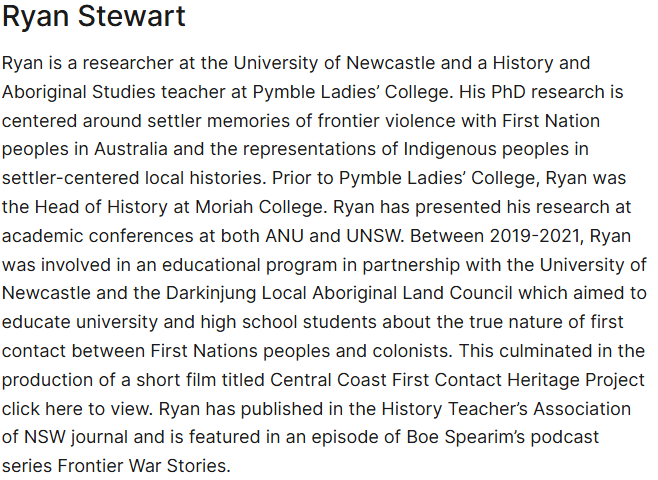
Drawing on archival records, genealogical forensics, Indigenous standpoint theory, and epistemological frameworks including cultic studies and pseudohistory, the analysis exposes how Stewart’s work reifies falsehoods. The thesis elevates the fabricated Charlotte Ashby descent line, relies heavily on the discredited sections of Geoff Ford’s work, and cites the efforts of impostors without verification. By credentialing these elements, Stewart’s thesis enables faux legitimisation of identity fraud, undermines Aboriginal Culture and sovereignty, while contributing to the ongoing erasure and replacement of legitimate Aboriginal knowledge systems.

Despite gestures toward decolonial discourse, Stewart’s uncritical reliance on discredited sources, unverified genealogies, and settler-centric interpretations fundamentally undermines his stated aims.
This analysis reveals how the thesis, by failing to uphold principles of Indigenous data sovereignty and relational accountability, enable Indigenous identity appropriation/fraud, displaces legitimate Aboriginal custodianship, and perpetuates harmful myths of Indigenous disappearance, thus ultimately reinforcing settler-colonial frameworks.
We conclude with a call for institutional reform: including identity verification protocols, formal disclaimers for compromised theses, the cessation of pseudohistorical citation, and redress for the harms caused to Aboriginal communities. This work serves not only as a critique of one thesis, but as a broader indictment of the systems that allow settler simulation to flourish under the guise of reconciliation and scholarship.

I. Introduction – The Credentialing of a Falsehood
Ryan Stewart’s 2025 doctoral thesis, Writing the History of Contact on the Central Coast of New South Wales, represents a deeply compromised intervention into Aboriginal historiography. Framed as a reconciliatory gesture grounded in scholarly rigor, the thesis in fact functions as a vehicle for the epistemic laundering of discredited settler narratives. As well as reproducing past errors of citation or interpretation, it also re-legitimises known fabrications and embeds them into the institutional archive under the authority of a PhD credential.
This critique argues that Stewart’s thesis constitutes an academic normalisation of genealogical fabrication, and settler simulation. It does so by affirming the existence of a “GuriNgai” people, a label long rejected by the Darkinjung, and Metropolitan Local Aboriginal Land Councils (AHO, 2015) as well as by confirmed descendants of Bungaree and Matora, and the wider Aboriginal community. By credulously reproducing the entirely fictional descent line from Bungaree through a daughter named “Sophy” to Charlotte Ashby, a claim long discredited in both community and archival records (bungaree.org, 2023; guriNgai.org, 2023; Charlotte Ashby, Charlotte Webb, and Charlotte Smith, 2025). These fabrications are not incidental and greatly impact the cultural credibility and safety of the thesis’s structure, citations, and claims to cultural relevance.
The endorsement of this thesis by the University of Newcastle, and its open archiving as legitimate scholarship, reveals a broader institutional failure. The University, through the Centre for the History of Violence, has extended its imprimatur to an artefact of settler mythmaking. This is not a neutral error. It is an act of symbolic violence against Aboriginal communities whose sovereignty, custodianship, and historical record have been overwritten by imposture masquerading as reconciliation.
The pages that follow conduct a detailed, evidence-based deconstruction of Stewart’s thesis, drawing on Indigenous-led genealogical research, historical scrutiny, epistemological analysis, and cultic studies. The critique exposes the systemic weaknesses that allowed such a thesis to be approved, the structural complicity that sustains settler simulations, and the real-world consequences; material, spiritual, and cultural, of academic institutions credentialing falsehoods. The GuriNgai identity, as promoted in Stewart’s work, is not an Indigenous truth. It is a settler fantasy repackaged in scholarly form.
The goal of this paper is not merely to refute one thesis, but to demand accountability from the institutions that allowed it to pass, and to offer structural recommendations for safeguarding Aboriginal identity and epistemic sovereignty in academic research. In refusing the GuriNgai simulation, this critique affirms that Aboriginal history must be written with, by, and for Aboriginal people; not through settler fantasies but through truth, law, and Country.
1.1 Critical Analysis of the Preface
The Preface to Ryan Stewart’s thesis opens with a seemingly respectful acknowledgement of his status as a non-Indigenous person on Aboriginal Country. The declarative humility of “I’m a saltwater person… but I’m not a person of saltwater Country” initially suggests awareness of boundaries. However, this positioning swiftly drifts into what Tuck and Yang (2012) call “settler moves to innocence”: rhetorical strategies that allow settlers to engage in decolonisation discourse without relinquishing power, authority, or entitlement.
Stewart repeatedly invokes Aboriginal sacred sites such as Mount Yengo and Baiame’s Cave, describing experiences facilitated by Elders. Yet, these accounts, paired with statements like “I yearn to access the spirituality of Country”, demonstrate what Aileen Moreton-Robinson (2015) has termed “the white possessive.” While Stewart claims reverence, he centers his own affective journey, his ‘yearning,’ and his transformation, effectively re-appropriating the sacred as part of his autobiographical arc. This reflects a familiar Settler-Colonial trope: the absorption of Aboriginal knowledge systems into a redemptive personal narrative (Clark & Nugent, 2010).
His reflection on receiving a Bicentenary medallion in 1988 and discovering Frederick Bennett’s discredited 1968 text functions as the catalytic moment for his “journey.” However, even as Stewart notes his shock at Bennett’s extinction narrative (“these friendly and worthy people…are no longer with us”), his own narrative remains embedded within the same settler schema. He focuses on what local white historians didn’t know, and how he, a modern settler, can know better, thereby recentering epistemic authority on himself (Smith, 2021).
Stewart refers to settler-named geographies “Bumble Hill Road,” “Bumbles Creek,” “Hospital Gully” and seems to recognise the violent colonial logic embedded in them. But his tone remains passive and observational rather than analytic or disruptive. He registers names as markers of loss, not as ongoing instruments of colonial power. This falls short of what Indigenous scholars have called for in decolonial methodologies: an ethics of active unsettlement, accountability, and the refusal to naturalise settler presence (Watson, 2014; Grande, 2015).
Moreover, Stewart’s invocation of “truth-telling” and his desire to “make [his] own, localised intervention” suggests a self-conferred legitimacy to represent Aboriginal history and experience. The use of “truth-telling,” a term central to the Uluru Statement from the Heart and grounded in Aboriginal sovereign frameworks, becomes compromised when deployed by a settler to frame his own historical authorship. As Watego (2021) warns, settler invocations of truth-telling often bypass accountability and reinscribe authority in non-Indigenous hands.
Crucially, Stewart never clearly articulates whose authority or permission legitimises his engagement with Aboriginal sacred sites or stories. The lack of specific Aboriginal community endorsement, consent, or co-authorship in this Preface signals a foundational flaw in his epistemic orientation. Instead of functioning as an act of relational accountability (Bainbridge et al., 2012), the Preface frames Stewart’s relationship to Aboriginal People and histories as deeply personal and affective, yet structurally detached from the protocols of Indigenous research methodologies.
Finally, while the Preface appears self-reflective, it foreshadows the thesis’s central contradiction: it critiques historical erasure while participating in a contemporary simulation of Aboriginality through endorsement of discredited figures, genealogies, and frameworks (as exposed throughout the remainder of the thesis). The personal narrative serves to establish emotional credibility, but it also insulates Stewart from scrutiny by presenting settler authorship as an evolved and enlightened form of allyship rather than a position of continuing colonial influence. The Preface, therefore, establishes a problematic framework of “settler innocence” that pervades the entire thesis.
Sentimental Settlerism as Epistemic Alibi
The Preface to Ryan Stewart’s thesis recentres the settler as the knower, mourner, and redeemer of Aboriginal history. It is emblematic of what Cooke (2025) terms “epistemic laundering”: the transformation of settler-authored affect and fabricated histories into seemingly decolonial knowledge. While Stewart claims to tread carefully, his steps throughout this narrative leave imprints of appropriation masked as reverence. This initial framing ultimately functions as an epistemic alibi for the thesis’s subsequent engagement with compromised histories.
II. Genealogical Fraud and the “Charlotte Ashby” Myth
Central to Ryan Stewart’s thesis is the repetition and endorsement of a discredited genealogical fabrication: that Bungaree, the well-documented Garigal leader and cultural broker of the early 19th century, had a daughter named “Sophy” who in turn gave birth to Charlotte Ashby. This fictitious descent line has been comprehensively debunked by Kwok (2015), guringai.org (2023), with no historical, archival, or genealogical evidence has ever substantiated the claims (see Charlotte Ashby, Charlotte Webb, and Charlotte Smith, 2025). Despite this, Stewart reproduces the narrative uncritically across multiple chapters, integrating it into his broader construction of the “GuriNgai” identity as continuous and legitimate, even if ‘contested’.
The story of “Sophy” and her daughter Charlotte emerges not from oral history of any verified Aboriginal community, but from modern mythmaking. As documented in forensic detail on guringai.org, no historical record links Bungaree to a daughter named Sophy, nor any primary evidence connects such a figure to Charlotte Ashby.
Stewart, however, treats this fiction as a matter of credible lineage.
By incorporating this mythic lineage into a thesis submitted for the degree of Doctor of Philosophy, Stewart transforms a settler fiction into a credentialed academic “truth.” This act constitutes what Cooke (2025a) terms epistemic laundering: the process through which unverified or fraudulent narratives, once credentialed by institutional mechanisms such as theses, peer-reviewed articles, or museum signage, acquire the status of legitimacy and circulate as fact. This laundering process is further intensified when these fabricated genealogies are later used by non-Aboriginal individuals and groups to obtain cultural authority, funding, awards, or land access.
A legitimate descent from Bungaree through “Sophy” to Charlotte Ashby is not merely contestable, but fictitious. Its continued repetition by Stewart is not a neutral act of historiographical inclusion. It is a reiteration of symbolic fraud that erases actual descendants, disrespects cultural law, and enables non-Aboriginal claimants to assume Aboriginal identities that do not belong to them.
In failing to interrogate this descent line, Stewart abdicates the basic responsibilities of historical research: to verify, to question, and to contextualise. His uncritical repetition of genealogical falsehoods exemplifies how settler desires for a usable Indigenous past, one that affirms continuity, cooperation, and spiritual resonance, are privileged over the hard truths of archival accuracy and community sovereignty.
2.1 Critical Analysis of the Acknowledgements Section
The Acknowledgements section of Ryan Stewart’s thesis reveals critical failures in scholarly judgement and ethical research practice. These Acknowledgments are not trivial or peripheral; they establish the epistemic scaffolding of the work.
Dr Geoffrey Ford
Stewart’s opening tribute to Geoff Ford situates his thesis within a chain of epistemic contamination. Ford’s 2010 MA thesis fabricated the “Wannungine” tribal identity based on misread and overextended interpretations of R.H. Mathews and A.W. Howitt. Ford’s speculative distinction between “coastal” and “inland” peoples was weaponised by later actors in the non-Aboriginal GuriNgai movement, who used it to construct a pseudo-historical argument that they, as “Wannungine” descendants, held seniority over Darkinjung People on the Central Coast.

This academic sleight of hand was identified by Cooke (2025) as a case of epistemic laundering: settler-authored myths are conferred legitimacy through institutional citation chains, peer-reviewed publication, or inclusion in academic theses. Stewart’s direct engagement with Ford’s work, framed without critique or disclaimer, functions as a gateway for laundering those earlier fabrications into his own thesis. This process not only misrepresents Bungaree’s lineage but also undermines the genealogically verified claims of living Carigal descendants (bungaree.org, 2023).
Furthermore, Stewart reproduces invented “clan” and “nation” labels—Walkeloa, Wannungine, Kuringgai—without disclosing that these are rejected by all relevant Aboriginal Land Councils (DLALC, MLALC, GMLALC), and by community representatives from Broken Bay, Hawkesbury, and the Hunter (guringai.org, 2025a). This erasure of legitimate custodianship in favour of settler-authored mythology is a form of symbolic violence that enables non-Aboriginal groups to simulate custodianship while diverting attention, funding, and legitimacy away from real communities. Stewart’s uncritical adoption of Ford’s lexicon thus directly facilitates the ongoing simulation of Aboriginal identity and authority.
Tim Selwyn
Stewart also thanks Tim Selwyn for the ongoing education they provide about peoples, animals, Language, Country and culture.” The inclusion of Tim Selwyn—who has no known genealogical or cultural connection to the Central Coast and who has actively supported the non-Aboriginal “GuriNgai” and “Wannungine” projects—raises grave concerns. Selwyn is affiliated with the non-Aboriginal GuriNgai and has publicly supported the fabricated genealogies promoted by Tracey Howie and the GuriNgai Tribal Link Aboriginal Corporation (guringai.org, 2023b).
Dr Laurence Paul Allen: Compounding the Simulation
In thanking Laurence Paul Allen for “sharing ideas and resources,” Stewart aligns himself with yet another figure whose work reproduces the GuriNgai simulation. Allen’s 2021 thesis repeated the false claim that Bungaree had a daughter named Sophy, who gave birth to Charlotte Ashby—an entirely fictitious descent line debunked in Charlotte Ashby, Charlotte Webb, and Charlotte Smith (guringai.org, 2025b). Allen, like Ford, relied heavily on settler oral history from Charles Swancott, a chronicler known for unverified accounts, romantic racialism, and the conflation of white admiration with Aboriginal authenticity.
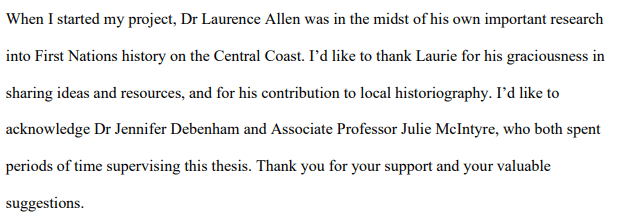
Stewart’s decision to thank Allen reflects his deep entanglement with what Letrud (2022) defines as “incorrigible science”: the persistent citation of discredited ideas due to institutional inertia or ideological convenience. It is particularly troubling that Stewart names Allen as contributing to “local historiography,” despite the latter’s role in replicating known genealogical and linguistic fraud. This gratitude is not neutral; it signals the author’s embrace of a scholarly lineage that privileges settler accounts over community-verified truth. By validating Allen, Stewart deepens his thesis’s entanglement with a compromised historical framework.
Compounding Harm: Simulated Custodianship and Real Consequences
The individuals thanked by Stewart are not merely academic mentors or sources of informal knowledge. They are key figures in a broader settler-colonial infrastructure of simulation. Each of them plays a role in perpetuating a constructed identity framework that directly competes with and undermines legitimate Aboriginal culture and sovereignty. These frameworks have been strategically used to block Aboriginal-led housing developments, access grant funding intended for Indigenous Peoples, and distort public understanding of who is Aboriginal and who is not (Cooke, 2025; guringai.org, 2025c).

The cultural harm of these Acknowledgments cannot be overstated. They validate identity fraud, enable settler cultic formations (e.g., GuriNgai and Coast Environmental Alliance), and facilitate the symbolic displacement of legitimate custodians. As Blancke and Boudry (2016) argue, pseudoscience and pseudo-history thrive when institutional actors fail to demarcate reliable sources from ideologically driven fabrications. These Acknowledgments are not benign; they are active contributions to the perpetuation of cultural harm and epistemic fraud.
Conclusion: Acknowledging the Acknowledgments
Stewart’s Acknowledgments are declarations of epistemic allegiance. They reveal the author’s proximity to a network of fraudulent identity constructs, discredited genealogies, and settler-simulated authority. These affiliations contaminate the entire thesis by embedding it within a lineage of falsehoods. Any claim the thesis might have to scholarly legitimacy is undermined by its uncritical reliance on Ford, Selwyn, and Allen, each of whom has played a role in the maintenance of the GuriNgai myth.
A decolonial response would require not only critical distancing from such figures but also institutional accountability: theses grounded in falsified genealogies should be retracted, and universities must consult with recognised Aboriginal Land Councils before validating identity-based historical claims. Stewart’s thesis, beginning with its Acknowledgments, exemplifies a failure to enact these responsibilities. The Acknowledgments thus function as a gateway for epistemic contamination, undermining the entire work’s scholarly integrity.
III. The GuriNgai Rebrand – From Fabrication to “Fact”
The term “GuriNgai,” as deployed in Ryan Stewart’s thesis, is treated as an established (even if contested) ethnonym signifying an authentic Aboriginal people of Northern Sydney and the Central Coast. This framing constitutes a direct contradiction of extensive scholarly, linguistic, and community-led research. The thesis fails to acknowledge that the term “GuriNgai” is a rebranded construction with origins in settler-era confusion, romanticised misreadings, and 20th-century amateur speculation.
The Aboriginal Heritage Office (2015), in a detailed review concluded that the word “Guringai” was a problematic colonial imposition, loosely applied to various groups north of Sydney based on a colonial misinterpretation. The report clearly states that there is no linguistic, historical, or cultural continuity linking the term to any coherent Aboriginal group in the Northern Sydney region, let alone to the Central Coast.
Similarly, Lissarrague and Syron (2024) reaffirm that the Guringai/Guringay people of the Dungog and mid-north coast region bear no relation to those claiming the “Guringai” or “GuriNgai” identity in Sydney’s north, and Central Coast regions.
Despite this, Stewart’s thesis adopts the term “GuriNgai” with minmal qualification, framing it as a legitimate (if contested) descriptor of a singular cultural group spanning vast and diverse regions, represented in the present by the people self-identifying as ‘GuriNgai’. The absence of critical engagement with this history is not a neutral omission. It is an active misrepresentation that validates a known fabrication, and in doing so, it dismisses the voices of legitimate Aboriginal custodians who have long rejected the GuriNgai narrative.
The result is a thesis that treats the GuriNgai as a historically enduring cultural group whose legitimacy is not only assumed but protected from scrutiny. This outcome exemplifies the insidious process of settler simulation: the replication of Aboriginality through performative identifiers, charismatic authority, and bureaucratic citation rather than through cultural law, community recognition, or genealogical truth.
That Stewart makes only passing reference to the sustained objections by the Darkinjung, Metropolitan Local Aboriginal Land Councils and wider Aboriginal community, does not engage substantively with the Attenbrow report, nor with guringai.org or bungaree.org, reveals a telling editorial choice. By omitting counter-evidence, the thesis curates an illusion of legitimacy to a disproven settler myth. It performs historical authenticity while shielding itself from the complex truths of contested identity.
In potentially elevating the term “GuriNgai” from fabrication to fact in spite of all evidence to the contrary, Stewart’s thesis does more than distort history. It offers institutional cover to a fraud that has caused deep and ongoing harm to legitimate Aboriginal communities. The elevation of this myth through doctoral credentialing represents a critical failure in historiography, cultural protocol, and scholarly ethics.

3.1 Critical Analysis of Page 5
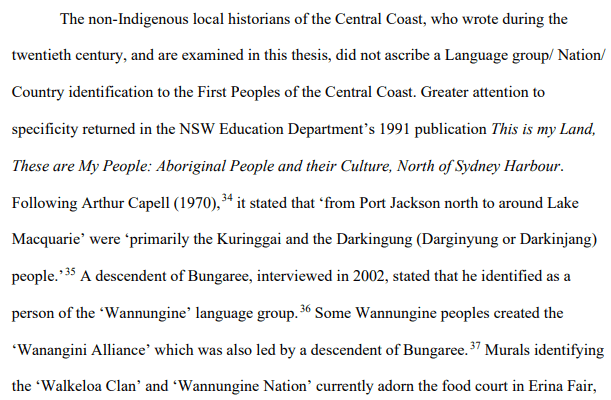
Ryan Stewart’s representation of linguistic categories, historical figures, and political processes on Page 5 of his thesis reflects a concerning pattern of Settler-Colonial distortion. The invocation of Walkeloa, Kurringgai/Guringai/GuriNgai, and the 2013 “Authorisation Meeting” contributes to the ongoing simulation of Aboriginal identity in the Central Coast and Northern Sydney region. This section not only fails to apply critical historiographical rigour, it actively perpetuates genealogical, cultural, and linguistic fraud.
1. Misuse of Walkeloa and Pseudolinguistic Authority
The reference to Threlkeld’s supposed classification of Brisbane Water peoples as “Walkeloa” is unsupported by reliable ethnolinguistic evidence. As noted in the 2024 linguistic review by Lissarrague and Syron, the term “Walkeloa” appears only sporadically in early colonial records and has no known continuity in community usage or linguistic mapping (Lissarrague & Syron, 2024, p. 6). Its uncritical reproduction by Ford (2010) and Stewart (2025) represents what Bainbridge et al. (2012) term an absence of “relational accountability”: a detachment from community-based knowledge validation. It also aligns with what Cooke (2025) characterises as “settler magical thinking”—the attribution of cultural coherence to colonial fabrications. Stewart’s uncritical adoption of “Walkeloa” exemplifies a disregard for established ethnolinguistic scholarship and community validation.
2. John Fraser’s Kurringgai Invention and Its Settler Echoes
Stewart’s citation of John Fraser’s 1892 ethnolinguistic grouping of the “Kurringgai” lacks both contextual critique and methodological caution. Fraser, a Scottish Presbyterian with no direct fieldwork experience in the Sydney region, developed his classifications through armchair synthesis and philological speculation. As Lissarrague and Syron (2024) observe, Fraser “imposed externally derived nomenclature” that “flattened diverse language groups into invented supertribes” (p. 4). His “Kurringgai” was one such creation, lacking any grounding in Indigenous self-description or linguistic structure.
Contemporary Gathang-speaking Guringay People, whose Country is located to the north around Gloucester and Forster, have repeatedly rejected the misapplication of “Guringai” to Northern Sydney and Brisbane Water. As Lissarrague and Syron (2024) state unequivocally: “Guringay is not ‘Guringai,’ and the latter term has no legitimate application to Country south of the Hunter” (p. 7). Stewart’s conflation of Fraser’s term with the identity claims of the modern non-Aboriginal GuriNgai group illustrates the dangers of uncritical settler historiography and the recursive legitimisation of pseudolinguistics through citation. By failing to critique Fraser, Stewart lends academic credence to an invented term that directly undermines authentic Guringay identity.
3. The 2013 Authorisation Meeting: Corporate Simulation of Culture
The 2013 “Authorisation Meeting of the Awabakal and Guringai Peoples” cited by Stewart was not a culturally legitimate community gathering but a procedural step in the activities of Awabakal and Guringai Pty Ltd, a now-defunct private company. The use of newspaper notices to claim descent from Bungaree and Queen Margaret was a legalistic strategy designed to create a paper trail for Native Title applications without consent from Traditional Owners. Stewart’s failure to critically interrogate the source or its corporate origins gives epistemic legitimacy to a simulated genealogy and perpetuates what Ford (2010) once warned against: the risk of “pseudo-Aboriginality” gaining traction through bureaucratic misrecognition.
The inclusion of Bungaree in the “Guringai” category and Queen Margaret in “Awabakal” directly contradicts verified genealogies and community recognition. Bungaree was a Carigal man from the Broken Bay region. His descendants are part of the Marramarra community and have never identified as Guringai (bungaree.org, 2023). Queen Margaret, whose ancestry connects to the Awabakal and Wonnarua Nations, was not part of the same political or cultural framework invoked in the meeting. As guringai.org (2025a) documents, these identities were retrofitted to serve the interests of a settler-constructed entity, not reflective of Aboriginal Law, kinship, or consent. Stewart’s uncritical acceptance of this “Authorisation Meeting” effectively legitimises a corporate simulation of cultural authority.
4. Coast Community News and the Reproduction of Settler Fantasy
Stewart’s reference to Coast Community News as a supporting authority reflects a broader failure to distinguish between journalism and propaganda. As documented by guringai.org (2024a; 2024b; 2025b), this outlet has operated as an uncritical platform for the GuriNgai identity fraud. It has routinely published articles that ignore Aboriginal Land Council statements, elevate discredited figures such as Tracey Howie, and refuse to acknowledge the fraudulence of the GuriNgai claim despite extensive genealogical refutation. That Stewart relies on this media outlet to support his thesis is an example of what Blancke and Boudry (2021) call “recursive citation failure”: misinformation masquerading as legitimate sourcework because it appears in multiple publications.
By incorporating Coast Community News references and discredited terminology into his thesis, Stewart exemplifies the epistemic laundering process in academic writing. This is the same pattern outlined by Cooke (2025) in his analysis of how pseudohistorical frameworks gain scholarly traction when universities fail to verify the foundations of cited sources. Stewart’s reliance on such an outlet actively propagates misinformation and reinforces the epistemic laundering of fraudulent claims.
Page 5 as a Simulation Node
Page 5 of Stewart’s thesis functions as a simulation node: a convergence point for false genealogies, linguistic misrepresentation, corporate identity fraud, and settler fantasy. Each element—Walkeloa, Kurringgai, Guringai, the 2013 public notice, and the media echo chamber—serves to further embed the GuriNgai simulation in public consciousness. Stewart’s treatment is not simply erroneous; it is epistemically violent, contributing to the symbolic displacement of real Aboriginal communities whose identities are erased by the performance of settler Indigeneity.
This page should not be seen as an example of historical analysis but as a warning sign of what happens when academic, media, and legal systems fail to uphold the principles of verification, community consent, and cultural accountability. Page 5 is thus a critical failure, actively contributing to the perpetuation of cultural fraud rather than its critique.
IV. Citation Practices as Epistemic Laundering
One of the most insidious mechanisms by which settler fabrications acquire the veneer of legitimacy is through citation. In Writing the History of Contact on the Central Coast of New South Wales, Ryan Stewart engages in what Cooke (2025a) terms epistemic laundering: the transformation of settler myths into academic “truths” through strategic citation, credentialed reproduction, and institutional amplification. Citation, far from a neutral or mechanical process, becomes a tool of simulation—able to disguise fabrication as consensus and pseudohistory as scholarship.
Stewart repeatedly cites works by authors who are either directly implicated in the fabrication of the GuriNgai identity (e.g., Geoff Ford, Warren Whitfield, Tim Selwyn) or who have based their claims on unverified oral traditions that lack community validation. For instance, Geoff Ford’s diagrams are reproduced as if they were objective genealogical data rather than speculative constructs already rejected by multiple Aboriginal Land Councils. Stewart treats Ford’s diagrams not only as legitimate sources but as visual evidence of continuity and descent (Stewart, 2025, pp. 120–126), despite their role in perpetuating the fictitious “Sophy–Charlotte Ashby” line.
This uncritical use of Ford, along with citations to Laurence Paul Allen and Charles Swancott, exemplifies what Hansson (2018) describes as “rhetorical reinforcement” in pseudohistorical writing: the appearance of scholarly consensus manufactured through recursive, cross-referential citations among a closed loop of unreliable sources. The illusion of legitimacy is compounded by Stewart’s failure to cite or engage with primary critiques—such as Filling a Void (Attenbrow et al., 2015) or Lissarrague and Syron’s (2024) linguistic refutations—that dismantle the very foundation of the GuriNgai narrative.
Moreover, Stewart’s thesis engages in selective citation. While presenting figures like Tracey Howie and Tim Selwyn as cultural authorities, he omits any mention of their rejection by Aboriginal community institutions or their involvement in politically charged, pseudo-Aboriginal activism. The deliberate absence of critical counterpoints—particularly from Aboriginal-led publications such as guringai.org—represents a calculated erasure. By curating his citations to exclude refutation, Stewart constructs an epistemic environment in which the fabricated identity appears not only plausible but confirmed.
Blancke and Boudry (2021) argue that pseudoscientific and pseudohistorical ideologies often gain traction not by overtly rejecting orthodoxy, but by mimicking its practices. In this case, Stewart’s thesis mimics the forms of rigorous academic work: peer-reviewed citations, footnotes, and archival references. Yet the content of those citations constitutes an echo chamber of settler narrative, oral hearsay, and unverified genealogy. The result is a closed epistemology—one that recycles and reinforces falsehoods under the guise of scholarship.
This laundering process is not incidental. Once published in a PhD thesis and archived by the University of Newcastle, these citations take on an institutional authority that future researchers may mistakenly treat as vetted truth. The thesis thus becomes a new node in the simulation: a “source” that can be cited by the next wave of scholars, activists, or media producers seeking to validate GuriNgai identity claims.
Stewart’s citation practices are not merely poor scholarship. They are a method of epistemic laundering: repackaging fraud as fact, and laundering settler desire through the mechanisms of the academy. The consequences are profound. Aboriginal identity becomes a citation style, rather than a lived reality grounded in law, kinship, and Country.
4.1 Critical Analysis of Page 6
Page 6 of Ryan Stewart’s thesis attempts to acknowledge contestation around the term “Guringai” but ultimately fails to foreground the epistemic and genealogical implications of its misuse. What is presented as a scholarly summary of linguistic debate is, upon closer inspection, a subtle act of epistemic laundering that continues the settler simulation of Aboriginal identity on the Central Coast.
1. Misrepresenting the Findings of Filling a Void (2015)
Stewart cites the 2015 Filling a Void report released by the Aboriginal Heritage Office (AHO) but selectively frames its findings. While he notes that some individuals have “adopted ‘Guringai’ to define their own Aboriginal connections or identity,” this quotation is divorced from its critical context. The full report is unequivocal: the term “Guringai” is not historically associated with the area in question in any early colonial source, linguistic documentation, or credible community tradition (Aboriginal Heritage Office, 2015, p. 9). It is a speculative construct derived from Fraser’s “Kurringgai,” which itself was a non-Indigenous invention imposed upon the diverse and distinct language groups of coastal New South Wales (Lissarrague & Syron, 2024, p. 4).
Stewart fails to apply critical historiographical judgment. His passive phrasing—“the use of the term ‘Guringai’ has been contested”—obscures the overwhelming scholarly and community consensus rejecting its validity. This is not a debate among equals; it is a contest between historical fabrication and community-verified truth. By selectively quoting and downplaying the AHO report, Stewart misrepresents the robust critique against “Guringai.”
2. Minimising the 2019 Koori Mail Rebuttal
Stewart refers to the 2019 Koori Mail article featuring Bob Syron and Nathan Moran but reduces it to a secondary “dimension” of debate. In fact, the article represents a significant act of epistemic resistance. Bob Syron, a Guringay Elder from the Port Stephens–Barrington region, asserts that the term “Guringai” misappropriates and distorts the authentic Guringay/Gringai identity, whose territory lies far north of Sydney (Paton, 2019, p. 21). Nathan Moran, CEO of the Metropolitan Local Aboriginal Land Council (MLALC), condemns the term outright as a “colonial misrepresentation and/or error” (Paton, 2019, p. 21). These are not vague concerns but direct refutations by authoritative Aboriginal voices, grounded in community recognition, kinship, and linguistic evidence.
Stewart’s failure to centre these statements exemplifies the dynamic described by Cooke (2025) as “epistemic marginalisation”: Indigenous authority is acknowledged in name but excluded in substance, creating the illusion of balanced representation while privileging settler-authored mythologies. Stewart’s minimisation of key Indigenous voices serves to obscure authoritative refutations of “Guringai” identity claims.
3. False Equivalence Between “Adoption” and Recognition
By stating that some First Peoples have “adopted” the term “Guringai,” Stewart draws a false equivalence between individual self-identification and legitimate cultural designation. Adoption, in this context, is not evidence of authenticity but of cultural dislocation, often mediated by settler institutions, legal processes, or genealogical misunderstanding. As Lissarrague and Syron (2024) argue, the imposition and internalisation of settler linguistic categories is a legacy of colonisation, not a reflection of Traditional Knowledge systems (p. 5). Naming, in Aboriginal cultures, is not an arbitrary process but one grounded in Country, kinship, and community.
The fact that “Guringai” appears in some Native Title notices or is used by a minority of individuals does not constitute cultural or legal legitimacy. As Blancke and Boudry (2021) explain in relation to pseudoscientific mimicry, repetition across institutional sources can simulate legitimacy without undergoing verification. Stewart’s repetition of “Guringai” without interrogation enables precisely this kind of simulation. Stewart’s framing of “adoption” as recognition creates a false equivalence that lends legitimacy to fabricated identities.
4. Avoidance of the Term’s Role in Identity Fraud
Most crucially, Stewart entirely avoids the role of the “Guringai” construct in facilitating ongoing Indigenous identity fraud. As documented across multiple analyses (guringai.org, 2023–2025), non-Aboriginal individuals have adopted the Guringai label to secure access to grants, cultural authority, and land negotiations. This fraudulent identity has been strategically reinforced through uncritical media, bureaucratic inertia, and academic complicity.
Page 6 of Stewart’s thesis thus serves as a rhetorical buffer that deflects scrutiny. By framing the issue as a matter of ongoing “debate,” he positions fraudulent constructs alongside legitimate Aboriginal voices as if they were co-equal participants in a discussion, rather than agents of displacement. This discursive tactic enables what Bainbridge et al. (2012) describe as a “non-Indigenous framing of Indigenous knowledge,” effectively severing truth from recognition. By presenting identity fraud as mere “debate,” Stewart’s analysis on this page acts as a rhetorical shield for the GuriNgai simulation.
Conclusion: Complicity Disguised as Nuance
Stewart’s treatment of the “Guringai” controversy on Page 6 reveals the subtle mechanisms by which Settler-Colonial scholarship perpetuates epistemic violence. Rather than offering clarity, verification, or truth-telling, the page cloaks myth in the garb of contested discourse. It fails to acknowledge that the dominant voices refuting “Guringai” as a legitimate identity are Aboriginal leaders, linguists, and community representatives—while the only voices affirming it are institutional, settler, or fraudulent.
In failing to take a position grounded in truth, relational accountability, and respect for Aboriginal self-determination, Stewart’s thesis instead reinforces a simulation. Page 6 is not a reflection of cultural complexity; it is an act of cultural distortion that lends complicity to ongoing fraud. This page exemplifies how a supposed scholarly “nuance” can inadvertently become an act of complicity in the perpetuation of cultural fraud.
V. Institutional Complicity and the Chilling Effect
The conferral of a doctoral degree upon Ryan Stewart by the University of Newcastle—despite the thesis’s reliance on discredited sources, fabricated genealogies, and non-Indigenous actors masquerading as cultural authorities—signals more than an isolated lapse in academic quality control. It reveals a structural complicity in the ongoing simulation of Aboriginal identity by settler institutions. This complicity is not passive. It is operationalised through supervisory endorsement, panel approval, archival preservation, and reputational protection, all of which transform settler-authored fabrications into seemingly indelible academic truths.
Stewart’s thesis was supervised and endorsed by scholars associated with the Centre for the History of Violence, a research group whose stated mission includes confronting colonial violence and amplifying marginalised voices. That such a centre could approve a thesis that platformed pseudohistory, omitted Indigenous dissent, and promoted a discredited identity fraud speaks to a profound institutional contradiction. The university did not simply allow a falsehood to be published; it facilitated the laundering of settler narratives under the banner of decolonisation.
The consequences of this complicity are amplified by what Cooke (2025b) identifies as the Bolt paradox: the legacy of Eatock v Bolt (2011), which created a chilling effect that discourages public criticism of Indigenous identity claims, even when those claims are fraudulent and rejected by Aboriginal communities. Institutions like the University of Newcastle, conscious of reputational risk and legal sensitivity, often err on the side of non-intervention, thereby allowing imposture to flourish under the protection of anti-racism discourse. In this environment, the cost of calling out fraud is perceived to outweigh the cost of permitting it.
This chilling effect has real implications. Researchers, educators, and Aboriginal community members face institutional pressure to remain silent or supportive, even when their cultural knowledge contradicts the official narrative. Stewart’s thesis, far from being a neutral contribution to history, becomes a weaponised artefact—one that can be used by GuriNgai claimants to secure funding, obstruct legitimate land claims, or gain public recognition under false pretenses. That this is achieved through a university thesis intensifies the harm. It transforms imposture into epistemic policy.
The chilling effect also silences those most qualified to refute the fraud. Legitimate Aboriginal people, particularly those with ties to the affected Country, may be accused of gatekeeping, lateral violence, or internalised colonialism if they challenge GuriNgai claims. The institutional message is clear: settler-authored narratives, even if fictitious, are safer to publish than Aboriginal truths that challenge imposture.
By awarding a PhD for this thesis, the University of Newcastle has not only credentialed falsehoods, it has institutionalised a mechanism of silence. It has created an epistemic safe zone for simulation, wherein criticism is pathologised, and truth becomes a reputational liability. The academy, in this configuration, does not decolonise. It colonises anew, using footnotes and degrees in place of chains and muskets.
Stewart’s work must therefore be understood not in isolation, but as a node in a broader structure of institutional complicity. Universities, funding bodies, museums, and cultural institutions all share responsibility for the legitimisation of settler simulation. Until they confront this complicity directly—by rejecting fraudulent claims, acknowledging epistemic harm, and prioritising community recognition over settler sentiment—they will remain complicit in the erasure of Aboriginal sovereignty.
5.1 Critical Analysis of Page 7
Page 7 of Stewart’s thesis traces the entrenchment of the term “Guringai” in New South Wales public education and local heritage discourse, citing sources such as the 1991 NSW Department of School Education publication This is My Land, These Are My People and a 1992 teacher’s kit by Lynette Thomson. However, Stewart fails to adequately interrogate the flawed genealogical and linguistic assumptions embedded in these materials. Instead, he presents their usage as indicative of a growing recognition of “Guringai” as a valid identity for the Central Coast’s Aboriginal Peoples. This narrative elides a large body of critical scholarship and Indigenous testimony directly opposing this fabricated term.
The 1991 Department of Education publication—produced during a time when Aboriginal communities were only beginning to reclaim visibility within educational frameworks—lacked rigorous verification protocols. As noted in Filling a Void (Aboriginal Heritage Office, 2015), the term “Guringai” was not based on any attested historical use in early colonial sources. It derived from John Fraser’s 1892 speculative linguistic taxonomy that grouped disparate peoples under the invented macro-group “Kurringgai,” an act now widely condemned as a colonial imposition lacking cultural legitimacy (Aboriginal Heritage Office, 2015, pp. 8–9; Lissarrague & Syron, 2024, pp. 4–6).
Stewart cites the use of “Guringai” in these educational texts without acknowledging the direct critiques made by scholars and communities since the 2000s. For instance, Bob Syron (a Guringay/Gringai man) and Nathan Moran (CEO of the Metropolitan Local Aboriginal Land Council) both publicly repudiated the usage of “Guringai” in 2019 as a colonial misapplication of their Nation’s name to an unrelated region (Paton, 2019, p. 21). Despite this, Stewart repeats the term uncritically, relying on outdated institutional materials rather than engaging with contemporary Aboriginal-led scholarship or governance.
The invocation of the term “Wannungine” as an alternative or preferred language group designation on the Central Coast is also treated with insufficient scrutiny. Stewart does not mention that the emergence of this term is primarily associated with Warren Whitfield, a non-Aboriginal man who established the “Wanangini Alliance” and falsely claimed descent from Bungaree. As documented in guringai.org (2023), this claim has been extensively debunked through genealogical research, and Whitfield’s activities have been characterised as a settler cultic appropriation of Aboriginality, lacking both cultural legitimacy and community endorsement.
Stewart’s failure to investigate the origins of “Wannungine” or distinguish between community-recognised descendants and mythic constructions is epistemically negligent. While he refers vaguely to a “descendant of Bungaree” citing Wannungine as their language group, the only documented source for this appears to be Whitfield himself, whose own non-Aboriginal ancestry has been verified (see A Long Con Gone on Too Long, 2023). By including such references without genealogical validation, Stewart reproduces the very historiographical contamination his thesis purports to clarify.
The impact of these educational misrepresentations is not merely academic. As The False Mirror (2025) and The GuriNgai and CEA Are Cults (2025) make clear, these discursive errors have empowered a settler cult movement to claim custodianship, obstruct legitimate land claims, and divert cultural funding under the guise of fabricated Aboriginality. The settler simulation of identity through institutional repetition—what Cooke (2025) defines as “epistemic laundering”—has allowed myth to become curriculum, and settler fantasy to masquerade as Indigenous knowledge. Stewart’s uncritical recounting of “Guringai” in education thus actively perpetuates settler-authored fictions within the historical record.
VI. Harmful Impacts on Aboriginal Sovereignty
The academic laundering of false identities, such as the “GuriNgai” fabrication endorsed in Ryan Stewart’s thesis, is not a victimless process. It has direct and measurable consequences for Aboriginal sovereignty, community wellbeing, and intergenerational justice. When settler institutions credential non-Aboriginal claimants through fabricated genealogies and pseudohistorical narratives, they do more than distort the historical record. They undermine the authority of actual Aboriginal peoples to determine their own identities, histories, and futures.
Aboriginal sovereignty is grounded in ontological, legal, and relational frameworks that precede and exceed colonial recognition. It is embedded in kinship, cultural law, and custodianship of Country. These relationships cannot be simulated through archival invention, spiritual appropriation, or administrative paperwork. Yet the GuriNgai simulation, as reinforced by Stewart’s thesis, performs precisely this erasure: it imposes settler constructs of legitimacy onto Aboriginal frameworks of descent and belonging, and in doing so, displaces the authority of legitimate Aboriginal people to speak for Country.
This displacement manifests in material, political, and cultural ways. On the Central Coast and Northern Sydney, the GuriNgai group—backed by fraudulent genealogical claims and now by Stewart’s PhD—has inserted itself into consultation processes, media events, and funding pipelines meant for Aboriginal communities. These actions divert cultural and economic resources from rightful custodians to impostors, sabotaging local self-determination efforts and breaching the principle of free, prior, and informed consent.
The harm is also epistemic. As Moreton-Robinson (2015) and Watego (2021) have shown, the erosion of Aboriginal epistemological authority through settler substitution constitutes a form of epistemic violence. In this case, the violence is double: Stewart’s thesis erases legitimate genealogies while promoting false ones, thereby replacing relationally grounded Aboriginal law with settler-invented fantasies. This act reproduces colonial logics of possession, where white desire to “belong” on Country supplants the lived sovereignty of those who already do.
Further harm occurs in legal and statistical domains. As documented by Cooke (2025c), race-shifting and identity fraud compromise the integrity of census data, Closing the Gap metrics, and Indigenous service provision. When individuals or groups falsely claim Aboriginality, their data is absorbed into national statistics and policies designed for the benefit of Aboriginal people. This contaminates datasets, erodes program accountability, and frustrates efforts to address real disparities in health, education, housing, and justice.
Finally, the psychological and cultural toll on Aboriginal communities is severe. Many community members experience deep distress when fraudulent figures are platformed in public ceremonies, cultural events, or educational materials. The presence of impostors—now bolstered by PhD credentials—triggers feelings of dispossession, powerlessness, and cultural erasure. The trauma is not abstract. It is lived and ongoing.
The harm done by Stewart’s thesis must therefore be named for what it is: an act of scholarly complicity in the displacement of Aboriginal authority. It is not a matter of academic disagreement or interpretive nuance. It is the credentialed transmission of settler fantasy into a space where only truth, accountability, and relational consent should dwell.
To repair this harm requires more than critique. It requires the removal of false claims from public discourse, the reallocation of resources to rightful custodians, and the institutional recognition that settler-authored imposture is not scholarship—it is a continuation of colonisation through simulation.
6.1 Critical Analysis of Page 8
Stewart’s commentary on the murals at Erina Fair, which publicly present the so-called “Walkeloa Clan” and “Wannungine Nation,” offers an important opportunity for reflection on how fabricated identities and settler-authored narratives are materialised through commercial and cultural spaces. However, his treatment is uncritical and devoid of necessary genealogical or epistemic scrutiny.
As shown in The False Mirror (Cooke, 2025), the public art displays at Erina Fair are not community-verified representations of First Nations history. Instead, they are examples of what Cooke refers to as aesthetic laundering: the laundering of cultural legitimacy through visual spectacle, where settler-initiated pseudohistories are reproduced in ways that mimic authentic Indigenous representation. The specific invocation of the “Walkeloa Clan” and the “Wannungine Nation” is rooted in genealogical falsehood and spiritualised mimicry, propagated primarily by the non-Aboriginal GuriNgai cult and its affiliates.
The name “Walkeloa” has no verified existence in any early colonial linguistic records, Aboriginal oral traditions, or descent-based documentation. Its circulation originates with non-Indigenous actors, most notably Warren Whitfield, who also advanced the equally fictitious “Wannungine Nation” narrative and falsely claimed descent from Bungaree. Whitfield’s “Wanangini Alliance,” documented extensively at guringai.org, is a settler invention, and the repetition of its terminology in civic spaces like Erina Fair is not an act of historical remembrance but one of epistemic fraud.
By referencing these murals as though they represent valid “First Nations history,” Stewart fails to acknowledge the core issue: these artworks do not emerge from community-sanctioned cultural authority, nor are they based on verified linguistic or genealogical traditions. Rather, they serve the interests of a settler cult movement that uses symbols, murals, performances, and institutional partnerships to simulate Aboriginal legitimacy in the public eye. This simulation distorts historical memory, miseducates the broader public, and undermines actual Aboriginal community authority on the Central Coast.
The influence of these murals—particularly on the non-Indigenous public—is real, as Stewart suggests. But their cultural power stems from the very absence of accountability. They exist in a vacuum of verification, shielded by aesthetic appeal and the assumed good faith of public art initiatives. As Attenbrow et al. (2015) argue, the term “Guringai” and its variants like “Walkeloa” are historically and linguistically unsubstantiated. Moreover, Lissarrague and Syron (2024) confirm that the linguistic territory of Guringay (sometimes confused with “Guringai”) is located in mid-northern NSW, not the Central Coast.
The Erina Fair murals, therefore, are not innocent artistic gestures but instruments of cultural misinformation. They function as Settler-Colonial memory machines—legitimising a non-Aboriginal cult’s fabricated claim to history and identity. Stewart’s lack of critique on this point allows for the very epistemic laundering that has plagued historical representation on the Central Coast for decades. Stewart’s uncritical depiction of these murals thus inadvertently lends legitimacy to instruments of cultural fraud.
VII. Recommendations – Toward Epistemic Accountability
The credentialing of Ryan Stewart’s thesis by the University of Newcastle reveals not only a failure of individual scholarly responsibility but a systemic weakness in how institutions verify, validate, and disseminate knowledge claims about Aboriginal identity. If universities are to fulfil their stated commitments to truth-telling, reconciliation, and decolonisation, they must enact structural reforms that prevent the recurrence of such epistemic fraud. This section offers practical, principled recommendations for restoring academic integrity and protecting Indigenous sovereignty from settler simulation.
1. Implement Indigenous-Led Identity Verification Protocols
Universities must not permit claims of Aboriginal descent or cultural affiliation to be cited, referenced, or endorsed in academic work without verification through both genealogical documentation and community recognition. This means engaging Local Aboriginal Land Councils (LALCs), Prescribed Body Corporates (PBCs), and Elders’ Councils in determining the legitimacy of claimed identities prior to thesis submission or publication. Protocols for this already exist in community and should be formally adopted into university policy (Bainbridge et al., 2012; Ryder et al., 2020).
2. Require Cultural Safety Reviews for Research Involving Identity Claims
All academic work dealing with Aboriginal identity, history, or cultural authority must undergo review by a cultural safety panel that includes Aboriginal scholars, knowledge holders, and representatives of the communities concerned. This should be an enforceable component of thesis approval, ethics applications, and peer-review processes, ensuring that epistemic accountability is embedded at every stage.
3. Reject the Use of Discredited or Community-Refuted Sources
Citation practices must be subjected to rigorous scrutiny, particularly when they involve genealogy, historical claims, or assertions of cultural continuity. Discredited sources such as Ford, Allen, and Swancott must not be elevated without full disclosure of their contested nature and must never serve as primary foundations for scholarly argument. Institutions must train candidates and supervisors in the identification of pseudohistory, simulation, and settler-fabricated genealogies.
4. Mandate the Inclusion of Community Perspectives and Counter-Narratives
Academic work involving contested histories or identities must include references to dissenting views, particularly those articulated by legitimate Aboriginal communities. The failure to engage platforms such as guringai.org, bungaree.org, or formal reports like Filling a Void (Attenbrow et al., 2015) constitutes not only poor scholarship but active erasure. Institutional policy should require balance and transparency where disputes over legitimacy exist.
5. Issue Formal Retractions or Disclaimers for Compromised Theses
Where a thesis is found to have laundered epistemically fraudulent claims, institutions must act decisively. This includes issuing public statements acknowledging the harm, appending critical disclaimers to digital repositories, retracting degrees where warranted, and publishing formal corrections. Such actions are not punitive; they are restorative, signalling a commitment to truth, justice, and cultural safety.
6. Protect and Resource Aboriginal-Led Counter-Research
Funding must be redirected to Aboriginal-led research initiatives that correct settler distortions, document genealogical truth, and preserve community narratives. Platforms like guringai.org are models of this work. Universities must build formal partnerships with these platforms and ensure they are cited, respected, and integrated into academic discourse on equal footing.
7. Reform Ethics Guidelines to Include Epistemic Sovereignty
Existing ethics protocols often focus on harm minimisation and informed consent in the context of interviews or fieldwork. They must be expanded to include principles of epistemic sovereignty: the right of Indigenous communities to control how their histories, identities, and knowledges are represented, interpreted, and archived. This shift is essential for decolonising research from within.
8. Embed Accountability Mechanisms for Supervisors and Examiners
Academic supervisors and examiners who pass theses containing discredited or fraudulent claims must be held accountable. This includes formal review, retraining, and, where necessary, disciplinary action. Institutional complicity cannot be addressed if academic staff are shielded from the consequences of their negligence or bias.
By adopting these reforms, universities and scholarly institutions can move beyond performative commitments to Indigenous inclusion and begin the real work of dismantling settler simulation. Epistemic accountability is not ancillary to scholarly excellence—it is its foundation.
7.1 Critical Analysis of Page 9
The murals at Erina Fair that reference the “Wannungine Nation,” “Walkeloa Clan,” and historical figure of Bungaree operate not as neutral depictions of Aboriginal heritage but as ideological mechanisms of Settler-Colonial simulation. While Stewart identifies their presence, he fails to interrogate their origin, authorship, or the epistemic agenda behind their installation. These murals do not reflect consensual cultural authority but instead serve as aesthetic laundering, where settler-led fabrications are presented as if they were grounded in Aboriginal continuity and consent (Cooke, 2025).
This simulation is critically documented in guringai.org’s January 2024 report, Coast Community News: A Propaganda Wing of the Guringai Cult, which exposes how CCN has played a direct role in laundering the legitimacy of the non-Aboriginal GuriNgai cult into public and institutional discourse. Through an extensive content audit, the article reveals that CCN has disproportionately platformed GuriNgai-linked individuals such as Tracey Howie, Neil Evers, Laurie Bimson, and Jake Cassar, while systematically excluding voices from legitimate Aboriginal governance bodies such as Darkinjung LALC and MLALC. This imbalance is not accidental: it is the function of an epistemic propaganda loop in which settler-fabricated narratives are amplified through the illusion of journalistic neutrality.
The article documents specific CCN articles that celebrate “Guringai” performances, mural unveilings, and cultural events without scrutiny or acknowledgment of the well-documented fraud surrounding the identity claims involved. In particular, the use of Bungaree’s name in these murals and articles operates as symbolic appropriation. Bungaree is reanimated not to honour his legacy but to provide counterfeit cultural currency to a settler cult with no bloodline connection to him or his descendants (bungaree.org, 2023). The propagation of the discredited “Sophy” and “Charlotte Ashby” descent narrative becomes especially egregious when linked to visual materials occupying central public spaces.
The CCN articles serve as feedback mechanisms within what Cooke (2025) terms epistemic simulation cycles: settler fabrications are presented in pseudo-journalistic formats, which are then cited or visually reaffirmed by institutions such as shopping centres, councils, or education providers. This cyclic process entrenches fraud within both public consciousness and policy infrastructure. Stewart’s omission of this dynamic constitutes a scholarly failure to address how pseudo-Indigenous authority is manufactured in settler-dominated media ecosystems.
Furthermore, Coast Community News: A Propaganda Wing of the Guringai Cult demonstrates how CCN actively shields these fabrications from critique by refusing to publish responses, corrections, or op-eds from recognised Aboriginal knowledge-holders. This editorial gatekeeping allows GuriNgai mythologies to flourish unchecked, transforming the newspaper into what Cooke describes as a media annex of cultic fraud. The result is not merely misinformation but the sustained displacement of Aboriginal sovereignty through the appropriation of historical figures, spiritual sites, and epistemological space.
In this context, Stewart’s neutral tone and lack of critical inquiry into mural content and media complicity becomes an act of epistemic omission. By failing to examine how settler simulation is reinforced through visual, textual, and symbolic media in sites like Erina Fair, Stewart not only understates the extent of the fraud but contributes to its academic laundering. Stewart’s uncritical treatment of these murals and their media propagation inadvertently validates a settler cult’s fabricated claims to heritage.
VIII. The Lifecycle of a Fraudulent Narrative – From Oral Myth to PhD Credential
The “GuriNgai” identity is not an Indigenous cultural inheritance, but a settler-colonial fabrication whose endurance reveals the mechanics of epistemic simulation. Its development follows a lifecycle that transforms settler oral myth into an institutionalised credential. Understanding this trajectory is critical to dismantling its legitimacy and preventing similar frauds from taking root in future scholarship.
Stage 1: Settler Mythmaking
The origin of the GuriNgai narrative lies in colonial-era linguistic confusion and 20th-century settler romanticism. The name “Kuring-gai” was originally misattributed by missionaries and linguists (notably Ridley) to various language groups north of Sydney, based on misinterpretations of words in the Awabakal lexicon. This error was later compounded by amateur historians such as Charles Swancott, who retrospectively assigned the term to Aboriginal groups in Sydney’s northern suburbs and the Central Coast. Swancott’s reliance on hearsay, settler oral tradition, and unchecked assumptions laid the groundwork for what would become the GuriNgai myth.
Stage 2: Genealogical Invention
The next phase involved the invention of a descent line linking contemporary non-Aboriginal people to Bungaree. This was achieved through fabricated genealogies, notably the fictional “Sophy,” allegedly a daughter of Bungaree and mother of Charlotte Ashby. This line, promoted by Geoff Ford, lacks archival evidence and contradicts established genealogical records. Nonetheless, Ford’s diagrams were treated by followers as authoritative and began circulating within community organisations and activist circles as if they were verifiable truths.
Stage 3: Pseudo-Tribal Activation
Once the GuriNgai label and fabricated descent line were in circulation, a network of non-Aboriginal individuals began to perform “custodianship” over large tracts of Country. Figures such as Tracey Howie, Warren Whitfield, and Tim Selwyn established or became affiliated with organisations like the Guringai Tribal Link Aboriginal Corporation, Coast Environmental Alliance, and the “Wannungine Nation” movement. These groups appropriated ceremonial practices, asserted sovereign status, and demanded consultation rights from government agencies—all without community recognition or cultural legitimacy.
Stage 4: Institutional Partnership
As these actors performed Indigeneity in increasingly public ways, local councils, schools, environmental groups, and even universities began to include them in reconciliation projects, welcome to country ceremonies, and heritage planning. Lacking the tools—or the political will—to verify identity claims, institutions conferred de facto recognition on these groups. This inclusion helped entrench the GuriNgai myth into the bureaucratic record.
Stage 5: Academic Endorsement
The final stage of simulation is credentialing through the university. Ryan Stewart’s thesis, by citing Ford, reproducing the Sophy–Charlotte Ashby line, and affirming the “GuriNgai” as a cultural reality, elevates the entire fabrication into academic legitimacy. The University of Newcastle, by accepting and archiving the thesis, transforms a settler oral myth into an institutional artefact. This move closes the loop: what began as hearsay becomes “history,” insulated from critique by the authority of a doctoral degree.
This lifecycle—from colonial misinterpretation to genealogical invention, from pseudo-tribal activation to academic validation—reveals the structure of settler simulation. It is recursive, performative, and institutionalised. It does not rely on evidence but on repetition and symbolic authority. And it flourishes not in the absence of regulation, but in its selective application.
The GuriNgai narrative, now etched into the university archive, threatens to become precedent. It can be cited by future researchers, used in cultural policy, and wielded in funding applications. Without intervention, it will reproduce itself across generations, displacing Aboriginal truth with settler mythology masquerading as scholarship.
To dismantle the fraud, we must understand its lifecycle—and break it at every stage.
8.1 Critical Analysis of Page 10
The debate over appropriate Language group attribution for the Central Coast continues to unfold within academic, linguistic, and cultural governance spheres. In 2010, Michael Powell and Rex Hesline critically revisited the ethnographic record and raised the possibility that R. H. Mathews had misunderstood his sources when he assigned the term “Darkinjung” to the First Peoples of the Sackville Reserve in the 1890s. They speculated that “Darkinjung” may not have been a reference to a language or nation per se, but rather a classificatory term designating a collective of initiated men (Powell & Hesline, 2010, p. 135). This reframing raises important questions about the epistemic authority and interpretive limits of settler ethnography.
Further complications arose when linguist Jim Wafer, in a 2021 report commissioned by the Guringai Tribal Link Aboriginal Corporation (GTLAC), claimed that Mathews had excluded the terms “Awabakal” and “Guringai” from his 1900 language map and improperly subsumed them under “Darkinjung” (Wafer, 2021, p. 7). However, this report has drawn strong critique from Indigenous scholars and cultural governance bodies for relying on a discredited entity—GTLAC—whose members are widely recognised as non-Aboriginal impostors. Wafer’s findings, though linguistically detailed, serve a troubling function when deployed to legitimise the false historical identity claims advanced by the Guringai group (Cooke, 2025; guringai.org, 2025).
As outlined in the comprehensive critique titled Dr Jim Wafer Hoodwinked by Pretendians, Race-shifters, and Frauds (guringai.org, 2023), Wafer’s 2021 report includes several inaccurate assertions. Most notably, Wafer uncritically repeated the claim that GTLAC members are descended from Bungaree. This myth, especially the fabricated “Ashby line,” has been thoroughly debunked by genealogical research demonstrating that individuals such as Warren Whitfield, Tracey-Lee Howie, and Paul Craig have no legitimate connection to Bungaree, Matora, or any known descendants (guringai.org, 2023).
Wafer’s failure to cross-examine the GTLAC’s own Rule Book, which omits any reference to the Central Coast as the organisation’s stated area of concern, raises further questions about scholarly diligence. Equally troubling is his dismissal of Indigenous critics like Robert Syron, a Guringay/Gringai/Worimi man and Rwandan war veteran, whose objections are mischaracterised as “scurrilous” (Wafer, 2021). Syron’s concerns—that language and cultural identities are being appropriated by individuals without descent-based legitimacy—have been echoed across the Aboriginal community. His critique represents a principled stand in defence of his People’s sovereignty, not a baseless attack (Syron in Koori Mail, 2019; guringai.org, 2023).
Wafer’s conclusion reveals his own doubt, acknowledging that the subject is riddled with “misunderstandings, blunders and confusion” and that he has questioned his “own ability to get it straight—or, simply put, to tell the truth” (Wafer, 2021, p. 18). Despite this, he chose to proceed based on unverifiable and ideologically driven claims made by GTLAC, and cited as motivation the advice to “Leave it to Country.” However, as rebutted on guringai.org, Country does not guess or decide. Aboriginal People know through intergenerational transmission, kinship, and recognition, not through settler simulation (Cooke, 2025).
In this context, Wafer’s report does not operate as an independent academic study but as a legitimising instrument for the non-Aboriginal Guringai cult. This aligns with what Cooke (2025) describes as cultic simulation: a strategy wherein pseudohistorical claims and linguistic ambiguity are leveraged to fabricate a convincing but false genealogy of cultural authority. The fact that such claims continue to circulate in both academic and public domains underscores the need for Indigenous-led review processes and strict adherence to community-sanctioned identity protocols (Bainbridge et al., 2012; Ryder et al., 2020). Stewart’s engagement with Wafer’s report, despite its problematic reliance on a fraudulent entity, further entrenches the GuriNgai simulation within academic discourse.
IX. Disciplinary Failure – Historiography, Genealogy, and the Collapse of Peer Review
The approval of Ryan Stewart’s thesis is not an isolated error. It represents a systemic failure within multiple academic disciplines—most notably history, genealogy, and Indigenous studies. Each field bears responsibility for failing to detect, challenge, or prevent the inclusion of demonstrably false claims, fabricated genealogies, and pseudohistorical interpretations. The failure is not simply intellectual, but ethical: it reflects a broader institutional abandonment of critical scrutiny in favour of settler affirmation.
Historiography and the Myth of Neutrality
Academic history in Australia has long struggled with its complicity in settler-colonial mythology. While the discipline has increasingly turned toward truth-telling and Indigenous historiography, Stewart’s work reflects a regression. By treating figures like Ford and Swancott as valid historical sources, and by presenting the “GuriNgai” as a legitimate Aboriginal identity, the thesis collapses the distinction between oral myth and documented truth.
Historiography requires source evaluation, contextual integrity, and interpretive accountability. Stewart’s narrative violates all three. Primary sources such as land council statements, archival genealogical records, and linguistic reports that contradict the GuriNgai simulation are omitted or marginalised. Instead, dubious secondary materials are elevated to primary status, transforming speculation into citation and citation into authority.
Genealogy and the Failure of Verification
Genealogy is not merely a narrative device; it is a forensic and evidentiary discipline. It demands proof through documentation, consistency with known historical records, and validation by living kin and communities. Stewart’s thesis, however, reproduces the discredited “Sophy–Charlotte Ashby” lineage without evidentiary grounding or critical caveat. This is a failure of genealogical method.
As shown by Charlotte Ashby, Charlotte Webb, and Charlotte Smith (guringai.org, 2025), there is no verifiable record of Bungaree having a daughter named Sophy. The linkage to Charlotte Ashby is a later invention, popularised by Geoff Ford and circulated without archival confirmation. Yet Stewart treats this lineage as legitimate, using it as the genealogical backbone of the GuriNgai identity claim. This error is not simply an oversight; it is an act of simulation embedded in the scholarly apparatus.
Peer Review and Supervisory Collapse
Perhaps the most troubling aspect of the thesis is how it passed through university review. Stewart’s work was supervised and assessed by academics affiliated with the Centre for the History of Violence, an institution with a strong reputation in colonial and postcolonial studies. That such scholars did not challenge the thesis’s foundational flaws—its uncritical reliance on impostors, its genealogical fabrications, its citation of pseudohistory—constitutes a disciplinary breach.
This failure cannot be dismissed as academic difference. The fact that multiple Aboriginal Land Councils had publicly rejected the GuriNgai identity prior to the thesis’s submission should have triggered immediate scrutiny. That it did not suggests either a lack of cultural competence, a fear of reputational risk, or a tacit endorsement of settler claims. None are acceptable.
As Blancke and Boudry (2021) argue, when peer review becomes a formality rather than a process of epistemic safeguarding, fraudulent ideas acquire the same status as well-substantiated ones. Stewart’s thesis passed because the institutional safeguards failed—not because the claims were sound.
Conclusion: Scholarly Collapse and Sovereignty Denied
The disciplines of history, genealogy, and Indigenous studies were entrusted to act as filters against falsehood. In Stewart’s thesis, they became conduits. The resulting scholarly failure has not only undermined academic credibility; it has contributed directly to the displacement of Aboriginal sovereignty by settler simulation.
If disciplinary standards are not reasserted—if peer review does not return to its critical function—then the university risks becoming a publisher of pseudohistory under the guise of reconciliation. A PhD is not a right. It is a credential that must be earned through truthfulness, rigor, and respect. In this case, it was conferred upon simulation.
9.1 Critical Analysis of Page 11
Page 11 of Stewart’s Writing the History of Contact on the Central Coast of New South Wales (2025) presents itself as an appeal to epistemic humility in the face of complex debates about Indigenous naming, language, and identity. However, when read critically, this passage reveals significant shortcomings in both its analytical framing and its political accountability, especially given the wider context of Indigenous identity fraud and settler simulation on the Central Coast.
Stewart invokes Mark Dunn’s argument that naming Indigenous groups creates “the impression of defined boundaries,” aligning this with Nerida Blair’s statement that “the concept of ‘boundary’ originates with non-Indigenous peoples.” These quotations are used to support Stewart’s decision to avoid naming specific Aboriginal Nations or Language groups on the Central Coast, except in direct quotations. On the surface, this approach appears sensitive and anti-essentialist, acknowledging the relational and interconnected nature of Aboriginal cultural geographies.
However, this framing is intellectually evasive. It conflates the ontological problem of boundaries in Indigenous worldviews with the political consequences of settler manipulation of group names for strategic purposes. The citation of Dunn and Blair is decontextualised: Dunn is describing colonial classification in the 19th-century Hunter Valley, and Blair is discussing her own People’s lived resistance to colonial categorisation. Neither are discussing the contemporary use of fabricated names by non-Aboriginal actors to claim cultural authority. Stewart does not engage with this vital distinction.
By characterising the naming debate as an abstract tension between colonial legacies and Indigenous fluidity, Stewart obscures the fact that the Central Coast is the site of an ongoing and well-documented identity fraud scandal. Non-Aboriginal individuals and groups, particularly those claiming the “GuriNgai” label, have been fabricating descent lines, appropriating language terms, and exploiting the ambiguity of colonial records to claim custodianship over lands to which they have no cultural or genealogical connection.
Recent investigations at guringai.org (2024, 2025) document how these actors, such as the Guringai Tribal Link Aboriginal Corporation, have used unverified genealogies (e.g., the fabricated Sophy–Charlotte Ashby line) and misrepresentations of Bungaree’s descendants to gain access to funding, media visibility, and cultural authority. Stewart’s silence on this context is not a neutral omission; it sanitises the real and urgent harms being done through epistemic simulation (Cooke, 2025).
Stewart’s justification for using only general terms such as “First Peoples” or “First Nations” outside of direct quotations is presented as a respectful response to “ongoing discussions and sensitivities.” However, this rhetorical move is a form of strategic ambiguity that allows him to sidestep accountability for evaluating the legitimacy of specific identity claims. It creates an epistemic vacuum where any group can insert themselves into the historical narrative under the guise of inclusivity.
This is particularly problematic when viewed in light of his broader thesis, which, as later chapters reveal, lends institutional legitimacy to discredited sources and settler-invented identities. As TallBear (2013) argues, the appeal to fluidity in Indigenous identity must not become a shield for fraud, opportunism, or the settler appropriation of kinship categories.
The final paragraph cites ABS statistics showing that 4.9 percent of the Central Coast’s population identified as Aboriginal and/or Torres Strait Islander in 2021, up from 3.8 percent in 2016. Stewart presents this as a straightforward indicator of population growth, without interrogating the underlying issue of unverified self-identification.
As outlined in Unreliable Data Due to Self-Identification (guringai.org, 2025), the spike in census self-identification figures in regions like the Central Coast correlates with a rise in race-shifting and identity fraud. These figures, when accepted uncritically, distort resource allocation, damage cultural governance structures, and dilute the legitimacy of genuine Aboriginal voices. Stewart’s failure to contextualise this data within that broader critique further weakens his claim to epistemic caution.
Rather than offering a genuinely reflective or relational methodology, Page 11 of Stewart’s thesis exemplifies a Settler-Colonial rhetorical pattern: gesturing toward Indigenous critiques of colonial categorisation while failing to name, challenge, or even acknowledge the contemporary misuse of those critiques by fraudulent actors. His approach amounts to a form of academic non-positioning that, whether intentionally or not, provides epistemic cover for ongoing acts of cultural fraud. Page 11’s appeal to “fluidity” becomes an intellectual evasion, inadvertently providing cover for identity fraud rather than dismantling it.
In this way, Stewart’s treatment of naming, boundaries, and census growth on the Central Coast contributes not to decolonising the archive, but to re-inscribing it with ambiguity exploitable by non-Aboriginal claimants. A truly accountable engagement would name the fraud, cite the fabricated lines, and call for institutional verification mechanisms. This page, by contrast, offers ambiguity where clarity is most needed.
X. The Role of Pseudohistory in Settler Conspirituality
The fabrication and credentialing of the GuriNgai identity cannot be fully understood without reference to the broader phenomenon of settler conspirituality: a fusion of conspiracy belief and spiritual appropriation that seeks to legitimise settler belonging through mimicry of Indigenous authority. At the heart of this ideology lies pseudohistory—the selective reworking of historical facts to support an emotionally resonant but empirically unsound narrative of spiritual entitlement and cultural inheritance.
Stewart’s thesis, whether intentionally or inadvertently, becomes a conduit for this worldview. By citing discredited sources such as Geoff Ford and Charles Swancott, and by legitimising the GuriNgai simulation, the thesis provides scholarly validation to claims that originated not in Aboriginal communities, but in settler New Age networks, identity-shifting mythologies, and genealogical invention. This is not simply bad history. It is epistemic simulation: the creation of a believable but false knowledge system that mimics the forms of Indigenous truth-telling while undermining its content.
Pseudohistory as Spiritual Cover
Pseudohistory is a key pillar of settler conspirituality because it offers a means by which non-Aboriginal people can claim sacred belonging to Country without political accountability or community recognition. This phenomenon is evident in the activities of groups such as the Coast Environmental Alliance (CEA), Guringai Tribal Link Aboriginal Corporation, and the Wannungine Nation—networks that combine environmental activism, spiritual ceremony, and sovereign citizen ideology under a veil of cultural authority.
The GuriNgai fraud is thus not a standalone genealogical error; it is part of a wider cultic system of settler spiritual nationalism. As Cooke (2025b) demonstrates, many of the figures and organisations Stewart elevates—such as Tim Selwyn, Tracey Howie, and Warren Whitfield—are implicated in the performance of custodianship without cultural legitimacy, often invoking myths of “ancient bloodlines” and “reawakened tribes” to justify their claims. These narratives resonate within settler spiritual circles, especially those shaped by New Age ideologies, permaculture communities, and conspiracy-driven resistance to state authority.
Stewart’s thesis, by laundering these narratives through academic language, footnotes, and historiographical form, supplies what Blancke et al. (2016) describe as the veneer of science to claims that are structurally indistinguishable from pseudoscience. It lends institutional weight to an ideology that seeks not to honour Indigenous sovereignty but to bypass it entirely, by creating a parallel, settler-approved system of cultural belonging.
Conspirituality and the Simulation of Resistance
One of the most dangerous aspects of settler conspirituality is its capacity to mimic resistance. By appropriating the symbols, language, and tone of anti-colonial struggle, groups such as the GuriNgai movement position themselves as agents of justice—“reviving lost knowledge,” “healing Country,” and “defending sacred sites”—while simultaneously undermining the rights of actual Aboriginal peoples. This simulation of resistance is seductive, particularly to institutions eager to be seen as supporting reconciliation but unwilling to confront the complexities of Indigenous sovereignty.
Stewart’s thesis aligns with this simulation. It frames the GuriNgai as victims of historical erasure and presents their emergence as a recovery of forgotten truth, rather than the invention of a convenient fiction. By excluding critical Aboriginal voices and ignoring the formal rejections by Land Councils, the thesis reinforces the idea that settler claimants have been unjustly silenced, rather than appropriately challenged.
In doing so, the thesis becomes not just a scholarly error but a spiritual endorsement of settler fantasies. It contributes to what Moreton-Robinson (2015) calls the “white possessive” logic: a structure in which whiteness affirms its relationship to Indigenous land through the performance of cultural affinity rather than the acknowledgement of political dispossession.
Conclusion: Pseudohistory as Settler Infrastructure
Pseudohistory is not a fringe element in settler Australia. It is a core component of its spiritual infrastructure, enabling non-Aboriginal people to feel connected to Country while denying the authority of those to whom Country actually belongs. Stewart’s thesis, by platforming such narratives without challenge, becomes a mechanism of settler self-affirmation cloaked in academic legitimacy.
To combat this, academic institutions must recognise that pseudohistory is not a neutral mistake. It is a tool of simulation, often aligned with cultic structures, spiritual mimicry, and conspiratorial distrust of Indigenous governance. Disrupting its spread requires more than footnote corrections—it demands an epistemological reckoning with the role of the university in enabling settler fantasy to masquerade as truth.
10.1 Critical Analysis of Pages 12, 15 and 16
Page 12 extends Stewart’s discussion by citing Nerida Blair’s 2003 characterisation of the Central Coast’s First Nations population as comprising “Peoples who have been relocated. Peoples who have chosen to move here. Peoples who were born here.” This is a legitimate observation about mobility and demographic complexity. However, Stewart uses it to mask the problem of fraudulent self-identification by implying that anyone living on the Central Coast who identifies as Aboriginal forms part of a continuous, authentic Indigenous community.
There is no interrogation of the distinction between Aboriginal People who are genuinely connected to Central Coast Country by lineage and law, and those who are not. This omission is not just a theoretical flaw; it has real-world consequences. The absence of any analytic distinction between custodial descent and residential identification enables the proliferation of simulated identities, particularly by groups such as the Guringai Tribal Link Aboriginal Corporation. As shown in guringai.org’s documentation (2024, 2025), this group is composed predominantly of individuals without verified descent from Central Coast Aboriginal ancestors.
By uncritically repeating Blair’s broad formulation, Stewart again refuses to engage with the urgent political stakes of identity fraud. This is especially dangerous in a region where cultural authority, land access, and legal recognition are all being contested through appeals to manufactured genealogies. Rather than unpacking these tensions, Stewart’s thesis dissolves them into a vague and uncritical notion of population diversity.
A more rigorous approach would distinguish between Traditional Custodians, recent residents with connections to other Countries, and non-Aboriginal settlers falsely claiming local Aboriginality. Instead, Stewart’s framing provides epistemic cover for all three categories to be treated as equally legitimate, thus erasing the authority of true custodians and undermining Indigenous governance. Stewart’s uncritical invocation of population diversity on this page serves to obscure the fundamental issue of identity fraud, granting false legitimacy to unverified claims.
Page 15:
Page 15 of Stewart’s thesis attempts to provide a historical overview of early colonial contact and its demographic impact on the Central Coast’s Aboriginal population. Stewart draws on a mix of settler records and retrospective settler accounts, including Governor Macquarie’s relocation of Bungaree’s group to Georges Head and Willoughby Bean’s 1827 census. However, the passage fails to apply adequate scrutiny to the Settler-Colonial perspectives embedded in these records.
The reference to a “pre-1788 population of around 240 people” derived from estimates of twelve family groups is presented with misleading precision, particularly when compared to Henry Kendall’s later claim of “six or seven hundred” based on secondhand settler memory. Both numbers are speculative, but Stewart gives unwarranted credence to the lower estimate while dismissing the higher oral history-based figure. The rationale behind this selective weighting remains unexamined.
More troubling is Stewart’s treatment of Willoughby Bean’s census. Although he notes that Bean “neglected to consider the inland family groups,” he treats Bean’s count of 65 individuals across five locations as a reliable baseline. There is no critical engagement with Bean’s positionality as a colonial magistrate, nor with the broader limitations of settler enumeration practices, which often excluded those who did not conform to European expectations of fixed residence or nuclear family structures.
This narrow view of population and kinship reproduces colonial assumptions and contributes to the ongoing marginalisation of inland groups such as those along Mangrove Creek and Kulnura—precisely the groups whose descendants are most often excluded by race-shifters who cluster around more visible or mythologised coastal sites such as Pearl Beach or Broken Bay.
Moreover, by continuing to reference Bungaree’s group as having relocated willingly to Georges Head under Macquarie, Stewart fails to acknowledge the coercive conditions and assimilationist aims behind such relocations. This omission sanitises the nature of state-led displacement and serves to distance the thesis from the lived realities of colonial disruption.
In failing to interrogate the epistemological limits of Settler-Colonial archives, Stewart’s reliance on these sources further entrenches the archive’s biases and undermines the possibility of Indigenous-centred historical recovery. A rigorous historical methodology would treat settler sources not as neutral data but as artefacts of power, requiring triangulation with Indigenous oral history, community verification, and epistemic humility.
Thus, Page 15 exemplifies how even apparently empirical or descriptive historical passages can participate in settler simulation when they fail to centre Aboriginal authority, question the archive, or name the political stakes of historical reconstruction. Stewart’s reliance on uncritical settler records on this page perpetuates colonial biases, hindering genuine historical recovery.
Page 16
Page 16 briefly acknowledges the onset of violent resistance by Central Coast and neighbouring First Peoples in 1828, attributing historical coverage of this period to Laurence Allen’s 2021 thesis, A History of the Aboriginal People of the Central Coast of New South Wales to 1874. While the reference to Aboriginal resistance is important, Stewart’s reliance on Allen’s work is problematic, given the serious concerns raised about Allen’s methodology and source material.
As previously documented (see guringai.org, 2023–2025), Allen’s thesis uncritically reproduces fabricated genealogies, elevates discredited settler oral histories, and aligns closely with the identity narratives promoted by the non-Aboriginal GuriNgai group. His repeated invocation of the Charlotte Ashby descent line—long debunked as a settler invention—renders his broader historical narrative epistemically compromised.
By positioning Allen’s thesis as a credible foundation for understanding Aboriginal resistance, Stewart inadvertently legitimises a tainted historiography. He does not disclose the contested nature of Allen’s sources or acknowledge the criticisms levelled against his work by both Aboriginal community members and independent researchers. This selective citation practice contributes to a broader pattern in Stewart’s thesis: the uncritical elevation of settler-authored accounts and the sidelining of Aboriginal-authored epistemologies.
A more accountable methodology would have referenced alternative sources, such as oral histories held by local Aboriginal families with verified descent, or peer-reviewed work by First Nations scholars. Stewart’s choice to lean on Allen undermines the historical integrity of this section and compromises its contribution to understanding the nature and causes of Aboriginal resistance. Stewart’s uncritical reliance on Allen’s compromised thesis on this page perpetuates a flawed historiography, undermining the discussion of Aboriginal resistance.
In short, Page 16 continues the thesis’s troubling pattern of sourcing from epistemically unreliable settler narratives while avoiding the necessary critical engagement with their political and cultural implications. The result is a thesis that gestures toward recognition of Aboriginal presence and resistance but does so through frameworks and authorities that have themselves been implicated in the simulation of Aboriginal identity.
XI. Simulation, Symbolism, and the Cultic Turn
The GuriNgai identity fraud, as propagated through public performance, environmental protest, and institutional endorsement, has now entered what may be termed the cultic phase of settler simulation. This development is not metaphorical. It reflects an observable transformation of a genealogical fabrication into a charismatic movement defined by epistemic closure, myth-based recruitment, symbolic inversion, and coercive control. Stewart’s thesis participates in this cultic turn by granting legitimacy to actors and narratives that fulfil the criteria of cultic formation.
Simulation and the Appropriation of Sacred Symbolism
At the core of the GuriNgai simulation is a weaponisation of symbolism. Figures such as Tracey Howie, Charlie Woods (Charlie Needs Braces), and Shad Tyler routinely perform ceremonies, adopt sacred motifs, and claim ancestral lineages that are not theirs. These symbols—whether drawn from Bungaree’s historical image, invented clan names like Walkeloa, or ceremonial references to “Sky Father” cosmology—are not expressions of cultural continuity. They are appropriated fragments, stitched together in pursuit of social authority, aesthetic legitimacy, and spiritual capital.
As Cooke (2025b) outlines, this symbolic mimicry allows impostor groups to simulate authenticity with striking visual and emotional appeal. By re-performing cultural symbols outside of community consent, they activate what Baudrillard (1994) calls the hyperreal: a simulation of reality that functions independently of truth, drawing its power from recognisability rather than legitimacy.
Stewart’s thesis, in citing these performances without interrogation, elevates symbolic simulation into scholarly evidence. This not only affirms the cultic identity externally, but also emboldens internal belief systems, deepening the group’s epistemic insularity.
Charismatic Leadership and High-Control Dynamics
The GuriNgai network, including affiliated organisations such as the Coast Environmental Alliance and Guringai Tribal Link, increasingly operates according to the logic of charismatic authority. Leaders assert spiritual or genealogical uniqueness, suppress dissent, and claim exclusive insight into “true” Aboriginality—despite lacking descent, recognition, or cultural sanction.
As Lalich (2004) and Singer (2003) argue, cultic environments often form around charismatic leaders who deploy spiritual narratives to construct an insulated belief system. Members are emotionally and epistemologically bound to the group, encouraged to reject external critique, and offered a sense of belonging in exchange for adherence to a fictionalised origin story. The GuriNgai simulation displays all these characteristics.
Stewart’s uncritical framing of these figures—particularly through the legitimisation of their genealogies and cultural assertions—further entrenches their authority. A doctoral credential that references or validates a group’s claims can be weaponised internally to consolidate power and silence dissent, deepening the cultic structure.
Cultic Mimicry and Institutional Enabling
The GuriNgai simulation has not grown in a vacuum. It has flourished through institutional complicity. Local councils, heritage offices, and schools have adopted the group’s symbols and language, sometimes under the mistaken impression that they are engaging in reconciliation or cultural celebration. This has created an infrastructure in which the cultic mimicry of Aboriginality is not only permitted, but materially supported.
Stewart’s thesis provides a final scaffold: academic respectability. Within the cultic framework, such recognition is interpreted not as a scholarly debate but as validation from “the system.” This fuels conspiratorial thinking, reinforcing the belief that their claims have survived critique and are now unchallengeable. As Hartelius and Gellar (2023) note, this feedback loop—between institutional recognition and charismatic myth—fuels the cult’s growth and immunises it against exposure.
Conclusion: The Cultic Turn as a Settler Defence Mechanism
The turn toward cultism is not accidental. It represents a settler-colonial defence mechanism: a final epistemic redoubt from which false claimants can resist exposure, reframe critique as persecution, and insulate themselves from accountability. In this context, Stewart’s thesis plays a deeply harmful role. It operates not as neutral history but as the credentialed apparatus of cultic reinforcement.
The GuriNgai movement should no longer be understood merely as a fraudulent identity claim. It must be recognised as a settler cult—a symbolic, genealogical, and spiritual imposture that now sustains itself through coercive belief, charismatic control, and institutional simulation. And the university, by conferring legitimacy upon it, has become a cultic enabler.
11.1 Critical Analysis of Pages 26, 27 and 29
Page 26
Page 26 continues this pattern of epistemic negligence, introducing a violent episode of Aboriginal-settler contact at Ironbark Creek (Mangrove Mountain) supposedly led by Boio, identified as one of Bungaree’s sons. Stewart reproduces this narrative primarily through local settler oral histories collected as late as 2001, referencing folkloric accounts in Bottomley and West (2001) and self-published family reminiscences by Mary Theresa Woodbury-Cook (2012). The time lag alone—over 150 years between the event and its documentation—ought to raise significant methodological caution, but Stewart fails to apply any such critical lens.
Most concerning is Stewart’s uncritical transmission of the claim that Boio led “about 40” Aboriginal People inland with the intent to “exterminate” white settlers, a narrative passed down by settler descendants and framed in openly racialised terms. Crucially, no Aboriginal source, oral or archival, supports or challenges this highly charged account. Instead, Stewart quotes without commentary settler voices who describe Aboriginal bodies as being “left behind, like dead kangaroos.” Such grotesque dehumanisation is repeated without ethical framing, critical interrogation, or even a footnote indicating its potential offensiveness.
The episode, as recounted, conforms to a well-established pattern in settler folklore: Aboriginal resistance is first exaggerated, then neutralised through settler heroism, and finally buried under the euphemism of ambush. The entire narrative is based on memories passed down within the Woodbury family and the recollections of settler matriarch Elizabeth Harriet Wallbank, with no triangulation from Indigenous knowledge holders.
Moreover, the attempt to identify Boio as a son of Bungaree, based entirely on non-Aboriginal oral tradition, is deeply problematic. As shown in guringai.org’s genealogical research (2024–2025), the attribution of familial lines to Bungaree is one of the most commonly exploited strategies used by impostor groups to fabricate legitimacy. The Woodbury family’s use of Boio as a narrative device retroactively inserts Bungaree’s name into Mangrove Creek settler memory, reinforcing the myth of shared history and obscuring the realities of Aboriginal dispossession.
By presenting this violent episode without critique, Stewart effectively laundered a settler fantasy of Aboriginal aggression and frontier conquest into academic legitimacy. The passage fails every test of ethical, methodological, and political rigour: it does not question the source, does not seek Aboriginal verification, and does not name the simulation it perpetuates. In doing so, Stewart enables the reproduction of settler myth as history and contributes to the erasure of authentic Aboriginal memory in favour of folkloric substitution. This page exemplifies a profound ethical and methodological failure, as Stewart uncritically reproduces harmful settler folklore as historical fact.
Page 27
Page 27 continues the narrative of Boio, recounting his post-conflict survival and leadership of a family group at Tacoma in 1842. Stewart references surveyor John F. Mann’s account of a corroboree involving Boio’s group and another from Wollombi, estimating a gathering of around 30 people. While such events mark important moments of Aboriginal cultural continuity under colonisation, the framing here again falls into a pattern of Settler-Colonial mediated reconstruction devoid of Indigenous verification.
The entire episode relies on non-Aboriginal documentation: Mann’s records, the colonial blanket distribution count, and the 1845 Select Committee report. No oral testimony or historiography from contemporary Aboriginal families with genealogical links to Boio’s line is cited. Worse, Stewart suggests that Boio’s survival and compliance with settler terms (never returning to Mangrove) mark the end of organised resistance—an implication that undermines the long continuities of refusal, endurance, and non-cooperation that characterised Aboriginal response to colonial incursion.
Stewart’s construction of this episode uses numerical corroboration (e.g., blanket distribution aligning with Mann’s estimate) as a proxy for truth. But such figures are products of colonial surveillance and enumeration, not evidence of Aboriginal consent, autonomy, or decline. Moreover, his framing fails to address the symbolic violence of describing corroboree attendance through population quantification, or the way these numbers were later used to justify dispossession by implying demographic diminishment.
By conflating ceremonial continuity with the cessation of resistance, Stewart reproduces a colonial epistemology in which Aboriginal persistence is only legible through settler observation and statistical validation. The absence of community voices, the over-reliance on colonial records, and the continued uncritical citation of discredited genealogical links (i.e., Boio as Bungaree’s son) together perpetuate a simulation of history that privileges settler memory over Aboriginal reality.
In this way, Page 27 adds to the broader pattern of Stewart’s thesis: the legitimisation of settler-sourced narratives through the omission of Indigenous verification. A more accountable historiography would treat the Tacoma corroboree not as a terminal scene of Aboriginal agency, but as a site for further community-engaged research, inviting Custodial Voices to frame their own history and survival on their own terms. This page continues to legitimize settler narratives, failing to foreground Indigenous agency and undermining a decolonial understanding of Aboriginal history.
Page 29
Page 29 continues Stewart’s description of Aboriginal survival on the Central Coast with an account of an 1859 corroboree near Tuggerah Lake. This event, involving a small group of Central Coast First Peoples and visiting Awabakal participants from Newcastle, is framed as a moment of celebration and intercommunity continuity. The ceremony reportedly celebrated the birth of a child, who was later baptised by Reverend Glennie on Hargrave’s property in Noraville. The child’s parents—Margaret and Ned—are presented as eponymous figures behind the place names Margaret’s Bay and Black Ned’s Bay near Swansea.
While the documentation of ceremonial continuity is important, Stewart’s narrative suffers from the same methodological blind spots identified in earlier pages. His account is based entirely on Settler-Colonial sources: the Empire newspaper (1859), Reverend Glennie’s journals, local magistrates’ records, and the 1874 blanket distribution count. These are all settler-authored texts, none of which are corroborated by Aboriginal oral histories or community consultation.
This pattern reflects Stewart’s persistent reliance on colonial documentation to reconstruct Aboriginal history. While some degree of archival reliance is necessary given the dispossession of Aboriginal voice from formal records, Stewart makes no effort to critically interrogate these sources. The use of blanket distribution numbers as a measure of Aboriginal population is particularly troubling. Such distributions were mechanisms of state surveillance and rationing, not accurate censuses or affirmations of cultural identity.
Moreover, Stewart implies that by the 1870s, Aboriginal presence on the Central Coast had dwindled to a remnant population identifiable through these distributions. This narrative aligns with a settler mythos of “vanishing” Aboriginal People and the last of their kind. His mention of only “thirteen blankets” issued in 1874, and the Empire’s earlier claim that only “seven or eight” Aboriginal People remained in 1859, uncritically reinforces these numbers as demographic truths rather than colonial fantasies.
The reference to Margaret being “lasted” in 1879, echoing the trope of Fawkner’s so-called “lasting” in 1874, signals the thesis’s continued investment in settler narratives of Aboriginal disappearance. Stewart’s passive voice—“was also lasted”—obscures the agency of those doing the erasing: settler historians, newspapers, and administrators. Nowhere does he explore how such symbolic finalities were used to justify land dispossession and extinguish Aboriginal legal presence.
The concluding suggestion that some individuals recorded in blanket rolls may have been from the Wollombi or Awabakal regions raises further questions Stewart fails to answer. He does not consider how these interregional movements reflect broader patterns of survival, kinship maintenance, and political strategy under colonialism. Nor does he acknowledge how these connections complicate settler-imposed territorial divisions.
Thus, Page 29, like much of Stewart’s thesis, presents a surface-level narrative of Aboriginal endurance but does so through frameworks that ultimately reinscribe settler logics of categorisation, containment, and closure. What is needed is a framework of survivance: an approach that centres Indigenous knowledge, interrogates colonial documents, and resists the settler impulse to record, reduce, and finalise. Stewart’s uncritical reliance on colonial records and “lasting” tropes on this page perpetuates the myth of Aboriginal disappearance, rather than affirming survivance.
XII. Conclusion – Refusing the Simulation
Ryan Stewart’s 2025 doctoral thesis, Writing the History of Contact on the Central Coast of New South Wales, must be understood not merely as an academic misjudgment, but as a symptom of a deeper institutional malaise: the failure to distinguish between Indigenous sovereignty and settler simulation. It is a credentialed artefact of epistemic laundering that elevates genealogical fiction to historical truth, platforming identity fraud as scholarly legitimacy. Its effects are not abstract—they are material, political, and cultural, contributing to the ongoing displacement of Aboriginal communities through symbolic, epistemic, and procedural violence.
This analysis has shown that Stewart’s work recycles discredited genealogies, affirms fabricated identities such as “GuriNgai,” “Walkeloa,” and “Wannungine,” and cites impostor authorities whose claims have been rejected by all relevant Aboriginal Land Councils. It excludes Aboriginal voices of record, fails to engage critically with the genealogy of its sources, and treats settler mythology as if it were evidence. In doing so, it reinforces a fantasy that began as settler oral tradition and now circulates through government consultation, public ceremony, and university archives.
The GuriNgai narrative’s durability is not a function of cultural truth, but of its utility to settler institutions. It provides a pliable, non-threatening, and decontextualised version of Indigeneity that can be mobilised in place of legitimate, sovereign Aboriginal voices. This is the essence of simulation: the replacement of Aboriginal law and kinship with symbolic proxies that resemble culture while enacting its erasure. Stewart’s thesis has now entered this machinery as an academic anchor for imposture.
The university, by accepting this work without contesting its foundational inaccuracies, has failed in its most basic ethical obligations: to the truth, to scholarly rigour, and to the Aboriginal communities whose histories and identities it purports to study. The approval of the thesis signifies not reconciliation, but colonisation renewed through credential. It does not close a gap; it deepens one.
The task ahead is clear. The simulation must be refused. Not negotiated with, not softened, not included under the guise of “multiple truths” or “plural perspectives.” It must be named, documented, discredited, and disqualified from positions of cultural, academic, and institutional authority. Anything less permits the imposture to persist and Aboriginal sovereignty to be further undermined.
Refusing the simulation requires structural redress: the de-legitimisation of fraudulent claims, the withdrawal of institutional recognition from known impostors, the establishment of Aboriginal-led review processes, and the public correction of archival and academic records. But it also requires cultural courage—the willingness of scholars, educators, and community members to say what too many have avoided: that not everyone who claims Aboriginality is entitled to it, and that failing to distinguish between truth and simulation is a betrayal of justice, not a gesture of inclusion.
This is not an attack on identity. It is a defence of truth.
12.1 Critical Analysis of Pages 41, 44 and 55
Page 41
Page 41 of Stewart’s thesis shifts focus to broader historiographical trends, contrasting the “abundant” academic output about Sydney’s contact history with the comparative neglect of the Central Coast. He lists works by Karskens, Orr, Irish, Gapp, and Fullagar as evidence of an established field of Sydney-centred colonial historiography. The critique here is reasonable: Broken Bay has long functioned as both a cartographic and epistemological boundary in colonial history-writing.
However, Stewart’s conclusion that this thesis fills that void by “exploring later local histories” is overstated, especially given its methodological problems. His admiration for Laurence Allen’s 2021 thesis is particularly revealing. Stewart calls Allen’s work “a longed-for addition to academic historiography” and celebrates it for providing a “much-needed narrative framework.” Yet this endorsement is given without qualification.
As has been shown in recent critiques (see guringai.org, 2024, 2025), Allen’s thesis is saturated with uncritical reliance on settler oral histories, particularly those of the Swancott lineage and Woodbury family descendants. These narratives elevate mythic figures such as Boio and Charlotte Ashby while omitting or erasing the political contexts in which their stories were reproduced and disseminated.
Stewart’s unqualified admiration for Allen reveals his own complicity in a broader pattern of settler-validated historiography that privileges narrative cohesion over genealogical verification, and celebrates continuity without interrogating credibility. There is no discussion of the significant criticisms that have been made of Allen’s work by Aboriginal community members and researchers who have exposed the falsehoods in the genealogies his thesis relies upon.
This celebratory framing of Allen—as both pioneer and enabler—positions Stewart’s own thesis as an extension of a historiographical lineage that remains beholden to settler recollection, narrative romanticism, and archival convenience. In doing so, Stewart implicitly reproduces the very hegemony he claims to address: the centring of white-authored histories, the marginalisation of Aboriginal knowledge-holders, and the epistemic laundering of contested or fabricated pasts. Stewart’s unqualified endorsement of Allen’s compromised thesis on this page further entrenches a flawed historiographical lineage.
Page 44
On Page 44, Stewart quotes Grace Karskens’ evocative reflection that “Settler history is full of life, full of ‘firsts,’ whereas First Nations history is usually stalked by death, marked out by a mournful litany of ‘lasts’” (Karskens, 2019, p. 105). While this quotation is a powerful observation on the discursive asymmetry between colonial triumphalism and Indigenous erasure, Stewart’s use of it serves to reinscribe, rather than subvert, the very paradigm it critiques.
By invoking this binary on a page where he previously celebrated Fawkner and Margaret as “lasts,” Stewart positions his thesis within the same narrative economy. He does not challenge or deconstruct the trope of the “last” Aboriginal person in a given area, nor does he interrogate how such symbolic closures function ideologically to legitimise settler sovereignty. Instead, Stewart aestheticises the tragedy, reinforcing the idea that Central Coast Aboriginality exists only in a lamented past.
This is a settler historiographical technique that has been repeatedly criticised in recent Aboriginal scholarship (e.g., Moreton-Robinson, 2015; Cooke, 2025). It transforms Indigenous presence into heritage, turns political subjects into objects of mourning, and invites settler readers into a catharsis that costs them nothing. What is required is not a better elegy, but a repudiation of the settler fantasy that there ever was a “last.”
In this sense, Stewart’s quotation of Karskens is not an act of critical solidarity but of appropriation. He mobilises her critique of settler history to shore up his own legitimacy, even as he perpetuates the discursive frames she identifies. Without centring contemporary Aboriginal voices, challenging fabricated genealogies, or naming identity fraud, his invocation of “lastness” functions as another performance of settler innocence, shrouded in borrowed insight. Stewart’s use of Karskens’ quote on “lastness” paradoxically reinforces the very settler trope it purports to critique, enabling a performance of settler innocence.
Page 55
Page 55 introduces a pivotal moment in the development of Central Coast historical narrative: the 1934 rediscovery of the “Brisbane Water Police District First Register – 1826–1840.” Reported by J. D. Staples in the Sydney Morning Herald under the title “Old Records. Reminders of the Early Colony,” this archival recovery was portrayed as a revelation of both convict and ‘black native’ life. This rediscovery served as the archival bedrock for subsequent local historical accounts, particularly the 1946 special supplement to the Gosford Times by G. A. King.
While Stewart highlights the influence of this rediscovery on local historical consciousness, he fails to interrogate the political implications of archival resurrection. The uncritical enthusiasm for Staples’ article and King’s supplement ignores the ideological work such publications perform. King’s nine-page broadsheet, titled “History Of The Brisbane Water District Is Story Of Early Days In A Young Colony,” frames Central Coast history squarely within the grammar of settler nostalgia. The cover artwork by Lola Vecsey exemplifies the racialised caricature style of mid-20th century ‘Aboriginalia,’ a visual genre steeped in condescension and stereotype.
Stewart notes that this same artwork adorned the covers of Charles Swancott’s Brisbane Water Story series, yet makes no comment on the implications of this aesthetic continuity. He does not ask what it means for a supposedly serious historical project to be wrapped in imagery that dehumanises the very subjects it claims to commemorate. Nor does he challenge the celebratory tone of King’s or Swancott’s narratives, both of which present settler occupation as the natural unfolding of civilisational progress.
In foregrounding the rediscovery of colonial records without analysing the settler frameworks in which they were re-embedded, Stewart contributes to the reification of archival authority. He treats the register’s reappearance as an apolitical event, rather than as a moment in the cultural reassertion of settler narrative dominance. What remains absent, once again, is any engagement with Indigenous perspectives, oral histories, or critiques of the representational violence embedded in these sources.
This section exemplifies a recurring flaw in Stewart’s thesis: the prioritisation of archival visibility over epistemic accountability. The rediscovery of records is not, in itself, a corrective to historical erasure. Without critical analysis of how these records are used, who uses them, and for what ends, such rediscoveries risk becoming tools of settler mythmaking rather than instruments of historical justice. By uncritically framing the “rediscovery” of colonial records, Stewart reinforces settler narrative dominance rather than pursuing historical justice.
XIII. The Fabricated Narrative – Deconstructing the ‘GuriNgai’ Identity
The term “GuriNgai” is a modern settler construction, not an Aboriginal identity. It lacks historical, linguistic, genealogical, and community grounding. Despite this, it has gained traction through repetition, institutional acceptance, and its packaging within reconciliation discourse. The proliferation of this term across local councils, school curricula, environmental campaigns, and now, academic scholarship, reflects not Indigenous resurgence but settler simulation.
The Origins of a Misnomer
The word “Kuring-gai” first emerged in colonial missionary linguistics. It was used inconsistently and erroneously by Lancelot Threlkeld and John Fraser, who conflated linguistic groups across vast distances with little understanding of their distinctiveness. Fraser’s 1892 map, in particular, imposed the “Kuring-gai” label over numerous unrelated clans, stretching from Sydney’s North Shore to the Mid North Coast. As Attenbrow et al. (2015) and Lissarrague and Syron (2024) make clear, no historical or ethnographic evidence supports the term “Guringai” as a self-identification used by any Aboriginal group.
The mutation into “GuriNgai” (capital N) emerged in the late 20th century through the work of Warren Whitfield and later, Tracey Howie. This rebranding was a deliberate aesthetic intervention designed to sound more “authentic,” despite having no linguistic basis. The new term was quickly adopted by non-Aboriginal individuals forming groups such as Guringai Tribal Link Aboriginal Corporation (GTLAC), which claimed cultural authority over areas historically connected to the Garigal, Cannalgal, Darkinyung, and Awabakal peoples.
Genealogical Fabrication as Foundational Myth
Central to the GuriNgai narrative is the fabricated descent from Bungaree through a supposed daughter “Sophy” and granddaughter “Charlotte Ashby.” This genealogy, first proposed in writing by amateur historian Charles Swancott (1954) and later systematised by Geoff Ford, has no verifiable archival basis. As demonstrated by guringai.org (2025), there is no birth, death, or marriage record connecting Bungaree to anyone named Sophy or Charlotte Ashby. The story is a settler myth, repeated often enough to acquire the veneer of fact.
Nevertheless, Stewart’s thesis reproduces this descent uncritically, citing Ford’s genealogies and treating the Ashby line as a foundational justification for contemporary GuriNgai identity claims. This decision is not a neutral historiographical choice—it is an epistemic endorsement of fabrication.
Rejection by Aboriginal Authorities
The GuriNgai identity has been formally and repeatedly rejected by the three Aboriginal Land Councils with jurisdiction over the claimed area: Darkinjung Local Aboriginal Land Council (DLALC), Metropolitan Local Aboriginal Land Council (MLALC), and Guringai Aboriginal Corporation (GMLALC). These rejections are based on both genealogical non-recognition and a refusal to endorse the group’s cultural legitimacy.
Public statements and internal documents confirm that these councils have received no verifiable evidence of descent from the claimants, and that the use of the term “GuriNgai” is a source of distress, frustration, and cultural erasure to legitimate Aboriginal communities (Attenbrow et al., 2015; Cooke, 2025a). Yet Stewart’s thesis omits these rejections, creating the illusion of consensus where none exists.
From Misnomer to Simulation
The transformation of “Guringai” from missionary mistake to institutional identity is a case study in epistemic laundering. The term moved from 19th-century linguistic confusion, to 20th-century amateur historiography, to 21st-century academic and bureaucratic usage—culminating in Stewart’s 2025 thesis. This progression follows the lifecycle of a simulation: myth becomes citation, citation becomes credential, and credential becomes canon.
What is simulated is not merely language, but authority: the right to speak for Country, perform ceremony, receive funding, oppose development, and be consulted on cultural matters. These rights are properly grounded in community-recognised descent and cultural continuity. The GuriNgai simulation bypasses this legitimacy, substituting settler affirmation and spiritual performance for relational accountability.
Conclusion: Naming the Fraud
To name “GuriNgai” as a fraud is not to deny culture—it is to defend it. It is to uphold the rights of Aboriginal peoples to define their own identities, protect their genealogies, and resist the symbolic violence of settler simulation. It is to affirm that history matters, and that truth cannot be negotiated through performance.
Stewart’s thesis, by reifying the GuriNgai narrative, now stands as an academic artefact of this fraud. It must be recognised as such.
13.1 Critical Analysis of Pages 56, 57, and 58
Pages 56 to 58 of Stewart’s thesis detail the revival of interest in Central Coast Aboriginal history during the twentieth century, beginning with the rediscovery of the “Brisbane Water Police District First Register – 1826–1840.” Stewart cites J. D. Staples’ 1934 Sydney Morning Herald article and G. A. King’s 1946 Gosford Times supplement as significant catalysts for local historical consciousness. However, he fails to interrogate how these sources, and their subsequent uptake by figures like Charles Swancott, participated in the construction of a Settler-Colonial narrative that both centred whiteness and marginalised Aboriginal perspectives.
The framing of Aboriginal resistance as a “constant source of trouble” to settlers, as reported by King via Staples, is relayed without critique. Stewart notes that Swancott later praised settlers for their resilience during times of “fear of the lurking blacks,” a phrase steeped in racialised anxiety and colonial fantasy. These settler perspectives, deeply embedded in local histories, are presented as benign or even foundational, rather than as part of an exclusionary ideological tradition.
Louise Prowse (2015) has shown that local historical societies in NSW frequently failed to seek out Indigenous perspectives or sources, leading to a narrative in which Aboriginal People were either omitted or rendered extinct. Graeme Davison (2000) similarly observed that when Aboriginal People did appear in these narratives, it was often as relics of a vanished race, reinforcing the myth of extinction. Stewart acknowledges this only to repeat the trope. He notes that while earlier narratives excluded Aboriginal voices, later ones included them only as “relics.” Yet he fails to interrogate the structural function of this trope in legitimising settler occupation.
Stewart’s overview of more recent First Nations historiography—including works by Nerida Blair and the 2001 Bungaree: Indigenous Statesman, or Colonial Puppet?—reveals another serious flaw: these texts, although authored or sponsored by Aboriginal organisations, are shown to rely heavily on Settler-Colonial histories by Swancott, Bennett, and Stinson. Stewart does not problematise this dependence, nor does he consider how such reliance might compromise the epistemic integrity of those works.
Rather than challenging the foundational narratives or assessing the accuracy of genealogical claims, Stewart’s thesis reinforces a chronological evolution in which settler histories are redeemed through limited Indigenous inclusion. He does not confront the possibility that these later Indigenous-branded publications may have replicated settler errors, especially when their source base is left unchallenged.
Finally, Stewart positions his own work as a continuation of this historiographical trajectory, claiming that with the rise of First Nations-authored histories in the late 1990s and early 2000s, the myth of Aboriginal extinction on the Central Coast was “finally expunged.” Yet he fails to ask why it took so long, or how institutional conditions may have delayed or distorted that shift. He also avoids naming the contemporary non-Aboriginal actors who continue to exploit this historical ambiguity—such as the Guringai Tribal Link Aboriginal Corporation—thus keeping intact the very framework he claims to deconstruct.
This section of Stewart’s thesis thus mirrors a broader failure in Australian settler historiography: the reproduction of myths under the guise of their exposure, and the aestheticisation of past wrongs without a genuine reckoning with their ongoing reproduction in the present. These pages reveal how Stewart’s thesis perpetuates settler narratives by failing to critically examine the continued influence of extinction myths and their role in facilitating identity fraud.
XIV. Recommendations for Institutional Reform and Redress
The Stewart thesis is not an isolated academic failure, but a case study in how settler institutions—universities, local governments, heritage offices, and media organisations—can enable and entrench Indigenous identity fraud. Addressing this failure requires a multi-tiered approach, guided by Indigenous authority, genealogical truth, and epistemic accountability.
1. Establish Aboriginal-Led Review Panels for Identity Claims in Research
Universities must no longer allow theses involving Aboriginal identity claims, especially those asserting custodianship or descent, to proceed without rigorous community verification. This includes formal approval from relevant Aboriginal Land Councils, recognised Elders, and Aboriginal governance bodies. Review panels must be Aboriginal-led, with power to halt research that relies on unverified or fraudulent genealogies.
As Bainbridge et al. (2012) and Ryder et al. (2020) affirm, research involving Indigenous identity must demonstrate relational accountability and consent. The failure to consult legitimate communities, as in Stewart’s case, should be grounds for disqualification.
2. Implement Genealogical Verification Standards
Universities and affiliated institutions must adopt genealogical verification standards aligned with those used by Native Title, Aboriginal Land Claims, and community-controlled organisations. Claims of Aboriginality must be supported by documented descent and community recognition, not self-identification or hearsay. As documented by Cooke (2025c), reliance on unverifiable ancestry opens the door to symbolic fraud, statistical distortion, and cultural harm.
Verification processes must be confidential, culturally safe, and overseen by Aboriginal experts in community history and genealogy.
3. Prohibit the Use of Discredited Terms Like “GuriNgai” Without Critical Context
Academic publications, theses, and educational resources must not cite the term “GuriNgai” or related fraud-based identities (e.g. Walkeloa, Wannungine) as factual without acknowledging their rejection by legitimate Aboriginal communities. Style guides and institutional protocols should require a disclaimer or contextual note wherever such terms appear.
Failure to contextualise fabricated terms constitutes epistemic laundering and contributes to public misunderstanding. Libraries and archives should also consider content warnings or notations on past works that reproduce these terms uncritically.
4. Issue Institutional Retractions or Disclaimers for Credentialed Fraud
The University of Newcastle must publicly acknowledge the errors embedded in Stewart’s thesis. This includes issuing an institutional disclaimer that the thesis relies on discredited genealogies and does not reflect the consensus of legitimate Aboriginal Land Councils.
Where appropriate, theses and publications that perpetuate Indigenous identity fraud should be retracted or corrected in public repositories, such as Open Research Newcastle. Without such measures, universities risk being complicit in perpetuating harm.
5. Cease Engagement with Known Impostor Groups and Individuals
Government departments, schools, cultural institutions, and councils must cease recognition of individuals or organisations found to have falsely claimed Aboriginal identity. This includes the Guringai Tribal Link Aboriginal Corporation (GTLAC), Coast Environmental Alliance, and individuals such as Tracey Howie, Neil Evers, and Charlie Woods.
Ongoing recognition of these figures undermines Aboriginal self-determination and violates principles of free, prior, and informed consent. Institutions must consult directly with the legitimate Aboriginal Land Councils whose jurisdictions have been impacted by imposture.
6. Reform Citation Practices to Prevent Recursive Legitimisation
Citation standards in Aboriginal studies must be reformed to prevent the circular legitimisation of unreliable or fraudulent sources. This includes requiring authors to disclose the verification status of sources involving identity claims or genealogical assertions.
Works that reproduce pseudohistory, such as those by Geoff Ford, Charles Swancott, or Laurence Paul Allen, must be clearly identified as contested and unverified. Universities must train supervisors and students to assess not just the presence of citations, but their epistemic integrity.
7. Support Cultural Redress and Healing for Affected Communities
Where fraudulent identities have led to the diversion of resources, consultation processes, or ceremonial representation, reparative justice must follow. This includes returning cultural and economic benefits to rightful custodians, issuing apologies for institutional endorsement of imposture, and funding community-led truth-telling initiatives.
The psychological and cultural damage caused by imposture is significant and ongoing. Redress is not symbolic; it must include practical outcomes, including support for Aboriginal genealogical research, legal assistance in contesting fraud, and educational materials led by Aboriginal communities.
These recommendations do not seek to punish; they seek to protect. They are grounded in the recognition that cultural identity, historical truth, and sovereign authority are not academic abstractions. They are lived realities, under threat from simulations now embedded in institutional practice.
To safeguard the integrity of Aboriginal identity, epistemic reform must be immediate, community-led, and uncompromising.
Page 120
Page 120 of Stewart’s thesis reveals the underlying hagiographic tendencies of both his sources and, by omission, his own narrative posture. Stewart’s treatment of Charles Swancott’s fascination with James Webb—described as the first British land grantee on the Central Coast—provides more than biographical insight into a local historical figure. It illustrates how Settler-Colonial mythmaking is forged not only through historical record but also through romanticised fiction, a process that serves to naturalise British presence and erase Aboriginal sovereignty.
Swancott’s fictionalised account of Webb’s marriage, published in the Australian Women’s Weekly as “A Marriage in Macquarie’s Day” (1964), is framed by Stewart as capturing the “imaginative” potential of history. However, Stewart fails to interrogate the deeper implications of Swancott’s narrative strategy. As Beck (2017) explains, the act of “firsting” is not simply a historical curiosity but a political tool: it creates a teleology in which British settlers are positioned as founders, pioneers, and rightful inheritors of land. Webb’s status as the first official settler is thus elevated into a mythic register, while Aboriginal presence is rendered prehistorical or incidental.
What is most troubling, however, is the uncritical inclusion of a footnote asserting that “First Nations descendants of the progeny of Webb and one of Bungaree’s daughters, Sophie/y, Charlotte Ashby, are active in the community today, with some identifying as GuriNgai and/or Wannungine peoples.” This line—though placed in a footnote—is a profound breach of genealogical rigor. The claim that Bungaree had a daughter named Sophy or Charlotte Ashby has been extensively debunked (guringai.org, 2024, 2025). There is no verifiable archival evidence supporting the existence of Sophy as Bungaree’s child, nor of a legitimate descent line connecting James Webb to Bungaree’s family.
As demonstrated in Charlotte Ashby, Charlotte Webb, and Charlotte Smith (guringai.org, 2025), this myth originated in Swancott’s unverified oral history compilations and was later perpetuated by other non-Aboriginal authors and self-identified groups such as the Guringai Tribal Link Aboriginal Corporation. Stewart’s failure to challenge this fabricated lineage—and worse, his implicit endorsement of it—serves to reproduce one of the central pillars of the GuriNgai identity fraud. This is not a neutral citation but a repetition of genealogical simulation that grants false legitimacy to settler-descended individuals making unfounded claims to Aboriginal identity.
Moreover, Stewart’s decision to position Swancott’s work as valuable historical narration, rather than as part of a broader Settler-Colonial epistemic project, reveals a methodological blindness. While Swancott was documenting history, he was also constructing myth, weaving settler romance with fictionalised genealogy in ways that directly contributed to the fabrication of postcolonial identities. These myths are not benign. They are actively deployed today by non-Aboriginal individuals seeking access to land negotiations, cultural authority, and institutional recognition.
By failing to interrogate Swancott’s fiction as a mechanism of settler legitimation, and by reproducing the discredited Sophy–Charlotte lineage as a footnoted aside, Stewart participates in what Cooke (2025) describes as epistemic laundering: the elevation of settler-fabricated identities to the status of credible historical knowledge through academic repetition. This is not merely an error of citation but an abdication of critical responsibility.
If Stewart’s thesis purports to be a historiographical investigation of Aboriginal–settler contact on the Central Coast, it cannot sidestep its duty to evaluate the genealogical and epistemic integrity of its sources. Page 120 demonstrates precisely how settler myth, when left uninterrogated, becomes sedimented into the archive—ready to be mobilised once more by those who seek to simulate Indigeneity and displace legitimate Aboriginal sovereignty. Stewart’s uncritical inclusion of a fabricated lineage on this page represents a profound breach of genealogical rigour, directly validating a key component of the GuriNgai identity fraud.
Page 122
Page 122 of Stewart’s thesis focuses on Swancott’s depiction of James Webb’s land grant at Booker Bay, particularly the contact experiences between Webb’s employees and the local Aboriginal People. The problem is not simply that these accounts are anecdotal; it is that Stewart fails to interrogate their epistemic foundation. Instead, he valorises Swancott’s reliance on local settler oral history as a necessary substitute for missing archival sources. This uncritical reproduction of hearsay opens the door for myth, distortion, and genealogical fraud to enter the historical record.
Stewart describes how Swancott derived his accounts of early contact from Sarah Ellen Murray, a woman living in Booker Bay during the 1940s and 1950s. She was the granddaughter of Edward Coulter, who had served as a foreman to James Webb. Murray, according to Swancott’s own autobiography, passed on stories handed down from her grandmother “of her employer [Webb] and life in those days.” Swancott took these stories—essentially thirdhand settler recollections—and wove them into a vivid narrative of early contact between Webb’s employees and the Aboriginal People of Brisbane Water.
Stewart, rather than analysing the reliability or ideological character of this oral tradition, accepts it at face value. He frames these recollections as “vivid and lucid,” implying that clarity and detail equate to historical credibility. This is a dangerous conflation. Oral traditions originating from descendants of colonial employers often reflect nostalgic settler memory rather than accurate representation of First Nations experiences. As Attwood (2005) and McGrath (1995) have shown, settler narratives often reconfigure colonial violence into stories of benign encounter or paternalistic care.
Moreover, the privileging of Murray’s account obscures the epistemic asymmetry in whose voices are allowed to survive. Aboriginal oral histories of the same period, especially those that might contradict the Webb narrative or name the violence and dispossession of settlement, are entirely absent. This reflects what Bain Attwood (2005) calls “the silence of the subaltern” in settler historiography: the voices of the colonised are lost or ignored, while the recollections of settler families are curated as heritage.
This section also marks a turning point in the thesis where the fusion of romantic settler folklore and fabricated genealogy becomes most potent. By citing Swancott’s settler-derived oral history without critique, and placing it adjacent to the unverified Sophy–Charlotte Ashby descent claim, Stewart unwittingly contributes to a broader Settler-Colonial project of epistemic enclosure. These narratives are not innocent; they lay the discursive groundwork for modern-day frauds, such as those perpetuated by the Guringai Tribal Link Aboriginal Corporation, to claim historical legitimacy through fabricated ancestry and romanticised contact myths (guringai.org, 2025).
In contemporary terms, these myths are instrumentalised in claims to land, funding, and cultural authority. By failing to draw a clear line between Swancott’s settler nostalgia and genuine Indigenous historiography, Stewart allows fabricated stories to masquerade as legitimate contact histories. This not only corrupts the historical record but directly undermines the efforts of legitimate Aboriginal communities to assert their sovereignty and correct the archive.
In sum, Page 122 exemplifies the methodological and ethical hazard of treating settler oral histories—especially those filtered through multiple generations and shaped by nostalgic affect—as legitimate sources of Indigenous–settler contact history. These are not just quaint tales from the past; they are the scaffolding for ongoing identity fraud in the present. A critical thesis would have deconstructed this scaffolding. Stewart’s instead helps reinforce it. This page critically fails by uncritically embracing settler oral histories, which serve as scaffolding for ongoing identity fraud.
Page 126
Page 126 of Stewart’s thesis marks a shift in tone, as the narrative surrounding James Webb moves from romantic settler hagiography into a pseudo-critical account of sexual violence. This pivot, however, is not an act of historical accountability. Rather, it functions as a rhetorical sleight of hand: it absorbs the brutality of colonial sexual exploitation into the existing framework of fabricated lineage, thereby preserving rather than challenging the fraudulent identity claims that rely on that lineage.
Stewart asserts that James Webb “sexually assaulted” and impregnated one of Bungaree’s daughters, known in settler accounts as “Sophy,” when she was approximately thirteen years old. This allegedly resulted in the birth of a daughter, Charlotte—later known in the fabricated genealogy as Charlotte Ashby. On its surface, this acknowledgement of violence might appear as a welcome act of critical historiography. However, a deeper interrogation reveals it as both genealogically unfounded and politically expedient.
Firstly, the claim that Sophy was Bungaree’s daughter and the mother of Charlotte Ashby is a myth with no evidentiary basis. As demonstrated in Charlotte Ashby, Charlotte Webb, and Charlotte Smith (guringai.org, 2025), the entire Sophy–Charlotte narrative originates in the unverified and imaginative writings of Charles Swancott and has been refuted through rigorous genealogical analysis. There is no primary documentation confirming the existence of a daughter named Sophy, let alone her sexual victimisation by James Webb. The myth was later elaborated by non-Aboriginal authors and organisations, most notably the Guringai Tribal Link Aboriginal Corporation, to manufacture an ancestral line that could legitimise false identity claims and cultural authority.
Secondly, Stewart’s use of the term “sexual assault” followed by speculative references to concubinage and ceremonial wife practices performs a rhetorical manoeuvre that grants the narrative a veneer of critical nuance while avoiding historical verification. Rather than citing independent evidence of the relationship between Webb and Sophy, Stewart leans on a generic invocation of Henry Reynolds’ broader work on frontier sexual violence and an unverifiable personal communication with historian Victoria Haskins. The effect is to insulate the fabricated lineage within an emotionally charged but ultimately unproven framework.
This move is not neutral. It transforms a discredited genealogical myth into a story of trauma and survival, which can then be instrumentalised in contemporary identity politics. As Cooke (2025) has argued, settler fraudsters often repurpose themes of violence, resilience, and ancestral suffering to imbue their false claims with emotional legitimacy. The invocation of sexual violence in this context thus functions not as a reckoning with settler brutality, but as a justificatory narrative that cloaks fabrication in the language of truth-telling and healing.
Moreover, Stewart’s uncritical use of the History of Aboriginal Sydney website (Read et al.) as a source of verification further undermines the claim’s credibility. This site has itself drawn uncritically from settler-authored and community-contested materials, and its endorsement of the Sophy–Charlotte lineage has been widely critiqued for lacking rigour and relying on derivative sources, including Allen’s thesis and Swancott’s oral-history-based constructions.
The deeper problem lies in how Stewart positions this story within his broader thesis. By weaving the fabricated Sophy–Charlotte lineage into a narrative of colonial sexual violence, he provides the Guringai fraud with a protective moral shield. Any challenge to the genealogical veracity of the claim can then be framed as an attack on the testimony of survivors or the memory of trauma. This is a textbook example of what Blancke and Boudry (2021) term “epistemic immunisation,” whereby pseudohistorical claims are rendered immune to criticism through emotional and moral appeal.
A genuine act of critical historiography would begin with the question of evidentiary legitimacy. Instead, Stewart begins with a commitment to the fabricated descent line and backfills it with trauma narratives to foreclose scrutiny. This not only perpetuates falsehoods but also distorts the historical reality of frontier sexual violence by embedding it within a context where the victims themselves are invented.
In sum, Page 126 does not represent a brave confrontation with the horrors of colonisation. It represents a strategic rebranding of a genealogical myth—one designed to reframe fraud as survivance and to inoculate false claimants against legitimate scrutiny. In doing so, Stewart contributes not to truth-telling, but to the moral laundering of settler simulation. On this page, Stewart’s narrative of sexual violence, though seemingly critical, effectively launders a fabricated genealogy into historical legitimacy, thereby protecting fraudulent identity claims.
Page 127
Page 127 continues Stewart’s effort to situate the fabricated Sophy–Charlotte Ashby lineage within a broader historical frame of colonial sexual violence, invoking Threlkeld’s 1825 memoranda describing the rape of Aboriginal girls by government stockmen near Lake Macquarie. While the documentation of sexual violence in early colonial New South Wales is an essential and often neglected task, Stewart’s integration of Threlkeld’s account into a discussion of James Webb and Bungaree’s supposed daughter is deeply problematic. It operates as a rhetorical manoeuvre designed to generalise and thereby naturalise a fabricated genealogy into the documented pattern of settler abuse.
By placing the unverifiable claim of Webb’s abuse of “Sophy” alongside Threlkeld’s verified accounts of rape in Lake Macquarie, Stewart performs an act of historical proximity that implies corroboration. However, this association lacks direct evidence. No archival source confirms the existence of Sophy as Bungaree’s daughter, let alone as a victim of Webb. Rather than remaining critically agnostic, Stewart weaves this into a seamless narrative: Webb’s alleged act is framed as concurrent with known systemic abuse, and therefore by implication just as likely. This is not historical method; it is insinuation framed as likelihood.
This strategy, once again, does not merely obscure the truth. It actively strengthens the mythic descent line used by the non-Aboriginal Guringai Tribal Link Aboriginal Corporation to justify fraudulent identity claims. It recasts this fabricated lineage as one born of trauma and survivance, embedding it within a broader landscape of settler violence. As Cooke (2025) argues, settler fraudsters often leverage narratives of historical injustice to pre-empt criticism and to morally shield their claims from scrutiny. In this way, fabricated descent is reimagined as the product of silenced suffering, and any challenge to its legitimacy can be recast as erasure.
The remainder of Page 127 then pivots to a historiographical account of Swancott’s later career, noting his shift away from the Central Coast after 1967 and the emergence of a “lacuna” in local historiography. Stewart’s reference to the “vacated field” left by Swancott suggests an opportunity that was taken up by “a new generation of local historians.” However, he does not interrogate how these subsequent historians, such as Geoff Ford and Laurence Allen, continued to rely on Swancott’s flawed genealogical foundations. Nor does he critically examine how the absence of accountable Indigenous consultation during this period created fertile ground for the later rise of settler-authored myths.
Moreover, Stewart’s spatial framing of Swancott’s shift—away from Brisbane Water toward the Hawkesbury, Dee Why, and Manly—serves to regionalise the limits of settler historical authority without acknowledging the broader pattern: that settler historiography was marked not by regional oversight, but by structural exclusion, racialised fantasy, and genealogical invention. That this vacuum later became a site of settler-simulated identity—via figures like Tracey Howie, Neil Evers, and the Guringai Tribal Link—remains unspoken. The failure to name this continuity amounts to a refusal to confront how the epistemic legacies of Swancott’s work were not merely incomplete but weaponised.
Finally, Stewart implies that the lack of attention to the “northern part of the Central Coast” under Wyong Shire created a space for new research. Yet this statement is doubly hollow: first, because much of that new research was itself authored by non-Aboriginal individuals relying on discredited genealogies, and second, because Stewart himself draws heavily from these flawed sources without critique. By tracing a historiographical lineage that implicitly validates his own work, Stewart once again reinscribes settler simulation into the archive. Stewart’s uncritical blending of verified colonial violence with a fabricated lineage on this page strengthens the GuriNgai fraud, enabling it to masquerade as a narrative of Indigenous trauma and survivance.
Page 128:
Page 128 continues Stewart’s historical account of settler historiography on the Central Coast, positioning Charles Swancott as the first to produce extended written histories of the region, before handing over the “mantle” to figures like F. C. Bennett and Edward Stinson in the 1960s to 1980s. Stewart acknowledges Swancott’s partial inclusion of First Peoples in his narratives—as “cheeky and active,” but also “violent and fearsome”—yet fails to offer a sufficiently critical interrogation of the deeper ideological and political functions of Swancott’s work. Instead, Swancott’s contributions are framed as flawed but earnest efforts to enliven the historical record.
This framing once again misses the point: Swancott’s legacy is not simply one of incomplete inclusion or tone-deaf omission. It is one of settler epistemic dominance—of narrating First Nations Peoples as adversarial relics who disappear conveniently at the climax of colonial arrival. The claim that Swancott “did not completely omit settler-colonial violence” but presented it as merely reactive and measured sanitises the deeply racialised tropes in his work. It reinforces a pattern of moral justification that appears throughout local histories of the Central Coast: settlers as reluctantly violent, and Aboriginal People as provocateurs of their own demise.
The passage under analysis includes Stewart’s concession that Swancott “shared the common assumption of his time, that the First Peoples of the Central Coast were no longer present in the region.” However, this is treated as a historical artefact rather than a position with present-day consequences. Stewart does not address the fact that such assumptions are not only inaccurate, but directly facilitated the epistemic conditions under which fraudulent groups like the non-Aboriginal Guringai Tribal Link Aboriginal Corporation could later emerge and claim representational space. Swancott’s failure to recognise the continued presence of Aboriginal communities created the very vacuum into which settler simulations of Indigeneity would insert themselves.
The page also introduces an ironic moment: one of Swancott’s final publications was a piece of historical fiction, “The Road Back,” in the Australian Women’s Weekly. This detail might have offered Stewart an opportunity to reflect on the blurred boundary between myth and history in Swancott’s oeuvre. Instead, it is left hanging as an aside, disconnected from the broader argument. Yet this is precisely the problem. Swancott’s blend of oral history, fictional narrative, and selective historiography prefigures the conditions under which mythic genealogies, such as the fabricated Sophy–Charlotte Ashby descent line, could be mistaken—or promoted—as fact. The use of narrative techniques to elevate settler figures, downplay atrocity, and deny Aboriginal continuity should not be viewed as merely a “style” of local history; it is a structure of power.
As Cooke (2025) argues, settler histories that combine aestheticised trauma, mythic disappearance, and romantic lineage-building are not benign cultural products. They are simulacral tools—technologies of forgetting that make room for fraud. Stewart’s failure to name this function, and his continued referencing of Swancott throughout his thesis without a framework of decolonial or genealogical accountability, places his own work within the same trajectory. Even while noting Swancott’s shortcomings, Stewart treats him as a foundational figure rather than a progenitor of a colonial imaginary that still underwrites identity fraud on the Central Coast today. Stewart’s uncritical framing of Swancott’s problematic historiography on this page perpetuates the very settler-colonial imaginary that underpins contemporary identity fraud.
Page 128 therefore illustrates how historical romanticism, epistemic omission, and settler-centric frameworks have worked in tandem to obscure Indigenous continuity and facilitate the rise of simulated identities. Without naming that these narrative structures are actively complicit in ongoing fraud, Stewart’s account does not disrupt the settler frame—it repeats it.
Page 129
Page 129 of Stewart’s thesis continues the examination of Charles Swancott’s historiographical influence, turning to one of Swancott’s final works of historical fiction, “The Road Back,” published in the Australian Women’s Weekly in 1974. In this narrative, Swancott has the poet Henry Kendall encounter an innkeeper, Matt Woodbury, who declares that “only one of the Brisbane Water Natives remained…his name was Billy Falkiner.” As Stewart acknowledges, this passage illustrates Swancott’s continued promotion of the “myth of lastness”—the narrative that Aboriginal presence on the Central Coast ended with a final, solitary figure.
However, Stewart fails to interrogate the political and epistemic consequences of this trope. The idea of “only one Native remaining” is not a benign flourish of settler nostalgia; it is a foundational Settler-Colonial strategy for legitimising occupation and cultural appropriation. As Patrick Wolfe (2006) argued, settler colonialism is premised on the logic of elimination, and the myth of extinction serves as one of its central discursive tools. The story of Billy Falkiner, framed as the “last,” is not an innocent anecdote. It is a mechanism through which the erasure of Aboriginal continuity is naturalised, and settler dominance is sanctified.
Stewart mentions that “Swancott again espoused First Nations lasting and extinction,” but he presents this as a descriptive feature rather than as a serious epistemic and political problem. He does not challenge the legitimacy or consequences of Swancott’s claim, nor does he link it to the present-day harms wrought by simulated Indigeneity. The use of “last of the tribe” rhetoric in settler fiction and history has long been recognised as a form of cultural foreclosure—one that actively denies the survival, resurgence, and resistance of Aboriginal communities. This denial is the precondition for later claims by non-Aboriginal actors to step into the cultural vacuum they have imagined into being.
Importantly, Stewart notes that this detail in Swancott’s fictional narrative does not appear in the original memoirs of William Woodbury, whom Swancott cites as a historical source. This discrepancy is significant, yet Stewart does not pursue it as an instance of creative licence or myth-making. Instead, he lets the contradiction pass without analytical weight, missing a crucial opportunity to explore how settler histories are often retrofitted with fictional detail to serve ideological purposes.
The remainder of the page transitions to Swancott’s successors, F. C. Bennett and Edward Stinson, who are described as bringing “different historiographical approaches” and accessing “alternative sources.” While this gesture toward historiographical diversity is welcome, Stewart does not ask the harder question: to what extent did Bennett and Stinson inherit or replicate the mythic frameworks laid down by Swancott? Did they, too, repeat narratives of extinction? Did they rely on unverified genealogies, settler oral traditions, or local mythologies in ways that contributed to the erasure or distortion of Aboriginal presence?
By failing to pose these questions, Stewart sustains a pattern throughout his thesis: identifying problems in settler historiography without naming their implications for present-day identity fraud. His reluctance to analyse the “lastness” myth as a political tool—one that helps facilitate the rise of groups like the non-Aboriginal Guringai Tribal Link Aboriginal Corporation—is a serious omission. As Cooke (2025) and Watego (2021) have argued, historical narratives do not merely describe the past; they structure the possibilities of the present. Swancott’s assertion of finality in “The Road Back” is not merely fictional flourish—it is settler simulation disguised as cultural remembrance. Stewart’s uncritical recounting of Swancott’s “lastness” trope on this page fails to expose its political function in enabling identity fraud.
In sum, Page 129 reveals once again that Stewart’s critique of settler historiography remains partial and defanged. He observes myth without exposing its mechanism; he notes fiction without naming its fraudulence. In doing so, he inadvertently contributes to the same epistemic landscape in which cultural appropriation and identity simulation continue to flourish.
Pages 139, 140, 141, 142
F. C. Bennett’s contribution to the historiography of the Central Coast, as detailed across these pages, reveals a Settler-Colonial logic rooted in experiential distortion, inherited extinctionism, and epistemic foreclosure. While Stewart frames Bennett’s journey toward historical authorship as a “planned programme of retirement,” the deeper issue is how Bennett, like Swancott before him, positioned himself as a narrator of Aboriginal history despite being both temporally and relationally severed from the community whose story he presumed to tell.
Page 139 introduces Bennett’s foundational epistemic moment: childhood interactions with a settler-labelled “King Billy,” described as “the last living representative of the local aboriginals” of Woody Point. This encounter is formative, not for its depth or relational understanding, but for how it instilled in Bennett the myth of Aboriginal extinction as a lived experience. Rather than prompting critical inquiry, it served as a template for his later assumptions about the Central Coast. The inherited trope of “lastness” was, from the outset, part of Bennett’s affective orientation to Aboriginal People: they were imagined as remnants, fading figures of a vanishing race.
Bennett’s amateur historiography, detailed on Page 140, was rooted in a settler-tourist trajectory: from curious child, to visiting technician, to retired local historian. His embrace of history began not with lived Indigenous relationships, but with a fascination with explorers like Flinders and intermediaries like Bungaree. This fascination, filtered through white memory, positioned Bungaree not as a sovereign Aboriginal leader but as an accessible figurehead through whom settlers like Bennett could triangulate their own belonging. Bennett’s archival excursions and methodological autodidacticism were not without diligence, yet his project was fundamentally shaped by what he failed to question: who had the right to write Aboriginal history in the absence of Aboriginal voice?
Page 141 further reveals the settler psychology at work in Bennett’s perception of Indigenous absence. Upon retirement to the Central Coast in the 1960s, Bennett, accustomed to seeing Aboriginal People in rural Queensland, was “struck” by their apparent invisibility in NSW. Stewart quotes Bennett’s lament that no First Peoples were “making a public issue about their identity,” a paternalistic framing that both erases and blames the silenced. Here, as Dean Ashenden (2022) similarly observed in Tennant Creek, the absence of Indigenous presence in public monuments and dominant narratives is taken not as evidence of systemic erasure, but as justification for settler authority to fill the void.
Bennett’s biographical sketches of Mosquito, Bungaree, and “Old Margaret”—especially his uncritical repetition of Margaret as the “last survivor of the Awabakal”—are emblematic of this problem. These sketches are less about relational history than they are about narrative containment: packaging Aboriginality into digestible, terminal figures that can be safely archived. The preoccupation with “lasts” allows the settler historian to assume curatorial control over an Indigenous past presumed to be finished.
Page 142 underscores this logic explicitly. Bennett declared that the Aboriginal People of the Central Coast “are no longer with us” (Bennett, 1968, p. 3), sealing the logic of absence into the historical record. His conclusion was not just descriptive; it was an act of narrative foreclosure. It legitimised settler occupation by disavowing any Aboriginal continuity. Crucially, this disavowal helped set the conditions for the later emergence of fabricated identity groups like the non-Aboriginal GuriNgai. The false vacuum constructed by Bennett and Swancott—through their declaration of extinction—invited mythmakers and impostors to step in and claim to be the “return” of that which had supposedly disappeared.
Stewart’s treatment of Bennett acknowledges the extinctionist framework but remains analytically weak. He does not interrogate the role Bennett’s declarations played in shaping a discursive landscape where identity fraud could flourish. He does not address the consequences of books like The Story of the Aboriginal People of the Central Coast (1968) being cited decades later as “evidence” by identity impostors. Nor does he reflect on how Bennett’s reliance on archival materials and local gossip, without Indigenous consultation or verification, made his work an open vessel for epistemic laundering.
Bennett’s aspiration to recover the “correct facts” (p. 142) is revealing: his empiricism operated under the illusion that Indigenous truth could be found solely in colonial archives, settler memory, and geographic resonance. Yet this method bypassed the relational ethics demanded by Indigenous research paradigms (Bainbridge et al., 2012; Ryder et al., 2020). What he found were not truths, but settler fictions rebranded as history.
In sum, Bennett’s legacy, as presented across these pages, is not that of a benign amateur historian filling a historical gap, but of an epistemic intermediary who consolidated settler authority over Indigenous pasts precisely by declaring those pasts finished. This legacy is not just antiquarian—it is a scaffolding upon which contemporary simulations of Indigeneity continue to stand. Stewart’s account of Bennett on these pages highlights how settler historians, by declaring Aboriginal “extinction,” actively created the epistemic conditions for contemporary identity fraud.
Page 149
Page 149 of Stewart’s thesis continues to highlight the structural omissions and methodological shortcomings of F. C. Bennett’s work, particularly in how he narrativised the contact period on the Central Coast. In his 1968 publication, The Story of the Aboriginal People of the Central Coast, Bennett transitioned quickly from a superficial overview of First Nations society into the arrival of Governor Arthur Phillip in 1788, beginning what he called “Section 2: After the First Fleet Until the First Settlement 1788–1821.” This structuring reflects a classical colonial historiographic schema: Aboriginal culture is treated as a prefatory background to the real story, which begins with European exploration and settlement. The effect is epistemic displacement; the pre-contact period becomes a brief, exoticised curtain-raiser to a white settler drama.
Bennett’s second and third sections—the first covering Phillip’s entry into Broken Bay and the second beginning with James Webb’s land grant in 1823—are built around settler timelines, settler incursions, and settler sources. Indigenous agency is not foregrounded; instead, Aboriginal People appear only in relation to colonial events, figures, and disruptions. Bungaree is a central figure, but his representation is filtered through his relationships with figures such as Flinders and Macquarie. There is no sustained engagement with Bungaree’s sovereignty, kinship networks, or political positioning within Aboriginal society. Instead, Bungaree becomes a symbol of mediation and domestication, moved from Broken Bay to Georges Head by Macquarie, a relocation often mythologised in settler historiography as benevolent rather than coercive.
Stewart notes that Bennett aimed to build upon Charles Swancott’s Settler-Colonial oral history tradition by expanding the geographic scope of his research to include the Tuggerah Lakes and Wyong area, rather than focusing solely on Gosford and Brisbane Water. However, this expansion was methodological rather than epistemological: Bennett may have diversified his Settler-Colonial sources, but he did not correct the foundational problem of writing Aboriginal history without Aboriginal input, accountability, or consultation. As Stewart himself concedes, Bennett never attributed language groups or Nations to the First Peoples of the Central Coast, despite the fact that even in the 1960s, debates around ethnolinguistic classification and Indigenous identity were already being addressed in anthropological, archaeological, and emerging Aboriginal-authored works (see Chapter One).
Bennett’s text has had an afterlife far beyond its original publication, cited uncritically in influential state and archaeological publications such as Patricia Vinnicombe’s 1980 Predilection and Prediction and the NSW Department of Education’s 1991 These are My People, This is My Land. These citations—some of which have themselves been used to justify the identity narratives of the non-Aboriginal GuriNgai—demonstrate how early settler-authored local histories can become embedded in institutional epistemologies and laundered as credible knowledge (Blancke & Boudry, 2021). Despite its absence of Indigenous co-authorship, its failure to ascribe Nation-specific identities, and its endorsement of extinctionist tropes, Bennett’s work continues to circulate as “source material” in state documents. This demonstrates the recursive legitimisation process Stewart fails to critique: how flawed settler-authored works are cited by others, reinserted into state curricula, and used by fabricated identity groups to claim legitimacy.
In short, Bennett’s structuring of the contact period exemplifies a historiographical model where Indigenous presence is subordinated to settler chronology, and where Aboriginal People are rendered as reactive figures in a drama of European incursion. Stewart’s passive recounting of this structuring—without deeper interrogation of its implications—misses an opportunity to challenge the epistemic architecture that continues to support identity fraud, historical distortion, and the symbolic displacement of living Aboriginal Peoples from the Central Coast. Stewart’s uncritical presentation of Bennett’s colonial historiography on this page inadvertently reinforces the systemic displacement of Indigenous presence from the historical narrative.
Pages 154, 155
The closing pages of F.C. Bennett’s The Story of the Aboriginal People of the Central Coast (1968), as discussed by Stewart on pages 154 and 155, serve as both a modest departure from and a reinforcement of extinctionist settler historiography. On one hand, Bennett distinguishes himself from his predecessors by including brief biographical sketches of named Aboriginal individuals—Bungaree, Mosquito, and Biraban—rather than portraying First Nations People as generic and undifferentiated. This move, as Stewart observes, was significant for the time, marking an embryonic step towards the individuation of Aboriginal historical subjects within local history writing. On the other hand, the surrounding narrative context—particularly Bennett’s uncritical reliance on concepts of ‘lastness,’ absence, and relic preservation—undermines the potential epistemic shift such biographies could have offered.
Bennett’s decision to conclude his text with a glossary of First Nations terms and a short reflection on the importance of site conservation must be understood as a manifestation of what Moreton-Robinson (2015) and Watego (2021) have critiqued as the objectification of Aboriginal culture in settler narratives: a transition from living, relationally situated knowledge systems to artefactual remnants to be preserved. As Stewart notes, Bennett’s focus turned to the “preservation of language” and “protection” of Aboriginal sites from vandalism, which he hoped would be ensured by their location within state forests and national parks. While this conservationist impulse may seem progressive, it simultaneously reinforces a museological framework that divorces Aboriginal culture from its contemporary custodians. It treats language and artefacts as static survivals rather than dynamic expressions of a Living People.
Bennett’s failure to incorporate or even acknowledge the presence of contemporary Aboriginal communities on the Central Coast is particularly striking in this conclusion. Although he recognised Margaret, also known as Old Margaret or Queen Margaret, as born at Waiong (Wyong) and affiliated with the Awabakal, his ultimate declaration that Aboriginal People “are no longer with us” (p. 3) reaffirms the logic of disappearance that underpins the entire work. His avoidance of Henry Kendall’s account of Billy Fawkner—one of the few settler-authored references to ongoing Aboriginal presence—may have been either accidental or strategic. Stewart suggests that Bennett sought to differentiate his work by ignoring Swancott’s citations of Kendall’s “Arcadia at Our Gates,” in which Kendall described massacres and referenced Billy Fawkner as a surviving Aboriginal man. That omission may have insulated Bennett from having to grapple with settler violence or from challenging the extinction narrative he ultimately reaffirmed.
Despite omitting footnotes or detailed citations, Bennett claimed to have conducted original archival research rather than relying on Swancott’s less rigorous methods. This self-positioning as an empiricist historian, one who sought to produce “correct facts” from archival sources, gave his work the veneer of authority despite its deep epistemic flaws. The irony, however, is that while he criticised prior historians for failing to cite sources, he reproduced the very same pattern—detailing anecdotes and biographical information without clear evidentiary trails. This rhetorical inconsistency allows the myth of Aboriginal disappearance to persist under the guise of historical fact.
Ultimately, Bennett’s concluding sections function as a final act of settler memorialisation: Aboriginal figures are biographically profiled, linguistically indexed, and materially conserved, but not culturally or politically engaged. The text does not seek to recognise the sovereignty, kinship networks, or lived continuity of the Central Coast’s First Peoples. It instead offers the reader an elegy. Stewart’s summary does little to critique the consequences of this epistemic fossilisation, instead affirming that Bennett produced an “adequate appraisal of contact history” without confronting how Bennett’s framework of ‘relics and lastings’ continues to inform and legitimise contemporary settler simulations of Indigeneity, including the GuriNgai fraud. The very format of Bennett’s text—ending with a glossary and a warning about vandalism—symbolises how settler-authored histories domesticate Aboriginal knowledge as a thing to be observed, not a sovereignty to be respected. Bennett’s concluding sections, as presented by Stewart, solidify a problematic settler narrative that objectifies Aboriginal culture and perpetuates the myth of disappearance, ultimately aiding contemporary identity fraud.
Page 181
On page 181, Stewart attempts to reconcile conflicting settler narratives of “Billy Fawkner” by suggesting that disparate regional traditions—one rooted in Berowra, the other on the Central Coast—may refer to the same individual. Drawing from Henry Kendall’s 1875 Arcadia at Our Gates, Stewart notes that Kendall attributed the death of “Long Dick” (also known as Boio, a son of Bungaree) to Billy Fawkner, describing it as a killing that took place at the head of Popran Creek. This anecdote is treated by Stewart as a pivotal point of historical synthesis, connecting two separate traditions and providing justification for the conflation of regional identities into a singular figure: “King Billy,” or Billy Fawkner.
This effort to stitch together the disparate regional memories into a coherent narrative reveals both the strengths and limitations of Stewart’s historiographical method. On the one hand, the analysis gestures toward a sophisticated understanding of how oral traditions and settler accounts overlap, diverge, and occasionally align. The possibility that Billy Fawkner may have enacted customary law in administering punishment against Long Dick offers a rare insight into Indigenous law and authority within the post-contact period. The reference to his possible role in a clan-sanctioned act of retribution, if substantiated by community memory, represents a significant counter-narrative to depictions of Aboriginal men as passive or culturally diminished following European invasion.
However, Stewart’s reliance on Kendall’s anecdotal, romanticised, and uncorroborated writing as “crucial evidence” reintroduces the epistemic hazards identified elsewhere in the thesis. Kendall’s Arcadia at Our Gates is a literary article infused with poetic license, settler sentimentality, and an extinctionist gaze. Its description of Fawkner as “the last of the blacks” typifies a colonial discourse that frames Aboriginal presence as vestigial and declining. Stewart acknowledges that this phrasing echoes the myth of ‘lasting,’ yet fails to adequately critique Kendall’s broader literary framing or to disentangle its metaphoric function from any potential factual kernel.
The supplementary claim that Swancott believed Fawkner had been “cast out of his own tribe” derives from another historical fiction piece, The Road Back, further blurring the boundary between archive and invention. Stewart does not interrogate the genre or motive of Swancott’s fictionalisation, instead suggesting that this narrative may reflect fallout from Fawkner’s killing of Long Dick. This circular reasoning—treating speculative fiction as evidence for interpreting another speculative account—demonstrates the dangers of constructing Indigenous history through the settler imagination without triangulating with community-based knowledge or documented oral tradition.
Allen’s contribution is also introduced in this section as reinforcing the “clan fighting” interpretation. Yet Allen’s thesis itself is based on genealogical conjecture and unsupported linkages, as has been demonstrated elsewhere in this critique. The cumulative effect of Stewart’s treatment is to validate a synthesis of conjecture: Kendall’s poetic mythology, Swancott’s fictionalisation, Allen’s unverified assertions, and Read’s archival layering coalesce into a composite figure—Billy Fawkner—who becomes both a literary device and a historical placeholder for a community long assumed to have vanished.
The appeal to place, particularly Popran and Berowra Creeks, adds spatial credibility to the narrative, but it also exposes the settler tendency to root identity in geography while dislocating it from kinship, governance, and community recognition. Fawkner becomes a figure of convenience through whom the settler archive attempts to paper over its own gaps in cultural understanding. The name “King Billy,” Stewart notes, was ubiquitously assigned to Aboriginal men in the nineteenth century, often as an act of erasure—imposing a colonial identity while negating the individual’s actual name, kin, or cultural role. This observation, though perceptive, should lead to a more radical conclusion: that the entire Fawkner narrative may be a settler fabrication, or at best, a partial truth distorted through the lens of colonial gaze.
In short, Stewart’s treatment of Billy Fawkner, though earnest in its attempt to reconcile divergent traditions, inadvertently extends the settler simulation of Aboriginal historicity. Rather than scrutinising how settler mythologies fill in for the absence of culturally verified histories, Stewart endorses the simulation as probable truth. The result is an epistemic synthesis built on fictional sediment—where Kendall, Swancott, and Allen are treated as informants of Indigenous truth, despite their participation in its obfuscation. As such, this section reinforces the central concern of this critique: that settler archives, when uncritically layered and reconciled, construct false lineages, propagate extinction myths, and undermine Aboriginal sovereignty through historical simulation. Stewart’s attempt to synthesize conflicting settler narratives about “Billy Fawkner” ultimately validates a composite figure based on fictional and unverified accounts, reinforcing settler simulations of Aboriginal history.
Page 221
On page 221, Stewart introduces the topic of colonial breastplates—alternatively referred to as kingplates, brassplates, or gorgets—as a distinct category of post-contact material culture that lies outside the scope of Vinnicombe’s archaeological analysis. His focus on these items, particularly their connection to Bungaree and the Central Coast, signals an important shift in the thesis toward symbolic artefacts that mediate the colonial performance of Indigenous recognition, loyalty, and extinction.
The analysis correctly identifies the 1815 breastplate given to Bungaree by Governor Lachlan Macquarie as the first documented instance of this practice in Australia, acknowledging the colonial apparatus of titles such as “Chief of the Broken Bay Tribe.” Stewart references Augustus Earle’s 1826 painting to reinforce the visibility and performativity of the gorget. While this is historically accurate and well-cited (Cleary, 2008), the interpretation remains somewhat superficial in its treatment of what the breastplate symbolises within the broader colonial epistemology.
Crucially, Stewart misses the opportunity to interrogate the breastplate as a tool of Colonial simulation and control. As argued by Tania Cleary (2008), and later expanded by McGregor (1997), these artefacts did not represent actual Indigenous governance structures but rather imposed settler understandings of hierarchy, authority, and allegiance onto Aboriginal societies. They were part of a broader strategy of symbolic domestication—granting apparent dignity while stripping sovereignty. The term “Chief,” for instance, has no analogue in most Aboriginal systems of law and kinship, and thus functions as a colonial fiction inscribed on metal.
Stewart acknowledges that breastplates “reinforced views about lasting and extinction,” but does not elaborate. A critical reading would observe that the naming and dating of breastplates often marked their recipients as ‘the last of their tribe,’ solidifying narratives of vanishing peoples and cementing settler inheritance of land and legitimacy. The breastplate was both a material reward and an ideological tool: it recognised compliance while enacting erasure. Its recipient became a living tombstone.
Furthermore, Stewart’s language reflects an ambiguous positioning: phrases such as “glimpses of intimacy between First Peoples and settler-colonists” inadvertently romanticise relationships that were often defined by power asymmetry, coercion, and performative diplomacy under duress. Rather than intimacy, a more accurate description would emphasise performative loyalty, symbolic appropriation, or administrative manipulation.
The note that these objects were inspired by North American colonial practices is important but underdeveloped. The parallel with British colonial engagements with Indigenous Peoples in Canada and the United States reinforces the breastplate’s role as a globally mobile technology of imperial governance—one that simulated diplomacy while undermining Indigenous autonomy. The British military gorget, as the original model, was itself a badge of hierarchical command, repurposed here as a tool to project imperial order onto Aboriginal polities imagined as disordered or extinct.
Finally, Stewart’s brief invocation of Cutta Muttan, possibly living a traditional life in the western Central Coast until around 1870, offers a fleeting counterpoint to the extinction narrative. Yet even this footnote is cast in speculative terms and left unexamined. A more rigorous critique would integrate Cutta Muttan’s story as evidence of survival and resistance, complicating the settler narrative of disappearance that breastplates were designed to stage.
In sum, while Stewart’s inclusion of breastplates is an important gesture toward the material culture of contact, his reading lacks critical depth. The artefacts he describes are not merely historical curiosities; they are instruments of Colonial theatre—simulating Aboriginal authority, coopting loyalty, and staging extinction for settler audiences. Without such a framing, the thesis risks reproducing the very settler narratives it seeks to analyse. Stewart’s superficial analysis of colonial breastplates on this page misses the opportunity to expose them as instruments of symbolic control and staged extinction, thus reinforcing rather than critiquing settler narratives.
Page 252
This page marks a pivotal shift in the thesis’s engagement with Aboriginal knowledge practices, foregrounding the work of Nerida Blair and, more subtly, her struggle with the epistemic limits imposed by Colonial rupture. Stewart recounts that Blair, despite being an Indigenous scholar working in partnership with Elders such as Aunty Bronwyn Chambers, was forced to rely on “the same sources that have been consulted by others” due to a “dearth” of First Nations oral history about Bungaree. This statement demands critical unpacking. The fact that colonisation had “robbed First Peoples of ‘songs, stories and dance’” is not merely a contextual note; it is a searing indictment of the intergenerational trauma and cultural dismemberment caused by invasion, displacement, and erasure. The phrase “left a void in our lives and we felt incomplete” (Chambers in Jones, 2008) speaks to more than historical difficulty; it describes an ontological wound that affects knowledge transmission itself.
Pages 258–262
These pages in Stewart’s thesis summarise and contextualise Nerida Blair’s historiographical contributions to First Nations history on the Central Coast. Stewart praises Blair’s emphasis on naming Aboriginal individuals and reconstructing biographical vignettes that restore a sense of agency, resistance, and relational continuity. Her 2003 works—Darkinjung – Our Voices, Our Place and Darkinjung Community – Standing Strong—are recognised here as landmark texts in Indigenous-authored local historiography. However, Stewart also critiques a key omission: the absence of Billy Fawkner, one of the most frequently referenced Aboriginal figures in Settler-Colonial records from the region.
Blair’s broader intervention is rightly understood as an effort to move beyond abstract categories and toward lived experience. In naming the warriors of the Brisbane Water Trials and constructing micro-biographies of figures such as Biraban, Chougley, Carbon (Hobby), and Margaret, Blair’s scholarship rejected the settler trope of extinction and the myth of Aboriginal passivity. Her attention to ‘the intimacy of contact’ (Dunn, 2020) allowed for a recognition of the mutual visibility, transactions, and even tensions that characterised frontier life. This approach brought First Peoples back into historical consciousness as knowable, relational beings, rather than as vanished or anonymous relics.
The specific mention of her decision to omit Billy Fawkner—despite his frequent appearance in the colonial archive—becomes a fulcrum for Stewart’s analysis. He argues that in Blair’s bid to correct the myth of extinction, she inadvertently produced a different form of erasure. Fawkner, though well documented as a post-contact Aboriginal man living across Wyong and Tuggerah Lake, is said to be excluded from Blair’s framework because his life did not align with the lineage-based continuity she sought to establish. While Bungaree and Margaret were positioned as apical ancestors with living descendants still on Country, Fawkner’s genealogy, lacking verified continuity into the present, may have disqualified him from inclusion.
Yet Stewart’s framing here requires critical scrutiny. While Blair can be faulted for the absence of Fawkner, her rationale appears rooted in ethical accountability to contemporary community. That is, Blair may have deliberately focused on figures whose descendants could be traced and who held enduring relationships with Darkinjung Country. The selection of biographical subjects was not simply about archival visibility, but about community connection and epistemic responsibility. Blair was writing not just to correct the settler archive, but to serve contemporary Aboriginal communities whose sovereignty she was seeking to affirm. In this context, a methodological choice to omit Fawkner—who exists almost entirely in Settler-Colonial records and who, crucially, has not been established as having living descendants recognised by local Aboriginal governance structures—can be interpreted as a refusal to reproduce settler narratives of tragic assimilation.
The suggestion that “a public history memorial could potentially…acknowledge this important local historical figure” at Tuggerah Lake positions Fawkner as a candidate for contemporary recognition. However, this proposal risks replicating the logic of museological tokenism if not guided by the local Aboriginal community. Commemorating a figure primarily known through settler records, without community validation, risks reinscribing the same epistemic violence Blair sought to undo.
In sum, Stewart’s critique of Blair’s omission of Fawkner opens a useful discussion, but it must be interpreted within the broader ethical constraints and obligations that guide Aboriginal historiographical practice. Blair’s work remains a pivotal contribution to epistemic sovereignty on the Central Coast. Any historiographical critique must engage with this context—not merely with what was left out, but with why it was left out, and for whom the history was written. While Stewart identifies Blair’s omission of Fawkner, he fails to adequately contextualise her choice within a framework of ethical accountability to community-validated genealogies, thus undermining a full appreciation of her decolonising historiography.
Stewart identifies this as a structural flaw in Allen’s effort to restore historical presence and agency to individuals such as Charlotte Ashby and Margaret. Even as Allen affirms that “First Peoples of the Central Coast survived and produced children after 1874” (Allen, 2021, p. xi), he closes his narrative at the very date that underpins the extinction discourse. This reveals the epistemic grip of settler chronologies—what Moreton-Robinson (2015) describes as the colonial ontology of time—which continues to delimit Aboriginal historicity within a settler-defined arc of appearance and disappearance. By ending at Fawkner’s death, Allen unintentionally reinscribes the settler gaze, even while he contests its assumptions.
Moreover, Allen’s treatment of Charlotte Ashby deserves scrutiny. As shown through research at guringai.org, Ashby’s claimed descent from Bungaree via “Sophy” is unsupported by any genealogical evidence and was constructed through non-Aboriginal local mythmaking (see Charlotte Ashby, Charlotte Webb, and Charlotte Smith, 2025). Allen’s uncritical incorporation of this figure undercuts the historical credibility of his thesis and compromises his challenge to lasting. The inclusion of fabricated genealogies, especially when linked to identity fraud by settler-descended GuriNgai claimants, aligns Allen with the very forces he seeks to critique.
Stewart then turns to the legacy of earlier settler historians—Swancott, Bennett, and Stinson—whose popular texts cemented dominant myths about Aboriginal disappearance, including through casual reference to “the last” Aboriginal person. He identifies poet and journalist Henry Kendall as the originator of Central Coast contact historiography, particularly through his 1875 article Arcadia at Our Gates. Kendall, writing at a generational remove from the most violent phases of colonisation, gathered oral histories from Settler-Colonists who were more willing to recount violent episodes once Aboriginal resistance had been suppressed. Kendall’s acknowledgment of “a horrible satire upon our civilisation” (Kendall, 1875, p. 379) demonstrates a rare, if still settler-centric, critique of Colonial violence.
However, Stewart’s framing of Kendall as the first serious chronicler of Central Coast contact history overlooks the Colonial positionality embedded in Kendall’s work. While Kendall’s poetic and journalistic accounts are valuable for what they reveal about settler memory, they also serve as artefacts of Settler-Colonial nostalgia. Kendall’s romanticism and mythologisation of Aboriginal People, often presented as tragic figures frozen in the past, foreshadow the aesthetic and moral framing adopted by twentieth-century local historians. These reminiscences, often published as obituaries or pioneer recollections, encode the settler desire for closure and moral exoneration. They erase ongoing Aboriginal presence by defining the past through sentimentality and loss.
In sum, Stewart’s examination of Allen and Kendall demonstrates how even well-intentioned attempts to resist the lasting narrative can be undermined by structural and historiographical inheritances. Allen’s reliance on the fabricated Charlotte Ashby descent and his temporal endpoint at Fawkner’s death reproduce settler simulations of history, despite gestures toward Indigenous continuity. Kendall’s romanticised journalism, meanwhile, stands at the origin of a settler literary tradition that aestheticises Aboriginal erasure. Both cases illustrate how settler frameworks of memory, morality, and chronology continue to shape the field of contact history, requiring more rigorous deconstruction and community-guided reconstruction. Stewart’s analysis on these pages reveals how both Allen’s and Kendall’s works, despite their varying intentions, inadvertently reinforce settler narratives of “lasting” and actively contribute to the epistemic laundering of fabricated genealogies and the aestheticisation of Aboriginal erasure.
Page 274
Page 274 closes Stewart’s thesis with a summative gesture that positions his work within a broader continuum of decolonial historiography. He claims that his thesis has provided a “historiographical analysis” of sources used to construct the contact history of the Central Coast, and asserts that twentieth-century narratives were dominated by myths of “violence,” “lasting,” and “extinction.” According to Stewart, this false narrative was first disrupted by Blair in the early 2000s, then extended by Allen in 2021, and ultimately consolidated by his own 2025 thesis. This rhetorical construction implies a neat succession of progress: from myth, to disruption, to truth-telling.
Yet this framing is not only premature but analytically flawed. The claim that Blair “interrupted this false historical narrative” is not untrue, but it glosses over serious issues of selectivity, genealogical omission, and the uncritical affirmation of descent lines that have since been shown to be fabricated or unverifiable. Most notably, both Blair and Allen rely on the existence of Charlotte Ashby—purported granddaughter of Bungaree—as a keystone figure in their efforts to assert continuity of Aboriginal presence on the Central Coast. As documented in Charlotte Ashby, Charlotte Webb, and Charlotte Smith (guringai.org, 2025), the genealogical link between Ashby and Bungaree has no basis in primary documentation or oral history affirmed by Aboriginal community authority. It originated instead in the speculative writings of non-Aboriginal chroniclers like Swancott, and was later uncritically perpetuated by Allen and Stewart.
This reflects a broader problem in Stewart’s thesis: the repeated blurring of archival evidence, community recognition, and authorial narrative preference. Where figures like Billy Fawkner are marginalised or excluded for not conforming to modern identity constructions, others like Charlotte Ashby are elevated despite their dubious provenance.
The most telling phrase in this concluding paragraph is the declaration that “contact history of the region can now be much more fully read, understood, explained and communicated.” This suggests that the thesis has produced epistemic closure: a final or settled account. Yet the very materials examined throughout the thesis demonstrate the opposite—that the Central Coast’s contact history is riddled with contradictions, settler myths, genealogical fabrications, and competing claims to cultural authority. Instead of reinforcing closure, a more honest conclusion would acknowledge the ongoing contestation of historical narrative and identity in this region, especially in the face of continued non-Aboriginal attempts to appropriate or simulate Indigenous identity under names such as “GuriNgai” or “Wannungine.”
Finally, Stewart links his work to the national truth-telling agenda under the banner of Makarrata. This invocation is symbolically potent but ethically fraught. Makarrata, a Yolŋu concept meaning peace-making after conflict, carries deep cultural significance and presumes that genuine truth has been told. To apply it here, where the thesis has uncritically legitimised discredited figures and relied on unverified descent lines, risks turning Makarrata into a performative gesture rather than a substantive act of accountability. True truth-telling cannot occur without epistemic rigour, genealogical integrity, and community consent.
In sum, the final page of Stewart’s thesis reveals the core problem at the heart of the project: a desire to construct a progressive historical arc that moves from erasure to affirmation, while bypassing the necessary work of deconstruction. In doing so, it reproduces the very mythologies it seeks to critique, albeit in new and institutionally sanctioned forms. Stewart’s concluding claim of achieving a “fuller” historical understanding is demonstrably premature, as his thesis ironically entrenches fabricated genealogies and undermines the very truth-telling it purports to advance, thus failing to achieve genuine decolonial progress.
JD Cooke
References
Aboriginal Heritage Office. (2015). Filling a void: A review of the historical context for the use of the word ‘Guringai’. https://www.aboriginalheritage.org/wp-content/uploads/AHO-Report-Guringai-Filling-a-Void.pdf
Bainbridge, R., Whiteside, M., & McCalman, J. (2012). Being, knowing, and doing: A phronetic approach to constructing grounded theory with Aboriginal Australian partners. Qualitative Health Research, 23(2), 275–288. https://doi.org/10.1177/1049732312461735
Baudrillard, J. (1994). Simulacra and simulation (S. F. Glaser, Trans.). University of Michigan Press. (Original work published 1981)
Blancke, S., & Boudry, M. (2021). Science as a vaccine against pseudoscience: What role for scientists? Journal for General Philosophy of Science, 52, 561–578. https://doi.org/10.1007/s10838-021-09555-3
Cooke, J. D. (2025a). The False Mirror: Settler Environmentalism, Identity Fraud, and the Undermining of Aboriginal Sovereignty on the Central Coast of NSW. guringai.org.
Cooke, J. D. (2025b). The Sacred and the Simulacrum: Distinguishing Indigenous Epistemology from Settler Magical Thinking in Contemporary Australia. guringai.org.
Cooke, J. D. (2025c). Unreliable Data Due to Self-Identification: Statistical Sabotage and the Consequences to Closing the Gap. guringai.org.
Ford, G. E. (2010). Darkinung recognition: An analysis of the historiography for the Aborigines from the Hawkesbury-Hunter Ranges to the northwest of Sydney [Master’s thesis, University of Newcastle]. https://ogma.newcastle.edu.au/vital/access/services/Download/uon:8939/ATTACHMENT02
Hartelius, E. J., & Gellar, A. (2023). Rhetorical pseudoscience: Secrecy, masculinity, and the new vaccine debates. Penn State University Press.
Lalich, J. (2004). Bounded choice: True believers and charismatic cults. University of California Press.
Lissarrague, A., & Syron, R. (2024). Guringaygupa djuyal, barray: Language and Country of the Guringay People. Muurrbay Aboriginal Language and Culture Co-operative.
Moreton-Robinson, A. (2015). The white possessive: Property, power, and Indigenous sovereignty. University of Minnesota Press.
Ryder, C., Yarnall, L., Riley, L., & Garby, L. (2020). Indigenous research methodology – weaving a research interface. International Journal of Critical Indigenous Studies, 13(1), 1–14. https://doi.org/10.5204/ijcis.v13i1.1495
Singer, M. T. (2003). Cults in our midst: The continuing fight against their hidden menace (Rev. ed.). Jossey-Bass.
Stewart, R. (2025). Writing the history of contact on the Central Coast of New South Wales [Doctoral thesis, University of Newcastle]. Open Research Newcastle. https://hdl.handle.net/1959.13/29421701
Swancott, C. (1954). The Brisbane Water story. C. Swancott.
Watego, C. (2021). Another day in the colony. University of Queensland Press.
 A Long Con, Gone on Too Long.
Leave a comment