Abstract
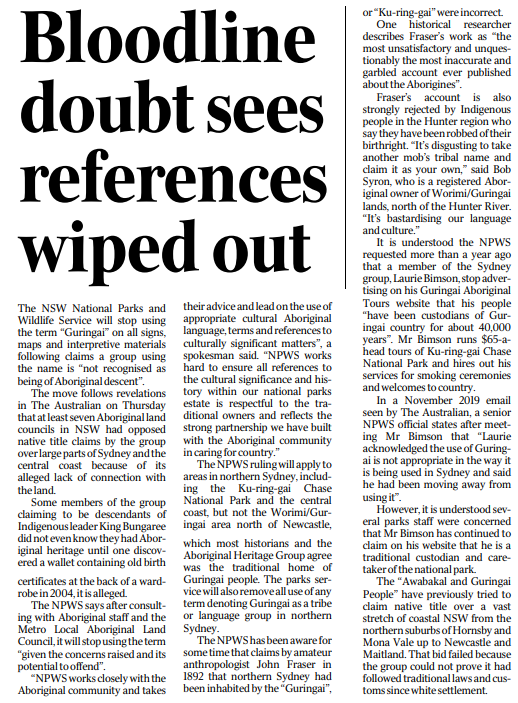
This paper examines the enduring self-assertions of non-authentic Aboriginal status by individuals and networks associated with the so-called “GuriNgai” identity, a fabricated Indigenous identity discredited by genealogical evidence, academic scrutiny, and Aboriginal community authorities.
Despite sustained exposure through dedicated platforms such as guringai.org and bungaree.org, this phenomenon persists. This endurance is analyzed through a multidimensional framework drawing from critical Indigenous studies, cult psychology, white-collar criminology, and poststructural theory.
The paper argues that the persistence is not merely a result of isolated delusion but a complex interplay of criminological impunity, sociocultural embedding, psychological investment, political expediency, legal ambiguity, and a broader crisis of epistemic legitimacy; a term referring to the public’s diminishing ability to distinguish credible from fraudulent claims to Aboriginality in settler-colonial contexts. Understanding this endurance requires an examination of the infrastructural conditions that allow such contested simulations to arise, evolve, and gain influence, functioning as a form of symbolic fraud: the strategic appropriation of Indigenous identity for personal, symbolic, or material gain.
Introduction:
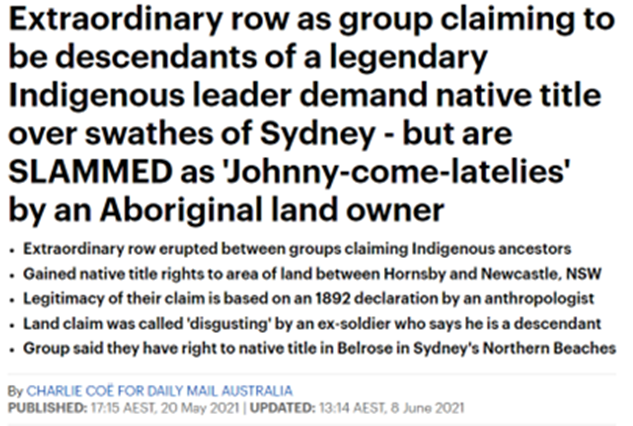
Despite overwhelming genealogical discrediting, academic scrutiny, Aboriginal community condemnation, and sustained exposure through websites such as guringai.org and bungaree.org, individuals and networks associated with the contested “GuriNgai” identity continue to assert non-authentic Aboriginal status across Northern Sydney, Hornsby Shire, and the Central Coast of New South Wales. The term “GuriNgai identity” refers to a manufactured claim to Aboriginality by non-Indigenous individuals who lack genealogical connection or community recognition.
This phenomenon cannot be dismissed as isolated delusion or misunderstanding. Its persistence reflects a confluence of criminological, sociological, psychological, political, and legal factors, underpinned by a deeper crisis of epistemic legitimacy. This paper adopts a multidimensional framework drawing from critical Indigenous studies, cult psychology, white-collar criminology, and poststructural theory to illuminate the infrastructural conditions that allow such identity simulations to endure, evolve, and gain influence.
Criminological Dimensions: Symbolic Fraud in a Regulatory Vacuum
From a criminological perspective, the GuriNgai phenomenon constitutes symbolic fraud, defined here as the strategic appropriation of Indigenous identity and cultural authority for symbolic or material benefit without genealogical legitimacy or community recognition. This aligns with white-collar crime, which typically involves non-violent deception by individuals in privileged positions to access economic or institutional advantage (Levi, 2008).
Claimants to the GuriNgai identity have reportedly accessed economic benefits such as grants and consultancy roles, and symbolic legitimacy including advisory appointments and public recognition. These benefits are obtained without adherence to genealogical truth or consent from Aboriginal communities. The absence of legal provisions criminalising fraudulent identity claims outside formal land or benefit schemes creates a low-risk, high-reward scenario. This legal vulnerability is evident in legislation such as the Aboriginal Land Rights Act 1983 (NSW) and the Native Title Act 1993 (Cth), which contain no explicit provisions to penalise false claims to Indigeneity in civic, cultural, or political contexts (Watson, 2014; Darnett, 2025).
Criminological theory provides tools for explaining this sustained impunity. Neutralisation theory (Sykes & Matza, 1957) suggests that individuals rationalise deviant actions through techniques such as denial of injury, appeal to higher loyalties, or condemnation of condemners. In this case, “GuriNgai” claimants frequently invoke narratives of spiritual connection, ancestral whispers, or justice for the “forgotten” to morally justify their actions. These rhetorical strategies position them as righteous intermediaries rather than deceptive actors.
Routine activity theory (Cohen & Felson, 1979) also illuminates the conditions for this symbolic fraud. The theory posits that crime occurs when three elements converge: a motivated offender, a suitable target, and the absence of a capable guardian. In the context of the GuriNgai simulation, the motivated offender is the identity claimant; the target is cultural authority and symbolic capital; and the absence of guardianship is constituted by inadequate legal protections, institutional hesitancy, and fragmented verification procedures. This criminogenic environment enables the persistence of fraudulent identity performance.
Moreover, the manipulation of bureaucratic inertia and legal ambiguity mirrors white-collar exploitation. Selective use of anthropological reports, curated genealogies, and performative ceremonies act as a form of symbolic laundering, obscuring the inauthenticity of claims behind a veneer of cultural legitimacy.
Sociological Embedding: Performative Indigeneity in Settler Networks
Sociologically, the endurance of the GuriNgai identity is sustained by its embedding within settler-led environmentalism, heritage activism, spiritual wellness circles, and community arts. Performative Indigeneity is the aesthetic display of Aboriginal identity through ceremony, language, or dress without genealogical legitimacy or cultural authority. Unfortunately such simulacra are valorized in these spaces as a sign of moral virtue and ecological authenticity (Carlson, 2016; Gorringe & Spillman, 2020).
The GuriNgai identity is not maintained in isolation. It is co-produced through settler desire for cultural inclusion, institutional aestheticism, and audience complicity. Ceremonial performances, land acknowledgements, symbolic regalia, and oral storytelling reinforce an illusion of authenticity. Institutions, including councils and cultural venues, often prioritise visibility and sentiment over verification, enabling the simulation to gain traction (Moreton-Robinson, 2015; Cooke, 2025a).
These performances operate as what Goffman might call impression management, curated to generate legitimacy and acceptance. Sociologically, they contribute to a process of symbolic capital accumulation, wherein the claimants accrue status, access, and moral authority by appearing to embody Aboriginal custodianship, regardless of the veracity of their claims.
Psychological Investment: Identity-Protective Cognition and Ontological Security
At the psychological level, the persistence of disputed claims is underpinned by identity, protective cognition, a phenomenon in which individuals reject evidence that threatens their group identity (Kahan et al., 2017)—and ontological security, the psychological stability derived from a coherent sense of self.
For many individuals reportedly involved in the GuriNgai simulation, the adopted identity has become foundational to their self-worth, social standing, and life narrative. Retracting the claim would entail a collapse of personal mythology and status, akin to what some scholars term psychic death. This aligns with self-verification theory, which shows that individuals are motivated to preserve a consistent identity, even in the face of disconfirming evidence (Swann, 1983).
Psychological research on motivated reasoning and belief perseverance explains why exposure or public denunciation often leads to defensiveness and deeper entrenchment rather than retraction (Bronstein et al., 2019; Bowes & Tasimi, 2022). This resistance is intensified when challenges come from legitimate Aboriginal voices, as such criticism directly threatens the spiritual and moral scaffolding upon which the simulation rests (Darnett, 2025).
Figures such as Tracey Howie, Paul Craig, and Laurie Bimson are frequently cited as constructing personal mythologies rooted in loosely interpreted ancestry, romanticised oral traditions, and spiritual entitlement. These narratives provide meaning, community, and identity, making them psychologically difficult to relinquish. The persistence of the GuriNgai simulation, therefore, reflects not only cognitive dissonance but also the existential utility of fabricated identity within emotionally resonant networks.
Conspirituality, Cultism, and Settler Magical Thinking
The GuriNgai simulation is embedded within a broader sociocultural configuration of settler conspirituality; a hybrid belief system combining New Age spiritualism, anti-establishment conspiracy theories, and pseudoscientific wellness practices (Ward & Voas, 2011; Day & Carlson, 2023). Conspirituality merges spiritual transcendence with suspicion of mainstream institutions, fostering a worldview where alternative knowledge is privileged, and institutional authority is seen as corrupt.
Within this framework, settler magical thinking encourages the belief that non-Indigenous individuals can intuitively or spiritually “become” Indigenous by claiming connection to land, dreams, or intuitive ancestry (Cooke, 2025a). This logic bypasses genealogical legitimacy and positions intuition and performance as valid substitutes for community recognition.
Figures such as Jake Cassar exemplify how settler conspirituality operates in practice. Cassar blends faux-environmentalism, mythic bushcraft, and self-appointed cultural stewardship into a charismatic persona that resonates with spiritually inclined settler publics. His appeal reflects cultic dynamics, including what Lalich (2004) calls bounded choice: a structure in which members experience a perceived lack of alternatives due to emotional coercion, sacred language, and constructed enemies.
The GuriNgai movement exhibits further cult-like traits: high control over internal narratives, exclusion of dissenting voices, ritualised identity performances, and the simulation of kinship networks. In such environments, opposition is reframed as persecution, reinforcing a martyr complex and deepening commitment to the fabricated identity (Cooke, 2025).
Political Utility: Symbolic Intermediaries of Settler Environmentalism
Politically, GuriNgai identities function as symbolic intermediaries: individuals who use the language of Aboriginal custodianship to mediate between settler institutions and Indigenous frameworks, often in ways that undermine genuine Aboriginal governance. These claimants have reportedly secured appointments to council advisory committees, participated in heritage consultations, and acted as spokespersons in land-use disputes (Cooke, 2025b).
Their strategic alliance with settler environmentalist groups such as the Coast Environmental Alliance and Save Kariong Sacred Lands enables them to present themselves as cultural authorities while advancing settler agendas. This alignment cloaks environmental obstructionism in a veneer of Aboriginal legitimacy, deflecting criticism and complicating policy discourse (Altman & Hinkson, 2007; Blancke et al., 2022).
Such symbolic legitimacy often circumvents community verification protocols and displaces genuine Aboriginal voices in consultative processes. This creates a dual harm: it obstructs Aboriginal self-determination while reinforcing settler control over land narratives. Politically, these actors are useful to councils seeking reconciliation optics without the perceived risks of engaging with sovereign Aboriginal institutions.
Legal Ambiguity: The Absence of Enforceable Verification
The persistence of the GuriNgai simulation is further enabled by a perception of legal ambiguity and institutional hesitation. In this context, legal ambiguity refers to the lack of application of consistent statutory mechanisms to verify Aboriginal identity in cultural and civic domains, especially outside of Aboriginal controlled spaces. Despite explicit rejection of the GuriNgai members assertions by Local Aboriginal Land Councils (LALCs), NTSCORP, and the Federal Court, many claimants continue to repeat disproven, highly offensive claims in the public sphere without consequence.
New South Wales lacks a statutory framework for penalising fraudulent claims to Indigeneity in arenas such as education, consultancy, and heritage governance. While identity verification standards exist in certain legal processes, such as native title, they are inconsistently applied in cultural and political spaces. Public officials, fearful of accusations of racism or litigation, often avoid identity adjudication altogether, even when fraud is suspected (Gardiner-Garden, 2003; Foley, 2003). This bureaucratic hesitancy creates a permissive environment in which impostor claimants exploit legal inertia and public confusion.
This pseudo-legal operating space mirrors white-collar dynamics: it involves the strategic exploitation of systemic vagueness, institutional fear, and the valorisation of lived experience over documented lineage. Claimants often rely on curated genealogies, spiritual narratives, and performative legitimacy, constituting what this paper refers to as symbolic laundering: the use of culturally coded aesthetics to obscure the absence of authentic authority. In the absence of enforceable verification mechanisms, institutions default to procedural neutrality, thereby enabling impostor actors to occupy roles of cultural authority unchallenged.
Theoretical Framing: Settler Simulation and the Epistemic Crisis
To fully comprehend the endurance of the GuriNgai simulation, it must be situated within a broader epistemological condition: the erosion of trust in authoritative knowledge systems. This crisis is particularly acute in settler-colonial contexts, where authenticity is increasingly measured by performance and emotional resonance rather than community recognition or genealogical truth.
Jean Baudrillard’s (1994) concept of the simulacrum is especially relevant. A simulacrum is a representation that no longer refers to any original; it becomes a copy with no basis in fact, yet perceived as real. The GuriNgai identity, as presented here, functions as a hyperreal simulation of Aboriginality, where the aesthetic and performative aspects of Indigeneity eclipse the genealogical and relational foundations upon which true identity is built.
This phenomenon is sustained by settler magical thinking: a belief system in which non-Indigenous individuals presume they can intuitively access or inherit Aboriginality through land connection, visions, or spiritual experiences. Rather than rooted in kinship and accountability, this form of identity is shaped by affective desire, symbolic enactment, and public affirmation (Cooke, 2025a).
Carl Sagan (1996) warned that societies governed more by intuition and emotional gratification than empirical reason are vulnerable to charlatanism. In this context, identity becomes not what is proven, but what is felt and performed. Public institutions, increasingly beholden to optics and inclusion rhetoric, struggle to differentiate between authentic and simulated Aboriginality—contributing to a broader epistemic rupture where aesthetic simulation replaces cultural truth.
The GuriNgai simulation is thus more than a cultural misrepresentation; it exemplifies a settler-colonial adaptation to contemporary crises of credibility, where symbolic performance is valorised over grounded authority. In this terrain, simulation is not error but strategy: it functions to obscure colonial power relations under the guise of reconciliation and inclusion.
Institutional Complicity and Political Hesitation
The GuriNgai simulation has been indirectly legitimised by the actions and inactions of public institutions. Institutional complicity refers here to the repeated failure of local councils, government bodies, and authorities to challenge fraudulent identity claims, often out of political expedience or administrative fear. Councils such as Hornsby Shire, Central Coast and Northern Beaches have historically engaged GuriNgai-affiliated individuals in advisory roles, awarded them heritage consultancy contracts, and endorsed them as cultural representatives.
These endorsements confer symbolic capital: legitimacy in the eyes of the public, access to institutional platforms, and credibility in media representation. Once granted, such legitimacy is difficult to retract, especially in bureaucratic cultures that are risk-averse and conflict-avoidant. Public institutions often operate within what this paper calls policy inertia: an administrative tendency to prioritise procedural continuity over cultural accuracy.
A key driver of this inertia is reputational risk. Council officers and public officials frequently avoid adjudicating identity disputes due to concerns about being accused of racism or cultural insensitivity. The affective power of spiritualised narratives, ceremonial performance, and inclusive language makes public confrontation politically hazardous. In such an environment, the default institutional response is deference, even in the face of clear genealogical refutation and community rejection.
This structural reluctance to verify identity claims reflects a deeper flaw in settler bureaucracies: the preference for surface reconciliation over substantive justice. Institutions prioritise aesthetics and consultation optics—appearances of inclusivity and cultural respect—over rigorous accountability to Aboriginal community governance. The result is a policy vacuum in which simulated identities thrive.
The Digital Front: Zeitgeist Warfare and the Power of Counter-Narratives
The endurance of the GuriNgai simulation is also shaped by contestation in the digital sphere. Here, the term zeitgeist warfare refers to the struggle over narrative authority in online spaces, where aesthetics, emotional resonance, and media fluency often shape public perception more than fact or expertise.
Digital media has been a double-edged sword. On one side, GuriNgai-affiliated actors have produced curated Welcome to Country videos, ceremony clips, and spiritual testimonials to construct the illusion of authenticity. These artifacts mimic genuine Aboriginal knowledge systems while hollowing them out, reducing cultural practice to visual signifiers designed to evoke recognition and legitimacy among settler audiences.
On the other side, digital resistance has emerged as a critical mode of Aboriginal self-determination. Websites such as guringai.org and bungaree.org have become repositories of genealogical evidence, oral history, and community testimony. These platforms do not merely expose fraud; they actively restore truth by reasserting the epistemic authority of Aboriginal communities and challenging the unverified narratives propagated by impostor claimants.
The success of simulated Indigeneity in digital culture is made possible by information asymmetry, the public’s limited knowledge of Indigenous identity protocols, and the affective bias toward emotionally resonant content. As Hartelius and Gellar (2023) argue, pseudoscientific and rhetorical mimicry can generate perceived credibility in wellness and spiritualist communities, despite lacking any evidentiary foundation. The same logic applies here: digital simulation often succeeds not by fooling experts, but by captivating audiences.
Ultimately, the digital front is not just a medium of representation but a battleground of legitimacy. In this contested space, settler simulations and Aboriginal truth-telling confront one another in real time, shaping public memory, policy perception, and the boundaries of cultural authority.
Cultural Harm and Epistemic Simulation
The stakes of the GuriNgai simulation are not merely symbolic but structurally damaging. Cultural harm refers to the displacement, distortion, or erasure of legitimate Aboriginal voices through fraudulent representations that mimic but do not embody Indigenous authority. These simulations siphon resources, sow confusion, and undermine both governance and public understanding of Aboriginal cultural protocols (Moreton-Robinson, 2015; Darnett, 2025).
Epistemic simulation, defined here as the strategic reproduction of knowledge systems and cultural signifiers in the absence of relational accountability, functions as a settler-colonial technology. By mimicking the language, symbolism, and rituals of Indigeneity, non-Aboriginal actors construct a convincing facsimile that gains institutional endorsement and public trust. This phenomenon aligns with Baudrillard’s (1994) concept of the simulacrum: a copy that substitutes for the original and ultimately displaces it in the collective imagination.
Postcolonial theory helps illuminate the deeper implications of this substitution. Through performance, fraudulent actors recode their presence on stolen land as spiritually legitimate, masking the foundational violence of dispossession with symbolic gestures of belonging. The result is not reconciliation but re-domestication; a symbolic reassertion of settler control under the guise of Indigeneity.
Critical race theory further reveals how structural whiteness enables these impostures. Institutions often treat whiteness as racially neutral, thereby granting fraudulent actors the benefit of presumed innocence while casting Indigenous resistance as disruptive or divisive. The privileging of individual self-identification over community recognition exacerbates this imbalance, privileging settler narratives of belonging over Aboriginal frameworks of kinship and custodianship.
Conclusion: Toward Disruption and Accountability
Understanding the persistence of the GuriNgai simulation requires a systemic lens. Its durability is not the result of a few deceptive individuals, but of an interlocking set of structural omissions, psychological incentives, sociocultural misrecognitions, and institutional failures. These simulations endure because they provide spiritual validation, symbolic capital, and material opportunity in environments where verification is weak, enforcement is absent, and aesthetics often substitute for authenticity.
The simulation thrives within supportive networks of settler conspirituality, pseudo-environmentalism, and bureaucratic hesitation. Its continued influence signals a broader legitimacy crisis in settler-colonial Australia, where truth-telling, identity governance, and public accountability remain unevenly enforced.
Disrupting this pattern requires more than critique. It demands the implementation of enforceable identity verification standards, the reassertion of Aboriginal community authority, the recalibration of cultural policy to centre genealogical integrity, and the development of public education campaigns to correct misinformation. Digital resistance platforms such as guringai.org and bungaree.org offer critical templates for such disruption, demonstrating the power of community-led truth-telling in reclaiming cultural sovereignty and exposing simulation.
Without these reforms, settler simulations will continue to displace, distort, and appropriate Indigenous identities, undermining both the present and future of Aboriginal governance
JD Cooke
Glossary of Key Terms
Bounded Choice: A concept from cult psychology describing environments in which members are conditioned to perceive no legitimate alternatives to group beliefs or leaders due to emotional coercion, sacred language, and isolation (Lalich, 2004).
Cultural Harm: The displacement, distortion, or erasure of legitimate Aboriginal voices through fraudulent representations that mimic but do not embody Indigenous authority.
Epistemic Legitimacy: The ability of knowledge claims to be recognised as credible and authoritative within a particular cultural or institutional context.
Epistemic Simulation: The strategic reproduction of knowledge systems and cultural signifiers in the absence of relational accountability or community recognition.
Identity-Protective Cognition: A psychological process whereby individuals reject evidence that threatens their social identity or group affiliation (Kahan et al., 2017).
Ontological Security: A sense of psychological stability and coherence derived from a consistent and socially affirmed identity.
Performative Indigeneity: The aesthetic or ritual display of faux-Aboriginal identity (e.g., through dress, language, or ceremony) by individuals without genealogical or community legitimacy, often for symbolic or material gain.
Policy Inertia: A bureaucratic tendency to avoid action on complex or politically sensitive issues, resulting in administrative stasis even in the face of known harms.
Pseudo-Legal Operating Space: A domain where actions exploit legal grey zones or gaps, especially where identity claims are unregulated, producing impunity for symbolic fraud.
Settler Conspirituality: A fusion of New Age spiritual beliefs, wellness discourses, and conspiracy theories that valorise intuition and esoteric knowledge while opposing scientific or institutional authority (Ward & Voas, 2011).
Settler Magical Thinking: The belief, often unconscious, that non-Indigenous people can intuitively or spiritually “become” Aboriginal without genealogical connection or community validation.
Simulacrum: A copy or representation that becomes disconnected from and replaces the original, as theorised by Baudrillard (1994). In this context, a simulated Aboriginal identity that appears more “authentic” than genuine Indigeneity.
Symbolic Fraud: The appropriation of cultural identity or authority for reputational, material, or political gain, without community consent or genealogical legitimacy.
Symbolic Intermediary: A person who presents themselves as a bridge between Aboriginal culture and settler institutions, often without genuine authority, serving settler political or environmental goals.
Symbolic Laundering: The process by which inauthentic identity claims are legitimised through performance, curated aesthetics, or institutional partnerships, obscuring their lack of credibility.
Zeitgeist Warfare: The contest over cultural legitimacy and public perception in digital spaces, where narrative framing, emotional resonance, and aesthetic appeal often outweigh factual accuracy.
References
Altman, J., & Hinkson, M. (2007). Coercive reconciliation: Stabilise, normalise, exit Aboriginal Australia. Arena Publications.
Baudrillard, J. (1994). Simulacra and simulation (S. F. Glaser, Trans.). University of Michigan Press.
Blancke, S., Boudry, M., & Pigliucci, M. (2016). Why do irrational beliefs mimic science? The cultural evolution of pseudoscience. Theoria, 83(3), 78–97.
Bowes, S. M., & Tasimi, A. (2022). Intellectual humility and the spread of misinformation: Individual differences in susceptibility to fake news, conspiracy theories, and pseudoscience. Current Opinion in Psychology, 47, 101392.
Bronstein, M. V., Pennycook, G., Bear, A., Rand, D. G., & Cannon, T. D. (2019). Belief in fake news is associated with delusionality, dogmatism, religious fundamentalism, and reduced analytic thinking. Journal of Applied Research in Memory and Cognition, 8(1), 108–117.
Carlson, B. (2016). The politics of identity: Who counts as Aboriginal today? Aboriginal Studies Press.
Cohen, L. E., & Felson, M. (1979). Social change and crime rate trends: A routine activity approach. American Sociological Review, 44(4), 588–608.
Cooke, J. D. (2024). How the GuriNgai cost Hornsby Shire residents $36 million dollars, and Westleigh Park. https://guringai.org/2024/06/14/how-the-guringai-cost-hornsby-shire-residents-36-million-dollars-and-westleigh-park/
Cooke, J. D. (2025a). The sacred and the simulacrum: Distinguishing Indigenous epistemology from settler magical thinking in contemporary Australia. Bungaree Press.
Cooke, J. D. (2025b). The false mirror: Settler environmentalism, identity fraud, and the undermining of Aboriginal sovereignty on the Central Coast of NSW. Bungaree Press.
Darnett, E. (2025). Interconnected false worlds: Indigenous identity fraud, settler conspirituality, and the epistemic crisis of belief in contemporary Australia [Doctoral dissertation, University of Sydney].
Day, P., & Carlson, B. (2023). So-called Sovereign Settlers: Settler Conspirituality and Nativism in the Australian Anti-Vax Movement. Humanities, 12(5), 112. https://doi.org/10.3390/h12050112
Foley, G. (2003). Indigenous epistemology and Indigenous standpoint theory. In G. Foley, Indigenous education and the role of research. Australian Society for Indigenous Education.
Gardiner-Garden, J. (2003). Defining Aboriginality in Australia. Parliament of Australia.
Gorringe, S., & Spillman, D. (2020). Beyond authenticity: Identity, performativity, and Aboriginal resistance. Journal of Indigenous Research, 9(1), 1–17.
Hartelius, E., & Gellar, L. (2023). Rhetorical pseudoscience and the credibility crisis in wellness communities. Rhetoric and Public Affairs, 26(4), 583–614.
Kahan, D. M., Peters, E., Dawson, E., & Slovic, P. (2017). Motivated numeracy and enlightened self-government. Behavioural Public Policy, 1(1), 54–86.
Kwok, N. (2015). Anthropological Connection Report: Awabakal and Guringai People NC2013/002.
Lalich, J. (2004). Bounded choice: True believers and charismatic cults. University of California Press.
Levi, M. (2008). White-collar crime and the counterfactual imagination: Problems of framing and anchoring. Theoretical Criminology, 12(3), 295–317.
Metropolitan Local Aboriginal Land Council (MLALC). (2020, June 3). Premier NSW Final Draft Letter Re: Guringai Claimants.
Moreton-Robinson, A. (2015). The White Possessive: Property, power, and Indigenous sovereignty. University of Minnesota Press.
NSW Aboriginal Land Council. (2020). Submission to the National Native Title Tribunal: ILUA Concerns.
Sagan, C. (1996). The demon-haunted world: Science as a candle in the dark. Random House.
Swann, W. B. (1983). Self-verification: Bringing social reality into harmony with the self. In J. Suls & A. G. Greenwald (Eds.), Psychological perspectives on the self (Vol. 2, pp. 33–66). Lawrence Erlbaum Associates.
Sykes, G. M., & Matza, D. (1957). Techniques of neutralization: A theory of delinquency. American Sociological Review, 22(6), 664–670.
TallBear, K. (2013). Native American DNA: Tribal belonging and the false promise of genetic science. University of Minnesota Press.
Vyse, S. A. (2018). Believing in magic: The psychology of superstition. Oxford University Press.
Ward, C., & Voas, D. (2011). The emergence of conspirituality. Journal of Contemporary Religion, 26(1), 103–121.
Watson, I. (2014). Aboriginal peoples, colonialism and international law: Raw law. Routledge.
 A Long Con, Gone on Too Long.
Leave a reply to Jake Cassar, the non-Aboriginal GuriNgai network, and the circulation of falsified authority – Bungaree.org Cancel reply