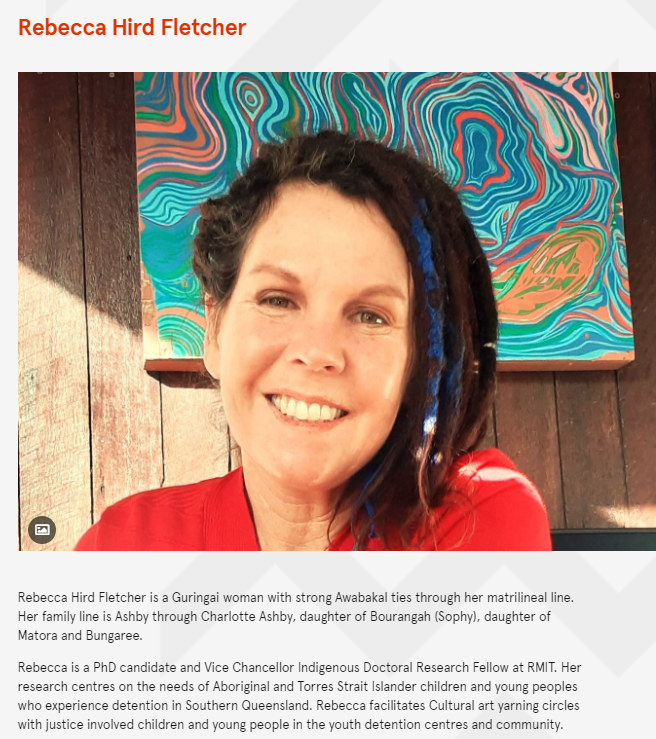
Charlie Needs Braces is the musical project of Melbourne-based artist Charlie Woods, frequently accompanied by her sister, Miri Woods. Together with their mother, Rebecca Hird-Fletcher, the Woods family has actively claimed Aboriginal identity by asserting descent from the historical Broken Bay leader Bungaree and his wife, Matora. These assertions have been widely and consistently challenged by Aboriginal community members (including descendants of Bungaree and Matora), cultural historians, and multiple statutory bodies on the basis of genealogical and historical inaccuracy and lack of cultural recognition (Guringai.org, 2024; MLALC, 2020).

There is no genealogical evidence to support the claim that Charlie Woods or her sister Miri Woods are of Aboriginal descent. Their mother, Rebecca Hird-Fletcher, has publicly claimed to be a GuriNgai woman descended from Bungaree and Matora, through their daughter ‘Sophy’.
However, genealogical research confirms that Bungaree and Matora had several children, but only one daughter—Biddy, also known as Biddy Salamander, Sarah Wallace, Sarah Ferdinand, or Sarah Lewis. These descendants are verifiably documented and continue their connection. The Hird-Fletcher-Woods family is not among them (Guringai.org, 2024).

Dr Natalie Kwok, in her forensic anthropological report completed in 2015, critically evaluated the lineage claims associated with Tracey-Lee Howie and her supposed descent from Bungaree and Matora. Dr Kwok concluded that there is no genealogical, historical, or cultural basis for the claim, which she found to be a unsupported by archival records, oral history, or Aboriginal community recognition. Crucially, because Charlie Woods, Miri Woods, and Rebecca Hird-Fletcher share the same line of descent as Tracey Howie, Dr Kwok’s findings apply equally to them. Her report affirmed that individuals in this lineage do not meet the three components of the tripartite definition of Aboriginality: proven descent, and community recognition, relying solely on self-identification. These findings render the Woods family’s GuriNgai identity claims invalid.

These conclusions have been reinforced and supported by numerous expert and community-based rejections. The Metropolitan Local Aboriginal Land Council (MLALC), in a letter dated 3 June 2020, unequivocally stated that the “Guringai” identity has no genealogical or cultural basis and is being used fraudulently by non-Aboriginal individuals (MLALC, 2020).
The Darkinjung Local Aboriginal Land Council (DLALC) has also submitted formal objections to custodianship claims made by the GuriNgai and affiliated groups, affirming that they are not recognised as Traditional Custodians (DLALC, 2024). The Aboriginal Cultural Heritage Advisory Committee (ACHAC) endorsed these concerns and called for greater rigour in institutional consultation processes, warning against the endorsement of fabricated identities (ACHAC, 2022). Further affirmation comes from the joint submission by the NSW Aboriginal Land Council and NTSCORP titled Our Culture in Our Hands, which directly addressed the harms caused by identity fraud in cultural heritage contexts and stressed the need for Aboriginal community-verified claims of identity (NSWALC & NTSCORP, 2011).

Linguistic research by Dr Amanda Lissarrague and Robert Syron (2024), in their language and country report Guringaygupa Djuyal Barray, confirmed that the Guringay/Guringai people are connected to the Upper Hunter region and are in no way connected to the Broken Bay or Central Coast area. They further noted that the use of the term “Guringai” on the Northern Beaches, Hornsby Shire, and Central Coast of NSW was a colonial imposition and misapplication without cultural continuity.
This position is reinforced by historians Geoff and Sandra Champion (2003), who argued that the supposed Kuringgai tribal identity was a colonial misreading of anthropological records and never represented an actual Aboriginal group within the Sydney basin or Central Coast. Even Warren Whitfield, the non-Aboriginal founder of the GuriNgai identity, admitted in a 2001 oral history interview with Rosemary Block that his claims were based not on Aboriginal knowledge or community support but on speculative reinterpretations of colonial texts and linguistic fragments (Whitfield, 2001).

These repeated, consistent, and well-documented rejections collectively dismantle the basis for the Woods family’s claims to Aboriginality and expose their assertion of GuriNgai identity as a settler fabrication unsupported by any authoritative Aboriginal entity or community.
Nevertheless, Charlie and Miri Woods routinely refer to themselves as “proud GuriNgai women” in public performances and media interviews. Charlie Woods has stated in Beat Magazine that her music is “derived from my mob” and rooted in “protecting Country” (Beat, 2025).
In her press release for the debut album Saltwater People, she claimed it reflected “songs and sounds passed down from my family” (Sheldon Ang Media, 2025). Such statements, unmoored from cultural accountability, exemplify what Watego describes as the performative deployment of identity, where an imagined Indigeneity—divorced from land, kin, and protocol—is used to authenticate settler-facing narratives of belonging.
Watego (2021) powerfully articulates how these narratives are often rehearsed within the white gaze: the ambiguously Indigenous individual, unable to name their ancestors or mob, relies instead on grainy photographs, whispers of distant relatives, and deathbed confessions. Identity becomes a performance for colonial institutions that privilege a sentimental or artistic indigeneity, rather than one embedded in cultural authority. The Woods sisters’ claim of “possum” as a personal totem and their invocation of “GuriNgai language” in songs such as “Daryung” (Sheldon Ang Media, 2025) are emblematic of this, as there is no verifiable totemic system, language tradition, or cultural practice connected to the invented “GuriNgai” identity.
Social media has amplified the identity performance. On Instagram and TikTok, Charlie Woods regularly tags #GuriNgai and refers to “my GuriNgai ancestors” (@charlieneedsbraces, 2024). In doing so, she draws upon settler-validated aesthetics of Aboriginality while circumventing the need for actual cultural legitimacy. As Watego notes, it is white institutions—festivals, universities, funding bodies—that most eagerly platform these ambiguously Indigenous figures, precisely because their identity performance reinforces rather than disrupts the colonial order.
Hird-Fletcher, the family’s matriarch, plays a central role in this strategy. As co-author of the GEM-Youth tool and co-admin of the “Family of Bungaree” Facebook group, Hird-Fletcher has advanced her family’s narrative despite its rejection by relevant Aboriginal authorities. Her affiliation with other controversial identity claimants such as Dr Sharlene Leroy-Dyer and Mr Laurie Bimson further implicates her in what Watego (2021) describes as the occupational Indigeneity industrial complex, where the performance of Aboriginality is used to secure employment, funding, and public authority, while marginalising actual Blackfullas.
This logic is most glaring in the reception of Charlie Needs Braces within arts institutions. The act was awarded the 2022 Upstart Award and the 2023 Archie Roach Foundation Award for Emerging Talent—both honours reserved for Aboriginal artists (ABC, 2025). The disbursement of such awards to unverified identity claimants represents a betrayal of their intent and a failure of institutional responsibility. As Watego argues, these institutions are more interested in counting Aboriginal bodies, regardless of cultural legitimacy, than in upholding cultural sovereignty or community governance. The Woods family’s inability to name their mob or Country, and their refusal to be accountable to Aboriginal protocols, should have precluded them from eligibility.
This appropriation of cultural identity is not neutral. It is, as Watego (2021) insists, an enactment of settler colonial violence: “It is not about ancestry, but about being… if you got no relationships you got nothing.” Aboriginal identity is relational, not possessive. It is about responsibility to community, not performance for audiences. Charlie Needs Braces, by contrast, has monetised and aestheticised Aboriginality while remaining disconnected from those whose lands and lineages they invoke.
Such conduct constitutes what Suzanne Ingram (2008) called “Sleight of Hand”, the strategic mobilisation of Aboriginality for career advancement. It erases Aboriginal experiences and recasts the identity question in settler terms, where “Who’s your mob?” becomes “How Indigenous do you look?” or “What does your bio say?” Watego (2021) reminds us that these are the same colonial terms used to erase Aboriginal peoples in the past, now redeployed by those who refuse to be accountable to the people they claim to be.
Ultimately, Charlie Needs Braces exemplifies a settler colonial hunger not for Aboriginal people, but for a consumable, affective, unthreatening performance of Aboriginality. It is the latest version of what Philip Deloria (1998) termed “Playing Indian”: a cultural fantasy in which settlers enact an Indianness without Indians. Watego (2021) affirms this in the Australian context, showing how settler institutions reward an Aboriginality that has no Country, no kin, and no resistance.
To address this harm, institutions must reject unverified identity claims and re-centre Aboriginal authority in decision-making. Awards and appointments must be contingent on cultural legitimacy, not self-narration alone. Media platforms must cease valorising settler performances of Blackness and instead uplift those who carry the burden and beauty of being Aboriginal every day. Most of all, we must heed the words of Watego (2021): being Indigenous is not an entitlement, it is a way of being in the world.
Reference List
ABC. (2025). Charlie Needs Braces artist profile. Triple J Unearthed. https://www.abc.net.au/triplejunearthed/artist/charlie-needs-braces/
AIATSIS. (2020). AIATSIS Code of Ethics for Aboriginal and Torres Strait Islander Research. https://aiatsis.gov.au
Beat. (2025). Charlie Needs Braces: “Protecting Country, taking care of our wildlife – a lot of the music is derived from my mob”. Beat Magazine. https://beat.com.au/charlie-needs-braces-protecting-country-taking-care-of-our-wildlife-a-lot-of-the-music-is-derived-from-my-mob/
Block, M. (2001). Warren Whitfield oral history interview [Transcript]. State Library of New South Wales.
Champion, G., & Champion, S. (2003). Did the Aborigines of the Manly, Warringah and Pittwater Peninsula really belong to the Kuring-gai Tribe? Unpublished manuscript, Warringah Library.
Deloria, P. J. (1998). Playing Indian. Yale University Press.
Darkinjung Local Aboriginal Land Council. (2024). Public submission regarding cultural heritage misappropriation in the Kariong area.
Guringai.org. (2024). Charlie Needs DNA testing. https://guringai.org/2024/07/11/charlie-needs-dna-testing/
Ingram, S. (2008). Sleight of hand: Aboriginality and the education pathway. Paper presented at the World Indigenous Peoples Conference on Education.
Kwok, N. (2015). Anthropological report: Tracey-Lee Howie lineage [Unpublished report submitted to NSW Government].
Lissarrague, A., & Syron, R. (2024). Guringaygupa djuyal, barray: Language and Country of the Guringay people https://hunterlivinghistories.com/wp-content/uploads/2024/11/Guringaygupa-djuyal-barray05-11-2024.pdf
McEntyre, E. (2023). Personal communication regarding Guringay cultural boundaries [Unpublished].
Metropolitan Local Aboriginal Land Council. (2020). Premier NSW final draft MLALC letter re Guringai claimants, 3 June 2020 [User-uploaded file].
NSW Aboriginal Land Council & NTSCORP. (2011). Our culture in our hands: Submission in response to the reform of Aboriginal culture and heritage in NSW [User-uploaded file].
Sheldon Ang Media. (2025). Charlie Needs Braces sings about Guringai’s totem in Daryung Melbourne launch show. https://sheldonangmedia.com/press-release/charlie-needs-braces-sings-about-guringais-totem-in-daryung-melbourne-launch-show/
Watego, C. (2021). Another day in the colony. University of Queensland Press. https://ebookcentral.proquest.com/lib/griffith/detail.action?docID=6784889
YouTube. (2024). Charlie Needs Braces official channel. https://www.youtube.com/channel/UCW6tnh8QF38b0gdbJtNIt8A
 A Long Con, Gone on Too Long.
Leave a reply to This Is Not Aboriginal Culture: “NYAA WA” by Charlie Needs Braces, Is a Ritual of Cultic Identity Fraud, and Must Be Exposed – Bungaree.org Cancel reply