In the aftermath of the COVID-19 pandemic, Australia witnessed an intensification of conspiratorial and anti-government ideologies, culminating in visible and increasingly dangerous settler movements that co-opted Aboriginal symbols, narratives, and sovereignty. Among these movements, the Muckadda Camp protest on the lawns of Old Parliament House in 2021–2022 signified a watershed moment. It fused anti-vaccination rhetoric, far-right sovereign citizen ideology, and a settler appropriation of Aboriginal identity.
This paper critically examines the ideological and material links between Muckadda Camp and regional settler conspiritualist movements such as My Place, Coast Environmental Alliance (CEA), Save Kariong Sacred Lands, and Community Voice Australia. It argues that these groups operate through a logic of settler nativism (Tuck & Yang, 2012), conspirituality (Ward & Voas, 2011), and the white possessive logic of sovereignty (Moreton-Robinson, 2015), performing a politics of replacement that erodes Aboriginal land rights and legitimised cultural authority.
Settler Conspirituality and the Anti-Vax Movement
Day and Carlson (2023) provide a discursive map of the ways settler conspiritualists co-opt Indigeneity to enact fantasies of sovereign purity and spiritual resistance. Muckadda Camp was a performative manifestation of this. Promoted as a gathering of “Original Sovereigns”, its participants engaged in what Philip Deloria (1998) would call “playing Indian”—appropriating cultural symbols such as ochre, the yidaki, and ceremonial dance while aligning themselves with the far-right QAnon mythos of an impending apocalyptic purge.
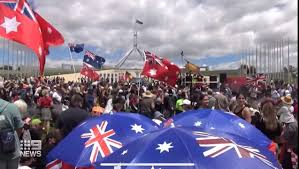
The fire at Old Parliament House in 2021—staged by people claiming to be “Original Sovereigns”—was framed by conspiracists as an Aboriginal uprising. But no recognised Elders or Aboriginal community groups supported or endorsed the act. On the contrary, many of us were horrified (Taplin, 2023). This false flag operation exploited Aboriginal pain for settler spectacle. It desecrated sacred political memory and misled the public into believing that Aboriginal people support pseudo-legal insurrections. The manipulation of Aboriginal imagery to justify anti-vaccine, anti-government, and anti-law stances does not liberate—it colonises anew.
Sovereign citizen ideology—rooted in U.S.-style pseudo-law—has been imported, localised, and dangerously entwined with misappropriated Aboriginal motifs (UNSW Law Journal, 2024; Fiebig & Koehler, 2024). This has produced new forms of legal fantasy that are weaponised to deny court authority, reject public health orders, and now, to subvert Aboriginal land claims. In Native Title meetings across the country, impostors now turn up demanding recognition as “sovereign Aboriginals,” obstructing legal processes, hijacking consultations, and derailing negotiations. Elders are forced to prove and re-prove their legitimacy against total strangers who have neither ancestry, nor kinship, nor standing in Aboriginal Law (Taplin, 2023; Singh, 2024).
These impostors are not only a nuisance; they inflict measurable harm. Aboriginal Land Councils have documented the psychological toll on communities forced to rebut false claims over and over again. The emotional labour placed upon Elders—already burdened by the legacy of colonisation—is immense. There is no dignity in having to argue one’s Aboriginality in front of a white man wrapped in a stolen flag.
Conspirituality, meanwhile, adds a dangerous spiritual veneer to settler intrusions. This ideology fuses New Age beliefs with anti-government conspiracies and anti-science sentiment, creating cult-like narratives that distort Aboriginal Dreaming and kinship systems (Baker, 2022; Halafoff et al., 2023). Wellness influencers rebrand our sacred sites as “vortexes” or “stargates.” Pseudo-ceremonies are performed on Country without permission. These acts profane sacred spaces and sever the relational ties we hold with land and Ancestors. They harm our spirits. The sense of violation we feel when outsiders trample our Law in pursuit of their fantasies is not metaphorical—it is visceral.


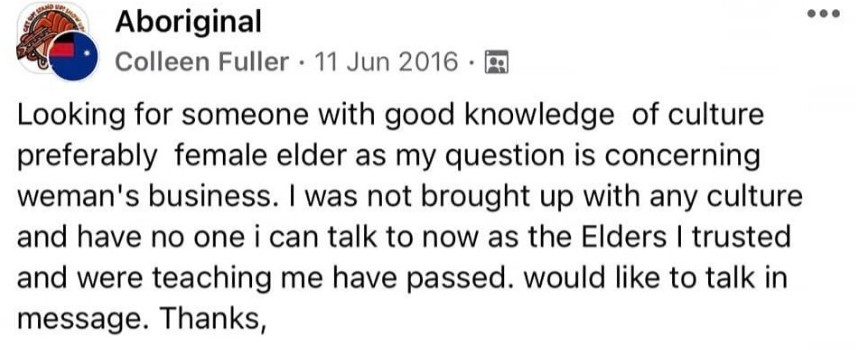
Rather than acting in solidarity with Aboriginal sovereignty movements, these actors attempted to overwrite them. This phenomenon was analysed by Aird and Ardill (2023) as a toxic admixture of pseudo-legalism and settler spiritual exceptionalism aimed at replacing Indigenous political orders. Singh (2024) further warns that these ideological formations pose serious risks in the high-risk offender and counter-terrorism contexts due to their legal nihilism and rejection of state authority.

From Muckadda to the Central Coast: The Localisation of Settler Conspirituality
Groups like My Place Central Coast and Coast Environmental Alliance exhibit near-identical ideological formations. My Place deploys a mixture of sovereign citizen language, anti-5G and anti-vaccine conspiracy, and white utopian nostalgia, presenting the pandemic response as evidence of state corruption.
Figures like Kate Mason, a prominent CEA and Community Voice Australia affiliate, have amplified similar rhetoric in opposition to Darkinjung Local Aboriginal Land Council’s land development projects, particularly at Kariong.
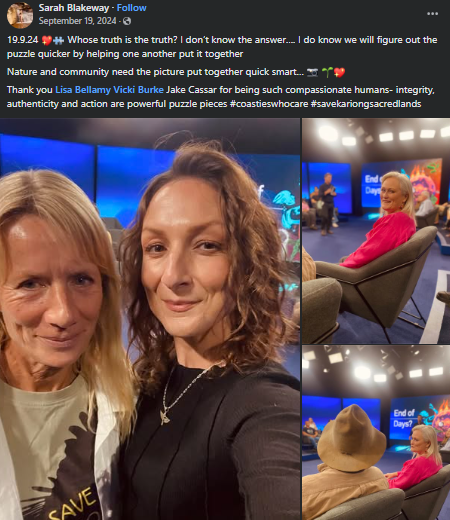
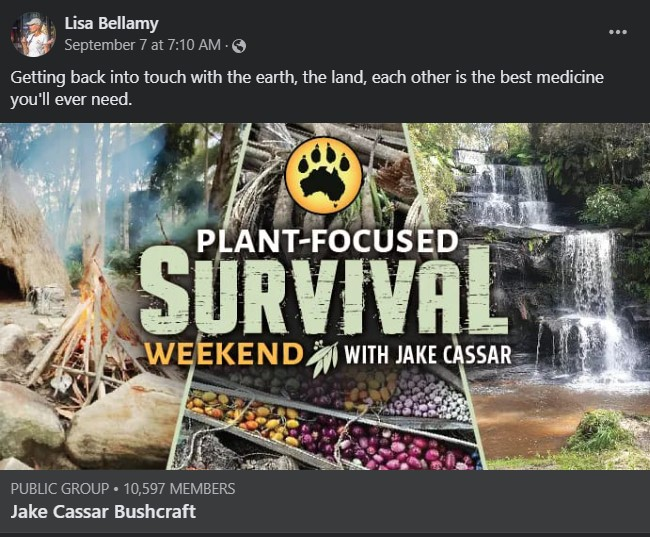
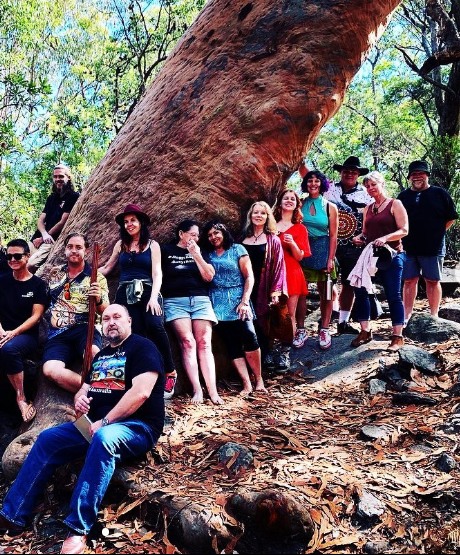
Jake Cassar—who has led “walks” to sites he deems sacred—uses quasi-spiritual settler environmentalism to mask a racialised opposition to legitimate Aboriginal land governance, echoing the symbolic logic of Muckadda Camp by positioning himself and his followers as spiritual guardians of Country (Cooke, 2025).

Taplin et al. (2023) argue that these actors form a “superconspiracy”—a loosely networked ideology that collapses far-right libertarianism, eco-fascism, and pseudo-Aboriginal spiritualism into one worldview.
The result is a movement that seeks to appropriate Aboriginality as a tool of resistance against perceived globalist control while simultaneously denying actual Aboriginal people a voice in land governance and cultural continuity.
Settler Nativism and the Logic of Replacement
Lorenzo Veracini (2010) defines settler colonialism as a structure intent on the elimination and replacement of Indigenous peoples. Day and Carlson (2023) expand on this by showing how contemporary white spiritual settlers perform sovereignty through borrowed Indigenous tropes while actively undermining the actual political claims of Aboriginal communities.
Save Kariong Sacred Lands and Save Kincumber Wetlands both illustrate this process. They mobilise settler environmental sentiment to oppose projects by Darkinjung LALC, despite the Aboriginal Cultural Authority of DLALC being clearly established (Darkinjung LALC, 2021; 2022).

This is settler nativism in practice. Tuck and Yang (2012) describe it as the process by which settlers attempt to nativise themselves to Indigenous lands to avoid the moral culpability of colonisation. It is not simply about co-option—it is about strategic cultural and political erasure.
The self-declared “GuriNgai” group, for example, claims a faux Aboriginal identity to assert cultural authority and leverage over heritage processes (Cooke, 2025). Their activities mirror those of the Original Sovereigns at Muckadda Camp, who leveraged Indigenous iconography to justify occupying land and resisting state mandates. As Walker (2023) notes, this includes individuals and factions operating with a dangerous blend of pseudo-Aboriginal identification and sovereign citizen ideology that deliberately seeks to erase both Aboriginal title and legal legitimacy.
The cultural and legal confusion sown by these actors exacerbates the precarity of legitimate Aboriginal claims. McGregor (2021) and Kowal (2020) have both highlighted how the post-1971 rise in self-identification as Aboriginal has created a terrain in which identity claims are increasingly decoupled from community verification, opening the door to what Leroux (2019) calls “distorted descent”. As Ingram (2008) explains, such performances of Aboriginality often accompany an “entrepreneurial” appropriation of Aboriginal status for symbolic capital in education, art, and policy. The NSW Aboriginal Land Council and NTSCORP (2011), along with the Metropolitan Local Aboriginal Land Council’s 2020 letter to the Premier of NSW, reinforce that unverified Guringai claimants lack both genealogical credibility and community endorsement.
Performing Indigeneity and the White Possessive
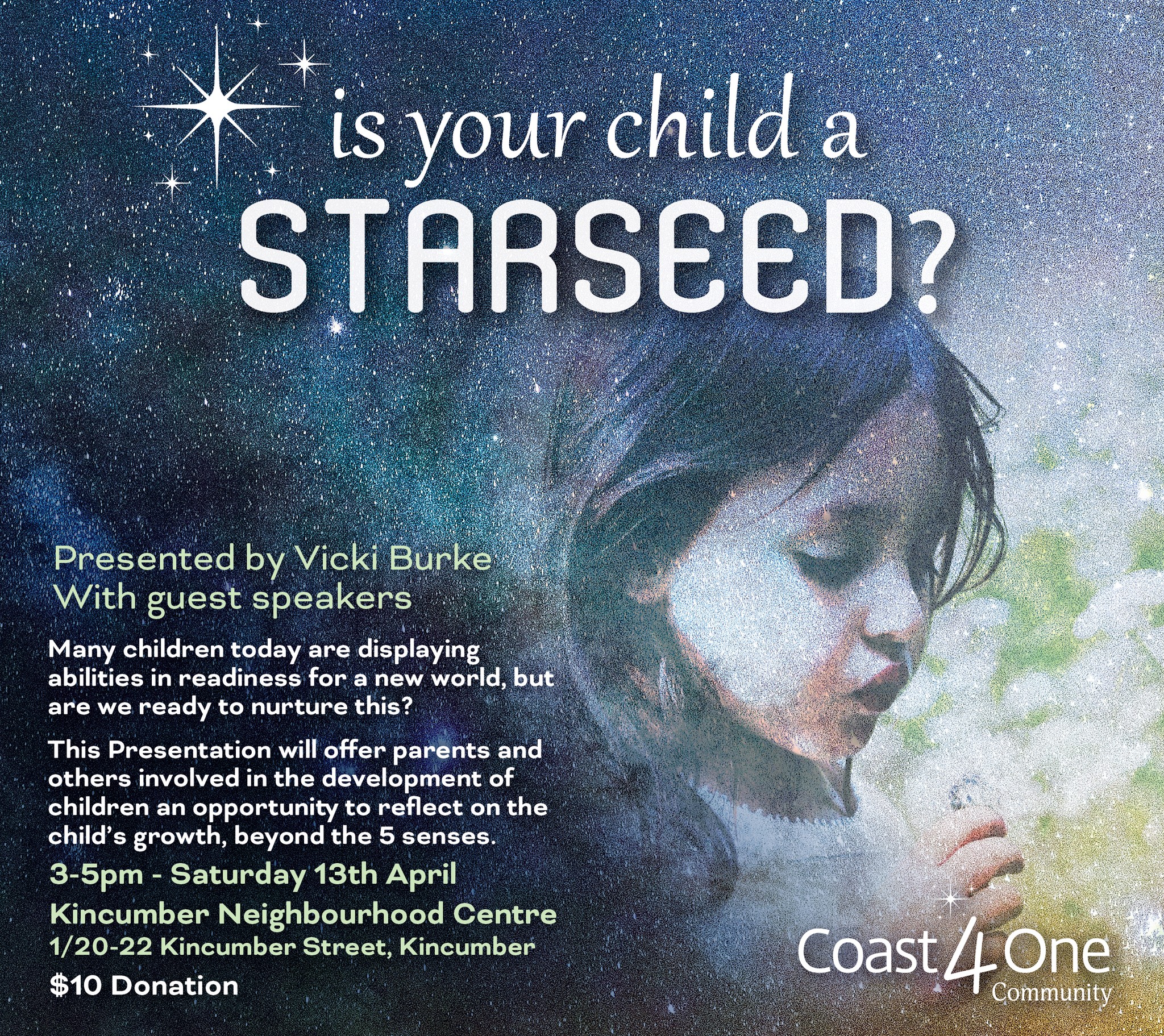
Moreton-Robinson’s (2015) theory of the white possessive is critical here. She argues that settler sovereignty is maintained through a possessive investment in land and law that positions whiteness as normative. This is clearly visible in the rhetoric of groups like Community Voice Australia and in the public statements of figures like Rod Culleton and Mark McMurtrie. Both have attempted to collapse sovereign citizen narratives with faux-Indigenous claims, positing that the Crown lacks legitimacy while simultaneously denying Aboriginal sovereignty. The inversion is complete when they declare themselves to be the lawful stewards of the land. McMurtrie’s own published documents, including statements hosted on Constitution Watch and Freeman Delusion, demonstrate his appropriation of both Aboriginal iconography and radical legalistic jargon to claim rights over Country on behalf of fictitious tribal corporations.

These narratives thrive in the absence of statutory protections for Aboriginal cultural authority. As highlighted in the 2022 NSW Legislative Council report on the Aboriginal Cultural Heritage (Culture is Identity) Bill, one of the core failures of current law is the lack of recognition of legitimate Aboriginal decision-making entities (NSW Legislative Council, 2022). Groups like the fake “GuriNgai” exploit this vacuum to lodge competing claims with no genealogical or community foundation, undermining land rights, cultural preservation, and truth-telling processes (Cooke, 2025; NSWALC & NTSCORP, 2011).

Media Circulation and Social Legitimisation
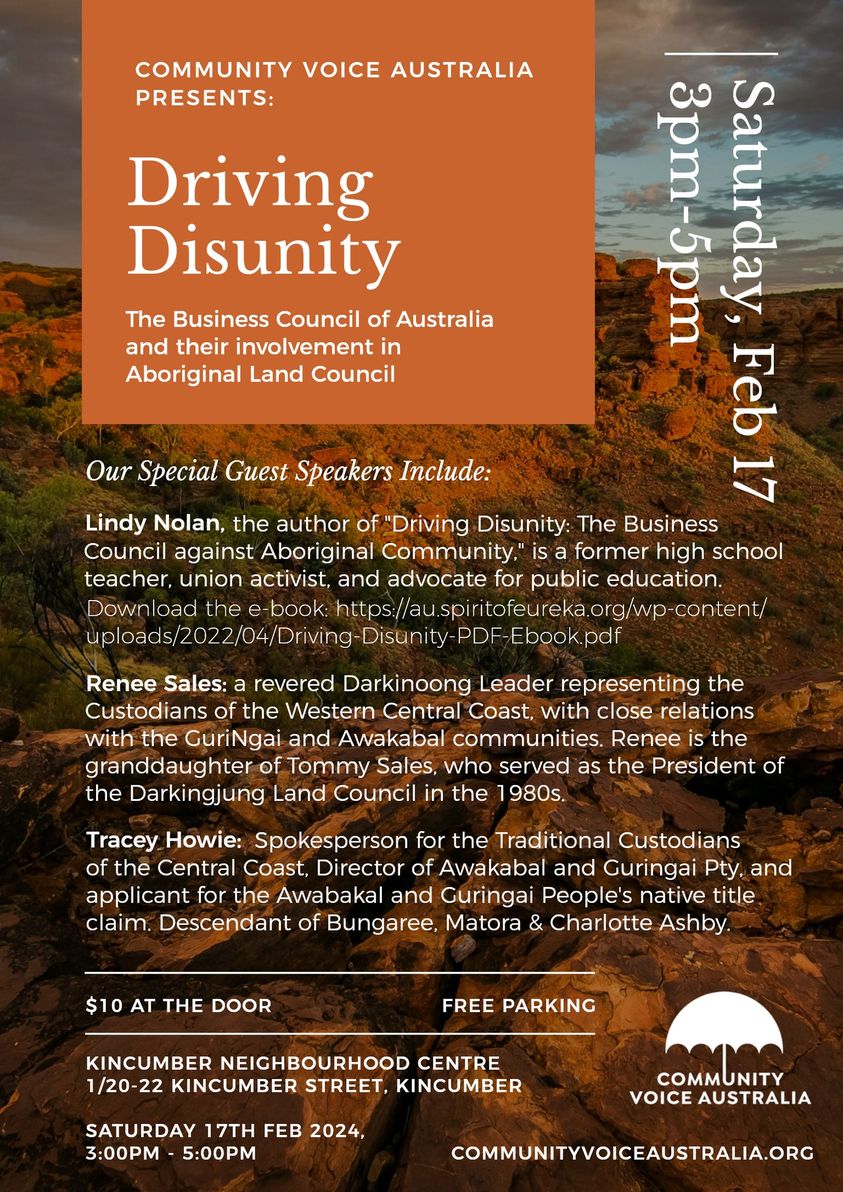
The role of alternative and mainstream media is instrumental in this cultural production. Muckadda Camp was heavily promoted through What’s Doin Media and social media influencers aligned with the Freedom movement, as well as through YouTube channels now affiliated with My Place. On the Central Coast, Coast Community News and Community Voice Australia provide similarly uncritical platforms for settler-conspiritualist narratives. These media outlets frame DLALC’s lawful developments as illegitimate, obscuring the reality that they are an Aboriginal land council acting under state legislation. Such distortion functions as a cultural displacement strategy—delegitimising actual Aboriginal sovereignty by saturating the public sphere with replacement settler narratives (Walker, 2023).
Conclusion: From Conspirituality to Counter-Sovereignty
Settler conspirituality in Australia, particularly on the Central Coast, is not merely fringe or irrational—it is a rational extension of settler colonial logic repackaged through the language of spiritual revival and natural law. From the Muckadda Camp to My Place and Save Kariong, these movements converge in their denial of Aboriginal sovereignty and their investment in settler futurity. Their rhetoric borrows from anti-globalist, eco-fascist, and wellness ideologies to spiritually bypass the obligations of truth-telling, treaty, and decolonisation.
The task, then, for scholars and communities is not only to document these movements, but to interrupt them—to expose the mechanisms of settler replacement and to reassert the ongoing and unceded sovereignty of Aboriginal and Torres Strait Islander nations.
JD Cooke
References
Aboriginal Heritage Office. (2015). Filling a void: A review of the historical context for the use of the word ‘Guringai’. https://www.aboriginalheritage.org
Aird, J., & Ardill, A. (2023). A ‘kind of sovereignty’: Toward a framework for the recognition of First Nations sovereignties at common law. Melbourne University Law Review, 46(2), 330–369. https://law.unimelb.edu.au/__data/assets/pdf_file/0004/4772749/01-Aird-and-Ardill-330.pdf
Carlson, B., & Day, M. (2023). So-called sovereign settlers: Settler conspirituality and nativism in the Australian anti-vax movement. Humanities, 12(5), 112. https://doi.org/10.3390/h12050112
Cooke, J. D. (2025). The appropriation of Indigenous identity by the non-Aboriginal GuriNgai group. https://guringai.org/2025/06/04/the-appropriation-of-indigenous-identity-by-the-non-aboriginal-guringai-group/
Darkinjung Local Aboriginal Land Council. (2021). Aboriginal Cultural Authority on the Central Coast: Position Paper. https://www.dlalc.org.au
Darkinjung Local Aboriginal Land Council. (2022). DLALC submission into the Central Coast Council First Nations Accord. https://www.dlalc.org.au
Deloria, P. J. (1998). Playing Indian. Yale University Press.
Ingram, S. (2008). Sleight of hand: Aboriginality and the education pathway. World Indigenous Peoples Conference on Education. https://researchdirect.westernsydney.edu.au/islandora/object/uws:48744
Kowal, E., & Watt, E. (2020). To be or not to be Indigenous? Understanding the rise of Australia’s Indigenous population since 1971. Australian Journal of Social Issues, 55(2), 137–152. https://doi.org/10.1002/ajs4.107
Leroux, D. (2019). Distorted descent: White claims to Indigenous identity. University of Manitoba Press.
McGregor, R. (2021). Fabricating blackness: Aboriginal identity and the politics of authenticity in Australia. Australian Historical Studies, 52(3), 313–332. https://doi.org/10.1080/1031461X.2021.1941749
Metropolitan Local Aboriginal Land Council. (2020, June 3). Letter to the Premier of NSW rebutting claims by Guringai group. [Unpublished letter].
Moreton-Robinson, A. (2015). The white possessive: Property, power, and Indigenous sovereignty. University of Minnesota Press.
NSW Aboriginal Land Council & NTSCORP. (2011). Our land, our culture, our future: Achieving justice for Aboriginal people in NSW. https://alc.org.au
NSW Legislative Council. (2022). Report No. 15 – PC7 – Aboriginal Cultural Heritage (Culture is Identity) Bill 2022. Parliament of NSW.
Singh, T. (2024). A sovereign citizen by any other name? Risks in the terrorism high-risk offender context. Alternative Law Journal, 49(3), 212–216. https://doi.org/10.1177/1037969X241265543
Taplin, P., Holland, C., & Billing, L. (2023). The sovereign citizen superconspiracy: Contemporary issues in native title anthropology. The Australian Journal of Anthropology, 34(2), 110–129. https://doi.org/10.1111/taja.12480
Tuck, E., & Yang, K. W. (2012). Decolonization is not a metaphor. Decolonization: Indigeneity, Education & Society, 1(1), 1–40. https://jps.library.utoronto.ca/index.php/des/article/view/18630
Veracini, L. (2010). Settler colonialism: A theoretical overview. Palgrave Macmillan.
Walker, R. (2023, January 11). Who are the ‘Original Sovereigns’ camped out at Old Parliament House – and what are their aims? Charles Sturt University News. https://news.csu.edu.au/opinion/who-are-the-original-sovereigns-camped-out-at-old-parliament-house-and-what-are-their-aims3
Ward, C., & Voas, D. (2011). The emergence of conspirituality. Journal of Contemporary Religion, 26(1), 103–121. https://doi.org/10.1080/13537903.2011.539846

 A Long Con, Gone on Too Long.
Leave a reply to The Freedom Summit Nexus in Australia – Bungaree.org Cancel reply