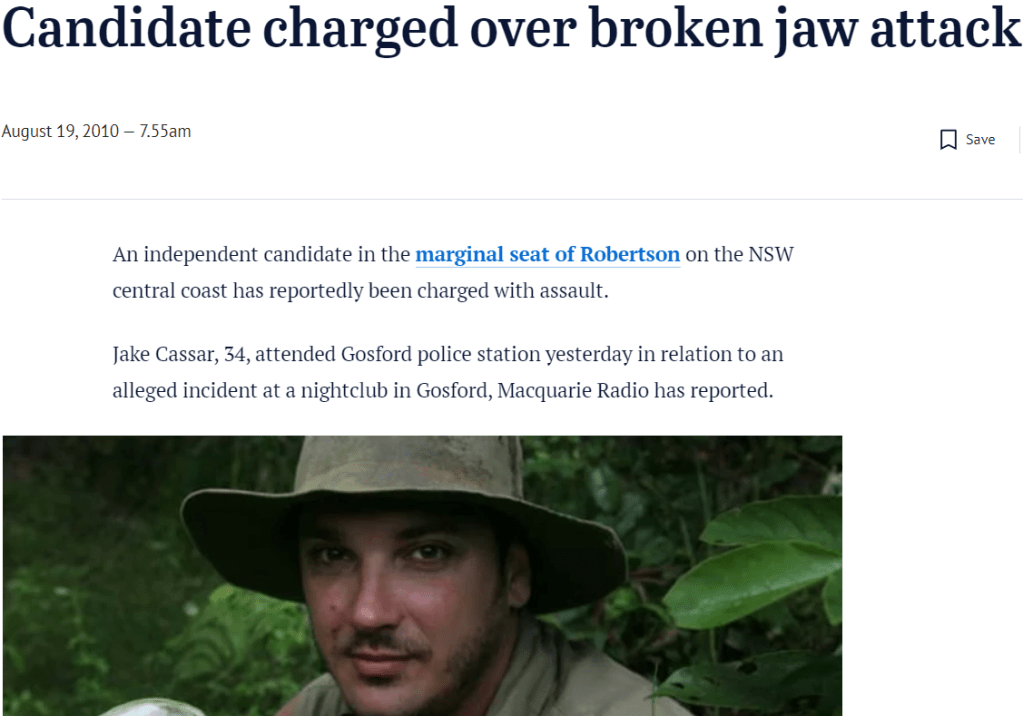
This report is issued in the public interest to assist Central Coast residents in understanding the activities, narratives, and impacts associated with Jake Cassar, The Campfire Collective, Coast Environmental Alliance, and Jake Cassar Bushcraft. While these entities are often presented as benign environmental, bushcraft, or community initiatives, available evidence indicates that their activities sit at the intersection of harmful conspiracist belief systems, spiritualised authority claims, anti-institutional rhetoric, and contested assertions of cultural legitimacy. These dynamics have implications for community cohesion, Aboriginal cultural authority, governance integrity, and public safety.
The purpose of this report is not to pathologise individuals or suppress lawful dissent, but to provide residents with a clear analytical framework for assessing risk, credibility, and harm. The report draws on peer-reviewed research in psychology, sociology, and political science, as well as documented patterns in Australian populist and far-right mobilisation.
Public Presentation and Organisational Overlap
Jake Cassar presents publicly as a bushcraft instructor, environmental advocate, and cultural guide, most visibly through Jake Cassar Bushcraft and affiliated networks. These activities are closely entangled with Coast Environmental Alliance and The Campfire Collective, which operate as loosely structured activist formations rather than transparent, accountable organisations.
Research on populist and conspiracist movements shows that such low-structure networks are not accidental, but functional. They allow rapid mobilisation, ambiguity of responsibility, and insulation from scrutiny, while concentrating symbolic authority in charismatic figures (Ben Moshe, 2001; McSwiney, 2023).
Residents should be aware that these entities are not independent silos. They share personnel, narratives, audiences, and campaigns, particularly around land use disputes, environmental conflict, and claims of spiritual or custodial authority over Aboriginal land.
Conspirituality and Authority Building
At the core of these networks is a belief system consistent with what scholars term conspirituality, the fusion of conspiracy thinking with spiritualised narratives of awakening, purity, and moral election (Ward & Voas, 2011; Sandlin & Gómez, 2023). In practical terms, this worldview divides the community into enlightened insiders and corrupted outsiders, delegitimises councils, Aboriginal Land Councils, scientists, and regulators, and elevates personal intuition, vision, or revelation above evidence-based decision making.
Research demonstrates that conspiritual belief systems function pedagogically. They teach adherents how to interpret uncertainty, how to assign blame, and how to justify rejection of institutional authority. They are also economically and socially productive, generating loyalty, monetisation opportunities, and reputational insulation for their leaders (Sandlin & Gómez, 2023).
Apocalyptic and Collapse Narratives
Jake Cassar’s public communications, creative outputs, and activist framing repeatedly rely on narratives of imminent collapse, ecological apocalypse, and moral emergency. Psychological research on doomsday and collapse beliefs shows that such narratives are strongly associated with conspiracy mentality, paranoia, cynicism, and distrust of institutions, rather than with superior insight or preparedness (Fetterman et al., 2019). These beliefs encourage pre-emptive justification of extreme positions and normalise hostility toward perceived opponents.
Importantly, collapse narratives operate less as predictions than as social training. They cultivate suspicion, urgency, and moral absolutism, making compromise or evidence-based correction appear dangerous or unethical. This has direct implications for community conflict and escalation.
Anti-Institutionalism and Governance Risk
Coast Environmental Alliance and The Campfire Collective routinely frame councils, planning authorities, Aboriginal Land Councils, and regulatory bodies as corrupt, captured, or illegitimate. Australian research on populist mobilisation shows that this style of anti-institutional rhetoric is a recognised pathway to governance erosion and community polarisation, even when framed in environmental or spiritual language (Dickenson, 2020; McSwiney, 2023).
When residents are encouraged to distrust all formal processes while deferring authority to unaccountable individuals or informal groups, the result is not empowerment but vulnerability. Decisions affecting land, heritage, and safety are removed from transparent processes and relocated into personalised, unverifiable authority claims.
Indigenous Identity and Custodianship Claims
A particularly serious concern arises where these networks appropriate Indigenous language, symbols, or claims to custodianship, despite the absence of verified Aboriginal identity or recognition by Aboriginal communities with established genealogical and cultural ties. Empirical research on Indigenous identity fraud documents clear harms arising from such practices, including erosion of Aboriginal cultural authority, distortion of consultation processes, and significant emotional and cultural harm to Aboriginal people (The Harms of Indigenous Identity Appropriation and Fraud, 2024).
Residents should understand that challenges to false or unverified identity claims are often reframed by these networks as persecution or colonial violence, even when raised by Aboriginal people themselves. This inversion is a recognised strategy within conspiracist systems, allowing scrutiny to be deflected while authority is preserved.
Gender, Masculinity, and Escalation Risk
Australian research on extreme-right and conspiracist milieus highlights the role of grievance-based masculinity narratives that emphasise embattled virtue, heroic struggle, and moral guardianship (Cochrane et al., 2024). While Jake Cassar and affiliated groups may not identify as far-right, the symbolic architecture of their messaging overlaps with these patterns. Such narratives increase the risk of escalation, particularly in land disputes and confrontations framed as existential battles.
Implications for the Central Coast Community
For Central Coast residents, the risks associated with these networks are not abstract. They include increased community conflict, intimidation of dissenting voices, marginalisation of Aboriginal people, distortion of environmental and heritage debates, and erosion of trust in local governance. Research consistently shows that ambiguity and institutional inaction amplify these harms, rather than containing them (Knorr et al., 2025).
Engagement with Jake Cassar, Jake Cassar Bushcraft, Coast Environmental Alliance, or The Campfire Collective should therefore not be treated as value-neutral. Residents, community organisations, and institutions are entitled to ask for transparency, evidence, and accountability, and to decline engagement where claims are misleading, harmful, or unverifiable.
Conclusion
This report warns Central Coast residents that the activities of Jake Cassar and his associated networks exhibit well-documented patterns linked to conspiracist belief systems, spiritualised authority building, anti-institutional mobilisation, and Indigenous identity appropriation. These patterns are associated in the research literature with social division, governance erosion, and harm to marginalised communities.
Protecting community wellbeing, Aboriginal cultural authority, and democratic decision making requires clarity rather than appeasement. Respect for culture and environmental concern does not require the suspension of evidence, accountability, or ethical responsibility. Residents are encouraged to engage critically, seek Aboriginal-led perspectives, and support transparent, lawful processes in all matters affecting Country and community.
 A Long Con, Gone on Too Long.
Leave a comment